
 05/26/2026
 Your 2026 growth strategy is only as strong as your last fulfillment audit. With FedEx announcing a 5.9% average freight rate increase and Amazon implementing a 3.5% fuel and logistics surcharge, your margins are facing an unprecedented squeeze. You likely feel the weight of complex invoices and surprise peak-season fees that make forecasting feel like guesswork. It’s frustrating to build a brand only to see your profits eroded by hidden operational costs that you didn’t see coming.
We’re here to turn that around. This guide gives you the tools for calculating ecommerce fulfillment costs with total clarity, ensuring every shipment supports your expansion rather than draining your bank account. You’ll learn how to protect your margins while scaling across new platforms like TikTok Shop. We’ll provide a clear formula to audit your existing spend, a framework to evaluate 3PL quotes, and a roadmap to peak profitability through logistics efficiency. It’s time to stop reacting to invoices and start driving your brand’s financial future with precision and confidence.
Key Takeaways
- Identify every line item beyond the standard invoice to capture your total fulfillment spend per order.
- Master our 3-step framework for calculating ecommerce fulfillment costs by auditing a 90-day window of logistics data.
- Uncover hidden drains on your profitability by factoring in invisible costs like insurance and warehouse equipment.
- Evaluate the strategic shift from in-house operations to professional 3PL warehouse services to unlock zone skipping and lower shipping spend.
- Transform your logistics from a mystery expense into a predictable engine for margin protection and brand scaling.
Beyond the Invoice: The Core Components of Ecommerce Fulfillment Costs
Stop looking at your shipping bills as the final word on your profitability. True fulfillment cost per order captures the entire lifecycle of a product. This lifecycle starts the moment a shipment hits the dock and ends only when it reaches the customer’s doorstep. It’s a comprehensive metric that includes every touchpoint in the Order fulfillment process. When you start calculating ecommerce fulfillment costs, you must look beyond the base shipping rate to see the full picture.
Modern 3PL environments split costs into fixed overhead and variable expenses. Fixed costs include monthly storage minimums or software access fees that remain steady. Variable expenses fluctuate with your sales velocity, covering labor for picking, packing, and shipping. This holistic view is the only way to master calculating ecommerce fulfillment costs without missing the small details that erode your margins. Dimensional weight (DIM) is a critical factor in 2026. Carriers calculate rates based on the space a package occupies, not just its weight. If your boxes are too big, you are paying for air. Silent killers like excessive packaging waste and inefficient kitting processes can drain your bank account before you even realize there’s a problem.
Operational Expenses: Labor, Storage, and Materials
Pick and pack fees are the heartbeat of your daily operations. However, your accuracy rate is the real cost driver. A 1% error rate leads to expensive returns and lost customer trust. For storage, hero-product brands thrive on pallet pricing, while high-SKU brands need the granularity of bin storage to keep overhead lean. In the US market, the shift toward sustainable packaging is no longer optional. While eco-friendly materials may have higher upfront costs, they reduce long-term brand risk and align with modern consumer expectations.
The Technology & Integration Layer
Technology isn’t a luxury; it’s a cost-saving necessity. Seamless API integrations for Shopify and TikTok Shop eliminate manual data entry errors and speed up processing times. Your account management fees should provide proactive strategy, not just status updates. Leveraging professional warehousing inventory management services reduces tech friction and ensures your data remains clean across every sales channel.
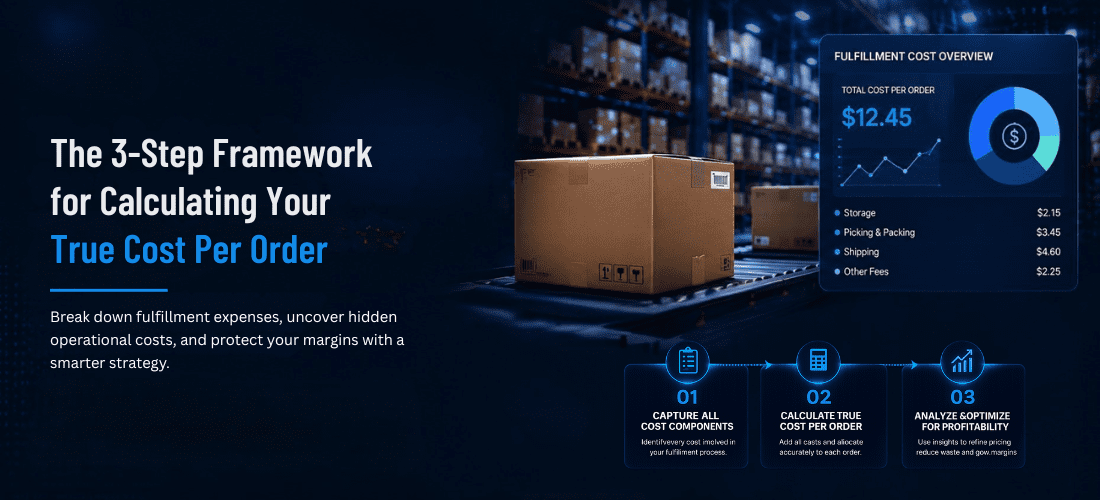
The 3-Step Framework for Calculating Your True Cost Per Order
Mastering your margins requires a move away from simple division. Most brands fail because they only look at a single month of data. This creates a skewed perspective that ignores the peaks and valleys of high-growth commerce. To get a real grip on calculating ecommerce fulfillment costs, you need a burdened view of every dollar spent to move a product from your manufacturer to your customer.
Step 1: Aggregate your logistics data. Gather every expense from the last 90 days. This includes freight-in, storage, pick and pack fees, and shipping labels. A 90-day window is the "gold standard" because it smooths out weekly anomalies while staying relevant to current carrier rates. However, for true annual forecasting, you should eventually compare this to a 12-month average to account for Q4 surcharges and seasonal dips.
Step 2: Identify the "invisible" layers. Your CPO isn’t just labor and postage. Factor in your WMS software subscriptions, warehouse insurance, and any specialized equipment like label printers or scanners. These are operational necessities that must be amortized across your total order volume to understand your true break-even point. For many growing brands, partnering with Financial Foothold for outsourced accounting ensures these complex overhead costs are tracked with precision.
Step 3: Apply the Cost Per Order (CPO) formula. Take your total logistics spend (Direct + Invisible) and divide it by your total shipped orders. Adjust this figure for seasonality by adding a buffer for peak-season surcharges, which can often spike your variable costs by 10% or more during November and December. Partnering with a professional ecommerce 3PL provider can simplify this calculation by consolidating these variables into a single, transparent dashboard.
The Multichannel Fulfillment Variance
Selling on TikTok Shop, Amazon, and Shopify simultaneously creates a "multichannel tax." Amazon has rigid prep requirements that differ from direct-to-consumer TikTok orders. You must weight your costs by platform. For example, your spend on Amazon FBA prep and multi-channel services may be higher per unit than Shopify orders, but the volume might justify the margin hit. Calculate a platform-specific CPO to see which channel is actually driving your profit.
Factoring in the "Return Tax"
Returns are a silent profit killer. With 2026 projections suggesting 15.8% of retail sales will be returned, reverse logistics must be part of your math. A 10% return rate can increase your overall CPO by up to 15% when you account for return shipping, labor for inspection, and potential disposal fees. Don’t let these costs hide in your P&L; treat every return as a variable fulfillment expense to keep your calculating ecommerce fulfillment costs accurate and actionable.
Strategic Optimization: Reducing Costs Without Sacrificing Speed
Crunching the numbers is only the first step. True mastery comes from using that data to re-engineer your operations for maximum profit. When calculating ecommerce fulfillment costs, many founders realize they’re trapped in the "founder’s trap." Every hour you spend managing tape, boxes, and warehouse staff is an hour lost on product development or high-level marketing. In-house fulfillment often looks cheaper on a basic spreadsheet, but it carries a massive opportunity cost that stunts your brand’s trajectory.
Switching to a professional ecommerce logistics provider unlocks advanced strategies like zone skipping. By placing your inventory closer to your customers in a strategic fulfillment center, you bypass expensive long-haul shipping zones. This move alone can slash your shipping spend and significantly increase delivery speed. Automation also plays a critical role. The tipping point for ROI happens when your manual labor costs exceed the cost of integrated tech solutions. Boost3PL eliminates this complexity tax, allowing you to scale without the operational friction that slows down your competitors.
Scaling with a High-Performance Strategic Ally
Professional pick and pack fulfillment services leverage massive scale to reduce your per-order labor costs. We provide a frictionless operation that protects your brand reputation and boosts customer LTV. "In 2026, the most expensive fulfillment strategy is the one that slows your ability to scale." Don’t let outdated processes become the bottleneck for your ambition. High-growth brands require a partner that moves as fast as the modern digital economy.
Next Steps: From Calculation to Execution
Take immediate action to protect your margins. Audit your current provider using the 90-day framework we established earlier. Identify the top three leaks in your pipeline, such as excessive packaging waste or slow intake times. Once you’ve identified these gaps, reach out for a strategy session. We’ll show you how Boost3PL optimizes these variables while calculating ecommerce fulfillment costs with total transparency. Turn your logistics from a cost center into a high-speed growth engine today.
Take Control of Your Brand’s Financial Future
Mastering the math of your supply chain is the ultimate competitive advantage. You’ve learned that calculating ecommerce fulfillment costs requires a deep dive into 90-day data sets and a keen eye for "invisible" overhead. By optimizing for dimensional weight and leveraging zone-skipping strategies, you transform logistics from a margin drain into a scalable engine. Every dollar you reclaim through efficiency is a dollar you can reinvest in your brand’s creative vision. It’s time to stop reacting to surprise surcharges and start driving your expansion with data-backed precision.
Stop letting operational chaos dictate your growth. We’re here to act as your high-performance strategic ally. Boost3PL provides specialized TikTok Shop and Shopify integrations alongside a professional Amazon FBA Prep Center to ensure your brand remains organized and fast. We thrive on handling the heavy lifting so you can focus on creative expansion. Our results-oriented partnership is built specifically for high-growth brands that value technological sophistication and operational excellence.
Ready to optimize your margins? Get a frictionless fulfillment quote from Boost3PL today.
Your success is the primary metric of our performance. Let’s build something remarkable together.
Frequently Asked Questions
How much should fulfillment cost as a percentage of revenue?
Fulfillment costs typically represent between 8% and 15% of a brand’s average order value. This range includes every expense from initial receiving and storage to final mile delivery. While luxury brands with high price points might see a lower percentage, brands selling heavy or low-cost items often find their logistics spend sits at the higher end of this bracket. Keeping your costs within this range is vital for maintaining healthy margins as you scale.
What is the average cost of pick and pack fulfillment in the USA?
Pick and pack fulfillment costs depend on your order volume, item count per box, and the complexity of your kitting requirements. Most providers structure their pricing with a base order fee followed by a smaller charge for each additional item picked. Brands with high-velocity "hero products" usually see lower per-unit costs than those managing thousands of individual SKUs. Focus on finding a partner that balances speed with high accuracy to avoid the hidden costs of shipping errors.
Is it cheaper to use Amazon FBA or a third-party logistics company?
The cost effectiveness of Amazon FBA versus a third party logistics company hinges on your sales channels and inventory turnover. Amazon FBA is built for speed within their ecosystem, but their peak-season storage hikes and surcharges can be aggressive. A dedicated ecommerce 3PL provider often offers more predictable pricing for multichannel brands. This is especially true if you’re growing on Shopify or TikTok Shop where brand control and custom packaging are priorities.
What are the most common hidden fees in 3PL contracts?
Common hidden fees include account management charges, API integration fees, and unexpected surcharges for receiving non-compliant shipments. Many founders miss these "silent killers" when calculating ecommerce fulfillment costs during the initial vetting process. You should also watch for dimensional weight adjustments and peak-season fuel surcharges that aren’t always highlighted in a basic quote. Demand a transparent, fully burdened cost model to ensure your brand’s profitability remains protected year-round.
