
 05/28/2026
 Your 3PL isn’t a line-item expense; it’s the engine that determines how fast your brand can actually grow. If you’re still viewing logistics as a cost center, you’re missing the bigger picture when calculating the roi of a 3pl. You probably feel the weight of every mispick and the sting of shipping rates that keep your margins thin. It’s frustrating to spend your day managing boxes instead of marketing your products. We understand that scaling feels like a constant battle against operational friction. It’s time for a change.
You’re ready to move beyond the chaos and take control of your bottom line. We promise to help you master the exact formulas and hidden metrics required to prove the financial impact of outsourcing to a high-performance partner. This guide provides a clear ROI framework to help you reclaim your time, lower your per-order costs, and build a frictionless operation that fuels your brand’s expansion.
Key Takeaways
- Audit your invisible overhead by identifying hidden expenses like warehouse insurance, utilities, and the true cost of seasonal labor turnover.
- Master a strategic framework for calculating the roi of a 3pl by aggregating your total in-house spend and comparing it against professional quotes.
- Unlock significant savings by leveraging negotiated carrier rates and reducing the financial impact of shipping errors.
- Scale your brand across multiple channels like TikTok Shop and Shopify with Boost3PL’s frictionless tech integrations that prevent costly overselling.
- Protect your marketplace status and avoid penalties through strategic Amazon FBA prep and smarter inventory management.
The Hidden Costs of Self-Fulfillment: Why Your Current Math is Wrong
Most founders start their logistics math with rent and postage. This is a mistake. When you’re calculating the roi of a 3pl, you must account for the "invisible" overhead that drains your bank account every single day. Audit your monthly spend on utilities, packing materials, and warehouse insurance premiums. These small line items often hide the true cost of staying in-house. Equipment maintenance and facility repairs also eat away at your margins, creating a financial leak that’s hard to plug without professional oversight.
Labor is your next big hurdle. It’s never just the hourly wage. You’re paying for recruitment, training, payroll taxes, and the high cost of seasonal turnover. If a warehouse worker leaves after two months, you’ve lost the thousands of dollars invested in their onboarding. Transitioning to Third-party logistics (3PL) providers eliminates these administrative headaches and stabilizes your operational costs. You stop paying for idle time and start paying for performance.
Don’t forget the "Dead Stock" penalty. Poor inventory management ties up your working capital in products that aren’t moving. Professional warehousing and inventory management services use data to keep your stock lean and your cash flow healthy. This ensures your money is working for you, not sitting in a dusty corner of a warehouse.
The Founder’s Opportunity Cost
Assign a real dollar value to every hour you spend on pick and pack fulfillment. If your time is worth $200 an hour and you spend 20 hours a week shipping boxes, you’re effectively paying $4,000 weekly for basic labor. Compare that to the cost of a strategic partner handling the same volume. Ask yourself: if I spent those 20 hours on high-level marketing instead of taping boxes, what would my brand’s growth look like by next quarter?
Technology Debt in In-House Logistics
Manual tracking systems might feel free, but they create technology debt. Technology debt is the cumulative cost of inefficient manual workarounds that slow down your entire operation. A modern Boost3PL WMS provides a frictionless experience that manual spreadsheets simply can’t match. Calculating the roi of a 3pl means recognizing that better tech leads to fewer errors, faster scaling, and a better reputation for your brand.
The 3PL ROI Formula: A Strategic Framework for Growth
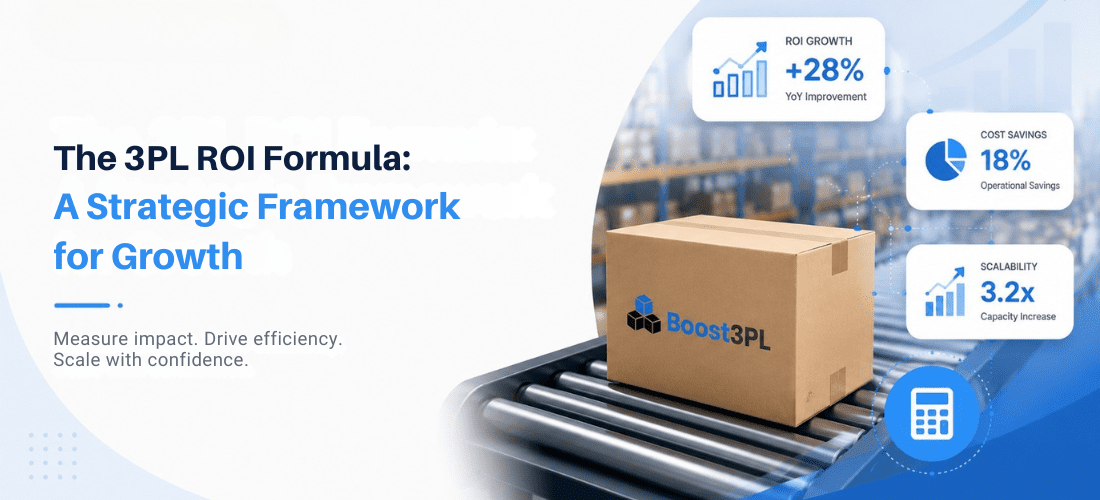
Stop treating logistics like a guessing game. To see the real value of your operations, you need a structured approach to calculating the roi of a 3pl. Start by aggregating every dollar spent on your current in-house setup. This total must include rent, warehouse labor, technology subscriptions, and the cost of shipping errors. Next, compare these figures against 3PL quotes. High-performance partners often secure the best return on investment by slashing your base shipping costs through massive aggregate volume. Negotiated carrier rates can be 5% to 30% below retail prices, providing immediate margin relief.
The third step involves revenue recovery. You must calculate the money saved by eliminating mispicks and shipping delays. While competitors often focus only on the immediate cost of a mistake, you should consider the impact on your brand reputation and Customer Lifetime Value (CLV). Finally, add the scale multiplier. This represents your ability to handle a 500% spike in orders during peak season without the stress of hiring or training temporary staff. When calculating the roi of a 3pl, this flexibility is what transforms a warehouse into a strategic growth engine.
Hard Savings: Shipping Rates and Labor Efficiency
Soft Benefits: Conversion Lift and Customer Retention
Speed is a competitive advantage that directly impacts your bottom line. Quantify the impact of 2-day shipping on your cart abandonment rates. When customers trust your delivery speed, conversion rates climb. A perfect unboxing experience also drives repeat purchases and organic social shares. Maintaining this consistency across every platform is the core value of multichannel fulfillment services. If you’re ready to stop managing boxes and start scaling, it’s time to partner with a strategic ally that prioritizes your growth.
Maximizing Your Return with Boost3PL’s High-Performance Infrastructure
Your fulfillment partner should be a catalyst for expansion, not a bottleneck. When calculating the roi of a 3pl, the strength of their technology stack is often the deciding factor in long-term profitability. Boost3PL provides a frictionless integration that syncs your inventory across Shopify, TikTok Shop, and Amazon in real time. This technological sophistication prevents the nightmare of overselling, which is a critical risk for brands navigating the complex multichannel landscape of 2026. Professional frameworks for evaluating 3PL performance emphasize that a partner’s ability to integrate with your sales channels is a primary driver of efficiency gains.
Marketplace sellers face unique pressures that can quickly erode margins. Our strategic Amazon FBA prep services ensure your products meet strict compliance standards every time. This precision reduces the risk of costly marketplace penalties and stock-outs that damage your search rankings. By leveraging our national reach, you achieve lightning-fast delivery across the USA without the massive overhead of managing multiple regional warehouses yourself. You get the benefits of a nationwide network while maintaining a lean, agile business model.
Scaling Without the Friction
Boost3PL acts as a high-octane growth engine for your brand. We don’t just store boxes; we optimize your entire supply chain to handle sudden demand spikes with ease. Utilizing professional 3PL warehouse services allows you to maintain a 99.9% order accuracy rate even during your busiest seasons. This reliability protects your reputation and ensures that every customer receives a perfect unboxing experience.
The Bottom Line: Your Logistics Partner as a Profit Center
Shift your mindset away from simple cost-cutting. Stop asking "How much does it cost?" and start asking "How much growth does this partnership unlock?" Calculating the roi of a 3pl reveals that the right partner pays for itself by increasing conversion rates and improving customer retention. When you offload the chaos of daily operations, you gain the mental clarity needed to focus on creative strategy and brand building. In 2026, the most successful brands aren’t the ones with the biggest warehouses, but the ones with the most efficient partners.
Transform Your Logistics into a Strategic Growth Engine
Boost3PL is built for founders who demand excellence. We deliver 99.9% order accuracy and nationwide 2-day shipping coverage to keep you ahead of the competition. Our tech stack offers seamless integration with Shopify, TikTok Shop, and Amazon, ensuring your operations remain organized and fast. Stop drowning in pick-and-pack tasks and start focusing on your creative vision. Ready to accelerate your growth? Get a custom ROI analysis from Boost3PL today. We’re ready to help you build the future of your brand.
Frequently Asked Questions
How do I calculate the ROI of a 3PL for my ecommerce brand?
You calculate the ROI by subtracting your total outsourced fulfillment costs from the sum of your current in-house expenses and regained revenue. Your in-house math must include rent, labor, packing materials, and the cost of shipping errors. When calculating the roi of a 3pl, also factor in the value of your reclaimed time and the potential sales growth from faster shipping speeds.
Is a 3PL actually cheaper than fulfilling orders in-house?
A 3PL is generally more cost-effective because it converts high fixed costs into flexible variable costs. You stop paying for underutilized warehouse space and idle staff during slow seasons. By leveraging shared infrastructure and massive shipping volume, professional partners provide an efficiency level that solo brands can’t match. This model ensures you only pay for the fulfillment activity you actually use.
What are the most important KPIs to track when measuring 3PL performance?
Focus on order accuracy, shipping speed, and inventory precision. You should monitor the percentage of orders shipped within your promised window and the rate of mispicks. High-performance providers maintain a 99.9% order accuracy rate. Tracking these metrics helps you quantify the "soft" savings of a partnership, such as reduced customer service tickets and lower return processing costs.
How much can I save on shipping rates by using a 3PL?
Brands typically access negotiated carrier discounts that are 5% to 30% below retail shipping rates. These savings are a result of the 3PL’s ability to aggregate volume across their entire client base. When calculating the roi of a 3pl, these shipping discounts often offset a significant portion of the pick and pack fees. This immediate margin relief allows you to reinvest in customer acquisition.
What is the typical ‘break-even’ point for moving to a 3PL?
The break-even point often occurs when your order volume hits 500 to 1,000 shipments per month or when you need to lease dedicated warehouse space. It’s also the moment when the opportunity cost of your time becomes too high. If you’re spending more time taping boxes than growing your brand, the efficiency gains of outsourcing will immediately outweigh the service fees.
Does a 3PL help reduce customer acquisition costs (CAC)?
A 3PL indirectly lowers your CAC by increasing your Customer Lifetime Value and improving your conversion rates. Fast, reliable delivery leads to better reviews and higher repeat purchase rates, which makes your advertising spend more efficient. When your fulfillment is frictionless, you don’t have to spend as much to replace customers who were lost to poor shipping experiences.
