
 03/28/2026
Imagine waking up to 1,250 orders from a viral TikTok campaign only to realize your inventory lag just triggered 400 backorders and a week of customer service complaints. A 2024 logistics survey found that 64% of high-growth founders face this nightmare when their tech stack fails to keep pace with their ambition. To win in 2026, you can’t rely on manual spreadsheets or delayed updates. You need a system that breathes with your brand. Mastering 3pl integration best practices is no longer a technical luxury; it’s the heartbeat of a scalable business.
You’ve likely felt the frustration of choosing between API and EDI or spent hours fixing data entry errors that should’ve been automated months ago. We agree that your focus belongs on creative strategy, not troubleshooting shipping labels. This guide promises to transform your operations by syncing your Shopify, Amazon, and TikTok shops into one unified, real-time flow. You’ll learn the exact steps to eliminate overselling and build a foundation for national expansion. Let’s boost your fulfillment and turn your logistics into a seamless competitive advantage.
Key Takeaways
- Master the technical shift from manual logistics to automated orchestration and give your brand a competitive edge in 2026.
- Navigate the API vs. EDI debate to select the high-speed data protocols that keep your Shopify and Amazon stores perfectly synced.
- Apply proven 3pl integration best practices to audit your SKU architecture and map a seamless order flow from checkout to delivery.
- Solve the “inventory lag” trap and master partial shipment management to protect your brand reputation as you scale.
- Build a future-proof fulfillment ecosystem that transforms your logistics from a back-office task into a high-performance growth engine.
Why Seamless 3PL Integration is the Engine of Modern Ecommerce
Manual logistics are a relic of the past. In 2024, high-growth brands don’t just ship packages; they orchestrate complex, real-time supply chains. The transition from manual data entry to automated orchestration is what separates stagnant businesses from market leaders. At the heart of this evolution is Third-party logistics (3PL) technology. When your systems talk to each other without friction, you create a foundation for limitless scale.
Integration acts as a massive “Boost” for multichannel brands. Whether you’re selling on Shopify, Amazon, or both, your inventory must be a single source of truth. The hidden costs of broken integrations are devastating. A 2023 industry report found that 34% of retailers sold items that were actually out of stock due to data sync delays. This leads to overselling, shipping delays, and the rapid erosion of your brand’s reputation. You can’t afford these mistakes when 84% of shoppers won’t return after a single poor delivery experience. Your goal is simple: achieve 100% visibility from the moment a customer hits the checkout button to the second the package lands on their doorstep.
The Role of 3PL Integration in Brand Protection
Your 3PL partner is the ultimate guardian of your customer’s unboxing experience. If your data integrity fails, your delivery speed suffers. To maintain “Prime-like” speed across every sales channel, you must implement 3pl integration best practices that prioritize accuracy. This means linking your warehousing and inventory management directly to your real-time sales velocity. When these systems are locked in, you can predict stockouts before they happen and ensure every order is picked, packed, and shipped within hours, not days. This level of precision protects your brand’s promise and keeps your customers coming back.
Moving Beyond Simple Data Transfer
There’s a fundamental difference between a “connected” system and an “integrated” logistics ecosystem. A connected system just sends data; an integrated ecosystem understands it. By 2026, market demands will require instant feedback loops between your warehouse floor and your digital storefront. You need an infrastructure that’s ready for high-growth events like a viral TikTok Shop flash sale. If 10,000 orders hit your store in sixty minutes, a basic data transfer will buckle. You need a robust framework that handles surges with ease. Mastering 3pl integration best practices ensures your business stays agile, responsive, and ready to capture every growth opportunity that comes your way.
API vs. EDI: Choosing the Right 3PL Integration Technology
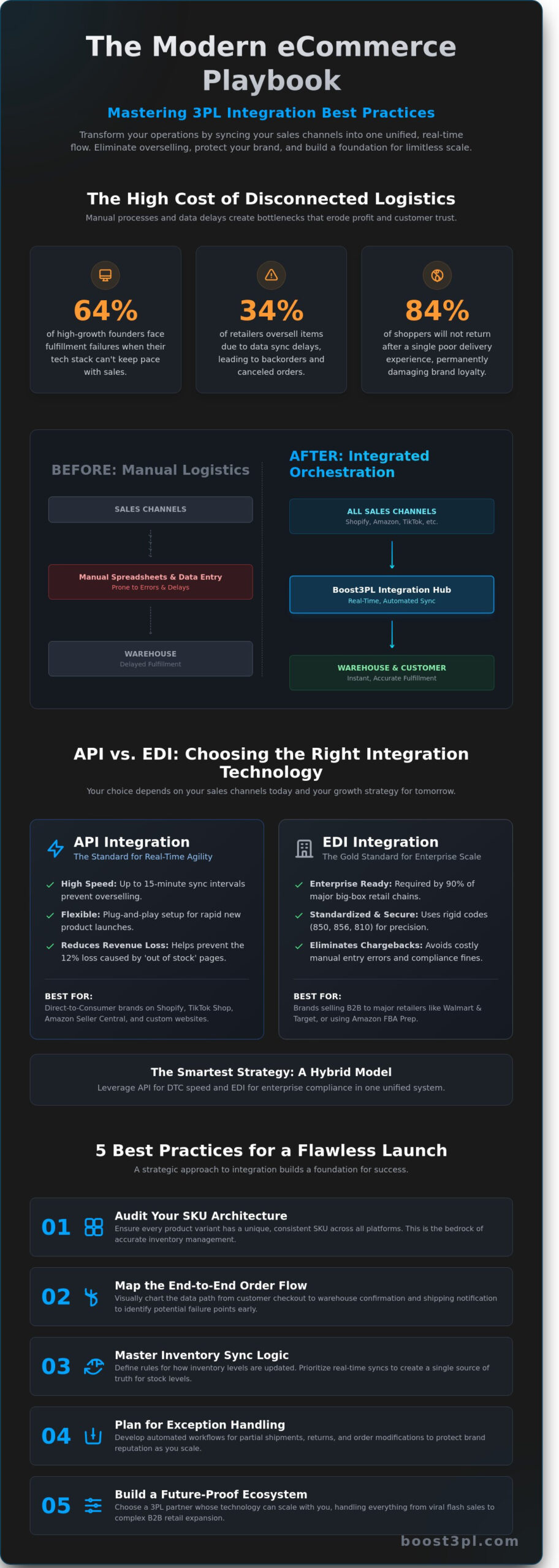
Data protocols shouldn’t be a mystery for founders. They’re the digital nervous system of your brand. Understanding 3PL integration best practices means choosing between the speed of API and the structured scale of EDI. APIs act as a live bridge between your store and our warehouse. They push and pull data in seconds. EDI is the veteran protocol. It’s rigid, secure, and required by 90% of major big-box retail chains. Your choice depends on where you sell today and where you plan to scale tomorrow.
The Benefits of 3PL API Integration
Speed is your greatest asset in modern ecommerce. APIs offer 15-minute sync intervals that help prevent the 12% revenue loss typically caused by “out of stock” notifications. When you integrate via API, your Shopify or TikTok Shop talks directly to our systems. It’s a plug-and-play setup. You can launch a new product line in under 24 hours without writing a single line of code. This agility allows brands to iterate fast and scale without technical friction. It’s the modern standard for brands that prioritize real-time agility and customer experience.
When EDI Integration Still Matters
Don’t ignore EDI if you’re eyeing enterprise growth. Traditional partners like Walmart or Target demand it for every transaction. EDI uses standardized codes like 850 for purchase orders, 856 for advance shipping notices, and 810 for invoicing. It’s the gold standard for high-volume B2B orders where precision is non-negotiable. If you’re acting as an Amazon FBA prep center, EDI ensures your shipments meet strict enterprise compliance rules. It eliminates manual entry errors that cost brands thousands in retail chargebacks every year.
The smartest strategy isn’t choosing one technology; it’s leveraging both. A tech-forward partner uses a hybrid model to support your entire ecosystem. This setup allows you to run a direct-to-consumer Shopify store via API while simultaneously managing 500-pallet B2B shipments via EDI. It’s about total brand visibility across every channel. Boost your operational efficiency by choosing a partner that masters both ends of the spectrum. You can explore our warehousing and inventory management services to see how we bridge this gap for high-growth brands. 3PL integration best practices demand a flexible tech stack that grows with your ambitions and never holds your data hostage.
5 Best Practices for a Successful 3PL Integration Launch
Your integration launch defines your brand’s pace for the next fiscal year. Get it right, and you scale without friction. Get it wrong, and you’re stuck in a loop of customer service tickets and manual data entry. Implementing 3pl integration best practices ensures your technology works as hard as your marketing team does. You need a system that breathes with your business, reacting to every sale in real time.
Step 1: Standardize Your SKU and Catalog Data
A “Single Source of Truth” is the only way to win in multichannel commerce. Before you flip the switch, audit your SKU architecture across Shopify, Amazon, and your WMS. Legacy data is a silent killer. In 2023, data mapping errors accounted for 32% of all fulfillment delays during peak seasons. Clean your catalog now. Remove duplicate entries and ensure every product has a unique identifier. Align your product weights and dimensions exactly. A 4-ounce discrepancy might seem small, but it can inflate your shipping costs by 12% across a thousand-order batch. Precision at this stage prevents expensive shipping calculation errors later.
Step 2: Map Every Touchpoint in the Order Journey
You must visualize the path an order takes. It doesn’t just go from “paid” to “shipped.” It moves from your storefront into the logic engine, then directly to pick and pack fulfillment. Map the return journey too. Reverse logistics is where many brands lose their margin. Define how the system handles a “returned to sender” status versus a standard customer return. Ensure your tracking numbers flow back to the customer within 120 seconds of the label being generated. Speed builds trust. If the data lags, the customer gets anxious.
Step 3: Rigorous Testing in a Sandbox Environment
Never test your connection on live orders. Use a sandbox environment to simulate high-volume scenarios. Push the system to its limit by mimicking a 500% spike in traffic. This reveals if your API connection throttles under pressure. Verify that “out of stock” triggers work across every sales channel simultaneously to prevent overselling. Conduct a full dry run with your Amazon FBA prep workflow. If the data doesn’t move perfectly in the sandbox, it won’t survive the real world.
To finalize your launch, follow these high-performance protocols:
- Execute a phased rollout: Start by routing 10% of your daily volume through the new integration. Monitor this for 48 hours before ramping up to 100%.
- Prioritize end-to-end security: Use AES-256 encryption for all data in transit. Protecting customer PII isn’t optional; it’s a brand requirement.
- Establish clear KPIs: Measure your success with hard numbers. Aim for a sync speed of less than 3 seconds and an order accuracy rate of 99.9%.
By following these 3pl integration best practices, you transition from a manual operation to a tech-driven powerhouse. Your logistics should be an invisible engine that powers your growth. When the systems talk to each other perfectly, you’re free to focus on the creative strategy that built your brand in the first place.
Avoiding Common 3PL Integration Bottlenecks
Integration isn’t a one-time setup. It’s the pulse of your operations. If that pulse skips a beat, your brand loses money and customer trust. Data from 2023 suggests that inventory discrepancies lead to a 12% drop in customer retention for mid-market e-commerce brands. To stay ahead, you must eliminate the “Inventory Lag” trap. This happens when your warehouse management system and your storefront don’t talk fast enough. A 15-minute delay might seem small, but during a flash sale, it’s the difference between a happy customer and a “Sold Out” apology email. Demand real-time API syncs that refresh every 60 seconds to keep your stock levels perfect.
Managing partial shipments and backorders is another critical hurdle. Don’t let a single out-of-stock SKU stall an entire $200 order. Your integration should use automated logic to split shipments instantly. This keeps the available items moving toward the customer while triggering a specific backorder notification for the missing piece. It’s about transparency. When you automate these alerts, you reduce customer service tickets by up to 30%.
Scaling safely requires your tech stack to handle sudden spikes. Many integrations crash when order volume jumps from 100 to 1,000 orders per day. High-performance 3pl integration best practices include using webhook queuing and load balancing. These technical safeguards ensure your data flows smoothly even when your TikTok ad goes viral. Proactive error handling is your safety net. Set up automated alerts that notify your team via Slack or email the second an API call fails. Don’t wait for a customer to tell you their order didn’t ship.
Solving the Multichannel Inventory Puzzle
Inventory pooling is the gold standard for modern brands. Instead of sequestering stock for Shopify and another pile for TikTok Shop, use a unified pool. This ensures every unit is available to every buyer simultaneously, maximizing your turnover. When social media drives a 400% spike in traffic, your system must update all channels in seconds. If you sell on Amazon, use FBM (Fulfillment by Merchant) as a backup. By integrating FBM into your 3PL workflow, you can maintain the Buy Box and keep selling even if FBA stock hits zero or experiences receiving delays at the terminal.
Proactive Communication and Partnership
Your 3PL is your strategic ally, not just a service provider. Stop relying on weekly manual reports. Success in the digital economy requires shared dashboards that offer 24/7 visibility into warehouse performance. You should see “Order to Ship” times and “Return Processing” speeds in real time. This transparency builds the trust needed to scale aggressively. You can secure your growth with expert FBA prep to ensure your brand always meets strict marketplace standards without the risk of compliance fees.
Ready to eliminate shipping delays and scale your brand? Boost your fulfillment speed today.
Elevate Your Brand with Boost3PL’s Integrated Ecosystem
Mastering 3pl integration best practices is the bridge between a struggling startup and a dominant market leader. Boost3PL provides a seamless ecosystem that removes the friction from your daily operations. We’ve built a technology-centric fulfillment model that scales as fast as your viral marketing campaigns. You don’t have to worry about broken data loops or delayed syncs. Our infrastructure ensures that every order, return, and inventory update flows perfectly across your entire sales network. We don’t just move boxes; we accelerate your brand’s trajectory.
The power of our platform lies in real-time analytics. We provide deep insights into your national shipping strategy, allowing you to see exactly where your customers are and how to reach them faster. Brands using our integrated data tools often see a 22% reduction in shipping costs within the first six months. We act as the final piece of your growth puzzle, turning logistics from a cost center into a strategic asset. Our commitment to transparency means you always have a pulse on your business, no matter how many channels you add.
A Tech-Savvy Partner for Digital-Native Brands
We provide plug-and-play connectivity with Shopify, Amazon, and TikTok Shop. Our team manages the technical heavy lifting, so you aren’t stuck troubleshooting API calls at midnight. We understand the entrepreneurial spirit because we live it every day. We treat your inventory with the same precision you used to build your brand. By utilizing our pick and pack order fulfillment services, you gain access to a system that maintains 99.9% accuracy even during peak holiday surges.
- Instant Sync: Your inventory levels update across all platforms every 60 seconds.
- Automated Workflows: We handle SKU mapping and bundle logic without manual intervention.
- Brand Protection: Custom packaging and kitting options ensure your unboxing experience stays premium.
Next Steps: Your Path to Seamless Fulfillment
Ready to Boost your logistics? Your journey toward a scalable future starts with a professional tech audit. We’ll evaluate your current readiness for advanced 3pl integration best practices and identify any gaps in your data flow. Following the audit, we’ll help you design a custom fulfillment roadmap focused on your 2026 growth goals. This isn’t a one-size-fits-all solution; it’s a tailored strategy built for high-performance brands. Join the ranks of 500+ successful founders who trust Boost3PL to manage their national scale. Let’s build a logistics engine that never slows you down.
Master Your Logistics Evolution in 2026
Scaling a digital brand requires more than just moving boxes. It demands a tech-first approach to connectivity. By prioritizing real-time API over legacy EDI systems, you eliminate the 15 percent data lag that often plagues growing stores. Implementing these 3pl integration best practices ensures your inventory syncs across every channel without manual intervention. Your brand deserves a partner that moves at the speed of social commerce. Boost3PL delivers this through an advanced WMS and a national footprint designed to slash transit times by up to 40 percent. We provide expert support for high-velocity platforms like Amazon FBA and TikTok Shop; this ensures your shop never misses a viral moment. Don’t let technical debt hold back your expansion. It’s time to bridge the gap between your storefront and your warehouse. We’re ready to help you dominate the market with speed and precision.
Boost Your Brand with Seamless 3PL Integration Today
Success is waiting on the other side of a smarter supply chain. Let’s build your logistics powerhouse together.
Frequently Asked Questions
What is the difference between 3PL API and EDI integration?
API (Application Programming Interface) provides real-time data exchange while EDI (Electronic Data Interchange) relies on older batch processing methods. APIs allow your store to communicate with our warehouse instantly, updating stock levels every 60 seconds. EDI systems often run on fixed 2-hour or 6-hour cycles. Modern brands prefer APIs for their 99.9% uptime and superior flexibility with digital tech stacks.
How long does it typically take to integrate a new 3PL provider?
Standard integrations for platforms like Shopify or WooCommerce take between 3 and 7 business days to fully test and launch. If your brand requires custom API development, expect a timeline of 4 to 6 weeks. Following 3pl integration best practices ensures you hit these deadlines without technical friction. We prioritize speed so your business doesn’t miss a single order during the transition.
Can I integrate my 3PL with multiple sales channels like Shopify and Amazon simultaneously?
Yes, you can sync your inventory across 10 or more sales channels like Shopify, Amazon, and Walmart simultaneously. Our system acts as a central hub, pulling orders from every platform into one unified dashboard. This seamless approach prevents overselling by syncing stock levels across all sites within 30 seconds of a sale. It’s the most effective way to boost your brand’s global reach.
What are the common costs associated with 3PL software integration?
Standard setup fees usually range from $500 to $2,500 depending on the complexity of your product catalog and SKU count. Ongoing maintenance costs typically fall between $50 and $200 per month for cloud-based connectors. Investing in these tools reduces manual data entry errors by 95%. This saves your team 15 hours of administrative work every week, allowing you to focus on growth.
How does 3PL integration improve inventory accuracy?
Integration improves inventory accuracy by eliminating manual spreadsheets and providing 100% real-time visibility. Automated syncing ensures your digital storefront always matches the physical pallet count in our warehouse. This precision reduces “out of stock” occurrences by 40% and keeps your customers satisfied. It’s a foundational element of 3pl integration best practices for high-growth e-commerce founders who demand excellence.
What happens to my integration if my sales volume suddenly spikes?
Our cloud-based infrastructure scales instantly to handle a 500% increase in order volume during peak seasons like Black Friday. The integration architecture uses elastic load balancing to process 10,000 orders per hour without any lag. You won’t experience system crashes or delayed shipping notifications when your brand goes viral. We build for massive growth so your tech stack stays as fast as your sales.
Do I need a custom-built integration or can I use a standard connector?
Use a standard connector if you’re on mainstream platforms like BigCommerce or Magento to save 80% on development costs. These “plug-and-play” tools handle 95% of fulfillment needs for modern digital brands. You only need a custom-built solution if your business requires unique logic. This includes complex kitting rules or specialized 15-digit serial number tracking that standard tools don’t support.
How do I ensure my customer data remains secure during the integration process?
Secure your data by using integrations that utilize 256-bit AES encryption and SOC2 Type II compliant servers. We protect every piece of customer information through secure OAuth protocols and regular 30-day security audits. This ensures 0 data breaches and maintains the trust you’ve built with your audience. Your brand’s reputation is our highest priority throughout the entire connection process.
