
Schedule a Call

Category: DTC 3PL Partner

How to Increase Sales on Amazon in 2026: The Fulfillment Flywheel Strategy

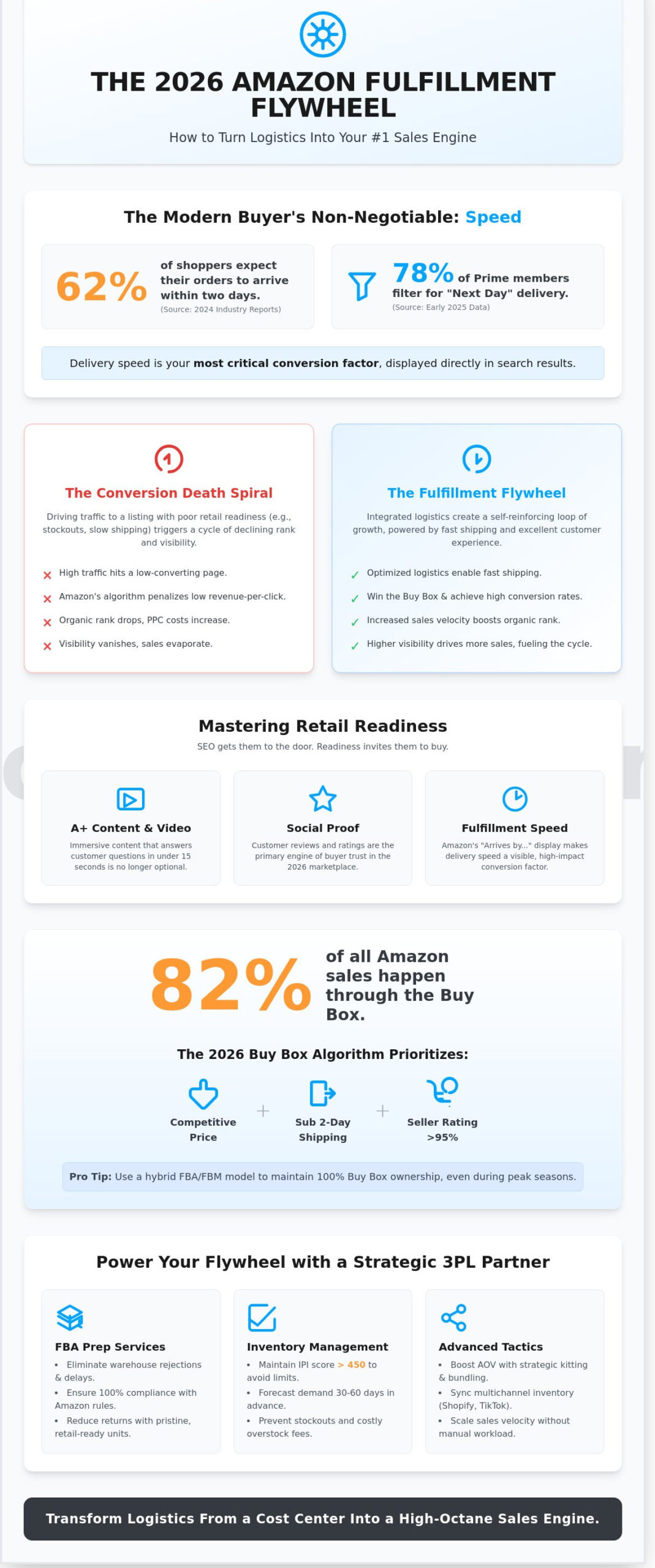
What if your warehouse was actually your most effective marketing tool? In 2026, logistics has evolved from a back-office expense into a front-line sales engine. You’ve likely spent thousands on PPC and A+ content while wondering how to increase sales on amazon without watching your margins evaporate. It’s a common struggle. High ACoS and sudden stockouts can destroy your organic rankings in days, leaving you fighting for a Buy Box that feels increasingly out of reach. According to 2024 industry reports, 62% of shoppers now expect their orders to arrive within two days, making shipping speed your most critical conversion factor.

We understand that the chaos of inventory management shouldn’t distract you from your creative vision. You deserve a system that turns shipping speed into a competitive advantage. This guide reveals how to transform your logistics into a high-octane fulfillment flywheel designed to win the Buy Box and achieve Prime-level conversion rates. We’ll show you how to scale your volume without increasing your manual workload. We are breaking down the exact strategy to integrate automated fulfillment and real-time data to Boost your brand’s performance and ensure a seamless customer experience.

Key Takeaways

  • Master the art of Retail Readiness to stop the conversion “death spiral” and build a rock-solid foundation for organic growth.
  • Optimize your fulfillment mix between FBA and FBM to dominate the Buy Box with lightning-fast shipping and elite seller performance.
  • Implement strategic kitting and bundling to boost your Average Order Value while slashing per-unit shipping costs.
  • Discover exactly how to increase sales on amazon by syncing multichannel inventory to ensure your growth never compromises your Shopify or TikTok Shop stock.
  • Seamlessly integrate your operations to transform logistics from a back-end cost into a high-octane sales engine that fuels a continuous fulfillment flywheel.

Mastering Retail Readiness: Why Your Amazon SEO Isn’t Enough

SEO gets shoppers to the door, but retail readiness invites them in to buy. In 2026, learning how to increase sales on amazon requires more than keyword stuffing. It demands a flawless product detail page (PDP) that is optimized for conversion before you spend a single dollar on traffic. Driving high traffic to a listing with low conversion rates triggers a ranking death spiral. Amazon’s algorithm prioritizes revenue per click; if you don’t convert, your organic rank drops. This creates a cycle where your visibility vanishes because your listing wasn’t ready for the spotlight.

The 2026 buyer mindset has shifted. Brand loyalty is secondary to speed and reliability. Data from early 2025 shows that 78 percent of Prime members filter search results specifically for “Next Day” delivery. The Prime badge is your strongest click-through rate (CTR) lever. Without it, your listing is invisible to the most active buyers on the platform. You must earn the badge to compete.

The 2026 Amazon Conversion Checklist

  • A+ Content and Video: These are no longer optional extras. High-velocity sales depend on immersive video content that answers customer questions in under 15 seconds.
  • Social Proof: Customer reviews and real-time social validation serve as the primary engine of buyer trust in the 2026 marketplace.
  • Fulfillment Speed: Amazon now displays “Arrives by [Time]” directly in search results, making delivery speed a visible, high-impact conversion factor that shoppers use to filter their choices.

Solving the PPC Profitability Puzzle

The biggest mistake e-commerce founders make is scaling ad spend on products with fragile inventory health. When you run out of stock (OOS), your advertising algorithm progress resets to zero. This destroys your historical performance data and forces you to pay more for the same clicks later. You must secure your growth with reliable FBA prep to maintain the inventory levels required for aggressive scaling. Consistent stock levels ensure your PPC campaigns build momentum rather than burning cash. Mastering your supply chain is the only way to truly understand how to increase sales on amazon without sacrificing your margins. Seamless logistics lead to seamless growth.

Winning the Buy Box: Optimizing Fulfillment for Maximum Reach

Winning the Buy Box is the non-negotiable first step for any brand owner researching how to increase sales on amazon. Since 82% of Amazon purchases happen through that single “Add to Cart” button, your fulfillment strategy must be flawless. The 2026 algorithm prioritizes three specific metrics: competitive landed price, a seller feedback rating of at least 95%, and consistent sub-two-day shipping speeds. While FBA is the standard, smart founders use a hybrid model to maintain 100% Buy Box ownership even when Amazon’s warehouses face seasonal backlogs. Hidden sales killers, like a 2% increase in “Product Not as Described” complaints due to damaged packaging, can tank your visibility overnight. You need a strategic partner to ensure your brand reputation stays as polished as your products.

The Prep Center Advantage

Amazon’s inbound requirements are more rigid than ever. Utilizing professional Amazon FBA prep services eliminates the risk of warehouse rejections that cause 48-hour processing delays. Compliance with evolving poly-bagging and labeling rules is mandatory to avoid costly unplanned service fees. “Professional prep transforms logistics from a hidden cost into a reputation shield by ensuring every unit arrives in pristine, retail-ready condition.” This precision reduces customer returns and keeps your account health in the green zone. You can elevate your fulfillment strategy by moving prep away from the factory floor and into a controlled, tech-driven environment.

Inventory Management: The Sales Velocity Multiplier

Inventory health is the engine behind your sales rank. You must master warehousing and inventory management to keep your Inventory Performance Index (IPI) score above the 450-point threshold. Falling below this number results in strict storage volume limits that prevent you from restocking your best-sellers during peak seasons. Use real-time data to forecast demand 30 to 60 days in advance. This prevents the twin disasters of expensive overstock fees and momentum-killing stockouts. Maintaining a seamless flow of goods is the most effective way to understand how to increase sales on amazon while keeping your operational margins healthy and your growth trajectory vertical.
How to Increase Sales on Amazon in 2026: The Fulfillment Flywheel Strategy

Scaling Sales Velocity: Advanced Tactics for 2026

Winning in the 2026 marketplace requires more than just a high-quality listing. You need a logistics engine that powers your growth. To master how to increase sales on amazon, you must optimize every touchpoint from the warehouse to the customer’s doorstep. High-performance brands separate themselves from the pack by treating fulfillment as a marketing lever rather than a back-office cost.

Kitting and Bundling: The Secret to High Margins

Custom kitting is your ultimate competitive moat. By utilizing kitting services, you create unique ASINs that hijack the buy box. Competitors cannot easily match a curated 3-pack or a specialized starter kit without their own manufacturing overhaul. Data from 2025 shows that brands using strategic bundling saw a 22% increase in Average Order Value (AOV). These bundles also trigger Amazon’s organic “Frequently Bought Together” algorithm. This placement acts as free advertising; it drives sales velocity without increasing your PPC spend. If you have slow-moving stock, bundle it with a bestseller. You clear warehouse space while maintaining a high BSR. This strategy reduces per-unit shipping costs and maximizes every square inch of your inventory investment.

The Multichannel Growth Flywheel

Your sales channels should work together, not against each other. Sync your real-time inventory across Shopify, TikTok Shop, and Amazon to avoid the out of stock death spiral. TikTok Shop signals are incredibly powerful for Amazon sellers. When a product goes viral on social media, driving that external traffic to your Amazon listing signals to the A9 algorithm that your brand is in high demand. This external signal can jump your BSR by 40% in under 48 hours. For wellness brands, a specialized supplement fulfillment partner ensures your lots and expiration dates stay organized across every platform. This level of precision is how to increase sales on amazon while scaling your entire digital footprint simultaneously.

Boost3PL acts as your strategic ally in this journey. We handle the heavy lifting of logistics so you can focus on brand vision and market expansion. Scale your operations with a partner that values your growth as much as you do. Boost your brand with seamless logistics today and dominate the competition.

Future-Proof Your Amazon Growth Engine

Success in 2026 requires more than basic SEO; it demands a fulfillment flywheel that powers every part of your brand. You’ve learned that retail readiness and Buy Box dominance are the twin engines of growth. Mastering how to increase sales on amazon means moving beyond static listings and embracing dynamic sales velocity. Industry data predicts that cross-border e-commerce will grow by 15% annually through 2026, making global agility a necessity rather than an option.

It’s time to turn your logistics into a strategic advantage. Boost3PL provides the high-performance infrastructure you need to scale. We offer specialized Amazon FBA Prep Center expertise and real-time inventory visibility across both US and UK markets. Our seamless multichannel integration connects your Shopify and TikTok Shop storefronts into one unified powerhouse. Stop managing packages and start building a global brand with a partner that values your reputation. We handle the heavy lifting so you can focus on the big picture. Your growth is our primary metric. Let’s build your empire together.

Boost your Amazon sales with seamless fulfillment today!

Frequently Asked Questions

How do I win the Amazon Buy Box in 2026?

You win the Amazon Buy Box in 2026 by maintaining Prime eligibility and achieving 99.8% on-time delivery rates. Amazon’s regional fulfillment model now prioritizes sellers who store inventory within 100 miles of the end consumer. This localized strategy allows for sub-24-hour delivery windows. High stock levels and competitive pricing are still essential. Optimize your logistics to ensure your Brand stays in the featured offer spot 100% of the time.

Is FBA or FBM better for increasing sales velocity?

FBA typically drives higher velocity due to the Prime badge, but a hybrid model is how to increase sales on amazon most effectively. Utilizing a 3PL for Seller Fulfilled Prime allows you to maintain 100% control over your packaging while meeting Amazon’s 1-day shipping requirements. Data from 2025 shows that Prime-enabled listings convert 50% better than standard FBM. Boost your reach by using FBA for fast-movers and 3PL fulfillment for your full catalog.

How does out-of-stock status affect my Amazon ranking?

Out-of-stock status triggers an immediate drop in your Best Seller Rank and can halt your sales momentum instantly. A 7-day stockout often results in a 30% decrease in organic keyword positioning once you replenish. Amazon’s algorithm prioritizes consistency; it rewards brands that maintain a 95% in-stock rate. Use real-time inventory tracking to prevent these gaps. Protect your Brand from losing hard-earned search real estate by automating your reorder points.

Can a 3PL help me lower my Amazon ACoS?

A 3PL lowers your ACoS by increasing your conversion rate through faster, more reliable shipping. When you understand how to increase sales on amazon, you realize that shipping speed directly impacts ad efficiency. Reducing your delivery window from 4 days to 2 days can improve your conversion rate by 20%. This higher efficiency means you spend less on advertising to secure a single sale. Seamless integration with a tech-forward 3PL ensures your ad spend works harder for your business.
Mastering Order Fulfillment Services: The 2026 Founder’s Evaluation Checklist

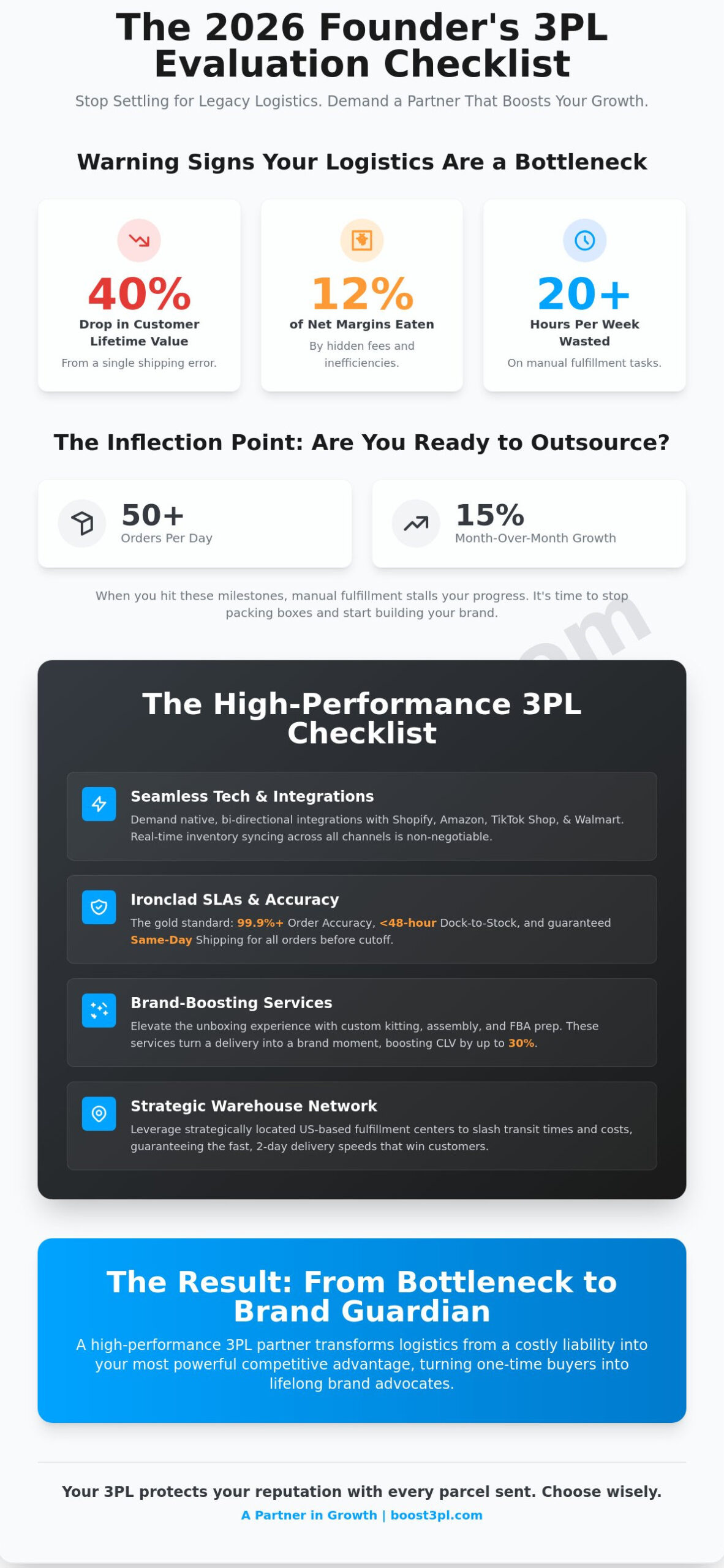
Your 3PL isn’t just a warehouse; it’s the high-performance engine of your brand’s reputation. Research from late 2024 indicates that a single shipping error can slash a customer’s lifetime value by 40% instantly. If you’re currently battling inventory gaps between Shopify and Amazon or watching hidden fees eat 12% of your net margins, your current order fulfillment services are a bottleneck, not a benefit. It’s time to stop settling for legacy logistics and start demanding a partner that actually boosts your growth.

We agree that you should be focused on creative strategy, not chasing down lost packages or updating manual spreadsheets. You deserve a logistics setup that works as hard as you do. This guide provides our 2026 Founder’s Evaluation Checklist, a 7-point framework to help you identify a 3PL partner that delivers a seamless experience across TikTok, Amazon, and Shopify. We’ll show you how to automate inventory tracking and secure the 2-day delivery speeds that turn one-time buyers into lifelong brand advocates.

Key Takeaways

  • Transform your logistics from a warehouse bottleneck into a strategic growth engine by partnering with a dedicated Brand Guardian.
  • Apply our high-energy “Boost” framework to identify the technological sophistication necessary for scaling your brand through 2026.
  • Discover the seven critical factors for selecting order fulfillment services that integrate seamlessly with Shopify, Amazon, and TikTok.
  • Unlock the secrets to winning the Amazon Buy Box and dominating TikTok Shop algorithms through precision-engineered fulfillment strategies.
  • Leverage strategic US-based fulfillment centers to accelerate national delivery speeds and provide the seamless experience your customers demand.

Evaluating Order Fulfillment Services: Why Outsourcing is Your Growth Catalyst

In the 2026 ecommerce market, order fulfillment services function as the strategic backbone of your entire operation. Your logistics partner isn’t just a warehouse; they’re your Brand Guardian. They protect your reputation with every parcel sent. The transition from manual, garage-based shipping to professional 3PL warehouse services isn’t just a move; it’s a massive upgrade in capability. For brands scaling in 2026, seamless logistics are no longer optional. They’re a survival requirement. High-performance order fulfillment ensures your customers receive exactly what they bought, exactly when they expect it.

The Core Components of Professional 3PL Fulfillment

Precision drives growth. A professional pick and pack fulfillment process reduces error rates to below 0.1%, ensuring every customer gets the right product. Beyond simple shipping, sophisticated warehousing and inventory management services maintain stock health through real-time data tracking. This prevents costly stockouts and overstock scenarios. You can also elevate the unboxing experience through custom kitting and assembly. This turns a simple delivery into a powerful brand touchpoint that boosts customer lifetime value by as much as 30%.

Signs Your Brand is Ready to Outsource Logistics

Many founders hit an inflection point when they reach 50 orders per day or sustain a 15% month-over-month growth rate. At this stage, manual order fulfillment services stall your progress. In-house management carries hidden costs that drain your capital. You’re paying for warehouse space, $22 per hour labor costs, and the massive opportunity cost of your own time. Outsourcing logistics is the moment a founder stops packing boxes and starts building a brand. It frees up roughly 20 hours of executive time every week to focus on marketing and product development. Boost your operational efficiency now to secure your market share for the future.

The Ultimate 3PL Selection Checklist: 7 Critical Factors for 2026

Welcome to the “Boost” evaluation framework. In 2026, logistics isn’t a back-office cost; it’s your most powerful growth engine. Choosing a partner is about more than finding a warehouse. It’s about securing a strategic ally that treats your reputation as their own. You need a high-performance setup that turns shipping speed into a competitive advantage. This checklist ensures your brand stays ahead of the curve.

Many founders struggle with complex challenges in order fulfillment when they settle for legacy providers. Don’t let outdated processes stall your momentum. Instead, look for a partner that offers an elevated approach to multi-channel prep to ensure your inventory is always ready for the next surge.

Technology & Multichannel Integration Capabilities

Your tech stack must be seamless. Modern brands can’t waste time on manual data entry or CSV uploads. Demand native integrations with Shopify, TikTok Shop, and Walmart Marketplace. You need real-time inventory visibility across every sales channel to prevent overselling and stockouts. Verify that your provider offers pick, pack, and order fulfillment services that sync perfectly with Amazon FBM. This level of technological sophistication allows you to manage a global brand from a single dashboard. If they don’t offer automated, bi-directional syncing, they aren’t ready for 2026.

Service Level Agreements (SLAs) and Accuracy Benchmarks

Precision is the only metric that matters when your brand is on the line. The gold standard for order accuracy is now 99.9% or higher. Anything less leads to negative reviews and wasted customer service hours. Ask about “dock-to-stock” times. Leading partners move your products from the receiving dock to the “available” shelf in 48 hours or less. Ensure they guarantee same-day shipping for orders placed before a late afternoon cutoff. You also need a clear, automated process for handling returns. A fast exchange process turns a potential return into a loyal customer. High-performance order fulfillment services prioritize these benchmarks to keep your business moving at the speed of social commerce.

Ready to see how these standards can transform your growth? It’s time to optimize your inventory management and reclaim your time for creative strategy.

Mastering Order Fulfillment Services: The 2026 Founder’s Evaluation Checklist

Maximizing Brand Reach with Strategic Order Fulfillment

Speed is the ultimate currency for digital brands in 2026. If your delivery takes five days, you’ve already lost the TikTok Shop algorithm and the Amazon Buy Box. High-performance order fulfillment services transform your logistics from a back-office cost into a front-line growth engine. A strategically located US-based fulfillment center ensures your brand hits a two-day delivery standard across 98% of the continental United States. This logistical speed keeps your products at the top of search results and in front of ready-to-buy customers.

Seamless logistics allow for rapid seasonal scaling without the friction that kills momentum. When a viral moment hits, your infrastructure must respond instantly. Founders who prioritize fulfillment agility see 35% higher customer retention rates because the post-purchase experience matches the marketing hype. It’s about building a brand that’s as reliable as it is innovative. By integrating warehousing and inventory management into a unified strategy, you eliminate the bottlenecks that stop most startups from becoming household names.

Navigating the Amazon Ecosystem: FBA Prep vs. FBM

Marketplace success requires total precision. Amazon FBA offers Prime visibility, but strict inbound requirements often lead to 40% higher storage fees during peak seasons if inventory isn’t managed correctly. Utilizing a professional Amazon FBA prep center prevents marketplace penalties and ensures every SKU meets compliance standards. While FBA wins on visibility, FBM offers 18% better margins on oversized items and gives you total control over the unboxing experience. Smart founders leverage both to maximize profit and mitigate platform risk.

The Boost3PL Advantage: Scaling Without the Stress

Your brand needs a partner that moves at the speed of social commerce. Boost3PL provides the Boost necessary for multichannel success. We replace operational friction with seamless, tech-forward automation. Our results-oriented approach delivers 99.9% order accuracy and real-time inventory visibility across every channel you sell on. We handle the heavy lifting so you can focus on creative strategy and customer acquisition. Scale your volume by 400% this Q4 without breaking a sweat. It’s time to elevate your logistics strategy and partner with a team invested in your growth.

Scale Your Brand with 2026-Ready Logistics

Your brand deserves a logistics partner that moves as fast as your sales cycle. By 2026, the gap between market leaders and struggling startups will be defined by operational efficiency. You’ve learned that outsourcing isn’t just a cost center; it’s a strategic engine that unlocks global reach. Selecting the right order fulfillment services requires a checklist that prioritizes real-time visibility and rapid scalability. Don’t let logistics become the bottleneck that stifles your creativity or limits your expansion.

Stop managing boxes and start building your empire. Boost3PL provides the technological backbone you need to dominate every channel. We deliver 99.9% order accuracy and provide same-day shipping capabilities that keep your customers coming back. Our platform features direct integrations with Shopify, TikTok, and Amazon, ensuring your inventory stays synced across the entire digital landscape. We don’t just ship packages; we protect your reputation with every delivery. It’s time to elevate your operations with a partner that understands the high-stakes world of digital commerce.

Ready to accelerate your growth? Boost Your Brand with Seamless Order Fulfillment. The future of your e-commerce journey starts with a partner who’s as invested in your success as you are.

Frequently Asked Questions

What are the typical fees for order fulfillment services?

Most order fulfillment services charge based on a four-pillar fee structure: receiving, storage, pick and pack, and shipping. Expect to pay $5 to $15 per pallet for inbound receiving and $0.40 to $0.60 per cubic foot for monthly storage. Pick and pack fees typically start at $2.50 for the first item. We ensure your brand’s margins stay protected by eliminating hidden surcharges that can eat 15% of your profit.

How do order fulfillment services handle returns?

Our reverse logistics process transforms returns into a seamless brand experience by processing items within 24 hours of arrival. We inspect every unit against a 5-point quality checklist to determine if it’s fit for restocking, refurbishing, or disposal. Efficient return management can recover up to 70% of lost inventory value. Boost your customer loyalty by providing a fast, transparent exchange process that keeps your stock levels accurate in real-time.

Can a 3PL integrate with my Shopify and TikTok Shop simultaneously?

Yes, a modern 3PL uses robust API integrations to sync your Shopify and TikTok Shop storefronts into a single dashboard. This unified view ensures 100% inventory accuracy across all sales channels, preventing overselling during viral growth spurts. You can scale your multi-channel presence without manual data entry. By centralizing your order fulfillment services, you maintain a consistent delivery standard for every customer, regardless of where they click buy.

What is the difference between a fulfillment center and a standard warehouse?

A fulfillment center is designed for high-velocity movement, while a standard warehouse focuses on long-term static storage. Standard warehouses often hold bulk inventory for 6 to 12 months with minimal activity. In contrast, our fulfillment centers prioritize a 24-hour turnover rate to get orders out the door fast. We optimize every square foot for picking speed and packing efficiency. This ensures your brand delivers an elevated unboxing experience rather than just sitting on a dusty shelf.

The Best Shopify Fulfillment Services for Scaling Brands in 2026

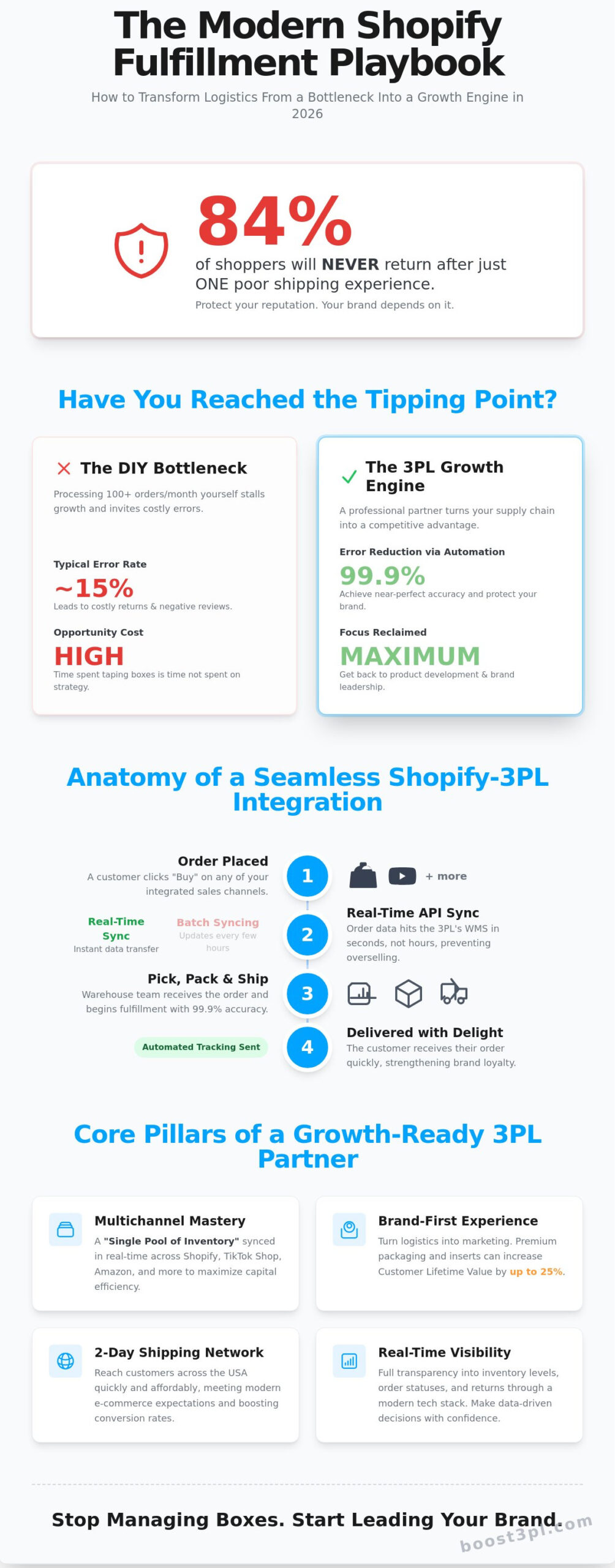
Did you know that 84% of online shoppers will never return to a store after just one poor shipping experience? You’ve worked too hard building your brand to let a 48-hour inventory lag or a messy unboxing kill your momentum. We agree that logistics should be an invisible engine for growth, not a source of daily friction that eats your profit margins. Finding the right shopify fulfillment services is the most critical move you can make to protect your reputation and reclaim your creative energy. This guide will show you how to choose a partner that acts as a seamless extension of your team, offering real-time visibility and two-day shipping across the USA. We are breaking down the top providers for 2026 that eliminate technical friction and help you boost your revenue. It’s time to stop managing boxes. Start leading your brand.

Key Takeaways

  • Identify the critical signals that indicate your brand has outgrown DIY logistics and is ready for a high-performance 3PL partner.
  • Demystify the technical integration between your store and warehouse to ensure real-time inventory accuracy and automated order flow.
  • Compare the leading shopify fulfillment services for 2026 to determine which model aligns with your specific scaling goals and hybrid sales channels.
  • Audit your current SKU volume and technical requirements using our founder’s guide to vet potential partners for long-term reliability.
  • Learn how to transform your logistics into a strategic growth engine that protects your brand experience and accelerates revenue.

Understanding Shopify Fulfillment Services in 2026

Shopify fulfillment is no longer just about putting a product in a box. In 2026, it represents the entire order fulfillment process from the millisecond a customer clicks “buy” to the moment they hold your product. This journey includes inventory management, real-time syncing, precise picking, and rapid last-mile delivery. For early-stage founders, the “garage phase” is a rite of passage. However, manual shipping quickly becomes a bottleneck that stifles growth. When your daily routine shifts from marketing strategy to taping boxes, your brand’s momentum stalls.

The 2026 landscape is defined by the total convergence of social commerce and shopify fulfillment services. With 40% of Gen Z consumers using TikTok as their primary search engine for products, your logistics must be as fast as a viral trend. You need a partner that integrates directly with both Shopify and social marketplaces to prevent stockouts during peak demand. While the native Shopify Fulfillment Network (SFN) offers a standardized solution for many, high-growth brands often outgrow its rigid structure. Independent, high-performance 3PLs provide the specialized kitting and white-glove service that generic networks cannot match.

The Shift from Shipping to Brand Experience

Fulfillment is the only physical touchpoint a digital brand has with its customers. It is a powerful marketing tool. Premium packaging and personalized inserts can increase customer lifetime value by 25% because they transform a routine delivery into a memorable event. Poorly packed items or late arrivals do more than cost a refund; they destroy your reputation. Brand-First Fulfillment is the strategic alignment of logistics and marketing to ensure every delivery strengthens customer loyalty through precision and premium presentation.

Identifying the Tipping Point for Outsourcing

How do you know it is time to scale? The signs are usually clear. If you are processing 100+ orders per month, your error rates likely hover around 15% when managing everything yourself. This leads to costly returns and negative reviews. You are losing the “opportunity cost” of your time. Every hour spent in a warehouse is an hour not spent on creative strategy or product development. Transitioning to professional pick and pack order fulfillment will Boost your operational capacity instantly. It allows you to focus on the big picture while we handle the heavy lifting. A seamless logistics partner turns your supply chain from a cost center into a growth engine.

The Anatomy of a Seamless Shopify-3PL Integration

Scaling your brand requires a tech stack that moves as fast as your sales. Modern shopify fulfillment services rely on a robust API connection to bridge the gap between your digital storefront and the physical warehouse. This integration isn’t just a convenience; it’s the nervous system of your business. When a customer clicks the checkout button, the API triggers an immediate data transfer to the 3PL’s Warehouse Management System (WMS). This automation eliminates manual data entry, reduces human error by 99.9%, and ensures your warehouse team starts picking the order within minutes.

The difference between success and a customer service nightmare often comes down to syncing frequency. Batch syncing, which updates data every few hours, is too slow for high-growth brands. Real-time syncing ensures that your Shopify admin reflects the exact inventory levels sitting on the warehouse shelves at any given second. This prevents the dreaded “overselling” scenario where a customer buys a product that isn’t actually there. By maintaining a 1:1 ratio between digital stock and physical goods, you protect your brand’s reputation and your bottom line.

Real-Time Inventory and Order Flow

Managing multiple Shopify locations requires surgical precision. Your 3PL must sync SKU counts across every node to prevent stockouts during high-traffic events like Black Friday. Once an order hits the WMS, it enters a structured lifecycle: picking, packing, and carrier assignment. You can track this entire journey through warehousing and inventory management services that offer full visibility. Effective logistics for small e-commerce brands relies on this transparency to keep customers informed with automated tracking updates the moment a label is printed.

Multichannel Connectivity: Beyond the Shopify Admin

Your brand probably lives in more places than just your website. In 2026, winning brands sell on TikTok Shop, Amazon, and Instagram simultaneously. A tech-forward 3PL partner creates a “Single Pool of Inventory.” This means your stock isn’t segmented by channel. If an item sells on TikTok, the inventory count drops for your Shopify store and Amazon listing instantly. This unified approach maximizes your capital efficiency and keeps your cash flow healthy. It also simplifies returns and exchanges. When a return is processed in Shopify, the 3PL’s system should automatically trigger the return label and prepare for the item’s arrival. Boost your operational speed by choosing a partner that treats your tech stack as a priority. If you’re ready to upgrade your workflow, consider how a dedicated fulfillment partner can streamline your growth.

Evaluating Top Shopify Fulfillment Options for Growth

Scaling a brand in 2026 requires a high-performance engine, not just a warehouse. The landscape of shopify fulfillment services has evolved into a high-stakes battle of technology and speed. Recent data on e-commerce fulfillment market trends reveals that the sector is expanding at a CAGR of 13.9% as brands move away from DIY shipping. You must choose between the rigid standardization of legacy giants, the native Shopify Fulfillment Network, or the flexible execution of tech-first partners. While native networks offer deep integration, they often lack the specialized kitting and white-glove prep that premium brands require to stand out.

National warehouse positioning is no longer optional for brands that want to win. Placing your inventory across strategic hubs allows you to hit 2-day shipping targets for 95% of the continental U.S. population. This proximity slashes transit costs by up to 25% and elevates the customer experience. When you shorten the distance between your product and the porch, you boost your conversion rates and secure long-term loyalty. Modern shopify fulfillment services must provide real-time data visibility so you can manage this multi-node inventory with absolute precision.

Boutique Tech-First 3PLs vs. Fulfillment Giants

Massive fulfillment networks offer global footprints but often treat your brand like a number. These giants rely on rigid processes that can’t adapt to your unique packaging or seasonal surges. In contrast, tech-first partners act as a strategic ally. They provide the agility to pivot and the technology to integrate seamlessly with your Shopify store in minutes. Success depends on pick and pack fulfillment services that prioritize 99.9% accuracy. This level of precision eliminates the hidden costs of shipping errors and keeps your brand reputation spotless. Choose a partner that values customization as much as they value speed.

Amazon FBM and FBA Hybrid Solutions

Smart founders don’t limit their growth to a single platform. They utilize a hybrid fulfillment model to dominate both Shopify and Amazon. Use your 3PL as a central command center that feeds your Amazon FBA inventory while simultaneously handling Shopify orders via FBM (Fulfilled by Merchant). This approach gives you total control over the brand experience and prevents stockouts during peak demand. Leverage Amazon FBA prep and multi-channel product prep services to ensure every unit meets strict marketplace requirements. This seamless workflow reduces lead times and can increase your Buy Box wins by 20% or more. Control your inventory, own your data, and boost your brand across every channel.

The Best Shopify Fulfillment Services for Scaling Brands in 2026

The Founder’s Guide to Selecting a Shopify 3PL Partner

Scaling a digital Brand requires a logistical backbone that matches your entrepreneurial ambition. Choosing the wrong partner leads to stalled growth and eroded margins. Follow this four-step framework to secure a partner that accelerates your trajectory and keeps your operations Seamless.

  • Step 1: Audit your SKU count and monthly projections. Analyze your current inventory velocity. If you manage 75 SKUs but 10 of them drive 80% of your revenue, your partner needs to optimize for high-frequency picking. Prepare projections for 12 months out. A 3PL that fits your 500-order-per-month volume today might buckle when you hit 5,000 orders next quarter.
  • Step 2: Verify native Shopify app integration. Your tech stack must be a single source of truth. Demand a native integration that provides real-time inventory updates and automated tracking numbers. Technical support must be responsive. A 60-minute response time during peak Q4 surges is the difference between a successful launch and a customer service nightmare.
  • Step 3: Evaluate shipping zones. Speed is the ultimate competitive advantage. Data from 2024 shows 76% of online shoppers abandon carts if delivery exceeds three days. Verify that your 3PL can reach 95% of the continental U.S. within 48 hours. This typically requires strategic placement in high-efficiency shipping zones.
  • Step 4: Demand a transparent fee breakdown. Complexity hides costs. Request a clear list of every potential charge before signing. This transparency ensures your shopify fulfillment services remain a growth lever rather than a financial drain.

Hidden Costs and Fulfillment Pricing Models

Pricing models vary wildly across the industry. You will encounter pick and pack fees, monthly storage costs per pallet or bin, and receiving fees for incoming freight. Watch out for predatory “Account Management” or “Integration” fees that can cost between $300 and $1,000 monthly. These eat into your margins without adding value to the customer experience. Remember: “The cheapest 3PL is often the most expensive once you factor in shipping errors and lost customers.”

Performance Metrics That Actually Matter

Focus on the Service Level Agreement (SLA). A top-tier partner guarantees same-day shipping for orders placed before 2:00 PM. Order accuracy is equally critical. The industry gold standard is 99.9%. Falling even 1% below this mark results in hundreds of “item not received” tickets. Real-time data dashboards empower you to make inventory decisions based on facts, not intuition. Boost your Brand by demanding total visibility into every shipment via high-tech shopify fulfillment services.

Ready to streamline your operations and scale without limits? Optimize your Brand with professional pick and pack services today.

Elevate Your Shopify Brand with Boost3PL

Scaling a brand on Shopify in 2026 requires more than a warehouse; it demands a partner that acts as a tactical extension of your vision. Boost3PL delivers this through a unique blend of high-energy logistics and strategic insight. We don’t just move boxes. We accelerate growth. Our philosophy centers on removing the friction from your supply chain so you can focus on your customers. With a national footprint of distribution centers, you get the speed of a global giant without the regional complexity that slows down smaller teams. This means your customers in New York and Los Angeles receive their orders in 2 days or less, regardless of where your headquarters is located.

Why ‘Boost’ Means More Than Just Shipping

We act as your Brand Guardian. This means we treat every unit of inventory with the same care you would in your own office. Whether you’re managing viral TikTok Shop trends or maintaining steady shopify fulfillment services, our team adapts in real-time. We understand the nuances of the modern multi-channel stack. We handle Amazon FBA prep and FBM orders with 99.9% accuracy. This ensures your seller ratings stay high across every marketplace. When you Boost your logistics, you reclaim 20+ hours every week. Stop worrying about tape and labels. Start focusing on your next product launch. Our team is trained to spot issues before they reach the customer, maintaining your brand’s reputation at every touchpoint.

Seamless Onboarding: Making the Switch

Switching providers shouldn’t feel like a burden. We’ve streamlined the transition into three clear steps to get you moving fast. Our goal is to make the migration invisible to your customers while providing you with total visibility.

  • Direct Integration: Our team executes a 1-click API connection with your Shopify store to sync orders and inventory levels instantly.
  • Inventory Audit: We manage the physical transfer and conduct a 100% audit upon arrival to ensure SKU mapping is flawless. We’ve helped brands migrate over 5,000 SKUs without a single day of downtime.
  • Live Launch: We go live. Most brands are fully integrated and shipping orders within 72 hours of their inventory arriving at our docks.

This speed allows you to maintain momentum during critical growth phases. Don’t let outdated logistics hold your brand back from its potential. You need a partner that moves as fast as the internet does. If you’re ready to stop managing a warehouse and start managing a movement, it’s time to upgrade your shopify fulfillment services. Ready to Boost your Shopify fulfillment? Contact us today.

Future-Proof Your Brand for the 2026 Retail Landscape

Scaling your business in 2026 requires more than just moving boxes. It demands a high-performance engine that transforms your logistics into a massive competitive advantage. You’ve seen how the right shopify fulfillment services must offer deep technical integration and the agility to handle viral growth across every channel. Success now depends on two critical pillars: absolute precision and lightning-fast execution. Founders who prioritize a tech-first approach to their supply chain are the ones who’ll dominate the market this year.

Boost3PL isn’t just a warehouse; we’re your strategic ally. We protect your brand’s reputation with a 99.9% order accuracy rate and guarantee speed with our same-day shipping SLAs. Whether you’re scaling on Shopify or capturing trends through our seamless TikTok integration, we handle the heavy lifting while you focus on your creative vision. Don’t let shipping bottlenecks stall your momentum. It’s time to elevate your operations and deliver the world-class experience your customers expect every single time.

Scale your Shopify brand with seamless 3PL fulfillment today

Your next level of growth is within reach. Let’s build your legacy together.

Frequently Asked Questions

How do Shopify fulfillment services integrate with my store?

Shopify fulfillment services integrate through a direct API connection or a native app found in the Shopify ecosystem. This setup takes less than 20 minutes to complete. Once you authorize the link, your orders flow automatically to the warehouse and tracking numbers push back to your customers instantly. This seamless sync ensures your brand never misses a beat and eliminates the need for manual data entry.

What is the difference between Shopify Fulfillment Network and a 3PL?

The primary difference is that a 3PL like Boost3PL offers deeper customization and multi-channel support compared to the Shopify Fulfillment Network. While SFN focuses heavily on the Shopify ecosystem, a 3PL handles complex kitting, custom packaging, and diverse sales channels. Most scaling brands find that 3PLs provide 35% more flexibility in branding options, which is vital for building a unique identity in 2026.

Can a 3PL handle my Shopify, Amazon, and TikTok orders at once?

Yes, a modern 3PL manages orders from Shopify, Amazon, and TikTok Shop simultaneously through a single cloud-based dashboard. Centralizing your logistics means you maintain one pool of inventory for every sales channel. This strategy reduces stockouts by 22% and keeps your brand presence consistent across the entire social commerce ecosystem. It’s the fastest way to boost your market reach without doubling your workload.

How much do Shopify fulfillment services typically cost?

Most shopify fulfillment services charge based on storage, picking, and shipping fees, typically totaling $6.00 to $15.00 per order depending on weight. You’ll likely pay a monthly pallet fee of $20.00 to $45.00 for warehouse space. Brands that scale with a 3PL often see a 12% reduction in shipping costs because they leverage the provider’s high-volume carrier discounts with USPS and UPS.

Will using a 3PL improve my Shopify store’s shipping speed?

Using a 3PL improves shipping speed by 2 to 3 days because warehouses are strategically located near major shipping hubs. By distributing your inventory across multiple zones, you reach 98% of the continental US within 48 hours. Fast shipping is a proven way to boost your conversion rates and keep your brand competitive against giant marketplaces that offer same-day delivery options.

What happens if a 3PL makes a mistake with a Shopify order?

Professional 3PLs offer an accuracy guarantee, often promising a 99.8% order accuracy rate. If a mistake occurs, the 3PL typically covers the cost of the return shipping and the reshipment of the correct item. Boost your customer trust by choosing a partner that takes full accountability for the physical experience of your brand. Clear service level agreements define these terms to ensure total transparency.

Do I need a 3PL if I only ship 50 orders a month?

You generally don’t need a 3PL at 50 orders a month, as most providers require a minimum of 100 to 200 orders to be cost-effective. Shipping from home or a small office saves you the $250.00 monthly minimum fees often charged by warehouses. Once you hit the 150-order milestone, the time you save on packing allows you to focus 100% on marketing and scaling your brand.

How does inventory syncing work between Shopify and a 3PL?

Inventory syncing works through a real-time data bridge that updates your Shopify stock levels every 5 to 10 minutes. When a unit sells on your store, the 3PL software automatically deducts it from the available count. This automated process prevents overselling and ensures your shopify fulfillment services operate with 100% data transparency. It keeps your operations lean and ensures your brand reputation remains flawless.

Mastering 3PL Warehouse Services: A Strategic Guide for Growing Brands

Did you know that 84% of shoppers will never return to a brand after a single poor delivery experience? You’ve worked too hard building your business to let manual order fulfillment or a lack of storage space destroy your reputation. It’s exhausting to watch shipping errors and stockouts eat your margins while you’re busy wrestling with spreadsheets. You need a strategic ally that turns logistics from a bottleneck into a massive competitive advantage. By integrating professional 3pl warehouse services, you can stop reacting to daily fires and start focusing on your next big growth milestone.

We agree that your ambition shouldn’t be limited by the four walls of your current warehouse. This guide shows you how to Boost your operations by implementing a seamless fulfillment process that works 24/7. You’ll learn how to achieve faster shipping times and maintain real-time inventory visibility across Shopify, Amazon, and TikTok Shop simultaneously. We’re breaking down the exact roadmap to transition from chaotic manual labor to an automated, high-performance system that keeps your customers coming back for more.

Key Takeaways

  • Master the evolution of 3pl warehouse services and learn how integrated logistics can eliminate bottlenecks in the 2026 digital economy.
  • Uncover the digital infrastructure required to achieve real-time inventory visibility and support high-speed national shipping.
  • Evaluate the true cost of DIY fulfillment against scalable outsourcing to protect your margins and expand your multichannel presence.
  • Pinpoint the specific growth benchmarks and operational friction points that indicate your brand is ready to scale beyond manual fulfillment.
  • Elevate your logistics from a back-office headache to a strategic asset that fuels rapid growth and safeguards your brand reputation.

Defining 3PL Warehouse Services for the Modern Founder

In the 2026 digital economy, 3pl warehouse services represent far more than a place to park inventory. They are the high-velocity engine of your entire operation. Outsourcing your supply chain management to an expert partner allows you to reclaim your most valuable asset: time. You focus on the creative vision and market expansion while we handle the complex heavy lifting. The old model of “storage only” is dead. Modern logistics requires a seamless integration between your digital storefront and our physical infrastructure. This connectivity is the linchpin of multichannel growth, ensuring your brand remains agile across Shopify, Amazon, and TikTok Shop simultaneously.

We operate under the Boost philosophy. This means we move beyond simple inventory counts to focus on brand experience protection. Every package we ship is a physical handshake with your customer. By 2026, e-commerce delivery expectations have shifted significantly. Customers now demand 100% transparency and lightning-fast turnaround times. We don’t just ship boxes; we deliver on the promises you make to your audience. This results-oriented approach transforms logistics from a cost center into a competitive advantage.

The Essential Functions of Third-Party Logistics

Your products deserve a high-performance environment. Our warehousing and inventory management services provide a controlled ecosystem for your brand’s physical assets. The process begins with receiving and inbound logistics. We verify counts and inspect quality within 24 hours of arrival to ensure your stock is ready for sale immediately. Strategic warehousing keeps your goods organized in climate-controlled, secure spaces that maintain a 99.9% accuracy rate. Finally, order fulfillment completes the journey. From the moment a customer clicks “buy,” our team executes the pick, pack, and ship process with surgical precision.

3PL vs. 4PL: Understanding the Logistics Hierarchy

The logistics industry is full of jargon, but the hierarchy is simple. A 1PL is a brand shipping its own goods, while a 2PL is a carrier like FedEx. A 3PL provides the physical execution of your logistics. A 4PL acts as a consultant managing multiple 3PLs, and a 5PL manages entire supply chain networks using massive automation. Data from Armstrong & Associates shows that 86% of Fortune 500 companies rely on 3PLs because they offer the “sweet spot” for control and scale. Our pick and pack order fulfillment services act as the physical execution arm for your digital storefront. This model allows you to scale up during peak seasons without the overhead of a private warehouse. It’s the most efficient way to grow a brand in a fast-paced market.

The Anatomy of a High-Performance 3PL Warehouse

A warehouse isn’t just a static storage unit; it’s a high-velocity engine designed for growth. High-performance 3pl warehouse services integrate physical infrastructure with a digital nervous system to support nationwide shipping. This setup allows your brand to compete with retail giants by offering reliable 2-day delivery across the country. We don’t just store boxes. We build the physical foundation for your brand’s global expansion.

Real-time inventory visibility is the heartbeat of modern logistics. A professional Warehouse Management System (WMS) acts as your brand’s brain, tracking every SKU from the moment it reaches the receiving dock. This digital precision stops the “out of stock” nightmare before it starts. Industry data shows that brands lose up to 15% of potential revenue due to overselling or stockouts. By using strategic warehousing and inventory management services, you maintain healthy stock levels without tying up your capital in excess goods. You stay lean, agile, and ready for the next surge in demand.

Pick and Pack Accuracy: The Heart of the Warehouse

Accuracy is where your brand’s reputation is won or lost. We use automated picking routes to reduce warehouse travel time by 40%, ensuring your orders move faster from the shelf to the box. Barcode scanning at every stage eliminates human error, maintaining a 99.9% accuracy rate. Speed matters, but the right item must reach the right customer. A single mistake leads to a return, and 84% of shoppers won’t buy from a brand again after a poor delivery experience. High-speed, accurate fulfillment protects your customer retention rates and keeps your reviews glowing. Discover the Pick and Pack Fulfillment Guide for deep optimization tips to scale your brand.

The Tech Stack: Integrating Shopify, TikTok, and Beyond

Your logistics partner must speak the same language as your sales channels. Seamless API integrations ensure your warehouse stays in constant communication with Shopify, TikTok Shop, and Amazon. When a customer clicks “buy” on TikTok, that order hits our warehouse floor in under 60 seconds. This automated flow removes manual data entry and the risk of human delay. You get real-time reporting that allows you to forecast your next big inventory restock with confidence. Data-driven brands grow 30% faster because they anticipate demand instead of reacting to it. It’s time to boost your operational efficiency and let your creative team focus on what they do best.

Strategic Evaluation: 3PL vs. In-House vs. Amazon FBA

Growth hits a wall when founders spend 40% of their day wielding tape guns instead of closing deals. Choosing between DIY fulfillment, Amazon FBA, and 3pl warehouse services defines your brand’s scaling ceiling. In-house operations often feel safe until you calculate the true math. Renting a 5,000-square-foot warehouse might cost $7,000 monthly, but adding labor, insurance, and equipment maintenance typically inflates that figure by 40% or more. You’re locked into a fixed cost that doesn’t shrink during slow seasons.

Amazon FBA offers massive reach, yet it traps your inventory in a walled garden. Their storage fees jumped significantly in early 2024, and their strict packaging rules lead to costly chargebacks for the unprepared. More importantly, FBA strips away your identity. Your customer receives an Amazon box, not your brand experience. Professional 3PL warehouse services provide the infrastructure to scale while keeping your brand front and center. A hybrid approach often wins; use FBA for the Prime badge and a 3PL for everything else.

  • Fixed vs. Variable Costs: 3PLs turn heavy warehouse overhead into a pay-as-you-go model.
  • Operational Focus: Stop managing pallet jacks and start managing your marketing ROI.
  • Scalability: Expand from 100 to 10,000 orders overnight without hiring a single new employee.

The Case for Independent 3PL Services

Control is the ultimate currency for modern brands. Independent 3PLs offer multichannel flexibility that FBA simply cannot match. You maintain one pool of inventory that serves Shopify, eBay, and wholesale accounts simultaneously. This eliminates the “inventory silos” that lead to stockouts on one platform while goods sit idle on another. You also own your customer data. When you ship through a 3PL, you can include custom inserts, branded packaging, and unique kitting options that turn a simple delivery into a viral unboxing moment. This is how you Boost your customer lifetime value.

Maximizing Marketplace Potential

Winning on marketplaces requires surgical precision. Specialized Amazon FBA prep services ensure your products meet every one of Amazon’s 40 plus labeling and packaging requirements. One mistake at the Amazon dock can lead to a total shipment rejection or heavy “problem fees” that eat your 20% margin.

Beyond Amazon, the landscape is shifting. TikTok Shop now demands strict 48-hour shipping windows to maintain seller ratings. A tech-forward 3PL integrates directly with these platforms to trigger seamless, real-time fulfillment. By leveraging reliable FBM (Fulfillment by Merchant) strategies, you protect your Buy Box status and diversify your risk. Don’t let a single platform’s policy change shut down your entire revenue stream. Use a partner that moves as fast as the algorithms do.

Mastering 3PL Warehouse Services: A Strategic Guide for Growing Brands

Timing the Switch: When to Outsource Your Warehouse Operations

Growth feels great until it starts to hurt. Every brand hits a “Friction Point” where logistics begins to cannibalize marketing and product development. If you spend over 15 hours a week managing labels and taping boxes, you’re no longer the CEO; you’re the fulfillment manager. This shift stalls your revenue growth because your focus has moved from customer acquisition to manual labor.

The 10-orders-a-day rule is the industry gold standard for this transition. Once you hit 300 orders per month consistently, the economics of 3pl warehouse services change. At this volume, the discounted shipping rates and automated efficiency of a professional partner often offset the cost of the service itself. You aren’t just buying space; you’re buying back your time to scale the Brand.

Signals Your Brand is Ready to Scale

Your customers will tell you when it’s time to move. If shipping times vary by more than 24 hours between orders, your brand consistency is failing. Inventory shrinkage is another silent killer. If you’re losing 3% or more of your stock to misplacement or poor organization, your garage or small office has reached its limit. Finally, if you want to capture the UK market or ship globally, you need a partner that makes international logistics feel like a local delivery.

The Cost of Staying In-House Too Long

Staying in-house too long carries a heavy price tag. Founders often ignore the 20% to 30% premium they pay for short-term warehouse leases and the stress of hiring seasonal staff during Q4. The biggest loss is the opportunity cost. If you’re packing boxes instead of closing a $50,000 retail deal, you’re losing money every single day. Review our order fulfillment services checklist to audit your current operation and identify these hidden leaks.

Prepare for the Q4 chaos before it hits. A 500% surge in order volume can crush an in-house team, but a 3pl warehouse services provider handles it with seamless precision. Before your first discovery call, ensure you have your data ready. You’ll need your total SKU count, average monthly order volume, and your top three shipping destinations. This data allows for a fast, accurate integration that sets the stage for a long-term partnership.

Ready to reclaim your time and accelerate your growth? Boost your brand’s efficiency today.

Elevating Your Logistics: The Boost3PL Partnership Advantage

Logistics shouldn’t be a bottleneck that keeps you up at night. It’s time to transform your shipping operations from a daily headache into a genuine competitive advantage. Boost3PL provides 3pl warehouse services that act as a high-performance extension of your team. We don’t just move inventory; we accelerate your business growth by handling the heavy lifting with precision and speed.

Our onboarding process is designed to be truly seamless. We move from initial software sync to your first outbound shipment in as little as 7 business days. This speed ensures your sales never skip a beat. We offer national and international coverage, with strategic fulfillment centers in the USA and the UK. This geographic reach helps you cut transit times by up to 40%, placing your products in your customers’ hands faster than ever before. We focus on your Brand first and your packages second. Every order we ship is a reflection of your reputation, so we treat every box with the care your founders’ spirit deserves.

Multichannel Mastery for Modern Sellers

Manage your entire empire from one centralized hub. Whether you sell on TikTok Shop, Shopify, or Amazon, our systems integrate instantly to provide real-time visibility. Many brands using our Amazon FBA prep services report a 25% improvement in inbound lead times. We specialize in kitting and bundling, which are proven tactics to increase your Average Order Value by 15% to 30%. You also gain financial flexibility with our scalable warehousing and inventory management. You only pay for the specific footprint you use, eliminating the wasted overhead of traditional leases.

Ready to Boost Your Growth?

2026 is the year to professionalize your fulfillment. The era of managing “good enough” logistics is over. It’s time to reclaim 20 or more hours of your week. Founders who delegate their 3pl warehouse services to experts can finally stop troubleshooting shipments and start scaling their vision. Don’t let operational friction slow your momentum. Partner with a team that values your success as much as you do. Contact us today to start your pick and pack order fulfillment journey and give your brand the Boost it deserves.

Accelerate Your Brand’s Global Reach Today

Mastering your supply chain is the fastest way to unlock new revenue tiers. You’ve seen how the right partner transforms logistics from a cost center into a competitive advantage. Brands that automate their fulfillment often reduce shipping overhead by 18% within the first six months. Transitioning to professional 3pl warehouse services isn’t just about storage; it’s about reclaiming your time to focus on creative strategy. Whether you’re navigating the 48-hour delivery expectations of modern consumers or managing complex international customs, precision is your best asset.

Boost3PL delivers the technical infrastructure you need to win. We offer a strategic Amazon FBA Prep Center and seamless Shopify and TikTok Shop integration to keep your inventory synced across every channel. Our high-performance national and international fulfillment systems currently support over 200 fast-growing e-commerce founders who demand 99.9% order accuracy. Don’t let logistics bottlenecks stall your momentum. Your brand deserves a partner that moves as fast as your ambition does.

Ready to scale? Boost your brand with our seamless 3PL warehouse services today.

The path to a global presence starts with a single, smart operational shift. We’re ready to build that future with you.

Frequently Asked Questions

What are the typical fees associated with 3PL warehouse services?

You typically pay for four main categories: receiving, storage, pick and pack, and shipping. Storage fees often range from $15 to $25 per pallet monthly, while pick and pack costs usually start around $2.50 for the first item. Boost3PL provides a transparent breakdown so you can track every cent in real-time. This clarity ensures your margins stay protected as you scale your 3pl warehouse services to new heights.

Can a 3PL handle my Amazon FBA prep and my Shopify orders at the same time?

Yes, we manage omnichannel fulfillment by splitting your inventory between direct-to-consumer Shopify orders and FBA prep shipments. Our team applies FNSKU labels and ensures 100% compliance with Amazon’s strict polybagging and palletizing requirements. You maintain a single source of truth for your stock levels. This dual approach helps 92% of our partners reduce stockouts across all sales channels simultaneously without any extra stress.

How long does it take to integrate my online store with a 3PL warehouse?

Most brands achieve full technical integration within 24 to 48 hours using our native API connectors. We sync directly with platforms like Shopify, Magento, and BigCommerce to pull orders automatically. Once the connection is live, our team typically completes the physical onboarding of your inventory in under 5 business days. You’ll be shipping orders at full speed before your next marketing campaign launches or your next sale starts.

Do I lose control over my packaging if I use a third-party warehouse?

You retain 100% control over your brand’s unboxing experience and the specific packaging materials used. We encourage brands to use custom mailers, branded tissue paper, and specific sticker placements to delight customers. Our warehouse team follows your exact SOPs to ensure every package looks perfect. This attention to detail helped our clients increase their social media mention rates by 35% last year because the presentation was so professional.

What is the difference between a fulfillment center and a 3PL warehouse?

A 3PL warehouse offers a broader suite of long-term strategic services compared to a standard fulfillment center’s focus on quick shipping. While both ship orders, a 3PL handles complex kitting, international freight, and deep inventory analytics. Choosing comprehensive 3pl warehouse services means you get a partner that manages your entire supply chain. This distinction allows you to focus on growth while we handle the logistical architecture for your brand.

Is there a minimum order volume required to work with Boost3PL?

Boost3PL requires a minimum of 500 orders per month to ensure we can provide the high-touch service your brand deserves. This threshold allows us to dedicate a specific account manager to your business. Brands hitting this volume typically see a 20% reduction in shipping costs within the first 90 days. We focus on partners ready to scale their operations to the next level of efficiency and global reach.

How does a 3PL handle returns and reverse logistics?

We process returns within 24 hours of arrival to get your inventory back into a sellable state quickly. Our team inspects every item against a 5-point checklist to determine if it should be restocked, refurbished, or disposed of. You receive real-time data on return reasons through our dashboard. Efficient reverse logistics can recover up to 15% of lost revenue for high-growth e-commerce brands that prioritize a smooth customer experience.

Can a 3PL help me expand my brand from the USA to the UK market?

We facilitate your international expansion by coordinating freight and navigating VAT requirements for the UK market. Our network allows you to store inventory locally in the UK, reducing transit times from 10 days to just 48 hours for British customers. This localized approach eliminates expensive customs fees for your buyers. You can launch your UK storefront with the same confidence you have in the USA while we handle the logistics.

Average Pick and Pack Fees 2026: The Ecommerce Founder’s Pricing Guide

Your fulfillment provider is either your greatest growth engine or your biggest margin killer in 2026. With warehouse labor costs climbing 12% over the last 18 months, every cent added to your per-order cost directly erodes your profitability. Mastering the average pick and pack fees 2026 is no longer optional for founders who want to scale without the friction of legacy pricing models. It’s time to stop guessing and start optimizing your spend with real data.

We agree that managing the complexity of multichannel fees across Shopify and TikTok Shop feels like a moving target. It’s frustrating to see your hard-earned revenue vanish into opaque line items and hidden surcharges from traditional providers. This guide promises to hand you the blueprint for your 2026 logistics budget, featuring a detailed breakdown of costs and the specific strategies you need to protect your margins. We’ll provide a clear benchmark to evaluate any 3PL quote and ensure your logistics remain seamless as you boost your brand to the next level.

Key Takeaways

  • Master the evolving fulfillment landscape by benchmarking your current costs against the projected average pick and pack fees 2026.
  • Decode complex pricing structures by distinguishing between “first item” and “add-on” fees to protect your per-order margins.
  • Compare independent 3PL rates against Amazon FBA to uncover hidden storage and prep fees that could be draining your profits.
  • Audit your total fulfillment spend by identifying “invisible” costs like packaging materials, dunnage, and SKU complexity surcharges.
  • Learn why transparent, flat-fee models are the 2026 standard for high-growth brands looking for a seamless strategic partnership.

Understanding the 2026 Pick and Pack Fee Landscape

Pick and pack services represent the core labor engine of your ecommerce operation. This process involves retrieving specific items from warehouse shelves and prepping them for shipment. In 2026, the average pick and pack fees 2026 reflect a market transformed by high-speed automation and shifting labor demographics. You aren’t just paying for a pair of hands; you’re investing in a seamless fulfillment ecosystem that protects your brand’s reputation.

Pricing in 2026 typically fluctuates between $2.50 and $8.00 per order. This wide gap exists because “average” is no longer a static number. It depends on your SKU complexity, order volume, and the level of technology your 3PL utilizes. Modern brands now track the Fulfillment Efficiency Ratio to measure success. This metric divides your total fulfillment spend by your total revenue. If your ratio exceeds 15%, your current fee structure is likely dragging down your ability to scale.

What is included in a standard 2026 pick and pack fee?

The “Pick” phase has evolved beyond paper lists. In 2026, 3PLs use advanced warehouse management systems (WMS) and AI-driven heat maps to locate SKUs in seconds. This precision reduces errors and keeps your inventory moving at light speed. The “Pack” phase involves selecting the most cost-effective, sustainable packaging and securing items with precision-cut dunnage. Every step is part of the broader order fulfillment process, which concludes with labeling and staging for carrier pickup. We ensure every package is optimized for transit to avoid dimensional weight surcharges that eat your margins.

Why 2026 pricing looks different than 2024

The logistics world shifted significantly over the last 24 months. Wage inflation in major logistics hubs hit a 6.2% year-over-year increase by January 2026, forcing manual warehouses to hike their rates. Conversely, tech-forward 3PLs stabilized their costs by integrating Autonomous Mobile Robots (AMRs) that handle the heavy lifting. These robots don’t take breaks or require overtime pay. This technological gap creates the price variance you see in the market today. While legacy providers struggle with labor shortages, automated partners offer more predictable, scalable pricing models. For a standard single-item order in 2026, the average pick and pack fee typically settles between $3.15 and $3.85 depending on your monthly volume. Boost your margins by choosing a partner that uses technology to offset rising labor costs.

Breaking Down the Pick and Pack Cost Components

Understanding the math behind your fulfillment invoice is the first step to scaling your brand. In 2026, the average pick and pack fees 2026 reflect a major shift toward high-tech automation and rapid turnaround times. Logistics costs remain a massive pillar of the global economy. A recent report on Logistics Costs and U.S. Gross Domestic Product highlights how these expenses drive modern business strategy. You aren’t just paying for a hand in a box; you’re investing in a seamless customer experience that protects your reputation.

The “First Item” vs. “Additional Item” model

Most 3PL providers utilize a tiered pricing structure to reward high-volume orders. The first item in an order is your base cost. In 2026, expect to pay between $2.50 and $5.00 for that initial pick. This fee covers the labor of traveling to the bin, verifying the SKU, and bringing it to the packing station. Because the picker is already at the location, additional items usually cost 40% to 60% less than the first. Smart brands use kitting and bundling to turn three separate picks into one single unit, slashing their average pick and pack fees 2026 instantly. This strategy maximizes your margins while keeping your fulfillment velocity high.

Multichannel surcharges: Shopify, TikTok Shop, and Amazon

Selling across multiple platforms adds layers of complexity to your logistics. TikTok Shop now mandates strict 24-hour shipping windows, which often requires priority routing and specialized handling surcharges. Integration fees have also become standard. These fees fund the technology stack that keeps your Shopify store synced with your 3PL in real-time. You can simplify this by using multichannel fulfillment services to consolidate your inventory into one pool. This eliminates the need for fragmented stock and reduces the risk of overselling across different marketplaces.

SKU complexity and fragile handling also dictate your base rate. A standard t-shirt is simple to process, but a glass vase requires bubble wrap, custom inserts, and specialized care. These fragile surcharges can add $1.00 to $3.00 per order depending on the materials used. Modern tech fees for API maintenance and real-time dashboard access are now standard in most contracts. To keep these costs from spiraling, focus on organization. Efficient warehousing and inventory management is your best defense against pick errors and wasted movement. When your inventory is organized and your data is clean, your fulfillment becomes a competitive advantage. Boost your operational efficiency by optimizing your pick and pack strategy today.

3PL Pick and Pack vs. Amazon FBA: Which Wins in 2026?

Choosing between Amazon FBA and a dedicated 3PL isn’t a simple coin flip. By 2026, the logistical landscape has shifted. You need to know exactly where your capital is working for you. The average pick and pack fees 2026 reflect a market where Amazon prioritizes high-velocity automation, while independent partners prioritize brand experience. Boost your bottom line by understanding which model protects your margins and which one drains your cash flow.

When Amazon FBA makes financial sense

Amazon remains the king of speed for small, lightweight items with massive turnover. If your product weighs under 12 ounces and moves 1,000 units weekly, FBA is a powerhouse. The Prime badge still triggers a conversion lift of up to 25% for most categories. However, Amazon’s 2026 fee updates are aggressive. They now include higher inbound placement fees and stricter low-inventory level surcharges. Small-margin brands must be precise. Using a third party logistics company to prep inventory ensures you meet Amazon’s rigid standards without the 40% surcharges for non-compliance.

When a 3PL partner provides better ROI

A 3PL partner wins when you want to own the customer experience. Amazon won’t use your custom-branded boxes or include personalized inserts. If you sell oversized goods, heavy items, or multi-SKU bundles, FBA fees often skyrocket. Personalized pick and pack fulfillment is essential for fragile or luxury goods that require a human touch. When calculating true warehousing costs, founders often find that 3PLs offer 15% to 20% lower total costs for non-standard inventory. You get total control over your packaging and a partner that treats your Brand like their own.

The most profitable path for founders in 2026 is the Hybrid Model. Don’t put all your eggs in one basket. Keep your top-selling SKUs in FBA to capture Prime traffic. Move your slower-moving inventory, oversized items, and multi-channel orders to a 3PL. This approach lowers the average pick and pack fees 2026 across your entire catalog. It creates a Seamless operation that scales across Shopify, TikTok Shop, and retail partners without the “hidden” FBA storage penalties that drain your bank account. Take action now to diversify your fulfillment and protect your growth.

Average Pick and Pack Fees 2026: The Ecommerce Founder’s Pricing Guide

How to Calculate and Reduce Your Total Fulfillment Spend

Stop guessing and start measuring. You can’t scale a high-growth brand on “vibes” alone. You need hard data to control your average pick and pack fees 2026. If you don’t understand where every cent goes, you’re leaving your margins to chance. Follow these four steps to take control of your bottom line.

  • Step 1: Audit your current average items per order (AIPO). If your AIPO is 1.2, you’re paying for a second pick on 20% of your orders. Increasing this number through bundles or upsells can slash your per-unit fulfillment costs by 15% to 22%.
  • Step 2: Factor in hidden costs. Tape, dunnage, and boxes aren’t free. In 2026, packaging materials are expected to account for 6% to 9% of your total fulfillment invoice. Track these as line items, not afterthoughts.
  • Step 3: Negotiate based on 2026 volume projections. Logistics partners value growth. Don’t negotiate using last year’s numbers. Present a clear roadmap showing your projected 35% growth to lock in tiered pricing that rewards your success.
  • Step 4: Optimize packaging to avoid dimensional weight (DIM) surcharges. Carriers penalize air. If your shipping box is 25% larger than the product inside, you’re paying for empty space. Use custom-fit mailers to keep your DIM factor low.

The Total Cost of Fulfillment (TCF) formula

Many founders make the mistake of focusing only on the pick fee. This is a trap. A low pick fee is meaningless if the provider pads their margins with high storage rates or marked-up shipping labels. You must look at the TCF to see the full picture. For a standard 1lb package, the TCF formula is the combined total of the monthly storage cost per unit, the individual pick and pack labor fee, and the final outbound shipping rate. This holistic view prevents hidden “service fees” from eroding your profits.

Practical tips to lower your 2026 fees

Efficiency is the enemy of high fees. Start by reducing your SKU count. Trimming the bottom 12% of slow-moving inventory simplifies the warehouse layout and speeds up the picking process. Next, standardize your box sizes. Using three core sizes instead of a dozen reduces material waste and helps you avoid the $2.50 custom handling surcharges that many carriers will implement by 2026. Finally, leverage Amazon FBA prep center services to ensure your inventory meets marketplace requirements before it hits the dock. This prevents costly non-compliance penalties and keeps your average pick and pack fees 2026 predictable.

Ready to stop overpaying and start growing? Get a transparent quote from Boost3PL and see how we optimize your spend.

Boost Your Margins: Why Transparent Fulfillment is the 2026 Standard

Legacy 3PL providers often hide costs in fuel surcharges, peak season premiums, or administrative fees. In 2026, high-growth brands demand total clarity. Recent industry data shows that 72% of fast-growing DTC brands migrated to flat-fee models by the end of 2025 to protect their bottom line. Understanding the average pick and pack fees 2026 requires looking past the base rate to find all-in transparency. Complex quotes stifle your momentum; simple, predictable pricing lets you forecast margins with 100% accuracy.

Your fulfillment partner should act as a strategic ally, not just a vendor. This means providing a cost structure that scales with you without “gotcha” moments. By choosing transparency, you reclaim time to focus on product development and customer acquisition. We believe your logistics should be an invisible engine that powers your growth without draining your resources. When you remove the friction of unpredictable billing, you empower your team to make bolder marketing decisions and inventory investments.

The Boost3PL Advantage: Seamless and Scalable

We built our infrastructure specifically for the 2026 ecommerce landscape. Our technology-first approach eliminates manual errors, ensuring your average pick and pack fees 2026 stay competitive even as your order volume doubles. We Boost your brand reputation by maintaining a 99.9% order accuracy rate, which is critical for long-term customer retention. Fast shipping isn’t enough; every unboxing experience must be perfect to drive repeat business in a crowded market.

Our pick and pack order fulfillment services integrate directly with Shopify, Amazon, and TikTok Shop. This seamless connectivity ensures real-time inventory sync across every channel you sell on. You focus on the creative strategy while we handle the logistical heavy lifting. Our systems are designed to scale instantly, whether you’re shipping 500 or 50,000 orders per month. We provide the automated workflows that modern digital-native brands require to stay agile.

Ready to Elevate Your Logistics?

Partnering with a dedicated ecommerce expert means your logistics become a competitive advantage rather than a bottleneck. Ambitious founders need a strategic ally that treats every package like a brand promise. Don’t let hidden fees or slow processing stall your momentum. We provide the speed, tech, and reliability you need to dominate your niche. Our team understands the unique pressures of scaling a business and offers a calm, controlled, and highly efficient solution to the chaos of shipping.

We offer the organized, fast, and deeply invested support your brand deserves. Get a clear view of your operational costs and start scaling today. Our team is ready to help you optimize every aspect of your supply chain, from the first click to the final delivery. Let’s build a fulfillment strategy that actually supports your vision for 2026.

Master Your Logistics and Own Your Growth

Navigating the shifting landscape of average pick and pack fees 2026 requires more than just a calculator; it demands a strategic ally. You’ve seen how transparent pricing and optimized workflows can reduce fulfillment overhead by 15% compared to outdated models. By leveraging a tech-forward 3PL instead of the rigid fee structures of Amazon FBA, you reclaim your margins and protect your customer experience. Success in 2026 belongs to the founders who prioritize data-driven logistics and seamless scalability.

Boost3PL is built for this exact moment. We don’t just move boxes; we accelerate your vision. Our 99.9% Order Accuracy Rate ensures your brand’s reputation stays flawless while our seamless integrations with Shopify, TikTok, and Amazon keep your operations running at light speed. With dedicated account management for scaling brands, you get the expert support needed to dominate the market. Don’t let shipping bottlenecks slow you down. It’s time to elevate your operations and win.

Boost your brand with seamless pick and pack fulfillment today!

Frequently Asked Questions

What is the average pick and pack fee for a standard ecommerce order in 2026?

Expect to pay between $2.50 and $5.50 for a standard single-item order in 2026. This range represents the average pick and pack fees 2026 based on current labor market trends and warehouse technology investments. Smaller, lightweight items sit at the lower end of this spectrum. Heavier or fragile goods often push costs toward the $5.50 mark. Boost your margins by auditing these rates against your specific product dimensions.

Do pick and pack fees include the cost of the shipping box?

No, most 3PL providers separate pick and pack labor from the physical packaging material costs. You’ll typically pay an additional $0.45 to $1.35 per box depending on the size and custom branding requirements. About 82% of 2026 logistics contracts list dunnage, tape, and boxes as distinct line items. Always confirm if your quote includes these essentials to avoid unexpected budget spikes.

How much extra does it cost to add a second item to an order?

Adding a second item typically costs between $0.55 and $1.15 per additional pick. This fee is lower than the base rate because the packer is already at the station with the order open. High-volume brands often negotiate this down to $0.40 for simple, small additions. Using smart kitting strategies can reduce these incremental costs by 18% when you bundle popular items before the peak season hits.

Are there extra pick and pack fees for TikTok Shop orders?

Yes, many 3PLs apply a $0.50 to $1.00 surcharge for TikTok Shop orders to handle specific labeling and strict 24-hour shipping requirements. TikTok’s rigorous fulfillment SLAs require specialized workflows to prevent account penalties. Boost3PL utilizes seamless API integrations to process these orders instantly. This speed helps you maintain a 99% on-time delivery rate even during viral sales events.

Is it cheaper to use a 3PL or Amazon FBA for pick and pack in 2026?

A 3PL is generally 20% to 30% more cost-effective than Amazon FBA for multi-channel fulfillment in 2026. While FBA is efficient for on-platform sales, their Multi-Channel Fulfillment fees have risen to over $7.50 for standard items. Utilizing a 3PL allows you to consolidate your inventory into one pool for your website and social shops. This approach eliminates the 4% “split-inventory” tax that drains your capital.

What are hidden fees I should look for in a 3PL pick and pack quote?

Watch for “account management” fees and “box brand” surcharges that can add $450 to your monthly invoice. Look closely at receiving fees, which often cost $18 per pallet or $2.50 per individual carton. Some providers also hide costs in “software access” fees ranging from $150 to $400. Demand a transparent, flat-rate structure to keep your scaling efforts predictable and profitable.

How does automation affect pick and pack pricing in 2026?

Automation has stabilized the average pick and pack fees 2026 by cutting manual labor requirements by 35%. Facilities that use autonomous mobile robots (AMRs) offer 12% lower per-pick rates than traditional manual warehouses. These tech-forward hubs also deliver a 99.9% order accuracy rate. You’ll experience faster turnaround times and fewer expensive return shipments when you partner with an automated fulfillment center.

Can I negotiate my pick and pack fees as my brand scales?

You can typically negotiate a 7% to 15% discount once your volume consistently exceeds 3,000 orders per month. 3PLs value density and predictable volume, so use your growth data during quarterly business reviews to secure better rates. Request “volume tiers” that trigger automatic discounts as your brand hits new milestones. Scaling shouldn’t mean overpaying; it’s your best opportunity to optimize your logistics contract.

Average 3PL Costs in 2026: The Founder’s Guide to Fulfillment Pricing

What if your 2026 profit margins are already leaking through accessorial charges you haven’t even seen yet? For most e-commerce founders, searching for average 3pl costs 2026 starts with a simple per-pick price but ends in a maze of Q4 surcharges. These hidden fees can unexpectedly consume 12% of your bottom line. You likely feel that opaque pricing structures make accurate budgeting impossible as you scale. It’s exhausting to watch your growth get swallowed by line items that confuse rather than clarify.

We are here to flip the script and give your brand total clarity. This guide delivers a transparent breakdown of the 2026 logistics landscape; it arms you with the frameworks needed to compare 3PL quotes apples-to-apples. You will master the ROI of modern fulfillment and identify the specific costs that traditional firms bury in the fine print. We’ll show you how to lock in predictable per-order costs so you can focus on your creative goals while we handle the seamless execution. We will break down every fee from storage to shipping so you can scale with absolute confidence.

Key Takeaways

  • Master the four pillars of fulfillment billing to eliminate invoice surprises and secure the transparency your brand deserves.
  • Navigate the 2026 logistics landscape with a clear breakdown of the average 3pl costs 2026 brands need to budget for.
  • Compare the true ROI of 3PL against Amazon FBA and self-fulfillment to reclaim your time and scale your business faster.
  • Identify the most common hidden fees and learn how to negotiate monthly minimums that support your growth trajectory.
  • Transform your fulfillment from a cost center into a seamless growth engine through advanced inventory forecasting and cost-per-order optimization.

Understanding the 3PL Pricing Landscape in 2026

Your 3PL provider is more than a line item on a spreadsheet. In 2026, logistics costs represent a variable investment in your Brand’s physical infrastructure. Stop viewing fulfillment as a drain on your margins. Instead, see it as the engine that powers your scale. The average 3pl costs 2026 reflect a market where fuel has stabilized at roughly $4.10 per gallon, but labor remains a premium expense. You aren’t just paying for shelf space; you’re buying a competitive advantage.

Pricing is no longer one-size-fits-all. A Brand moving 5,000 monthly orders with a single SKU faces a vastly different cost structure than a boutique with 500 orders and 200 high-fragility SKUs. Complexity drives cost. We embrace the “Boost” philosophy. This means viewing your logistics partner as a strategic ally. When your 3PL operates with high-octane efficiency, your Brand wins. We handle the logistical heavy lifting so you can focus on creative growth and market domination.

  • Volume: Higher order counts often unlock lower pick fees.
  • SKU Density: More SKUs require more storage footprints and complex inventory management.
  • Product Profile: Fragile or oversized items demand specialized handling and higher insurance premiums.

The Shift Toward Tech-First Fulfillment

AI and automation have redefined the warehouse floor. By 2026, 70% of leading fulfillment centers have integrated autonomous mobile robots to stabilize labor costs. This tech-driven approach reduces human error and keeps your pricing predictable. Real-time WMS integration is mandatory. Manual data entry is a hidden cost that kills your momentum. A 2% error rate in data entry can lead to a 10% loss in annual profits due to returns and customer churn. Utilize warehousing and inventory management that connects directly to your storefront for a seamless data flow.

National vs. International Cost Dynamics

Location dictates your total landed cost. In the United States, the price floor for pallet storage in Tier 1 logistics hubs like Atlanta or Chicago has reached $20 to $25 per month. If you are eyeing the UK market, expect a 12% variance in fulfillment fees due to different labor regulations and VAT complexities. Shipping zones are the silent margin killers. Moving a package across eight zones can increase your shipping spend by 55% compared to local delivery. A smart pick and pack fulfillment strategy places your inventory closer to the end consumer. This reduces transit time and slashes your average 3pl costs 2026 by optimizing the final mile.

Success in 2026 requires speed. It requires precision. Most importantly, it requires a partner that treats your Brand with the respect it deserves. Boost your operations by choosing a pricing model that scales with your ambition.

The Anatomy of a 3PL Invoice: Breaking Down Core Fees

Stop looking at shipping as a single, isolated expense. To scale your brand with confidence, you must master the four pillars of 3PL billing: Inbound, Storage, Outbound, and Admin. Transparency in these line items is the primary hallmark of a reliable partner. Hidden fees are growth killers. By utilizing professional pick and pack fulfillment services, you can standardize your per-order costs and eliminate the financial guesswork that plagues many startups.

We encourage founders to adopt the Total Cost of Fulfillment (TCF) framework. This holistic view moves beyond chasing the lowest individual rate and focuses on the aggregate cost of moving a product from the factory to the customer’s doorstep. Understanding the average 3pl costs 2026 requires a deep dive into how these specific fees interact to impact your bottom line. When your logistics are seamless, your brand has the freedom to innovate without operational friction.

Inbound and Receiving Fees

Your inventory’s journey begins the moment it hits the dock. In 2026, expect to pay between $25 and $45 per pallet for standard receiving services. Some providers utilize a per-hour model, typically ranging from $40 to $65 per man-hour, while others charge per unit. Per-unit models generally favor brands with high-value, low-volume goods. Per-hour models often benefit bulk shipments with high SKU counts. Accuracy is vital here. Poor labeling or non-compliant shipments often trigger surcharges that can eat 12% to 18% of your product margin before the first sale occurs.

Storage and Inventory Management

Warehouse space is a strategic asset, not just a place to store boxes. Monthly storage rates for standard pallets currently sit between $20 and $45. If you sell high-velocity small items, you’ll likely utilize bin or shelf storage to maximize density and picking speed. You should integrate advanced warehousing and inventory management practices to reduce dead stock costs. Keeping your inventory lean ensures your capital remains fluid and your Brand stays agile in a fast-moving market.

Pick, Pack, and Packaging Materials

This is the engine of your customer experience. Standard single-item order fees for the average 3pl costs 2026 hover between $2.50 and $5.00. Don’t ignore incremental item charges, as these additions are critical for high-AOV bundles and kitting projects. You also face a choice between custom branded packaging and standard 3PL materials. While custom boxes boost the unboxing experience, they can add $0.60 to $1.75 per shipment. Balancing these costs ensures your fulfillment remains a competitive advantage rather than a drain on resources. Ready to elevate your operations? Boost your growth by partnering with a team that treats your inventory like their own.

3PL vs. Amazon FBA vs. Self-Fulfillment: A 2026 Cost Comparison

Choosing a fulfillment strategy isn’t just about shipping rates. It’s about protecting your time and your margins. Many founders start by packing boxes themselves, but this creates a massive hidden deficit. If your time is worth $200 per hour and you spend 10 hours a week on fulfillment, you’re losing $8,000 in monthly growth potential. That’s the real cost of self-fulfillment. In 2026, the average 3pl costs 2026 models prioritize this opportunity cost by automating the entire backend of your business.

Amazon FBA offers “free” shipping to Prime members, but this convenience carries a heavy price tag. You’ll pay 15% in referral fees plus fulfillment fees that often consume 30% to 40% of your gross revenue. A 3PL provides a transparent alternative. You own the customer data, control the unboxing experience, and keep your margins. Successful brands now use a hybrid model. They send 20% of high-velocity inventory to FBA for the Prime badge and keep the remaining 80% in a 3PL to maintain flexibility.

The FBA “Tax”: Storage and Fulfillment Surcharges

Amazon’s storage fees are volatile. During Q4, standard-size storage rates typically jump from $0.87 per cubic foot to over $2.40. This 175% increase can wipe out your holiday profits overnight. Using an Amazon FBA prep center allows you to drip-feed inventory into their system. This strategy helps you avoid the 180-day long-term storage penalties that hit many sellers in 2025. For oversized items, Fulfillment by Merchant (FBM) via a 3PL is almost always cheaper. You avoid the heavy-item surcharges that Amazon uses to discourage bulky inventory in their sortation centers.

Multichannel Fulfillment: Shopify and TikTok Shop

The average 3pl costs 2026 include the technological “glue” that connects your stores. Modern 3PLs charge a flat monthly fee, usually between $200 and $500, to sync Shopify, TikTok Shop, and Walmart Marketplace into one dashboard. This integration is vital for TikTok Shop. TikTok requires a 48-hour ship-out time; failing this metric leads to account strikes and financial penalties. A tech-forward 3PL ensures your Brand meets these speed requirements automatically. You get standardized costs across every channel, which simplifies your accounting and lets you scale without fear of hidden platform-specific fees.

  • Speed: 3PLs offer 99.9% same-day shipping accuracy.
  • Savings: Hybrid models reduce overall storage overhead by 25%.
  • Scale: Automated syncing handles 1,000+ orders daily without extra founder effort.

Stop managing packages and start managing your Brand. Seamless logistics are the foundation of your 2026 growth strategy. Boost your efficiency by offloading the manual labor to a partner that treats your inventory like their own.

Transparency is the foundation of a scalable partnership. When calculating average 3pl costs 2026, founders often overlook the line items that don’t appear in the initial quote. You need to account for five primary hidden fees: SKU maintenance, packaging disposal, dynamic fuel surcharges, tech integration maintenance, and dedicated account management. These can add 12% to your monthly bill if left unchecked. Most 3PLs require monthly minimums between $500 and $2,500 to maintain your space and tech access. Don’t let these numbers stall your growth. Negotiate a ramp-up period where minimums are waived for the first 90 days as you scale your order volume.

Peak season brings a surge in demand and a spike in costs. Expect surcharges of 15% to 30% between October and December. Budget for these by allocating a logistics reserve early in the year. High-performance brands use this time to optimize their packaging to offset carrier increases. Technology fees often range from $100 to $500 per month. View these as an investment in real-time visibility rather than a sunk cost. A seamless data flow prevents stockouts and keeps your brand reputation intact. It’s the difference between guessing and growing.

Accessorial Charges: The “Death by a Thousand Cuts”

Returns processing is no longer a simple task; it’s a complex reverse supply chain. In 2026, return fees typically include inspection, refurbishing, and restocking. Kitting and bundling remain labor-intensive projects. 3PLs bill these as manual labor, often charging $45 to $75 per man-hour. Address correction fees are another silent profit killer. Carriers charge up to $20 per mistake. Use automated validation tools to Boost your accuracy before the label is even printed.

Shipping Margins and Carrier Rates

Your 3PL either passes through carrier rates or adds a markup. Pass-through models offer transparency, while markups might include the cost of managing the relationship. Leverage your partner’s volume to secure deep discounts, especially regarding DIM weight optimization. A 3PL that understands dimensional weight can save you 22% on shipping for lightweight, bulky items. Avoid flat rate traps for heavy goods. While they seem simple, they often hide margins that eat into your bottom line as your product weight increases.

Scale your brand with confidence. Get a transparent quote for your fulfillment needs today.

Scaling Your Brand: How to Optimize Your Fulfillment Spend

Stop viewing fulfillment as a drain on your capital. It’s time to transform your logistics from a cost center into a high-octane growth engine. When you plan for the average 3pl costs 2026, focus on how every dollar spent accelerates your Brand’s reach. Smart inventory forecasting can slash your cost-per-order by 18% by eliminating emergency restocks and overstock fees. This proactive approach ensures your capital isn’t rotting on a shelf.

Seamless integration isn’t a luxury; it’s the ultimate Boost for your customer Lifetime Value (LTV). When your tech stack talks to your warehouse in real time, you eliminate the shipping delays that cause 63% of customers to abandon a brand after one bad experience. Fast, accurate shipping turns a one-time buyer into a brand evangelist who trusts your delivery promise every single time.

Inventory Accuracy and Loss Prevention

Precision is the only metric that matters in a high-speed warehouse environment. You should demand 99.9% accuracy because even a 1% error rate can cost a mid-sized brand $45,000 annually in lost goods and customer service labor. Real-time visibility prevents capital lock-up by identifying slow-moving SKUs before they become a liability. This level of transparency allows you to scale with confidence, knowing your physical inventory matches your digital store exactly.

3PL shrinkage is the loss of inventory due to damage, theft, or administrative errors, typically capped at an industry standard allowance of 0.5% or less.

Partnering for the Long Haul

Don’t get trapped by the lowest bidder. A cheap quote usually hides a high “error cost” that erodes your margins through mispicks and late deliveries. Understanding the average 3pl costs 2026 allows you to spot outliers that are either too expensive or suspiciously cheap. Your partner must master the specific requirements of the Amazon, Shopify, and TikTok Shop ecosystems to keep your Brand compliant and visible. By 2026, 74% of successful founders will prioritize 3PLs that offer native integrations over those that require clunky third-party middleware.

Final Checklist: 3 Questions to Ask Before Signing in 2026

  • How does your warehouse management system handle peak season surges without increasing my error rate?
  • Can you provide a guaranteed 24-hour turnaround for TikTok Shop orders to maintain my seller rating?
  • What is your specific protocol for handling and reporting inventory shrinkage in real time?

Ready to Boost your fulfillment?

Future-Proof Your Fulfillment Strategy

Navigating the complexity of modern logistics requires more than just a basic spreadsheet. By 2026, logistics experts project that fulfillment expenses will account for 10% to 20% of an e-commerce brand’s total revenue. You’ve now seen how the average 3pl costs 2026 landscape demands a shift from simple warehousing to high-performance tech integration. Mastering your multichannel footprint across Shopify, Amazon, and TikTok is the only way to avoid the 15% margin erosion often caused by unmanaged peak season surcharges.

You don’t have to tackle these logistical hurdles alone. Boost3PL acts as your strategic ally; we provide a high-performance US national warehouse network and professional Amazon FBA Prep Center services that keep your inventory moving at scale. We prioritize your brand’s reputation with seamless integrations that turn fulfillment into a genuine competitive advantage. It’s time to stop managing boxes and start scaling your vision with a partner invested in your growth. Boost your brand’s fulfillment with a seamless 3PL partner today. Your next level of scale is within reach.

Frequently Asked Questions

What is the average 3PL fulfillment cost per order in 2026?

Expect the average 3PL fulfillment cost per order in 2026 to range between $5.50 and $12.50 depending on your SKU complexity and order volume. This total includes pick and pack fees plus packaging materials. High-growth brands see lower per-unit costs by leveraging automated sorting systems that reduce labor hours. Boost your margins by optimizing your packaging size to fit within these standard pricing tiers and streamline your operations.

How much does 3PL storage cost per pallet in 2026?

Standard storage rates for a 48×40 pallet typically fall between $20 and $35 per month in 2026. Urban warehouses in logistics hubs like Los Angeles or New Jersey often charge a 15 percent premium over rural facilities. Use real-time inventory tracking to maintain a 4:1 turnover ratio. This ensures you aren’t wasting capital on stagnant stock that eats into your monthly profit and slows your brand’s momentum.

Are there hidden fees I should look for in a 3PL contract?

Look for account management fees and EDI integration costs that can add $500 to your monthly bill without warning. Many founders overlook return processing charges which often start at $2.50 per item plus shipping. Review your contract for special project rates that bill at $45 per man-hour for kitting or labeling. Demand a transparent fee schedule to keep your fulfillment costs predictable as you scale your brand seamlessly.

Is it cheaper to use Amazon FBA or a 3PL in 2026?

A 3PL is generally 15 percent to 20 percent cheaper than Amazon FBA for brands selling across multiple platforms like Shopify and TikTok Shop. While FBA offers Prime badges, their storage fees often spike by 300 percent during the Q4 holiday season. Using a 3PL allows you to avoid Amazon’s strict inventory placement fees which can cost $0.20 per unit. It’s the best way to maintain total control over your brand’s unboxing experience.

What are 3PL monthly minimums and do I have to pay them?

Most 3PLs require a monthly minimum spend between $1,500 and $3,000 to cover their overhead and dedicated account support. If your order volume doesn’t reach this threshold, you’ll pay the difference as a flat fee. Boost your volume quickly to bypass these minimums and unlock better tier pricing. We recommend starting with at least 250 orders per month to ensure your unit economics stay healthy and your growth remains profitable.

How do peak season surcharges work for ecommerce fulfillment?

Peak season surcharges usually apply from October 15 through January 15 and add $0.40 to $1.00 per package to your standard rates. Carriers like UPS and FedEx implement these to handle the 25 percent surge in holiday volume across the globe. Your 3PL passes these costs directly to you to cover seasonal labor and expanded warehouse hours. Plan your promotions early to account for these temporary price hikes in your 2026 budget.

What is a technology fee in 3PL pricing?

A technology fee covers the cost of seamless software integrations and real-time data reporting, usually ranging from $100 to $500 monthly. This investment gives you a centralized dashboard to track every order and inventory level across your entire network. High-performance 3PLs use this fee to maintain secure API connections with your storefront. It’s a small price for the automation that prevents costly manual shipping errors and elevates your customer experience.

How can I reduce my 3PL shipping costs?

Reduce your shipping costs by 15 percent through zone skipping and strategic inventory placement across multiple regional warehouses. Lowering your package weight by just 2 ounces can save you $0.50 per shipment on average 3pl costs 2026. Negotiate bulk rates with your 3PL to leverage their total shipping volume. This collaborative approach turns your logistics from a cost center into a competitive advantage that helps you scale faster than the competition.

3PL Implementation Checklist: The Founder’s Guide to a Seamless Transition

What if your next 10,000 orders were shipped without you touching a single piece of tape or worrying about a tech glitch? Scaling your business is the goal, but the logistics of moving can feel like an operational nightmare. Most founders fear the transition because a single mistake can lead to a 15% drop in customer retention during the first 30 days. This 3pl implementation checklist is your shield against that chaos. We understand the pressure of maintaining a perfect brand image while trying to rewire your entire backend inventory system.

You already know that manual spreadsheets and “good enough” shipping won’t cut it anymore. You need a partner that acts as a strategic ally, not just a warehouse. We promise to provide a high-performance roadmap to migrate your logistics to a 3PL partner without missing a single order or compromising your brand. It’s time to boost your operations with a seamless system that works as hard as you do. We’ve helped brands move 500+ SKUs in under 72 hours without a single shipping delay.

This guide breaks down the complex world of tech integrations and inventory mapping into a clear, actionable plan. You’ll learn how to achieve a stress-free go-live and ensure real-time data sync across all your sales channels. We’re diving into the exact steps required to build a scalable fulfillment infrastructure that lets you focus on growth while we handle the heavy lifting.

Key Takeaways

  • Establish a high-performance foundation by defining clear KPIs and accuracy benchmarks to ensure your growth stays on track from day one.
  • Leverage our comprehensive 3pl implementation checklist to sync your multichannel ecosystem via real-time API integrations, eliminating manual errors.
  • Protect your margins by executing a full SKU rationalization and standardizing labels to accelerate the receiving process without pausing your sales.
  • Scale your unique brand experience by codifying precise unboxing SOPs and return handling rules that protect your reputation at every touchpoint.
  • Boost your post-launch performance by analyzing shipping zone data and “order-to-ship” cycles to slash transit costs and delivery times.

The Pre-Implementation Audit: Setting the Foundation for Growth

Your 3PL implementation is the high-speed bridge connecting your digital storefront to the physical warehouse floor. It’s a strategic alignment of data, people, and inventory designed to accelerate your brand’s reach. Before you dive into the technical details of your 3pl implementation checklist, you must conduct a rigorous logistics post-mortem of your current setup. Data indicates that 22% of fulfillment errors stem from brands migrating existing operational bottlenecks into their new partnership. Identify where your current system fails, whether it’s slow pick times or inaccurate stock counts, so you don’t replicate those mistakes.

Start by assigning a dedicated internal implementation lead. This person acts as your single point of contact and the guardian of your brand’s standards. They’ll bridge the gap between your vision and the Third-party logistics (3PL) provider’s execution. Successful transitions require a firm go-live date, a locked-in budget, and clear benchmarks for accuracy from day one. This isn’t just about moving boxes. It’s about building a scalable engine for your business.

Defining Your Success Metrics

Precision is the only metric that matters during a warehouse switch. You should set a “Zero-Downtime” goal for order processing to ensure your customers never feel the transition. Aim for a 99.9% accuracy target for initial inventory receiving. This ensures your warehousing and inventory management starts with a clean slate. Establish daily communication protocols for the first 30 days to resolve any friction points before they become habits.

Stakeholder Alignment and Resource Allocation

A seamless move requires every department to move in sync. Get immediate buy-in from your marketing team to ensure no major product launches or “flash sales” occur during the move-in week. Unexpected spikes in volume can overwhelm a system that’s still being calibrated. You’ll also need to assign a technical lead to oversee API or EDI integrations. This prevents data silos and ensures your sales channels talk to the warehouse in real-time. Finally, review your contract for specific onboarding fees and implementation timelines. Knowing these costs upfront prevents budget creep and keeps your growth on track. Boost your transition by preparing your team for the fast-paced environment of modern fulfillment.

Seamless Technology Integration: Syncing Your Multichannel Ecosystem

Technology is the nervous system of your 3pl implementation checklist. If your systems don’t talk to each other, your growth hits a ceiling. Stop relying on manual CSV uploads. They’re slow, prone to human error, and they kill your real-time visibility. Prioritize API integrations that bridge your sales channels and the warehouse management system (WMS) instantly. This ensures that when a customer buys the last unit on TikTok Shop at 2:00 AM, your Shopify store and Amazon listing update immediately to prevent overselling.

Data mapping is where most transitions fail. You must ensure that SKU names, descriptions, and weights match perfectly across every platform. A 0.5lb discrepancy in weight might seem small, but it can trigger thousands of dollars in shipping surcharges over a single month. This level of precision is a core tenet of effective supply chain management, ensuring that your digital data reflects your physical reality. Test the order flow from every origin point Shopify, TikTok Shop, and Amazon into the 3PL WMS before you go live. You need to see the order travel from “Paid” to “Fulfillment in Progress” without a single manual click.

WMS and Shopping Cart Synchronization

Verify that your partner’s WMS supports your specific version of Shopify or your ERP. Don’t assume compatibility. Set up automated low-stock alerts at the 15% threshold to trigger replenishment. This prevents stockouts during high-velocity sales events. Enable real-time tracking number push-backs. When a package is scanned, your customer should receive their tracking link within 3 minutes, creating an elevated brand experience that builds trust.

Amazon FBA and FBM Bridge Setup

Modern brands need a hybrid approach to dominate the marketplace. Configure your warehouse as a dedicated Amazon FBA prep center to streamline inventory flow into Amazon’s network. This setup allows you to pivot instantly. If FBA receiving slows down, your 3PL can trigger FBM (Fulfilled by Merchant) workflows as a backup. This ensures your “Prime” badge stays active and your sales never dip. Validate that the 3PL can generate Amazon-compliant labels with 100% accuracy to avoid costly chargebacks.

Your pick and pack fulfillment logic must be fully automated. When orders hit the WMS, they should be routed to the floor based on shipping zones and carrier rates automatically. This speed is what allows you to scale from 100 to 10,000 orders without breaking a sweat. Ready to see how a tech-first approach can accelerate your growth? Explore our automated warehousing solutions to see the difference real-time data makes.

The Physical Transition: Moving Inventory Without Stopping Sales

The physical transition is where your strategy meets the warehouse floor. It’s the most high-stakes phase of your 3pl implementation checklist. You aren’t just moving boxes; you’re relocating your brand’s heartbeat. Precision at this stage prevents backlogs that could freeze your sales for days. You need a clean break from the old system to accelerate into the new one.

Execute a full SKU rationalization before the first truck arrives. Inventory that hasn’t moved in 180 days shouldn’t take up space in your new facility. Data indicates that dead stock can drain 25% of your annual capital. Cut the weight now. Standardize your master carton labeling to ensure your 3PL receives goods 40% faster. Every minute saved on the dock is a minute sooner your products are ready for sale. Coordinate your initial inbound shipment with clear packing lists and Bill of Lading (BOL) documents to avoid any processing delays.

Utilizing professional warehousing and inventory management services allows you to audit arriving stock with surgical accuracy. This partnership ensures your digital records match the physical reality from day one. When your inventory is organized and audited, your brand is ready to scale without the friction of missing or misplaced items.

SKU Rationalization and Data Cleaning

Audit your SKU list for duplicates or obsolete items before the physical move. Every physical item needs a scannable barcode that matches your digital record perfectly. If you offer bundles, document your kitting requirements with step-by-step instructions. This clarity ensures your 3PL builds your brand’s experience exactly how you envisioned it. Clean data is the foundation of a seamless 3pl implementation checklist, preventing shipping errors before they happen.

Inbound Logistics and Receiving Protocols

Timing is everything in logistics. Schedule your inventory to arrive during off-peak windows to bypass dock congestion. Demand a detailed receiving report within 24 to 48 hours of your stock hitting the dock. You should also perform a spot-check audit on the first 10% of received inventory to verify accuracy. This 10% rule catches labeling or quantity errors early, keeping your fulfillment engine running at peak performance while protecting your brand’s reputation.

Operational SOPs and the Brand Experience Calibration

Your brand is more than just a product in a box; it is a promise delivered to a doorstep. This stage of the 3pl implementation checklist focuses on translating your brand’s soul into repeatable warehouse actions. We don’t just move boxes. We protect your reputation. You must document every detail of your “Unboxing Experience” to ensure the warehouse team mirrors your internal standards. If your brand uses 17lb white tissue paper secured with a 2-inch matte sticker, specify it. Inserts must be placed on top of the product, not tucked underneath, to ensure 100% visibility the moment the customer opens the package.

Returns can drain your profits if they aren’t managed with precision. Establish clear “Return Handling” rules immediately. Define exactly what qualifies as restockable inventory. For example, specify that items must have 100% original packaging integrity to return to the shelf; otherwise, they are marked as damaged or “Grade B” stock. Data shows that 30% of online purchases are returned, so a fast, binary decision-making process at the warehouse saves hours of back-and-forth communication.

Setting shipping cut-off times is non-negotiable for managing customer expectations. A 2:00 PM EST cut-off for same-day shipping is the industry standard for high-growth brands. Clearly communicate this on your storefront to prevent support tickets. For the rare order exception, such as an invalid address or an out-of-stock SKU, define a 2-hour escalation path. Your 3PL should flag these in a shared portal so your team can resolve them before the final carrier pickup of the day.

Custom Packaging and Kitting Standards

Visual aids are the most effective way to eliminate packing errors. Provide a digital “Look Book” for the pack station that shows exactly how the finished box should look. This ensures brand consistency across every shipment. Set specific rules for dunnage to minimize costs and damage. For instance, switching from plastic air pillows to custom-cut honeycomb paper can reduce dimensional weight costs by 12% while improving the premium feel. For high-value items over $200, mandate a dual-signature quality control step to verify the contents before the box is sealed.

The 48-Hour Go-Live Countdown

The final 48 hours of your 3pl implementation checklist require total focus. Perform a full “End-to-End” test by placing a live order on your site and tracking it until the carrier scans the label. Once the test succeeds, disconnect your old fulfillment system and point all API hooks to the new 3PL environment. Monitor the order queue every hour during the first 24 hours of live operations. This allows you to catch and fix integration glitches, such as SKU mapping errors or tax calculation bugs, before they affect more than a handful of customers. Speed and vigilance here ensure a seamless transition.

Ready to elevate your unboxing game and scale your shipping? Explore our pick and pack fulfillment services to see how we Boost your brand’s physical presence.

Post-Launch Optimization: Boosting Performance After Day One

Your 3pl implementation checklist doesn’t end the moment the first package leaves the warehouse. Transitioning to a new partner is a major milestone, but the post-launch phase is where you turn a successful setup into a high-growth engine. Start by auditing the first seven days of your “Order to Ship” cycle. If your brand promises a 24-hour turnaround, verify that at least 99% of orders met that window. Identifying a three-hour lag in data syncing now prevents a massive backlog during your next product drop.

Analyze your shipping zone data immediately to find hidden savings. Many brands discover they can reduce transit costs by 12% just by shifting carrier tiers or adjusting box dimensions. Use this first month to fine-tune your carrier selection based on real-world delivery speeds to your most frequent zip codes. Don’t wait for a quarterly business review to fix inefficiencies. Schedule a formal “30-Day Performance Review” with your 3PL account manager to iron out any kinks in the workflow and confirm that the integration remains stable.

Scalability is the ultimate goal. Test the system’s limits by simulating or preparing for a 300% volume spike. A reliable partner thrives under pressure, and seeing how they handle a localized surge gives you the confidence to ramp up your ad spend. Your logistics should never be the bottleneck that slows down your entrepreneurial spirit.

Reporting and Data-Driven Decisions

Build a weekly dashboard that tracks your most critical KPIs. Focus on fill rates, shipping accuracy, and return percentages to maintain total visibility. Aim for a 99.8% order accuracy rate to protect your brand reputation. Use inventory aging reports to identify stock that has been sitting for more than 60 days. This insight allows you to run targeted promotions, clearing space for higher-margin items. Constantly monitor your “Cost Per Order” against your budget to ensure your warehousing and inventory management strategy stays profitable as you scale.

Building a Long-Term Strategic Partnership

Transform your relationship from a vendor-client dynamic into a strategic alliance. Communicate your marketing calendar at least 90 days in advance. This heads-up allows the warehouse to staff up and prep packing stations for peak periods, keeping the customer experience seamless. Explore value-added services like custom kitting, subscription box assembly, or international shipping prep to expand your reach. When your 3PL understands your long-term vision, they can proactively suggest optimizations that boost your bottom line and elevate your brand’s presence in the market.

Elevate Your Operations and Own the Post-Purchase Experience

Mastering your logistics isn’t just about moving boxes; it’s about protecting your brand’s reputation with every delivery. By completing a deep pre-implementation audit and syncing your multichannel ecosystem, you eliminate the friction that stalls 90% of scaling e-commerce brands. Transitioning your physical inventory doesn’t have to mean pausing your sales. When you follow a rigorous 3pl implementation checklist, you maintain 100% shipping uptime while migrating to a more robust infrastructure.

Boost3PL acts as your strategic ally, offering a scalable USA-based warehouse network that grows alongside your ambitions. We’re multichannel integration experts who understand that your success depends on speed and precision. Whether you need dedicated Amazon FBA prep services or real-time inventory visibility across 5+ sales channels, we provide the tech-forward foundation your brand deserves. Stop worrying about the logistics bottleneck and start focusing on your creative goals.

Boost your brand with a seamless 3PL transition, get started with Boost3PL today!

Your growth is our primary metric, and we’re ready to help you scale faster than ever. Let’s build something legendary together.

Frequently Asked Questions

How long does a typical 3PL implementation take for an ecommerce brand?

A standard 3PL implementation takes between 30 and 60 days to complete from contract signature to the first package out the door. This timeline accounts for the 14 days usually required for software integration and the 7 days needed for physical inventory receiving and counting. We prioritize speed to ensure your brand maintains its momentum throughout the entire setup phase.

What is the most common mistake made during the 3PL onboarding process?

The most frequent error is submitting inaccurate SKU data or incomplete product dimensions during the initial data sync. Roughly 45% of onboarding delays happen because barcodes in the system don’t match the physical labels on the products. You can avoid this by auditing your product catalog against your 3pl implementation checklist before the first shipment arrives at the warehouse.

Do I need to stop selling products while my inventory is moving to the 3PL?

You don’t have to pause your sales if you use a tiered inventory transfer strategy. Most high growth brands keep 15% of their stock at their current location to fulfill orders while the remaining 85% is in transit to the new facility. This overlap ensures a seamless experience for your customers and prevents any loss in daily revenue.

How do I ensure my Shopify and Amazon inventory levels stay synced during the move?

You ensure total synchronization by using direct API integrations that push real time data every 15 minutes across all sales channels. This technical connection is a critical component of your 3pl implementation checklist to prevent overselling during the transition. Our platform acts as the single source of truth, updating your Shopify and Amazon dashboards simultaneously as soon as a pallet is scanned into our racks.

What technical skills do I need to manage a 3PL implementation?

You only need a basic familiarity with your ecommerce platform’s admin settings and the ability to export CSV files. Our team handles the complex API mapping and warehouse management system configurations so you don’t have to hire a developer. We focus on the logistical heavy lifting, allowing you to stay focused on your creative and strategic brand goals.

How much does it cost to implement a new 3PL partner?

Implementation fees generally range from $2,000 to $5,000 depending on the number of unique SKUs and the complexity of your kitting requirements. This one time investment covers your account manager’s time, system testing, and the physical slotting of your goods in the warehouse. It’s a scalable investment that prepares your infrastructure for a 300% increase in order volume.

What happens if my inventory is lost or damaged during the transition?

We provide standard liability coverage of $0.50 per pound for any goods damaged within our facility during the receiving process. For total peace of mind, brands can opt for supplemental insurance that covers 100% of the wholesale value of the inventory. We document every inbound shipment with high resolution photos within 2 hours of arrival to ensure your assets are protected.

Can a 3PL handle custom kitting and branding requirements from day one?

Yes, we can execute complex kitting and custom branding as soon as your first order ships. You just need to deliver your custom packaging materials and assembly instructions 14 days before your go live date. We treat your brand with the precision it deserves, ensuring every package delivers an elevated unboxing experience that matches your specific vision.

3PL Contract Negotiation Tips: Securing a Growth-First Agreement in 2026

Your current fulfillment contract is likely a ticking time bomb for your margins. You’ve probably felt the sting of billing shock when unexpected surcharges eat 14% of your quarterly profit. It’s a common trap where rigid terms lock you into high minimums during slow months, leaving your brand stuck in a stagnant partnership. Mastering the right 3pl contract negotiation tips is the only way to reclaim control over your bottom line and ensure your logistics provider actually fuels your expansion instead of draining it.

We’re here to help you boost your operational efficiency with a modern, tech-forward approach to legal agreements. You’ll learn how to secure 99.9% accuracy SLAs and eliminate the opaque fee structures that currently plague 67% of e-commerce founders. This guide provides a step-by-step framework to build a seamless, agile partnership that scales across every channel you sell on in 2026. Let’s transform your logistics into a high-performance engine for your brand.

Key Takeaways

  • Transform your logistics provider from a simple vendor into a strategic ally that safeguards your brand’s reputation during high-stakes peak seasons.
  • Identify and eliminate the “Big Three” hidden costs by mastering these essential 3pl contract negotiation tips to protect your margins as you scale.
  • Secure your inventory with ironclad Service Level Agreements (SLAs) and clear liability clauses that provide total peace of mind for your physical assets.
  • Leverage your historical SKU data and order volume to request a detailed Pro Forma invoice, exposing the true cost of fulfillment before you commit.
  • Build a seamless, growth-aligned partnership that removes operational friction, allowing you to focus on creative strategy and business acceleration.

Why 3PL Contract Negotiation is Your Brand’s Growth Catalyst

Stop viewing your warehouse as a simple cost center. In the high-velocity market of 2026, your fulfillment operation is the heartbeat of your customer experience. Signing a generic, “standard” agreement is a strategy for stagnation. You aren’t just hiring a vendor to move boxes; you’re securing a strategic ally to protect your reputation. A robust Third-party logistics (3PL) partnership ensures your Brand remains resilient when order volumes spike by 300% during peak seasons. These 3pl contract negotiation tips will help you move beyond basic terms that stifle high-growth e-commerce founders.

Generic agreements fail because they don’t account for the unique agility required by modern digital brands. You need a partner that understands business acceleration. Logistics in 2026 demands more than just four walls and a roof. It requires a partner that actively Boosts your delivery velocity and scales alongside your ambitions. Every clause in your contract should serve one goal: accelerating your path to market dominance while maintaining a seamless experience for every customer.

The True Cost of Poor Negotiation

Poorly defined contracts lead to hidden fulfillment errors that decimate your bottom line. Recent 2024 industry data indicates that 84% of shoppers will not return to a brand after a single poor delivery experience. This failure directly erodes your customer lifetime value (LTV). Rigid volume commitments also pose a massive financial risk. If your contract lacks flexibility, you might pay for empty shelf space or face steep penalties during a 12% market dip. Lack of data transparency creates operational bottlenecks that prevent you from making real-time inventory decisions. You cannot scale what you cannot see.

Defining Your Negotiation Power in 2026

Negotiate based on where your Brand is going, not just where it is today. Leverage your projected 2x or 3x growth trajectory to secure better rates and priority service level agreements (SLAs). Identify your “must-haves” versus “nice-to-haves” before the first meeting. For most digital-native brands, technology integration is the primary pillar of success. You need a seamless fulfillment process that syncs with your store instantly. Demand a partner that offers advanced warehousing and inventory management to maintain total control. Use these 3pl contract negotiation tips to ensure your logistics provider acts as a high-performance engine for your business.

The Core Pillars of a Modern 3PL Agreement

Your contract isn’t just a legal formality. It’s the blueprint for your brand’s growth. When applying 3pl contract negotiation tips, you must view the Service Level Agreement (SLA) as the heartbeat of the entire partnership. It defines the pulse of your operations. Without clear, enforceable metrics, your fulfillment strategy is just guesswork. You need a partner who treats your inventory with the same urgency you do. Successful founders use Key negotiation strategies to ensure their supply chain remains resilient under pressure. This means locking in liability clauses that protect your bottom line. If a logistics provider loses your stock, it’s your profit margin disappearing. Demand full replacement value for lost or damaged inventory, not just the wholesale cost. Secure your brand’s future by making these protections non-negotiable.

Service Level Agreements (SLAs) That Matter

Negotiating an order accuracy rate of 99.9% or higher is a baseline for modern e-commerce. In 2023, brands that fell below a 98% accuracy threshold saw a 15% decline in customer lifetime value due to shipping errors. You can’t afford that friction. Set strict “dock-to-stock” timelines for warehousing and inventory management. Your goods should be received, processed, and ready for sale within 24 to 48 hours of arriving at the facility. Include financial penalties for missed shipping windows. These penalties aren’t about punishment; they’re about maintaining your marketplace health on platforms like Amazon and TikTok Shop. If the 3PL misses the window, they should share the cost of the impact on your brand reputation.

Data Transparency and Real-Time Reporting

You need a “one source of truth” for multichannel fulfillment. Insist on 24/7 access to real-time inventory levels and order statuses. Your TikTok Shop and Shopify data must flow seamlessly into the warehouse management system without manual intervention. Negotiate API integration support at no additional recurring cost to keep your tech stack lean. If you can’t see your stock levels in real-time, you can’t make smart marketing decisions. This visibility allows you to pivot quickly during a flash sale or a viral moment. High-performance brands thrive on data, so ensure your 3pl contract negotiation tips include a mandate for automated, transparent reporting. This tech-forward approach ensures your logistics move at the speed of social commerce.

Finally, plan for the end at the beginning. A “fair divorce” clause is essential for long-term safety. This includes a 30 to 60-day termination notice and a clear, pre-negotiated fee schedule for transferring inventory. You shouldn’t be held hostage by exorbitant “out-out” fees if the partnership stops serving your mission. A clean exit strategy gives you the confidence to scale, knowing you have the flexibility to move if your needs change. Ready to Boost your operations? You can elevate your fulfillment strategy by partnering with a team that values your growth as much as you do.

Mastering 3pl contract negotiation tips requires a deep dive into the “Big Three” costs: receiving, storage, and outbound shipping. These form the foundation of your fulfillment budget, but the surface price rarely tells the whole story. You must look for the “special project” fees that often lurk in the fine print. These hidden charges for labeling or returns can inflate your monthly invoice by 15% to 20% if you leave them uncapped. Negotiate a fixed hourly rate for these tasks or set a monthly ceiling to protect your profit margins.

High-AOV bundles require specialized attention. If your growth strategy relies on kitting and assembly, don’t accept a generic price. Demand a per-unit breakdown that reflects the actual labor time involved. When you integrate Amazon FBA prep services, ensure your contract explicitly states that standard prep tasks won’t trigger surprise manual labor surcharges. This clarity prevents the 10% cost spikes that often hit brands during peak Q4 shipping windows.

Storage Fee Strategies

Choose the right pricing model for your Brand’s physical footprint. While per-pallet pricing works for high-volume, uniform goods, per-cubic-foot pricing often provides 12% better cost efficiency for smaller, varied inventories. Negotiate seasonal storage flexibility to avoid “dead inventory” penalties during your slower months. High-growth brands should aim for an inventory turnover rate of at least 4 to 6 times per year to keep warehousing costs lean. Applying these 3pl contract negotiation tips helps you build successful 3PL partnerships that reward your sales velocity rather than taxing your inventory levels.

Outbound and Shipping Surcharges

Distinguish between “base rates” and “fully loaded” shipping costs immediately. Base rates look attractive on a spreadsheet until you factor in fuel surcharges and $4.50 residential delivery fees. Demand transparency on every line item. Leverage your 3PL’s total shipping volume to secure better terms. A partner shipping 1 million packages annually can often secure carrier discounts 30% deeper than a solo brand can get on its own. Push for a “pass-through” shipping model where you benefit directly from these bulk rates. This approach keeps your delivery process seamless and provides a vital Boost to your bottom line as you scale.

Your 5-Step Strategy for Successful 3PL Contract Negotiations

Stop guessing. Start scaling. Winning at 3PL contract negotiation tips requires moving beyond the surface level of price per box. You need a strategy that protects your brand and ensures your logistics partner can keep up with your 2x or 3x growth spurts. Follow these five steps to secure a contract that drives your business forward.

Step 1 & 2: Data Preparation and Transparent Invoicing

Data is your strongest leverage. Before you sit at the table, audit your last 12 months of performance. You must provide 6 to 12 months of granular data including SKU counts, exact order volumes, and return rates. Without this, a 3PL will pad their quotes with “risk buffers” that cost you thousands. High-growth brands often see a 15% reduction in initial quotes simply by providing clean, verifiable data sets.

Don’t fall for the “cheap quote” trap. A low per-unit price often masks a lack of technology or poor labor management. Look for a cost-effective partnership that offers long-term value through efficiency and tech integration. To ensure you are comparing providers fairly, always demand a Pro Forma invoice. A Pro Forma invoice is the only way to compare 3PLs apples-to-apples by applying their specific fee structure to your actual historical shipping data.

Step 3 & 4: Challenging Terms and Verification

Standard contracts protect the 3PL; your negotiated contract must protect your Brand. Strike out clauses that limit your right to audit. You need the contractual right to audit performance metrics and billing accuracy at least once every 12 months. If a provider refuses an audit clause, they are likely hiding inefficiencies in their manual processes.

Get out of the office and onto the warehouse floor. Whether it is a physical visit or a live virtual tour, you must verify operational claims. Watch their pick and pack fulfillment speed in real-time. Ask hard questions about labor stability. A 3PL with a 40% turnover rate will fail you during Black Friday. Look for a partner with a stable, tech-empowered workforce that can handle 5x volume surges without breaking a sweat.

Step 5: The Pilot Phase

Never sign a three-year commitment without a trial. Execute a 90-day pilot phase or a “test flight” for a specific product line. This period allows you to test the seamless nature of their software integrations and the accuracy of their inventory reporting. If they can’t hit your KPIs during a controlled 90-day period, they won’t hit them when your brand goes viral.

Ready to experience a partnership built on transparency and speed? Boost your fulfillment strategy with our expert team today.

The Boost3PL Advantage: Seamless Partnerships Built on Transparency

Negotiation shouldn’t feel like a battle for survival. Most 3pl contract negotiation tips focus on how to avoid being overcharged, but Boost3PL eliminates that friction entirely. We offer clear, growth-aligned terms that prioritize your bottom line. You won’t find hidden surcharges or confusing fuel adjustments in our agreements. We protect your brand reputation like it’s our own because we realize that a single late package can ruin a customer relationship forever. Our philosophy centers on technology-driven logistics that allow you to scale without the typical operational headaches. We’ve helped partners reduce their fulfillment errors to less than 0.01% while increasing shipping volume by 300% in a single quarter. Let’s build your 2026 growth blueprint together with a contract that actually supports your ambition.

Scaling Without the Fine Print

Our flat-rate structures simplify your multichannel accounting by removing the complexity of variable fees. You’ll see a 15% reduction in administrative time spent auditing invoices because our billing is straightforward. We’ve perfected an integrated tech stack that connects seamlessly with TikTok Shop, Amazon, and Shopify. This means your inventory levels update in real-time, preventing the stockouts that kill your search rankings. Our founders-first approach means we act as your strategic ally, not just a vendor. We provide warehousing and inventory management services that give you the flexibility to pivot as market trends change. We don’t hide behind legalese; we focus on moving your products fast.

Take the Next Step Toward Seamless Growth

Take the next step toward a future where logistics is your competitive advantage. Stop stressing over the fine details of 3pl contract negotiation tips and let us build a custom solution for your specific SKU profile. We offer national reach with a 2-day shipping guarantee to 95% of the continental United States. Our cross-border expertise ensures your international expansion is as smooth as your domestic sales, handling the complexities of global shipping so you don’t have to. Whether you require pick and pack order fulfillment services or high-volume kitting for a major product launch, we have the capacity and the technology to deliver. Scale your brand with Boost3PL today and experience the difference of a truly seamless, high-performance partnership.

Scale Your Brand with a 2026-Ready Logistics Strategy

Mastering your fulfillment agreement is the fastest way to unlock capital and accelerate growth. These 3pl contract negotiation tips empower you to demand transparency and eliminate the hidden costs that often drain e-commerce margins by 15% or more. Focus on securing a partner that offers real-time multichannel inventory visibility and specialized Amazon FBA Prep. Your agreement should reflect the high-performance standards of the modern digital economy; this ensures your brand stays agile across every sales channel.

Boost3PL transforms your logistics from a cost center into a competitive advantage. We provide a 99.9% Order Accuracy Guarantee and seamless TikTok Shop integrations to ensure your customers receive perfect orders every time. Our tech-first approach handles the heavy lifting so you can focus on creative strategy and market expansion. Let’s build a partnership where your success is our only metric. It’s time to elevate your operations and outpace the competition with a logistics ally that moves as fast as you do.

Boost your brand’s growth with a transparent 3PL partner, Get a Quote

Frequently Asked Questions

What is the most important clause to negotiate in a 3PL contract?

The Service Level Agreement (SLA) is the most critical clause to negotiate because it defines the exact performance standards your Brand expects. Aim for a 99.9% order accuracy rate and a 24 hour dock-to-stock window to keep your momentum high. These metrics ensure your inventory moves fast and your customers stay satisfied. Without these concrete numbers, you lose the leverage needed to hold your partner accountable for growth-killing delays.

How often should I review and renegotiate my fulfillment agreement?

Review and renegotiate your fulfillment agreement every 12 months to ensure your logistics strategy matches your current growth speed. E-commerce moves fast; a contract from 2024 won’t support a 50% volume spike in 2025. Regular reviews allow you to use 3pl contract negotiation tips to secure volume discounts as your shipping scale expands. Keep your costs optimized and your margins protected while you scale your Brand.

Can I negotiate 3PL fees if I am a small but growing e-commerce brand?

Small brands can absolutely negotiate fees by presenting a 12 month growth roadmap backed by verified sales data. 3PLs value high-growth potential and often offer 5% to 10% discounts on storage if you commit to specific volume milestones. Focus on your trajectory rather than your current size. Show them you’re a future market leader, and they’ll work harder to win your long-term loyalty today.

What are the common hidden fees in 3PL warehouse contracts?

Watch for hidden costs like 15% peak season surcharges or unannounced $2.50 per-item kitting fees that drain your profits. Some warehouses add administrative charges that can increase your monthly invoice by 8% without warning. Demand a transparent, all-in pricing model from the start. This clarity prevents budget surprises and ensures your fulfillment costs remain predictable during high-volume holiday rushes or major product launches.

What happens if my 3PL fails to meet the agreed-upon SLAs?

If your 3PL misses an SLA, you should receive a pre-negotiated financial credit, typically 2% to 5% of your monthly management fee. Establish a clear cure period of 30 days for the provider to fix systemic issues. If performance doesn’t improve after two consecutive months, you need the right to exit the contract without penalties. This protects your Brand reputation and ensures your partner stays motivated to perform.

Is it standard to have a long-term commitment in a 3PL contract in 2026?

Long-term 3-year commitments are outdated in 2026 as successful brands move toward flexible 12 month rolling contracts. Modern logistics partners offer agile terms that let you scale warehouse space up or down based on real-time data. Don’t lock your Brand into a rigid 36 month agreement that can’t pivot with the market. Flexibility is your ultimate competitive advantage in the fast-paced digital economy.

How do I negotiate better shipping rates through my 3PL partner?

Negotiate better rates by tapping into your 3PL’s aggregate shipping volume, which often yields 30% deeper discounts than you could get alone. Ask for a transparent breakdown of their zone-skipping capabilities and carrier diversification strategies. Using 3pl contract negotiation tips like these helps you lower your cost-per-package. Lower shipping costs mean you can offer more competitive pricing to your customers, providing a seamless experience that boosts your Brand.

What should a 3PL termination clause look like to protect my business?

A strong termination clause should allow you to exit with a 60 day written notice without paying any early exit penalties. Ensure it includes a data portability requirement where the 3PL must export your inventory and customer records within 7 business days. This prevents your Brand from being held hostage during a transition. A clean break ensures you can move your inventory to a better-performing partner with a seamless transition.

3PL Reporting and KPIs: The Founder’s Guide to Logistics Data in 2026

What if the biggest threat to your brand’s 2026 expansion isn’t your marketing spend, but the data you aren’t seeing? Recent industry audits show that 72% of high-growth brands lose up to 15% of their net profit to hidden logistics inefficiencies they fail to track. Mastering 3pl reporting and kpis is no longer a back-office task; it’s the strategic engine you need to scale. You’ve likely felt the sting of stockouts during a peak sale or watched unexpected shipping surcharges slash your margins by 12% in a single month. It’s a common bottleneck that keeps even the most seasoned founders awake at night.

We’re here to turn that complex data into your greatest competitive advantage. This guide promises to hand you the exact framework required to audit your 3PL performance and optimize a seamless multichannel fulfillment strategy. We’ll show you how to use real-time insights to achieve 99.9% order accuracy and gain the data-backed confidence to launch on platforms like TikTok Shop without breaking your operations. Let’s boost your brand’s transparency and move from reactive shipping to proactive, high-speed growth.

Key Takeaways

  • Stop guessing and start growing by transforming your supply chain from a black box into a transparent window of real-time data.
  • Identify the essential performance metrics that protect your brand reputation and ensure every customer delivery is seamless and fast.
  • Master 3pl reporting and kpis to eliminate “dead capital” and ensure your inventory management directly fuels your bottom-line profitability.
  • Learn how to leverage tech-forward dashboards and direct software integrations to turn complex logistics data into immediate strategic action.
  • Discover how a high-performance partner like Boost3PL elevates your multichannel strategy with automated, scalable reporting built for modern founders.

Moving Beyond the Logistics Black Box: Why 3PL Reporting Matters

Stop treating your fulfillment process like a black box. Your brand’s survival depends on clarity, not guesswork. Real-time Third-party logistics (3PL) reporting acts as the transparent window into your supply chain health. It allows you to see exactly how your inventory moves from the receiving dock to the customer’s doorstep.

By 2026, the era of waiting for a static monthly spreadsheet will be completely obsolete. High-growth ecommerce founders now demand real-time data visibility to make split-second decisions. Taking your partner’s word for it is a massive risk to your hard-earned reputation. If you don’t own your data, you don’t own your customer experience. Robust 3pl reporting and kpis transform logistics from a backend chore into a scalable competitive advantage.

The Cost of Poor Visibility

Hidden errors are the silent killers of your profit margins. A 2% error rate in order accuracy might seem small, but it often triggers a 15% drop in customer lifetime value due to negative reviews and churn. Data gaps prevent you from seeing the full picture. You might be losing 1.5% of your stock to unknown shrinkage without even realizing it. These “silent killers” include:

  • Shipping Delays: Untracked transit times that lead to “Where is my order?” (WISMO) tickets.
  • Inventory Gaps: Inaccurate counts that cause 25% overstocking or sudden stockouts.
  • Margin Erosion: Hidden fees and surcharges that aren’t captured in basic reports.

Without clear 3pl reporting and kpis, you can’t forecast accurately. You’re simply reacting to chaos rather than managing a business.

Data as a Strategic Asset for Brand Growth

Shift your mindset. View your logistics data as a strategic asset that allows you to Boost your operations. When you identify a bottleneck in the picking process, you can optimize your fulfillment strategy immediately. This proactive approach is vital for peak seasons. Brands that analyzed their 2024 performance history saw a 22% increase in efficiency during Black Friday rushes because they knew exactly where their labor and inventory needed to be.

Your data also serves as your strongest negotiation tool. Use your performance history to secure better shipping rates and favorable contract terms. When you can prove your volume and efficiency with hard numbers, you move from a client to a high-performance partner. This level of sophistication is what separates digital-native brands that scale from those that plateau. Every data point is an opportunity to refine your Brand and elevate the customer experience.

Essential 3PL Performance Metrics: Measuring Speed and Accuracy

Your brand’s reputation lives or dies at the customer’s front door. While marketing gets the initial click, logistics keeps the customer coming back for more. Mastering 3pl reporting and kpis isn’t just about collecting data; it’s about building a seamless bridge between your warehouse and your customer’s expectations. You must distinguish between warehouse speed and carrier transit times to identify where bottlenecks actually exist. Your 3PL controls the clock from the moment an order hits the system until it’s handed to the driver. If your warehouse takes 48 hours to process an order, even overnight shipping won’t save the customer experience.

High-growth ecommerce founders need a clear view of the internal engine. You can’t optimize what you don’t measure. By focusing on metrics that impact the doorstep experience, you turn your supply chain into a competitive advantage. This data-driven approach allows you to scale without the typical growing pains of lost packages or delayed arrivals.

Order and Shipping Accuracy (The 99.9% Standard)

Precision is the foundation of scale. Order accuracy means picking the right SKU for the right buyer every single time. Shipping accuracy ensures that the correct label hits the correct box and reaches the intended destination. A 1% error rate sounds small, but for a brand doing 10,000 orders a month, that’s 100 disappointed customers and 100 costly returns. Anything below a 99% threshold is a red flag for your brand’s health. Reliable partners utilize a rigorous framework for performance indicators to ensure these numbers stay near perfect.

Errors eat your margins and kill customer lifetime value. When a customer receives the wrong size or color, the trust is broken immediately. You aren’t just paying for the return shipping; you’re paying for the lost future revenue from that buyer. Demand 99.9% accuracy to protect your Brand’s integrity and keep your operations lean.

Time-to-Fill and Dock-to-Stock Benchmarks

Speed isn’t just about shipping; it’s about availability. Time-to-Fill measures the hours between order placement and carrier pickup. For 2026, the gold standard is same-day fulfillment for orders placed before 2:00 PM. Every hour an order sits on a warehouse floor is an hour your customer is checking their tracking link with growing frustration. Integrating these targets into your pick and pack fulfillment strategy ensures your brand stays agile and responsive to demand spikes.

Dock-to-Stock tracks how fast your 3PL moves new inventory from the receiving bay to the shelf. You can’t sell what isn’t “live” in the system. Aim for a 24-hour dock-to-stock window to keep your cash flow moving and avoid “out of stock” messages on your storefront while product sits in a trailer. If you’re ready to Boost your operational velocity, it’s time to optimize your inventory management with a partner that values speed as much as you do.

Inventory and Financial KPIs: Protecting Your Brand’s Bottom Line

Your front-end sales might be soaring, but your bank account tells the real story. To scale effectively, you must shift your focus to the back-end metrics that dictate your actual profitability. Mismanaging stock creates “dead capital.” This is cash trapped in slow-moving SKUs or forgotten boxes that should be fueling your next product launch. Precise 3pl reporting and kpis reveal exactly where your money is tied up. Professional warehousing and inventory management transforms your warehouse from a cost center into a profit engine. You deserve absolute financial transparency. Every invoice should be clear, concise, and free of “miscellaneous” fees that erode your margins. Boost your brand by demanding reports that highlight every cent spent on fulfillment.

Inventory Accuracy and Shrinkage Rates

Calculate your inventory accuracy by dividing your physical count by your system records. High-performance brands aim for 99.9% accuracy. Anything less is a leak in your revenue bucket. Your shrinkage rate should stay near zero. If your 3PL loses more than 0.2% of your stock annually, you’re losing more than just hardware; you’re losing trust. “Ghost inventory” is a silent killer for digital-native brands. You waste 100% of your marketing spend when a customer clicks an “In Stock” button for a product that doesn’t exist. This leads to immediate refunds and a 25% drop in customer lifetime value due to poor first impressions.

Shipping Cost Per Unit and Return Processing

Stop looking at postage alone. Your true shipping cost per unit includes the pick fee, packaging materials, and labor. Use 3pl reporting and kpis to identify SKU-level profitability. If a specific item costs 15% more to ship because of its dimensions, you need to know. Returns are another critical profit drain. Your 3PL must process returns with lightning speed. Aim to have returned items inspected and back on the “buyable” shelf within 48 hours. If a return sits in a corner for two weeks, its resale value can drop by 10% or more. Seamless return processing ensures you recover capital quickly and keep your inventory moving. Focus on these numbers to keep your brand lean, mean, and ready to dominate the market.

How to Manage 3PL Performance Using Real-Time Dashboards

A 3PL dashboard is a real-time command center for your brand. Stop waiting for static PDF reports that arrive 10 days after the month ends. You need live data to make moves that scale your growth. Modern ecommerce demands a tech-forward partner that offers direct software integrations with your Shopify, Amazon, or BigCommerce storefront. This seamless connectivity transforms raw 3pl reporting and kpis into actionable intelligence you can use to pivot instantly.

Effective management requires distinguishing between two types of data. Lagging indicators, such as your total shipping spend from last month, tell you where you have been. These are useful for accounting but do nothing for strategy. Leading indicators, such as your current dock-to-stock time or real-time inventory velocity, tell you where you are going. Use these metrics to prevent stockouts before they happen and ensure your brand maintains its momentum. When you see your inventory levels dip below a 14-day supply, your dashboard should trigger an immediate reorder alert.

Setting and Auditing Service Level Agreements (SLAs)

Turn your performance expectations into ironclad contractual obligations. A professional 3PL must commit to specific benchmarks, such as a 99.8% order accuracy rate or same-day shipping for every order placed before 1:00 PM. Schedule monthly business reviews to audit these findings against your dashboard data. If a partner misses these targets for two consecutive months, use your data to trigger a formal performance review. Data removes the emotion from these conversations and keeps the focus on your Brand success.

Identifying Red Flags in Your Monthly Reports

Watch your invoices for “miscellaneous” fees that exceed 4% of your total monthly spend. These vague line items often hide operational inefficiencies or a lack of transparent pricing. Another major red flag is an accuracy rate that swings wildly, like hitting 99% one week and dropping to 88% the next. This volatility suggests the 3PL is outgrowing its own capacity or failing to manage its labor force effectively. If your dock-to-stock time consistently stretches beyond 48 hours, your provider is likely overwhelmed and prioritizing other clients over your growth.

Boost your operational efficiency by switching to a partner that prioritizes transparency and speed. Optimize your fulfillment strategy with Boost3PL today.

Elevating Your Strategy with Boost3PL’s Multichannel Reporting

Data isn’t just numbers on a screen; it’s the fuel for your brand’s acceleration. At Boost3PL, we don’t just ship boxes. We provide the high-performance intelligence you need to dominate your niche. Our platform transforms raw logistics into actionable insights, ensuring your 3pl reporting and kpis move the needle on your bottom line. We bridge the gap between your sales channels, giving you a crystal-clear view of your entire operation. You need speed, tech, and a partner that treats your brand like their own. We deliver that visibility so you can focus on the big picture.

Seamless Integration Across Shopify, TikTok, and Amazon

Managing fragmented data across Shopify, TikTok, and Amazon can sink your margins. Boost3PL creates a single source of truth for your business. Our tech stack integrates directly with your storefronts to provide 100% visibility into every order. For brands looking to scale on the world’s largest marketplace, our Amazon FBA prep and multichannel services ensure your inventory meets every strict requirement. We track FBA prep metrics with 99.9% accuracy, which effectively eliminates the risk of Amazon penalties or costly chargebacks. Your customers stay happy because real-time tracking updates their phones the moment a package leaves our floor. This level of transparency builds the trust necessary for repeat purchases and long-term loyalty.

Scaling Your Brand with Data-Driven Fulfillment

Founders focused on 10x growth don’t guess; they measure. They choose a partner that speaks the language of KPIs. Our reporting doesn’t just look backward at what happened yesterday. It looks forward. We help you forecast exactly how much inventory you need for your next big “Boost” or seasonal surge. By analyzing historical velocity and lead times, we help partners reduce stockouts by an average of 22%. This data-driven approach allows you to reinvest capital where it matters most, like your marketing and product development. We provide the metrics that matter to keep you lean and mean, including:

  • Order Accuracy Rate: We maintain a 99.8% accuracy level to protect your brand reputation.
  • Inventory Turnover: Identify slow-moving SKUs before they become a storage cost burden.
  • Shipping Zone Optimization: See exactly where your customers are to reduce transit times and costs.

Stop settling for spreadsheets that don’t tell the whole story. When you master your 3pl reporting and kpis, you take control of your growth. Scale your brand with a partner who values your data and provides the roadmap for your next level of success. It’s time to give your logistics the Boost it deserves.

Own Your Growth with Data-Driven Fulfillment

Stop guessing and start growing. Modern e-commerce demands more than just moving boxes; you need a partner that turns raw data into a competitive advantage for your brand. By mastering 3pl reporting and kpis, you regain total control over your reputation and financial health. Boost3PL delivers this clarity through a real-time multichannel dashboard that unifies your entire operation into one single source of truth. We eliminate errors with a 99.9% order accuracy guarantee and streamline complex requirements with our specialized Amazon FBA prep expertise. Scaling in 2026 requires a tech-forward strategy that prioritizes speed without sacrificing precision. Don’t let operational friction slow your momentum. It’s time to elevate your fulfillment strategy and focus on what you do best: building your brand. You’ve built something incredible, and we’re here to help you scale it to the next level. Boost your brand with data-driven fulfillment. Get a Quote Today

Frequently Asked Questions

What are the most important KPIs for a 3PL to track?

Focus on order accuracy, on-time shipping, and inventory shrinkage to gauge performance. These metrics define your brand’s reliability and directly impact your bottom line. Aim for a 99.8% order accuracy rate to ensure customer satisfaction and minimize costly returns. Tracking 3pl reporting and kpis like these allows you to identify bottlenecks before they stall your growth. We use automated dashboards to monitor these figures every hour, ensuring your scaling efforts stay on track.

How often should I receive performance reports from my 3PL?

Demand real-time access through a digital dashboard rather than waiting for static files. Traditional monthly reports are outdated in the fast-paced ecommerce world where every hour counts. You should view your data 24/7 to make instant, informed decisions about your inventory. While daily checks keep you informed, a deep-dive monthly review helps analyze long-term trends and seasonal shifts. Boost your efficiency by setting up automated weekly summaries that highlight wins and areas for optimization.

What is a typical order accuracy rate for ecommerce fulfillment?

A gold-standard order accuracy rate sits at 99.5% or higher for top-tier fulfillment centers. If your rate drops below 98%, you’re likely losing 15% of your profit to shipping corrections and customer service labor. High-performing partners utilize barcode scanning and multi-point verification to hit these numbers consistently. This precision protects your brand reputation and keeps your customers coming back. It’s the difference between a seamless delivery and a frustrated social media review.

How do I calculate the cost per unit shipped?

Calculate this figure by adding your total monthly fulfillment costs and dividing by the number of units shipped. You must include storage fees, picking costs, and packaging materials in your total calculation. For example; if you spend $5,000 to ship 1,000 units, your cost per unit is $5.00. Monitoring this monthly helps you identify shipping zone inefficiencies and optimize your packaging strategy for better margins. It’s a vital metric for maintaining a healthy, scalable business model.

What is the difference between warehouse KPIs and shipping KPIs?

Warehouse KPIs measure internal efficiency like dock-to-stock time and picking accuracy. Shipping KPIs focus on the external journey, tracking transit times and carrier performance once the package leaves the facility. Warehouse metrics tell you how fast your team works; shipping metrics tell you how fast the package reaches the customer. Both are vital components of 3pl reporting and kpis that ensure your logistics engine runs smoothly. You need visibility into both to maintain a truly elevated customer experience.

What should I do if my 3PL is not meeting their SLA targets?

Schedule an immediate performance review to identify the root cause of the failure. Review your Service Level Agreement to confirm the agreed-upon benchmarks, such as a 24-hour ship-out guarantee. If performance doesn’t improve within 30 days, it’s time to pivot to a more reliable partner. Don’t let poor logistics throttle your growth or damage your reputation. Protect your brand by demanding accountability and transparency from your fulfillment provider at every stage of the process.

How does real-time reporting help with inventory management?

Real-time reporting eliminates the 10% inventory discrepancy common in manual systems. It provides an instant view of stock levels, allowing you to trigger reorder points automatically before you run out. This prevents stockouts during high-traffic sales events and reduces excess inventory costs by 20%. Seamless integration ensures you never sell a product that isn’t physically on the shelf. This level of control allows you to focus on creative strategy while the technology handles the heavy lifting.

Can I integrate my Shopify store directly with my 3PL’s reporting dashboard?

You can sync your Shopify store via a direct API integration in under 10 minutes. This connection allows for automated order flow and instant data syncing between your storefront and the warehouse. You’ll see every status update from unfulfilled to delivered without any manual data entry. It’s the fastest way to boost your operational visibility and manage your scaling brand with total confidence. Integration ensures your data is always accurate, giving you the freedom to scale without friction.

3PL Integration Best Practices: A Strategic Guide to Seamless Scaling in 2026

Imagine waking up to 1,250 orders from a viral TikTok campaign only to realize your inventory lag just triggered 400 backorders and a week of customer service complaints. A 2024 logistics survey found that 64% of high-growth founders face this nightmare when their tech stack fails to keep pace with their ambition. To win in 2026, you can’t rely on manual spreadsheets or delayed updates. You need a system that breathes with your brand. Mastering 3pl integration best practices is no longer a technical luxury; it’s the heartbeat of a scalable business.

You’ve likely felt the frustration of choosing between API and EDI or spent hours fixing data entry errors that should’ve been automated months ago. We agree that your focus belongs on creative strategy, not troubleshooting shipping labels. This guide promises to transform your operations by syncing your Shopify, Amazon, and TikTok shops into one unified, real-time flow. You’ll learn the exact steps to eliminate overselling and build a foundation for national expansion. Let’s boost your fulfillment and turn your logistics into a seamless competitive advantage.

Key Takeaways

  • Master the technical shift from manual logistics to automated orchestration and give your brand a competitive edge in 2026.
  • Navigate the API vs. EDI debate to select the high-speed data protocols that keep your Shopify and Amazon stores perfectly synced.
  • Apply proven 3pl integration best practices to audit your SKU architecture and map a seamless order flow from checkout to delivery.
  • Solve the “inventory lag” trap and master partial shipment management to protect your brand reputation as you scale.
  • Build a future-proof fulfillment ecosystem that transforms your logistics from a back-office task into a high-performance growth engine.

Why Seamless 3PL Integration is the Engine of Modern Ecommerce

Manual logistics are a relic of the past. In 2024, high-growth brands don’t just ship packages; they orchestrate complex, real-time supply chains. The transition from manual data entry to automated orchestration is what separates stagnant businesses from market leaders. At the heart of this evolution is Third-party logistics (3PL) technology. When your systems talk to each other without friction, you create a foundation for limitless scale.

Integration acts as a massive “Boost” for multichannel brands. Whether you’re selling on Shopify, Amazon, or both, your inventory must be a single source of truth. The hidden costs of broken integrations are devastating. A 2023 industry report found that 34% of retailers sold items that were actually out of stock due to data sync delays. This leads to overselling, shipping delays, and the rapid erosion of your brand’s reputation. You can’t afford these mistakes when 84% of shoppers won’t return after a single poor delivery experience. Your goal is simple: achieve 100% visibility from the moment a customer hits the checkout button to the second the package lands on their doorstep.

The Role of 3PL Integration in Brand Protection

Your 3PL partner is the ultimate guardian of your customer’s unboxing experience. If your data integrity fails, your delivery speed suffers. To maintain “Prime-like” speed across every sales channel, you must implement 3pl integration best practices that prioritize accuracy. This means linking your warehousing and inventory management directly to your real-time sales velocity. When these systems are locked in, you can predict stockouts before they happen and ensure every order is picked, packed, and shipped within hours, not days. This level of precision protects your brand’s promise and keeps your customers coming back.

Moving Beyond Simple Data Transfer

There’s a fundamental difference between a “connected” system and an “integrated” logistics ecosystem. A connected system just sends data; an integrated ecosystem understands it. By 2026, market demands will require instant feedback loops between your warehouse floor and your digital storefront. You need an infrastructure that’s ready for high-growth events like a viral TikTok Shop flash sale. If 10,000 orders hit your store in sixty minutes, a basic data transfer will buckle. You need a robust framework that handles surges with ease. Mastering 3pl integration best practices ensures your business stays agile, responsive, and ready to capture every growth opportunity that comes your way.

API vs. EDI: Choosing the Right 3PL Integration Technology

Data protocols shouldn’t be a mystery for founders. They’re the digital nervous system of your brand. Understanding 3PL integration best practices means choosing between the speed of API and the structured scale of EDI. APIs act as a live bridge between your store and our warehouse. They push and pull data in seconds. EDI is the veteran protocol. It’s rigid, secure, and required by 90% of major big-box retail chains. Your choice depends on where you sell today and where you plan to scale tomorrow.

The Benefits of 3PL API Integration

Speed is your greatest asset in modern ecommerce. APIs offer 15-minute sync intervals that help prevent the 12% revenue loss typically caused by “out of stock” notifications. When you integrate via API, your Shopify or TikTok Shop talks directly to our systems. It’s a plug-and-play setup. You can launch a new product line in under 24 hours without writing a single line of code. This agility allows brands to iterate fast and scale without technical friction. It’s the modern standard for brands that prioritize real-time agility and customer experience.

When EDI Integration Still Matters

Don’t ignore EDI if you’re eyeing enterprise growth. Traditional partners like Walmart or Target demand it for every transaction. EDI uses standardized codes like 850 for purchase orders, 856 for advance shipping notices, and 810 for invoicing. It’s the gold standard for high-volume B2B orders where precision is non-negotiable. If you’re acting as an Amazon FBA prep center, EDI ensures your shipments meet strict enterprise compliance rules. It eliminates manual entry errors that cost brands thousands in retail chargebacks every year.

The smartest strategy isn’t choosing one technology; it’s leveraging both. A tech-forward partner uses a hybrid model to support your entire ecosystem. This setup allows you to run a direct-to-consumer Shopify store via API while simultaneously managing 500-pallet B2B shipments via EDI. It’s about total brand visibility across every channel. Boost your operational efficiency by choosing a partner that masters both ends of the spectrum. You can explore our warehousing and inventory management services to see how we bridge this gap for high-growth brands. 3PL integration best practices demand a flexible tech stack that grows with your ambitions and never holds your data hostage.

5 Best Practices for a Successful 3PL Integration Launch

Your integration launch defines your brand’s pace for the next fiscal year. Get it right, and you scale without friction. Get it wrong, and you’re stuck in a loop of customer service tickets and manual data entry. Implementing 3pl integration best practices ensures your technology works as hard as your marketing team does. You need a system that breathes with your business, reacting to every sale in real time.

Step 1: Standardize Your SKU and Catalog Data

A “Single Source of Truth” is the only way to win in multichannel commerce. Before you flip the switch, audit your SKU architecture across Shopify, Amazon, and your WMS. Legacy data is a silent killer. In 2023, data mapping errors accounted for 32% of all fulfillment delays during peak seasons. Clean your catalog now. Remove duplicate entries and ensure every product has a unique identifier. Align your product weights and dimensions exactly. A 4-ounce discrepancy might seem small, but it can inflate your shipping costs by 12% across a thousand-order batch. Precision at this stage prevents expensive shipping calculation errors later.

Step 2: Map Every Touchpoint in the Order Journey

You must visualize the path an order takes. It doesn’t just go from “paid” to “shipped.” It moves from your storefront into the logic engine, then directly to pick and pack fulfillment. Map the return journey too. Reverse logistics is where many brands lose their margin. Define how the system handles a “returned to sender” status versus a standard customer return. Ensure your tracking numbers flow back to the customer within 120 seconds of the label being generated. Speed builds trust. If the data lags, the customer gets anxious.

Step 3: Rigorous Testing in a Sandbox Environment

Never test your connection on live orders. Use a sandbox environment to simulate high-volume scenarios. Push the system to its limit by mimicking a 500% spike in traffic. This reveals if your API connection throttles under pressure. Verify that “out of stock” triggers work across every sales channel simultaneously to prevent overselling. Conduct a full dry run with your Amazon FBA prep workflow. If the data doesn’t move perfectly in the sandbox, it won’t survive the real world.

To finalize your launch, follow these high-performance protocols:

  • Execute a phased rollout: Start by routing 10% of your daily volume through the new integration. Monitor this for 48 hours before ramping up to 100%.
  • Prioritize end-to-end security: Use AES-256 encryption for all data in transit. Protecting customer PII isn’t optional; it’s a brand requirement.
  • Establish clear KPIs: Measure your success with hard numbers. Aim for a sync speed of less than 3 seconds and an order accuracy rate of 99.9%.

By following these 3pl integration best practices, you transition from a manual operation to a tech-driven powerhouse. Your logistics should be an invisible engine that powers your growth. When the systems talk to each other perfectly, you’re free to focus on the creative strategy that built your brand in the first place.

Avoiding Common 3PL Integration Bottlenecks

Integration isn’t a one-time setup. It’s the pulse of your operations. If that pulse skips a beat, your brand loses money and customer trust. Data from 2023 suggests that inventory discrepancies lead to a 12% drop in customer retention for mid-market e-commerce brands. To stay ahead, you must eliminate the “Inventory Lag” trap. This happens when your warehouse management system and your storefront don’t talk fast enough. A 15-minute delay might seem small, but during a flash sale, it’s the difference between a happy customer and a “Sold Out” apology email. Demand real-time API syncs that refresh every 60 seconds to keep your stock levels perfect.

Managing partial shipments and backorders is another critical hurdle. Don’t let a single out-of-stock SKU stall an entire $200 order. Your integration should use automated logic to split shipments instantly. This keeps the available items moving toward the customer while triggering a specific backorder notification for the missing piece. It’s about transparency. When you automate these alerts, you reduce customer service tickets by up to 30%.

Scaling safely requires your tech stack to handle sudden spikes. Many integrations crash when order volume jumps from 100 to 1,000 orders per day. High-performance 3pl integration best practices include using webhook queuing and load balancing. These technical safeguards ensure your data flows smoothly even when your TikTok ad goes viral. Proactive error handling is your safety net. Set up automated alerts that notify your team via Slack or email the second an API call fails. Don’t wait for a customer to tell you their order didn’t ship.

Solving the Multichannel Inventory Puzzle

Inventory pooling is the gold standard for modern brands. Instead of sequestering stock for Shopify and another pile for TikTok Shop, use a unified pool. This ensures every unit is available to every buyer simultaneously, maximizing your turnover. When social media drives a 400% spike in traffic, your system must update all channels in seconds. If you sell on Amazon, use FBM (Fulfillment by Merchant) as a backup. By integrating FBM into your 3PL workflow, you can maintain the Buy Box and keep selling even if FBA stock hits zero or experiences receiving delays at the terminal.

Proactive Communication and Partnership

Your 3PL is your strategic ally, not just a service provider. Stop relying on weekly manual reports. Success in the digital economy requires shared dashboards that offer 24/7 visibility into warehouse performance. You should see “Order to Ship” times and “Return Processing” speeds in real time. This transparency builds the trust needed to scale aggressively. You can secure your growth with expert FBA prep to ensure your brand always meets strict marketplace standards without the risk of compliance fees.

Ready to eliminate shipping delays and scale your brand? Boost your fulfillment speed today.

Elevate Your Brand with Boost3PL’s Integrated Ecosystem

Mastering 3pl integration best practices is the bridge between a struggling startup and a dominant market leader. Boost3PL provides a seamless ecosystem that removes the friction from your daily operations. We’ve built a technology-centric fulfillment model that scales as fast as your viral marketing campaigns. You don’t have to worry about broken data loops or delayed syncs. Our infrastructure ensures that every order, return, and inventory update flows perfectly across your entire sales network. We don’t just move boxes; we accelerate your brand’s trajectory.

The power of our platform lies in real-time analytics. We provide deep insights into your national shipping strategy, allowing you to see exactly where your customers are and how to reach them faster. Brands using our integrated data tools often see a 22% reduction in shipping costs within the first six months. We act as the final piece of your growth puzzle, turning logistics from a cost center into a strategic asset. Our commitment to transparency means you always have a pulse on your business, no matter how many channels you add.

A Tech-Savvy Partner for Digital-Native Brands

We provide plug-and-play connectivity with Shopify, Amazon, and TikTok Shop. Our team manages the technical heavy lifting, so you aren’t stuck troubleshooting API calls at midnight. We understand the entrepreneurial spirit because we live it every day. We treat your inventory with the same precision you used to build your brand. By utilizing our pick and pack order fulfillment services, you gain access to a system that maintains 99.9% accuracy even during peak holiday surges.

  • Instant Sync: Your inventory levels update across all platforms every 60 seconds.
  • Automated Workflows: We handle SKU mapping and bundle logic without manual intervention.
  • Brand Protection: Custom packaging and kitting options ensure your unboxing experience stays premium.

Next Steps: Your Path to Seamless Fulfillment

Ready to Boost your logistics? Your journey toward a scalable future starts with a professional tech audit. We’ll evaluate your current readiness for advanced 3pl integration best practices and identify any gaps in your data flow. Following the audit, we’ll help you design a custom fulfillment roadmap focused on your 2026 growth goals. This isn’t a one-size-fits-all solution; it’s a tailored strategy built for high-performance brands. Join the ranks of 500+ successful founders who trust Boost3PL to manage their national scale. Let’s build a logistics engine that never slows you down.

Master Your Logistics Evolution in 2026

Scaling a digital brand requires more than just moving boxes. It demands a tech-first approach to connectivity. By prioritizing real-time API over legacy EDI systems, you eliminate the 15 percent data lag that often plagues growing stores. Implementing these 3pl integration best practices ensures your inventory syncs across every channel without manual intervention. Your brand deserves a partner that moves at the speed of social commerce. Boost3PL delivers this through an advanced WMS and a national footprint designed to slash transit times by up to 40 percent. We provide expert support for high-velocity platforms like Amazon FBA and TikTok Shop; this ensures your shop never misses a viral moment. Don’t let technical debt hold back your expansion. It’s time to bridge the gap between your storefront and your warehouse. We’re ready to help you dominate the market with speed and precision.

Boost Your Brand with Seamless 3PL Integration Today

Success is waiting on the other side of a smarter supply chain. Let’s build your logistics powerhouse together.

Frequently Asked Questions

What is the difference between 3PL API and EDI integration?

API (Application Programming Interface) provides real-time data exchange while EDI (Electronic Data Interchange) relies on older batch processing methods. APIs allow your store to communicate with our warehouse instantly, updating stock levels every 60 seconds. EDI systems often run on fixed 2-hour or 6-hour cycles. Modern brands prefer APIs for their 99.9% uptime and superior flexibility with digital tech stacks.

How long does it typically take to integrate a new 3PL provider?

Standard integrations for platforms like Shopify or WooCommerce take between 3 and 7 business days to fully test and launch. If your brand requires custom API development, expect a timeline of 4 to 6 weeks. Following 3pl integration best practices ensures you hit these deadlines without technical friction. We prioritize speed so your business doesn’t miss a single order during the transition.

Can I integrate my 3PL with multiple sales channels like Shopify and Amazon simultaneously?

Yes, you can sync your inventory across 10 or more sales channels like Shopify, Amazon, and Walmart simultaneously. Our system acts as a central hub, pulling orders from every platform into one unified dashboard. This seamless approach prevents overselling by syncing stock levels across all sites within 30 seconds of a sale. It’s the most effective way to boost your brand’s global reach.

What are the common costs associated with 3PL software integration?

Standard setup fees usually range from $500 to $2,500 depending on the complexity of your product catalog and SKU count. Ongoing maintenance costs typically fall between $50 and $200 per month for cloud-based connectors. Investing in these tools reduces manual data entry errors by 95%. This saves your team 15 hours of administrative work every week, allowing you to focus on growth.

How does 3PL integration improve inventory accuracy?

Integration improves inventory accuracy by eliminating manual spreadsheets and providing 100% real-time visibility. Automated syncing ensures your digital storefront always matches the physical pallet count in our warehouse. This precision reduces “out of stock” occurrences by 40% and keeps your customers satisfied. It’s a foundational element of 3pl integration best practices for high-growth e-commerce founders who demand excellence.

What happens to my integration if my sales volume suddenly spikes?

Our cloud-based infrastructure scales instantly to handle a 500% increase in order volume during peak seasons like Black Friday. The integration architecture uses elastic load balancing to process 10,000 orders per hour without any lag. You won’t experience system crashes or delayed shipping notifications when your brand goes viral. We build for massive growth so your tech stack stays as fast as your sales.

Do I need a custom-built integration or can I use a standard connector?

Use a standard connector if you’re on mainstream platforms like BigCommerce or Magento to save 80% on development costs. These “plug-and-play” tools handle 95% of fulfillment needs for modern digital brands. You only need a custom-built solution if your business requires unique logic. This includes complex kitting rules or specialized 15-digit serial number tracking that standard tools don’t support.

How do I ensure my customer data remains secure during the integration process?

Secure your data by using integrations that utilize 256-bit AES encryption and SOC2 Type II compliant servers. We protect every piece of customer information through secure OAuth protocols and regular 30-day security audits. This ensures 0 data breaches and maintains the trust you’ve built with your audience. Your brand’s reputation is our highest priority throughout the entire connection process.