Global trade policies exist as critical elements which determine international market operations for goods movement. Tariffs and trade agreements together with regulatory changes, create a direct impact on supply chain operations and logistics planning. 3PL service-dependent businesses must navigate these policies because they create changes which impact their operational efficiency and delivery timelines and cost structures. It is important to understand this when considering how companies could use external regulations or politics in their favor.
Understanding Global Trade Policies
Tariffs, import, export regulations, quotas and international trade agreements constitute the complete set of global trade policies. Governments use these tools to control goods movement and protect local businesses and establish economic ties with foreign nations.
Policy modifications create instant effects for supply chain operations. The implementation of higher tariffs leads to increased expenses for imported products, whereas trade agreements create reduced barriers which facilitate easier international business operations. The 3PL logistics companies need to monitor these regulatory updates because it helps them maintain operational efficiency.
Rising Costs and Pricing Pressures
Global trade policies produce their most visible effects on 3PL services through cost fluctuations. The expenses involved in international goods transportation experience substantial growth because of tariffs and duties and other compliance-related charges.
3PLs need to recalibrate their pricing models to capture these changes. This sometimes translates into high costs in warehousing, transportation and order fulfillment. Companies that rely on these services may have to change their prices in order to stay profitable.
Some companies decide to transfer extra expenses to their customers. Price-sensitive markets especially feel the impact of this situation because it decreases their ability to compete. Businesses together with their third-party logistics partners must focus on cost-efficient operations as their main business goal.
Changes in Shipping Routes and Logistics Strategies
The established shipping routes face disruptions from trade policies and geopolitical tensions. The existing restrictions on certain countries and regions force businesses to find new methods for transporting their goods.
The 3PL logistics companies help their customers to adapt to market changes. They conduct route assessments while calculating expenses to discover the optimal solution for their clients. The process may require moving to alternative ports and using different carriers and transportation methods.
The supply chain management process becomes more complicated because the operational changes create better resilience. The delivery performance of their supply chain operations requires businesses to depend on 3PL providers who have extensive industry experience.
Increased Compliance and Regulatory Requirements
Global trade policies usually establish more rigorous compliance standards which organizations must follow. The requirements include complete documentation and specific product labeling rules and procedures for customs clearance.
3PL providers must guarantee that their shipments follow all established regulatory standards. The penalties for noncompliance include shipment delays and financial penalties and security personnel will seize any contraband goods. The rising complexity of regulations requires 3PL companies to take on greater responsibilities for compliance management.
Established 3PL companies dedicate their resources to developing compliance expertise and complete systems which enable them to track all regulatory changes. This helps businesses avoid costly mistakes and maintain smooth cross-border operations.
Impact on Fulfillment Centers and Warehousing
Trade policies determine the locations where companies decide to maintain their stock. Companies tend to store their goods nearer to customers because high tariffs and import restrictions make it necessary to do so.
The shift creates higher demand for strategically located fulfillment centers and 3PL warehouses. Businesses can achieve cost savings through shipping when they establish inventory distribution centers in important geographical areas.
Consequently, the need for regional and global warehousing solutions continues to escalate. Multi-location 3PL Storage Providers The 3PLs that can provide flexible storage solutions over multiple facilities are best positioned to support businesses in responding to changes in policy.
Supply Chain Diversification and Risk Mitigation
Businesses are diversifying their supply chains to decrease their reliance on one specific market. The strategy protects against risks that arise from unexpected policy changes and trade interruptions.
3PLs enable this model by providing logistics services across multiple regions. They handle inventory distribution, consolidate shipments from multiple suppliers and offer access to various transportation networks.
The supply chain network gains better resilience through diversification which protects operations during times of uncertainty. Businesses that adopt this strategy are better prepared to handle changes in global trade policies without major disruptions.
Technology and Data-Driven Adaptation
The advanced systems enable providers to monitor their shipment movements and control their expenses while they assess their supply chain effectiveness during all operational hours.
Data analysis enables organizations to discover patterns which help them forecast future interruptions. Organizations can base their choices on specialized knowledge while using this method to create their operational plans. For example, companies can reroute shipments or adjust inventory levels based on policy changes.
3PL logistics providers with high technology investment are better equipped to deal with the challenges of global trade. The fact they can offer real-time insights also gives those firms a meaningful advantage in handling uncertainty.
The Role of 3PL in Supporting Global Expansion
Businesses continue to pursue global expansion despite facing obstacles from trade restrictions. The international logistics process becomes easier to manage because 3PL providers deliver essential support for its implementation.
The company provides customs regulation support to assist businesses with their cross-border shipping operations and local law compliance requirements. The process enables businesses to enter new markets with reduced obstacles which helps them expand their operations.
Through their worldwide network connections and specialized knowledge, 3PL companies help businesses achieve operational efficiency across different geographical areas. The support becomes vital for companies which need to expand their operations in a world where everything is increasingly interconnected.
The bottom line
International trade regulations significantly affect 3PL services, with implications for cost, compliance, and supply chain management strategies. Companies need to be aware of and be able to respond to these changes. Through partnering with knowledgeable 3PL logistics providers, they are able to handle complexity, minimize risk, and keep operations running smoothly. In a changing world market, solid 3PL support is a must for sustained success.
3PL Pricing Models Explained: A Founder’s Guide to Fulfillment Costs in 2026
Your 3PL invoice should be a predictable growth lever, not a 14% tax on your entrepreneurial ambition. You didn’t build your brand to spend 10 hours every month decoding complex invoices that feel like they require a math degree to understand. It’s frustrating when hidden surcharges eat 8% of your margins right when you hit your stride. We believe your logistics partner should accelerate your success, not complicate your accounting. This guide provides 3pl pricing models explained for the 2026 market so you can stop guessing and start scaling with confidence.
We’ll help you master the complexities of modern fee structures and show you how to choose a model that stays seamless as your volume grows. You deserve a pricing strategy that rewards your hard work and provides full transparency into every shipping and handling fee. We’re breaking down the four essential pricing frameworks and the specific red flags that could cost you thousands in 2026. It’s time to turn your fulfillment operation into a high-performance strategic ally that boosts your brand and protects your bottom line.
Key Takeaways
Benchmark your fulfillment spend against industry standards to ensure your logistics costs aren’t quietly eroding your brand’s gross revenue.
Navigate the complexities of the industry with all major 3pl pricing models explained, helping you select the structure that scales seamlessly with your growth.
Uncover “silent margin killers” and hidden fees like dimensional weight that often lurk beneath misleading headline rates.
Optimize your logistics strategy for specific sales channels, from steady Shopify growth to the high-velocity, low-SKU demands of TikTok Shop.
Leverage real-time tech integrations to eliminate billing friction and transform your fulfillment into a transparent, performance-driven engine for growth.
What is 3PL Pricing and Why is it So Complex?
Understanding 3PL pricing is the difference between scaling your brand and watching your margins evaporate. At its core, 3PL pricing represents the total investment required to outsource your supply chain operations. For most high-growth ecommerce brands, this typically accounts for 25% to 35% of gross revenue. While that percentage might seem high, it covers everything from the moment a container hits the dock to the second a customer unboxes their order. However, having Third-party logistics (3PL) pricing models explained clearly is rare in an industry known for opaque contracts and hidden line items.
Founders often fall for “headline rates” that promise rock-bottom picking fees. These are usually smoke and mirrors. By the time you add in account management fees, software access, and receiving surcharges, that “budget” option becomes your most expensive line item. As we move into 2026, the industry standard has shifted toward absolute transparency and tech-driven efficiency. You must focus on one metric above all else: the All-in Fulfillment Cost. This figure combines every hidden fee into a single, actionable number that reflects your true operational spend. It’s the only way to protect your bottom line while you boost your market share.
The Anatomy of a 3PL Invoice
Your monthly statement rests on three primary pillars: Storage, Fulfillment, and Shipping. Storage costs are determined by your SKU count and the specific warehouse footprint you occupy. Fulfillment covers the physical labor; this is where pick and pack order fulfillment services differ significantly from bulk warehousing. While bulk storage focuses on pallet movement, ecommerce fulfillment requires precision at the individual unit level. Your order volume dictates your leverage here. Brands moving 5,000+ orders monthly often secure better tier-based pricing than those just starting out. Precision in these categories ensures your brand remains agile and responsive to market shifts.
Why Traditional Quotes Often Fail Ecommerce Brands
Traditional quotes fail because they don’t account for the “Growth Penalty.” Many legacy providers use 3pl pricing models explained through rigid structures that actually punish you for scaling fast. If your order volume spikes by 300% during a holiday rush, hidden surcharges for “excessive labor” or “peak season access” can wipe out your profits. Modern brands require a partnership-based approach. In 2026, the best 3PLs act as strategic allies rather than mere vendors. They offer seamless integrations and scalable pricing that grows with you. This shift ensures your logistics costs remain a predictable part of your success story rather than a volatile bottleneck that stifles your creativity and ambition.
The 4 Major 3PL Pricing Models Explained
Navigating the logistics world requires a clear map of your expenses. To protect your margins, you need 3pl pricing models explained with total clarity. In the US and UK fulfillment markets, four dominant structures dictate how you pay for your logistics. Choosing the wrong one can drain your capital; choosing the right one can Boost your bottom line. Every brand has a unique rhythm, and your pricing should reflect that pace.
Activity-Based Pricing: This is the “Pay-as-you-go” standard. It’s built for high-growth DTC brands that want to pay only for the work performed.
Flat-Rate Fulfillment: This model provides predictability for brands with consistent SKU profiles and standard packaging.
Cost-Plus Pricing: Enterprise-level operations favor this for its transparency. You pay the direct cost of labor and materials plus a fixed management fee.
Hybrid Pricing: This blends fixed and variable costs to create a customized, resilient solution.
Most common 3PL pricing models focus heavily on transactional volume. However, the best partners look at your brand’s specific trajectory. Whether you’re shipping 500 or 50,000 orders a month, your pricing structure must remain flexible enough to handle the pressure of rapid expansion without hidden penalties.
Activity-Based vs. Flat-Rate: Which Wins?
Activity-based pricing offers granular control over every cent. It’s the superior choice for TikTok Shop viral moments where order volume might spike 450% in a single weekend. You aren’t locked into a rigid rate that doesn’t account for massive scale. Flat-rate models offer simplicity but often lack the flexibility required for complex kitting or varied order sizes. Your warehousing and inventory management fees will fluctuate between these two. Activity-based models charge for the exact space used; flat-rate models might bundle storage, which can lead to overpaying during slow seasons when inventory sits still.
The Hybrid Model: The 2026 Industry Favorite
The hybrid approach is becoming the 2026 industry favorite for a reason. It combines fixed storage costs with variable fulfillment fees. This provides the best balance of scalability and predictability for the modern merchant. You get a stable monthly baseline for your inventory footprint, while your labor costs remain tied directly to your actual sales. Boost3PL utilizes hybrid structures to support multichannel sellers who need to pivot between Amazon and D2C fulfillment seamlessly. It’s about building a logistics foundation that doesn’t just store boxes, but accelerates your growth. If you’re ready to optimize your overhead, explore our fulfillment solutions to find your perfect fit.
Hidden Fees and the “True Cost” of Fulfillment
Founders often focus on the base pick-and-pack fee while ignoring the silent margin killers that erode profitability. When you see 3pl pricing models explained on a sales sheet, the numbers look clean. The reality is often messier. You must look beyond the surface to find the true cost of moving your goods. Dimensional Weight (DIM) is one of the most common surprises. Carriers calculate shipping based on package volume, not just physical weight. If you ship a lightweight product in an oversized box, your costs could spike by 300% or more instantly. Strategic brands optimize packaging to ensure they aren’t paying to ship air.
The cost of errors represents another massive drain on your capital. A single mispick costs an e-commerce brand between $35 and $75 when you account for return shipping, customer service labor, and potential inventory loss. Shrinkage, or inventory that disappears during warehousing, is a reality you must track. Most 3PLs allow for a 0.5% to 2% shrinkage allowance before they reimburse you. If your inventory management isn’t seamless, these small percentages turn into thousands of dollars in lost revenue by year-end.
Don’t ignore the impact of Q4. Peak season surcharges typically hit in October and stay through December. These fees can increase your per-package cost by $0.40 to $6.50 depending on the carrier. If your holiday margins are thin, these surcharges will wipe out your profit before the new year begins.
Account Management and Integration Fees
Onboarding fees aren’t just administrative red tape. They cover the technical heavy lifting of syncing your tech stack with the warehouse management system. These fees vary from $500 to $5,000 depending on your SKU count and integration complexity. Dedicated support offers a massive advantage over generic ticketing systems. Having a direct line to a strategist who understands your brand prevents small bottlenecks from becoming total shutdowns. For brands scaling on multiple channels, Amazon FBA prep services involve specialized labor for labeling and kitting. These tasks are essential for compliance and require precise execution to avoid Amazon’s hefty non-compliance fines.
Shipping Surcharges: Fuel, Residential, and Beyond
3PLs pass carrier surcharges directly to you, often with a small markup for handling. Fuel surcharges fluctuate weekly based on national averages, while residential delivery fees add a flat $4 to $5 per order. You can bypass some of these costs through zone skipping. This strategy involves shipping orders in bulk to a regional hub closer to your customers, effectively turning a Zone 8 shipment into a Zone 2 shipment. Audit your shipping rates every 90 days. Data from 2023 shows that brands who audit their 3PL invoices identify billing errors in roughly 7% of all shipments. Stay proactive to keep your growth on track.
Choosing the Right Model for Your Sales Channels
Your sales channel dictates your logistics strategy. A Shopify-only brand prioritizes custom packaging and the unboxing experience. In contrast, an Amazon power seller focuses on strict compliance and high-volume turnover. Understanding these nuances is vital when looking at 3pl pricing models explained. For example, TikTok Shop creates explosive, high-velocity spikes where a single viral video can trigger 5,000 orders in 24 hours. You need a pricing model that rewards this velocity without punishing you for low SKU counts.
Integrating multichannel fulfillment (MCF) can reduce your overhead by 18% compared to siloed inventory. By centralizing your stock, you avoid paying double storage fees across different providers. For brands scaling from the US to the UK, logistics costs often jump by 30% due to VAT and localized shipping rates. A smart 3PL partner helps you navigate these shifts with transparent, flat-rate international pricing. This ensures your global expansion remains profitable from day one.
Amazon FBA Prep vs. FBM Fulfillment Pricing
Choosing between FBA and FBM is a math problem. Amazon FBA storage rates can spike by 300% during Q4, which quickly eats your margins. Prepping for Amazon requires specific labeling and palletization that must be perfect to avoid fines. You can analyze the trade-offs in our guide: Secure Your Amazon Growth: FBA Prep Without the Risk. FBM offers more control over the customer experience and often proves 12% more profitable for oversized items or brands with high return rates.
The Founder’s Decision Matrix
Use this 3-step framework to evaluate your potential 3PL partner:
SKU Complexity: If you have 500+ SKUs with low turnover, prioritize low storage rates over pick fees.
Order Velocity: High-volume brands should negotiate lower pick and pack fees. A $0.50 difference per order saves $50,000 annually for a brand moving 100,000 units.
Tech Needs: Ensure seamless integration with your tech stack to prevent manual data entry errors.
Don’t fall for the “cheapest” quote. Budget providers often hide costs in fuel surcharges or account management fees. Cheap fulfillment is the most expensive mistake a brand can make because it results in lost customers and tarnished reputations. Focus on value and scalability to Boost your bottom line. We handle the heavy lifting so you can focus on the creative vision that drives your brand forward.
Boost Your Brand: Transparent Pricing with Boost3PL
Stop guessing about your margins. Start scaling with total clarity. Many logistics providers hide their true costs behind complex tiers and fine print. We’ve seen how 3pl pricing models explained in theory often fall apart in practice. At Boost3PL, we eliminate billing friction through high-performance tech integrations. We don’t just move boxes; we protect your brand’s bottom line. Our scalable pricing model rewards your growth. As your volume increases, your efficiency skyrockets. This partnership approach ensures our success is tied directly to yours.
Our multichannel expertise allows brands to save 15% to 20% on total overhead costs. We achieve this by consolidating your operations into one streamlined flow. You won’t find surprise surcharges or hidden “account maintenance” fees here. Instead, you get a dedicated account management team and a clear, line-item invoice every single time. It’s time to trade the chaos of traditional shipping for a modern, tech-forward solution.
Technology as a Cost-Saver
Efficiency is the ultimate cost-cutter. Our proprietary Warehouse Management System (WMS) slashes manual labor requirements by 30% compared to legacy systems. We pass these savings directly to your brand. You get real-time inventory visibility across every channel, which prevents the twin nightmares of stockouts and overstocking. One bad stockout can cost a brand 10% of its annual revenue in lost customer lifetime value. We stop that leak before it starts.
Our platform offers seamless integration with the tools you already use. Whether you sell on Shopify, TikTok Shop, or Amazon, our system unifies your billing and data. This automation eliminates the need for manual data entry and reduces human error to near zero. You can view your inventory management metrics at any time, day or night. We provide the data you need to make aggressive, confident business decisions.
Ready to Scale Your Fulfillment?
Your brand deserves a logistics partner that moves as fast as you do. We don’t believe in one-size-fits-all quotes. Every brand has unique requirements, from custom kitting to specific packaging needs. That’s why we start every partnership with a comprehensive logistics audit. We analyze your current shipping volume, SKU count, and growth projections to build a transparent, all-in quote that fits your specific needs.
We’ve helped brands jump from 500 orders a month to 5,000 without hitting a single operational bottleneck. Our team handles the heavy lifting so you can focus on product development and creative marketing. If you’re tired of opaque billing and slow communication, it’s time for a change. Let’s build a fulfillment strategy that acts as a competitive advantage, not a cost center. Boost your fulfillment strategy with a custom quote from Boost3PL today and see the difference that true transparency makes.
Scale Your Brand With Logistics Precision
Mastering your bottom line starts with absolute clarity. We’ve looked at how 3pl pricing models explained in this guide impact your 2026 growth targets and why hidden fees often derail emerging brands. You now have the tools to choose a structure that matches your specific volume while protecting your profit margins. Logistics shouldn’t be a black box; it’s a strategic lever for your brand’s expansion.
Boost3PL acts as the high performance partner you need to turn shipping into a competitive advantage. We’re already trusted by 500+ ecommerce brands to deliver excellence every single day. Our team maintains a 99.9% shipping accuracy rate, ensuring your customers receive exactly what they ordered. With seamless API integrations for TikTok, Shopify, and Amazon, you can sync your entire inventory instantly. Stop overpaying for inefficient systems and start scaling with a partner that values your reputation as much as you do.
Your vision deserves a logistics engine that can keep up. It’s time to accelerate your growth and dominate your market.
Frequently Asked Questions
What is a typical 3PL setup fee in 2026?
Expect to pay between $500 and $2,500 for a standard 3PL setup fee in 2026. This one time investment covers your software integration, SKU onboarding, and initial account configuration. Boost your launch speed by choosing providers with automated API connectors that reduce manual data entry by 45% during the implementation phase.
How much does pick and pack fulfillment usually cost per order?
Pick and pack fulfillment usually costs between $1.50 and $5.00 for the first item in an order. Additional items typically add $0.35 to $0.80 each to the total labor cost. Our 3pl pricing models explained guide highlights how high volume brands can secure 18% discounts once they surpass 1,500 monthly shipments.
Does 3PL pricing include shipping costs?
Standard 3PL pricing models treat shipping costs as a separate pass through expense from fulfillment fees. You pay for the labor to pack the box, then pay the carrier rate for UPS, FedEx, or USPS. Leading partners leverage aggregate shipping volume to secure 30% lower postage rates than individual brands can obtain on their own.
What are the most common hidden fees in 3PL contracts?
The most common hidden fees include return processing charges, account management minimums of $300 per month, and specialized packaging material markups. Audit your contract for inbound receiving surcharges that apply when shipments arrive without pre-applied barcodes. These overlooked costs can increase your total logistics spend by 14% if you fail to plan for them early.
How do 3PLs charge for storage; by pallet or by cubic foot?
3PLs charge for storage by either the pallet or the cubic foot depending on your specific product dimensions. Pallet rates currently average $20 to $45 per month; while small item storage often costs $0.45 to $0.65 per cubic foot. This granular billing ensures your brand only pays for the exact warehouse footprint you occupy each month.
Can I negotiate 3PL pricing as my brand grows?
You can definitely negotiate more favorable rates once your brand hits a consistent volume of 2,500 orders per month. Most fulfillment providers offer tiered structures where pick and pack fees drop by 7% to 12% as you reach new growth milestones. Use your historical shipping data to leverage better terms and boost your overall profit margins during annual reviews.
Is a 3PL cheaper than renting my own warehouse?
A 3PL is typically 22% to 35% cheaper than renting a private warehouse because you eliminate fixed overhead like long term leases, utilities, and labor management. You transform these heavy fixed expenses into flexible variable costs that scale with your sales. This seamless transition allows founders to focus capital on product development rather than industrial real estate.
How does dimensional weight affect my 3PL pricing?
Dimensional weight increases your shipping costs if your package is large but lightweight. Carriers calculate this by multiplying length, width, and height; then dividing by a standard divisor like 139. If this calculated weight is higher than the actual scale weight, you pay the higher price. Optimize your packaging to reduce empty space and keep your 3pl pricing models explained within a lean budget.
Pick and Pack Fulfillment: The Ultimate Guide to Scaling Your Brand in 2026
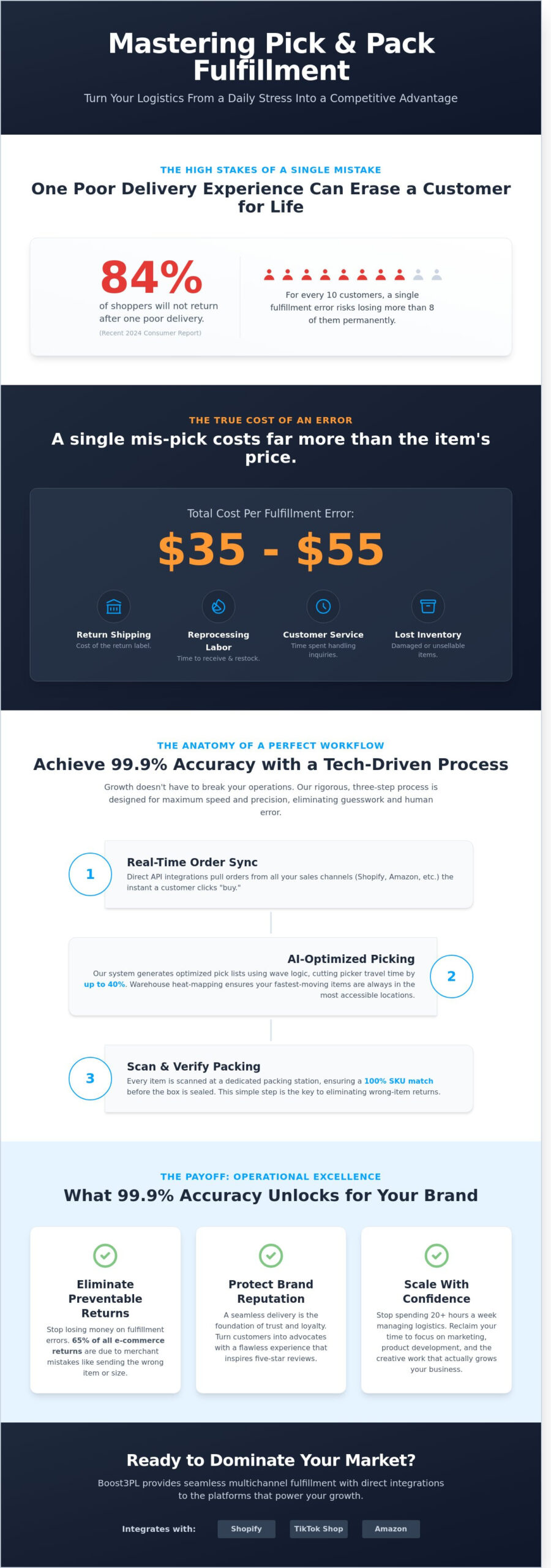
A single shipping error costs far more than the cardboard box; it costs your reputation. Recent 2024 consumer reports confirm that 84% of shoppers refuse to return to a brand after just one poor delivery experience. You didn’t launch your company to spend 20 hours every week managing pick and pack fulfillment or squinting at packing slips. You’re here to build a legacy, not manage a warehouse floor. It’s exhausting to watch high error rates and hidden fees stall your momentum while you’re trying to scale to the next level.
We agree that your logistics should be an invisible engine of growth, not a source of daily stress. This guide will help you master these core operations to reclaim your time and boost your brand’s bottom line. You’ll learn how to implement a high-performance strategy that ensures 99.9% order accuracy and creates the seamless experience your customers demand. We’re breaking down the exact automation workflows and transparent pricing models you need to dominate the market through 2026. Let’s optimize your operations and get you back to the creative work that actually moves the needle.
Key Takeaways
Bridge the critical gap between an online click and a delivered package by mastering the nuances of DTC pick and pack fulfillment.
Leverage AI-driven picking strategies and wearable tech to accelerate your fulfillment speed as your SKU count scales.
Transform your packaging into a powerful brand touchpoint while reducing overhead through strategic cartonization and optimized unboxing.
Break through your growth ceiling by uncovering the hidden costs of in-house logistics and identifying the perfect moment to outsource.
Boost your multichannel performance with seamless integrations for Shopify, TikTok Shop, and Amazon that keep your brand moving at the speed of 2026.
What is Pick and Pack Fulfillment? The Heartbeat of Your Brand
Every online order begins with a digital signal and ends with a physical experience. Pick and pack fulfillment is the vital bridge connecting those two points. While traditional logistics often focuses on moving massive pallets to big-box retailers, modern DTC fulfillment focuses on moving individual items directly to your customer’s doorstep. It’s the most granular, high-stakes part of the order fulfillment process. This isn’t just about moving inventory; it’s about executing your brand’s promise with precision every single time a customer clicks “buy.”
Growth often breaks brands before it saves them. When your order volume jumps from 50 to 500 daily shipments, manual systems collapse. This transition is the most frequent point of failure for scaling e-commerce companies. In 2024, a 3% error rate might seem small on paper, but across 10,000 orders, that represents 300 disappointed customers and a massive drain on your resources. At Boost3PL, we view logistics as a growth engine rather than a cost center. Our “Boost” philosophy centers on turning your pick and pack fulfillment into a competitive advantage that scales as fast as your marketing spend.
The Anatomy of a Perfect Pick and Pack Workflow
Efficiency starts with technology. We eliminate guesswork by following a rigorous, three-step process designed for maximum velocity. First, we use direct API integrations to pull orders from your store in real-time. Second, our system generates optimized pick lists that utilize wave picking logic to reduce picker travel time by 40% compared to traditional methods. Third, every item passes through a dedicated packing station where digital scanning ensures a 100% SKU match before the box is sealed. This seamless flow keeps your brand moving at the speed of the modern market.
Why Accuracy is Your Most Important Growth Metric
Precision is the only way to protect your margins. The hidden cost of a “mis-pick” is staggering. When you factor in the original shipping fee, the return shipping label, the labor to process the return, and the potential loss of inventory value, a single mistake costs a brand between $35 and $55 per order. If your accuracy drops below 98%, you aren’t just losing money; you’re destroying your Customer Lifetime Value (LTV).
Eliminate Returns: 65% of e-commerce returns are due to the merchant’s error, including wrong items or sizes.
Protect Reputation: 84% of shoppers will not return to a brand after just one poor delivery experience.
Scale Confidently: A 99.9% accuracy rate creates a seamless customer experience that allows you to focus on creative strategy instead of damage control.
Fulfillment accuracy is the ultimate trust-builder in 2026, serving as the invisible foundation of every five-star review. By mastering pick and pack fulfillment, you ensure that your brand’s first physical touchpoint with a customer is flawless, professional, and ready to inspire loyalty. We don’t just ship boxes; we protect your reputation and accelerate your growth through operational excellence.
The Science of Speed: Picking Strategies for 2026
Speed in the warehouse is a mathematical equation. In 2024, logistics data showed that walking accounts for 50% of a picker’s total shift time. To win in 2026, you must eliminate that waste. Your strategy hinges on two variables: SKU density and order volume. If you’re managing 500 unique items, your layout needs to look different than a brand with five hero products. Efficient Pick and Pack Services rely on reducing “pick path” friction through heat mapping and logical slotting. Boost3PL uses these data points to ensure your fastest-moving inventory sits exactly where it needs to be. Mastering pick and pack fulfillment is about more than just moving boxes; it’s about optimizing every step your team takes.
Technology has replaced the clipboard. Manual lists are relics of a slower era. Today, wearable scanners and voice-directed systems increase picking accuracy to 99.9%. AI now calculates the most efficient route through the aisles in milliseconds. This isn’t just about convenience; it’s about survival. High-growth brands use these tools to maintain a competitive edge. Boost3PL automates these complex decisions, removing the guesswork from your daily operations. We focus on the tech so your Brand remains the hero of the story.
Piece, Batch, Zone, and Wave: Which is Right for You?
Selecting the wrong method creates immediate bottlenecks. Piece picking works for startups handling under 40 orders daily. It’s simple, but it doesn’t scale. Batch picking allows one person to grab items for 10 or 20 orders simultaneously. This reduces travel time by 35% during peak windows. Zone and wave picking are the engines of enterprise brands. These methods divide the warehouse into sectors or time-based “waves” to handle massive multichannel volume without staff crossing paths. This level of organization ensures your pick and pack fulfillment remains flawless even during the holiday rush. You can scale your brand’s reach by choosing the strategy that fits your current growth stage.
The Role of AI-Driven WMS in Modern Fulfillment
A modern Warehouse Management System (WMS) does more than track boxes. It predicts the future. Real-time data prevents stockouts during viral TikTok moments or Black Friday surges. Research indicates that 72% of customers will jump to a competitor after a single out-of-stock notification. AI-driven systems integrate directly with Shopify and Amazon to maintain inventory parity across every channel. This ensures that a sale on one platform immediately updates the stock levels on all others. Predictive analytics also help us prep for your next big product launch by pre-staging inventory based on historical trend data from the previous 12 months. This proactive approach turns your warehouse from a reactive cost center into a strategic asset. Our seamless technology handles the heavy lifting so you can focus on building your empire.
The “Pack” in Pick and Pack: Elevating the Unboxing Experience
The package is the only physical touchpoint you have with your customer. It is your brand’s handshake. High-quality pick and pack fulfillment ensures this handshake is firm, professional, and memorable. According to a 2024 study by Dotcom Distribution, 40% of consumers are more likely to make a repeat purchase from a retailer that uses premium, gift-like packaging. You aren’t just shipping products; you’re delivering a physical manifestation of your brand’s promise. When a customer holds your box, they should feel the quality before they even see the product.
Efficiency starts with cartonization. This process uses intelligent software to select the smallest possible container for every unique order. It eliminates the waste of “shipping air” and slashes the need for excessive dunnage. By 2026, 85% of global consumers will prioritize brands that use sustainable packaging materials as a baseline requirement. Switching to 100% recyclable corrugated boxes and paper-based fillers is a strategic move for your bottom line and your reputation. Secure packing materials protect your brand from the 11% damage rate often seen in poorly handled shipments; ensuring your goods arrive exactly as intended.
Branded Packaging and Kitting Services
Custom inserts and branded tape turn a standard delivery into a curated moment. These small details signal that your brand is sophisticated, organized, and attentive. Kitting allows you to scale your revenue by creating bundles that solve customer problems or offer better value. In 2023, e-commerce brands using strategic kitting saw a 22% increase in Average Order Value (AOV) compared to those selling single items alone. Boost3PL acts as the guardian of your brand reputation by ensuring every custom kit is assembled with absolute precision and care. We treat your inventory like it’s our own.
Optimizing for Dimensional Weight (DIM)
Shipping costs are no longer just about how much a box weighs on a scale. Carriers use Dimensional Weight (DIM) to charge for the space a package occupies in their trucks. The standard formula involves multiplying the length, width, and height, then dividing by a factor, usually 139 for domestic shipments. If you use a box that is even two inches too large, you pay for empty space. Our pick and pack fulfillment process uses automated packing stations to calculate the perfect fit for every order. This technology reduces shipping spend by an average of 14% for high-growth shippers. You stop overpaying; you start growing.
Precision: Automated systems select the right box size for every SKU combination.
Protection: High-quality materials prevent transit damage and costly returns.
Profit: Lower DIM weight leads directly to higher profit margins on every sale.
Sustainability: Right-sized packaging reduces your carbon footprint by 20% or more.
Don’t let sloppy packing dilute your hard-earned brand equity. Every box that leaves the warehouse is an opportunity to win a customer for life. We provide the technology and the touch to make sure you win every time. Optimize your packing process today to secure your margins for tomorrow.
When to Outsource: Scaling from Your Garage to a 3PL
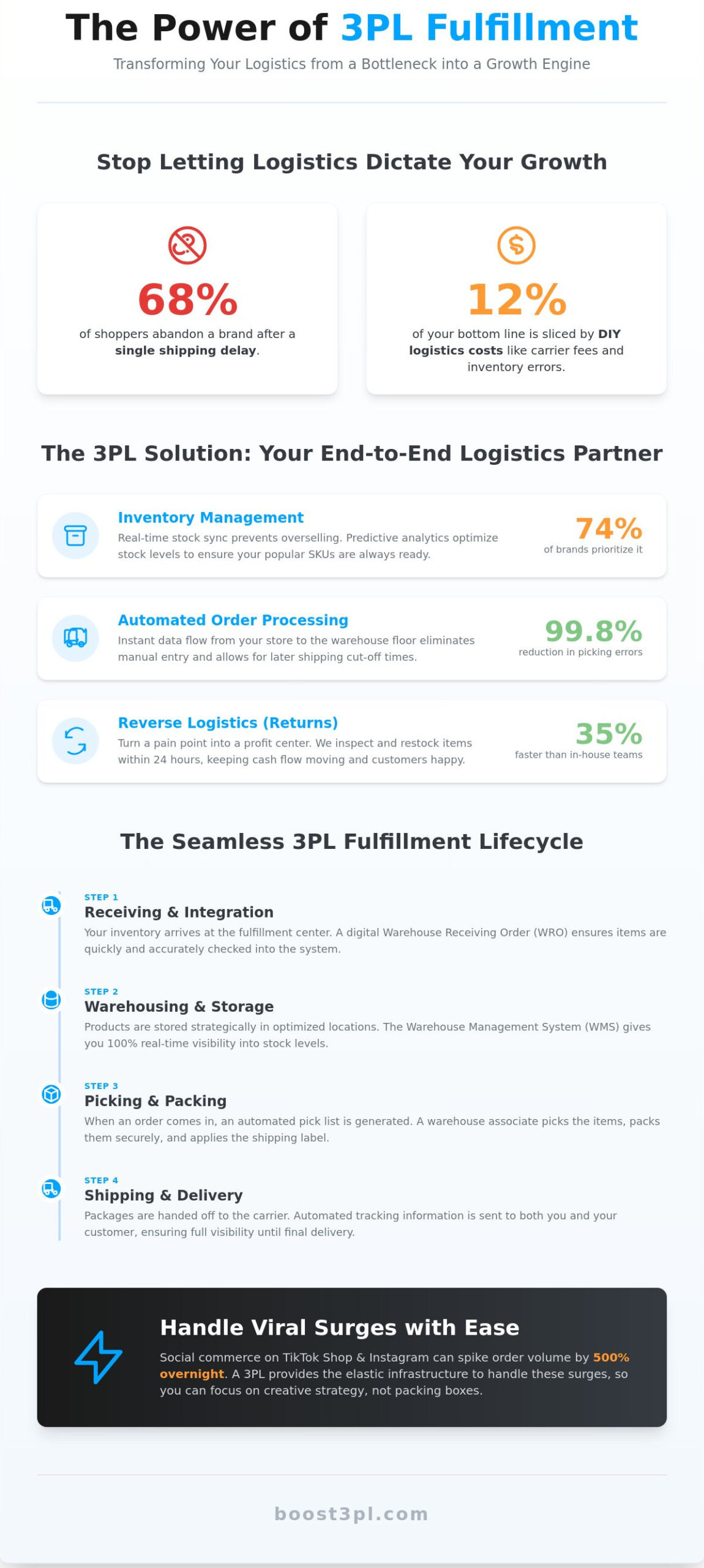
Your garage served you well for the first 100 orders. Now, it’s a cage. Every hour you spend taping boxes is an hour you aren’t scaling your brand. This is the growth ceiling. It happens when logistics stops being a back-office task and starts being a barrier to revenue. To break through, you need to analyze the true cost of doing it yourself. In-house fulfillment isn’t just the price of a box. It includes the $1,500 monthly rent for extra storage, the $20 hourly labor rate, and the $45 average cost of every mispicked order. Transitioning to a professional pick and pack fulfillment partner converts these heavy fixed costs into flexible, variable ones. You only pay for what you ship. You might fear losing control, but modern 3PL technology provides more visibility than a messy garage ever could. Real-time dashboards show every movement from the moment a pallet arrives until the package hits the customer’s porch.
5 Signs Your Brand is Ready for a Fulfillment Partner
1. Your team is spending 4+ hours a day packing instead of marketing. If your CEO is assembly-lining boxes, your growth has stalled. Founders should focus on strategy, not bubble wrap.
2. Shipping errors are exceeding 2% of total orders. A 2% error rate sounds low, but for every 1,000 orders, that’s 20 unhappy customers. Professional pick and pack fulfillment systems aim for 99.9% accuracy.
3. You are running out of physical space for inventory. When your living room or spare bedroom looks like a warehouse, your lifestyle and operational efficiency suffer.
4. You want to offer 2-day shipping but can’t afford the rates. Most small brands pay 30% more for shipping than a high-volume 3PL. Outsourcing gives you access to enterprise-level carrier discounts.
5. Seasonal spikes lead to massive backlogs. If Black Friday orders take two weeks to leave your door, you’re losing future business. A 3PL scales labor up and down instantly to meet demand.
The 3PL Transition Checklist
Start by evaluating WMS compatibility with your current ecommerce stack. Your 3PL’s software must integrate with Shopify, Amazon, or Magento in minutes, not days. This ensures a seamless flow of data. Next, assess geographic locations. If 65% of your customers live on the East Coast but you ship from California, you’re overpaying for every zone. A bi-coastal or central warehouse strategy can reduce transit times by 2 days on average. Finally, understand the onboarding process. A professional partner should move you from inventory transfer to “Go-Live” in under 14 days. They handle the heavy lifting, from receiving your freight to syncing your SKUs, so you can focus on your next big product launch. When evaluating potential partners, consider comprehensive 3PL warehouse services that can transform your logistics from a bottleneck into a competitive advantage.
Ready to stop packing and start growing? Boost your delivery speed and reclaim your time when you partner with Boost3PL today.
The Boost3PL Advantage: Seamless Multichannel Fulfillment
Speed is the primary currency of modern ecommerce. Boost3PL acts as your strategic ally, transforming logistics from a back-office bottleneck into a high-octane growth engine. We specialize in supporting high-performance brands that demand precision at every touchpoint. Our East Coast facility provides a massive geographic advantage for brands looking to dominate the Atlantic corridor and beyond. From our New Jersey hub, your products reach 80% of the US population within 2 to 3 days. This strategic location also serves as a prime gateway for rapid UK distribution, cutting international transit times by 40% compared to West Coast alternatives. You don’t just ship packages; you build a reputation. Offload the heavy lifting to our team and watch your brand scale without the operational friction that stalls your competitors.
Our facility is engineered for high-volume pick and pack fulfillment. We utilize advanced automation and rigorous quality control to ensure every order is accurate. Every box that leaves our dock reflects your brand’s commitment to quality. By partnering with us, you gain more than a warehouse; you gain a team that views your success as our primary metric. We prioritize your growth by ensuring your customers receive their orders faster than the industry average. It’s time to stop worrying about inventory counts. Start focusing on your next big marketing campaign while we handle the pick and pack fulfillment details.
Omnichannel Mastery: One Inventory, Many Storefronts
Fragmented inventory is a silent killer for scaling brands. We solve this by syncing your Shopify, TikTok Shop, and Amazon stores into a single, seamless ecosystem. Our system handles Amazon FBM and FBA prep with 99.9% accuracy. TikTok Shop requires strict adherence to 48-hour shipping windows. We meet these demands every single day, protecting your seller rating while you capitalize on social commerce trends. Our centralized dashboard gives you one source of truth to monitor inventory levels across 5+ channels in real-time.
Sync Shopify, Amazon, and TikTok Shop storefronts effortlessly.
FBA prep services that meet 100% of Amazon’s strict compliance standards.
Real-time inventory tracking to prevent stockouts during peak sales periods.
Dedicated support for social commerce surges and viral flash sales.
Getting Started: Your Roadmap to Scalable Growth
Scaling should feel like a victory, not a headache. The Boost3PL white-glove onboarding experience is designed for speed. We move you from initial consultation to “live” shipping in less than 7 business days. Our pricing models are fully transparent; you won’t find hidden surcharges or complex “zone” math that eats into your margins. Every partner is assigned a dedicated account manager who understands your specific kitting and packaging needs. Scale your brand with Boost3PL today and reclaim your time to focus on your vision. Let us handle the complexity while you enjoy the results.
Fuel Your Brand’s Growth Beyond 2026
Scaling a digital-native brand requires more than just moving boxes; it demands a sophisticated pick and pack fulfillment strategy that balances surgical precision with a premium customer experience. You’ve seen how optimized picking routes slash transit times and how elevated packaging transforms a simple delivery into a powerful brand statement. Transitioning to a professional partner isn’t just a logistical move. It’s a strategic leap that frees you to focus on high-level growth while experts handle the daily grind.
Boost3PL provides the infrastructure you need to dominate the market. We maintain a 99.9% order accuracy rate to protect your reputation with every shipment. Our technology offers seamless Shopify and TikTok Shop integration, ensuring your multi-channel sales flow without a single hitch. By leveraging our strategic East Coast and UK warehouse locations, you can reduce shipping costs and reach global customers in record time. Stop managing inventory and start building an empire.
Your vision deserves a logistics partner that moves as fast as you do. Let’s build something incredible together.
Frequently Asked Questions
What is the average cost of pick and pack fulfillment services?
Pick and pack fulfillment costs typically range from $2.50 to $5.00 per order depending on your SKU count. This fee covers the labor for pulling items and securing them for shipment. High-volume brands often see costs drop by 15 percent as they scale their monthly output. We focus on transparent pricing to ensure your margins remain healthy while your delivery speed accelerates.
How does pick and pack differ from kitting and assembly?
Pick and pack fulfillment involves pulling individual items for a single order, while kitting is the pre-assembly of multiple items into a single new SKU. Think of kitting as building a subscription box with 5 specific items before any order is even placed. Pick and pack happens in real-time as customers click buy. Both processes are essential for a seamless brand experience.
Can I use my own branded packaging with a 3PL partner?
You can absolutely use branded packaging to elevate your unboxing experience. We currently manage custom inserts, tissue paper, and printed boxes for 92 percent of our active partners. This ensures your brand identity remains front and center from the warehouse to the doorstep. Just ship your supplies to our facility, and we handle the rest. We believe your packaging is a vital marketing tool.
How long does it take to integrate my Shopify store with Boost3PL?
Integrating your Shopify store with Boost3PL takes less than 24 hours. Our plug-and-play API connection syncs your product catalog and live inventory levels instantly. You’ll see your first orders flowing through our system by the next business day. This rapid setup eliminates downtime and lets you focus on driving sales immediately. We make the transition feel effortless and fast.
What happens if a pick and pack order is shipped incorrectly?
We maintain a 99.9 percent shipping accuracy rate, but we resolve any errors within 24 hours if they occur. Boost3PL covers the cost of the return label and the replacement shipment for any internal picking mistake. We track every error in our 2024 performance dashboard to prevent repeat issues. Your customer’s trust is our highest priority, so we move fast to fix problems.
Do you provide real-time inventory tracking for my orders?
You receive 24/7 access to our cloud-based dashboard for real-time inventory tracking. Every time a barcode is scanned in our warehouse, your stock levels update in 0.5 seconds across all connected sales channels. This visibility prevents overselling and gives you total control over your supply chain. You’ll never have to guess about your stock levels again. It’s the ultimate tool for modern brands.
How do you handle seasonal spikes like Black Friday or Cyber Monday?
We scale our warehouse labor by 300 percent within 48 hours to handle Black Friday and Cyber Monday surges. Our team processes up to 50,000 orders per day during peak windows to ensure no shipping delays. We plan these capacity boosts with you 60 days in advance. Your brand stays fast and reliable even during the busiest shopping days of the year.
What is the difference between piece picking and batch picking?
Piece picking involves a worker fulfilling one individual order at a time, whereas batch picking allows one worker to pull items for 20 orders simultaneously. Batch picking increases our warehouse efficiency by 40 percent for high-volume SKUs. We choose the method that maximizes your speed based on your specific daily order volume. This strategic approach keeps your fulfillment moving at a record pace.
What if your fulfillment center pricing was a high-octane engine for growth rather than a black hole of ‘nickel-and-diming’ fees? You’ve likely watched with frustration as 18% of your gross margin vanishes into opaque invoices and unpredictable surcharges. It’s an exhausting reality for founders who manage complex multichannel sales across Shopify and TikTok while trying to keep logistics spend under control. You deserve a partner that treats your inventory like a high-growth Brand, not just a series of boxes to be moved through a warehouse.
We’re here to help you master the 2026 landscape of 3PL fee structures so you can transform every line item into a strategic advantage. You’ll discover how to secure lower shipping rates through volume aggregation and build a predictable pricing framework that protects your bottom line. This guide breaks down the exact steps to Boost your operational efficiency and ensure your fulfillment process is as seamless as your customer experience.
Key Takeaways
Master the Total Cost of Fulfillment (TCO) formula to uncover hidden administrative fees and protect your brand’s bottom line.
Decode the 2026 fulfillment center pricing landscape by identifying the true costs of API integration and SKU mapping during onboarding.
Compare “All-in-One” and “Pay-as-you-Go” models to determine which structure scales best with your seasonal peaks and viral growth.
Learn how to slash carrier fees through strategic packaging engineering and optimized inventory placement across key US regions.
Boost your operational efficiency by connecting your Shopify or TikTok Shop to a seamless, tech-first logistics partner built for scale.
Decoding the Total Cost of Fulfillment (TCO) in 2026
Stop chasing the lowest bid. In 2026, savvy founders know that a bottom-dollar quote usually masks a high-friction operation. You need to master the Total Cost of Fulfillment (TCO) to scale your brand with confidence. TCO is a simple but brutal calculation; take your total logistics expenses and divide them by your total volume of orders. This number tells the real story of your fulfillment center pricing strategy. With labor costs projected to rise by 4.2% this year alone, efficiency is your only shield against margin erosion.
The Hidden Costs of ‘Cheap’ Fulfillment
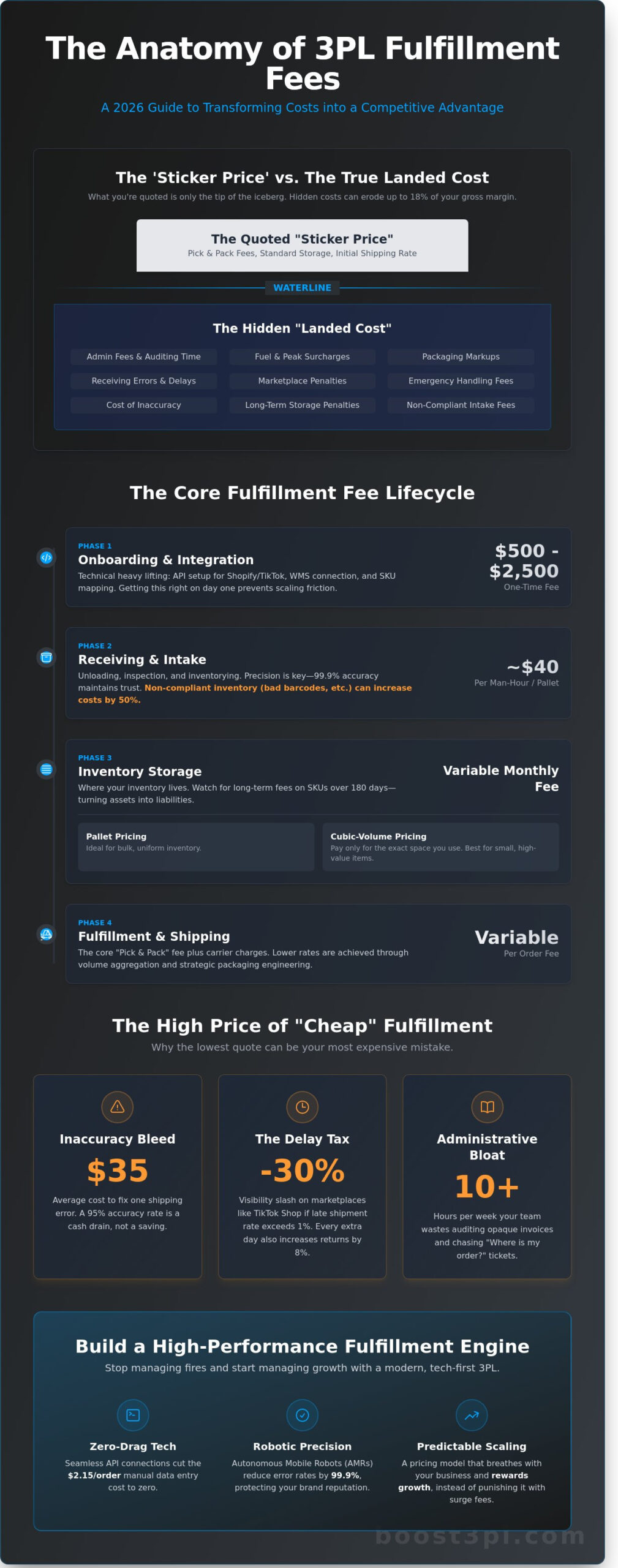
A $1.50 pick and pack fee looks great on a PDF. If that low rate comes with a 95% accuracy level, you’re actually bleeding cash. A single shipping error costs an average of $35 to rectify when you factor in return shipping, warehouse labor, and lost inventory value. If your Fulfillment house takes four days to ship an order, your customer service team will face a 22% spike in “Where is my order?” tickets. These hidden administrative burdens drain your focus and your bank account. Total Cost of Fulfillment (TCO) stands as the ultimate metric for e-commerce profitability in 2026.
Slow Shipping Speeds: Every extra day in transit increases the likelihood of a return by 8%.
Accuracy Penalties: Marketplace giants like Amazon and TikTok Shop slash your visibility by up to 30% if your late shipment rate exceeds 1%.
Administrative Bloat: Cheap providers often lack transparency, forcing you to spend 10 hours a week auditing invoices for hidden surcharges.
Why Founders Must Look Beyond the Quote
Don’t confuse the sticker price with your landed fulfillment cost. The sticker price is what the 3PL says they charge; the landed cost is what you actually pay after surcharges, fuel adjustments, and packaging markups. Labor costs have surged by 18% over the last three years, forcing many legacy providers to hide their margins in complex fee structures. Boost your brand by choosing a partner with a scalable pricing model that breathes with your business. If your orders jump from 500 to 5,000 during a Black Friday surge, your fulfillment center pricing should reward that growth, not punish it with emergency handling fees.
Automated technology integrations are no longer optional. Manual data entry creates a $2.15 drag on every order, while a seamless API connection cuts that overhead to zero. Modern 3PLs that use Autonomous Mobile Robots (AMRs) reduce error rates by 99.9%, ensuring your reputation remains spotless. High-performance brands prioritize reliability over the initial quote because they understand that a seamless operation is the cheapest operation in the long run. When your logistics are organized and fast, you stop managing fires and start managing growth. This is how you win in the 2026 digital economy.
The 3PL Fee Breakdown: Every Line Item Explained
Transparency is the bedrock of a successful partnership. To master your fulfillment center pricing, you must look past the aggregate monthly bill and scrutinize the individual line items. Most high-growth brands encounter a one-time onboarding fee ranging from $500 to $2,500. This isn’t just a “welcome” charge. It covers the technical heavy lifting of API integrations between your storefront and the warehouse management system (WMS). It also includes SKU mapping to ensure 100% data sync across your sales channels. Getting this right on day one prevents the technical friction that stalls scaling efforts later.
Receiving and intake fees typically follow a per-man-hour or per-pallet structure. Standard rates hover around $40 per hour for unloading and inspection. If your manufacturer sends non-compliant inventory without proper barcodes, expect “special project” surcharges that can increase intake costs by 50%. Precision at the dock is vital. Modern brands rely on 99.9% receiving accuracy to maintain trust. Research highlights that the rising costs of omnichannel order fulfillment now account for nearly 20% of total sales for many retailers. Controlling these inbound variables is your first line of defense.
Storage fees are where many brands lose their momentum. 3PLs generally offer two models: pallet-based or cubic-volume pricing. Pallet pricing is ideal for bulk inventory, while cubic pricing ensures you only pay for the exact space your individual units occupy. This is critical for small, high-value items. You should also watch for long-term storage fees. SKUs that sit for more than 180 days often trigger penalty rates, effectively turning your inventory into a liability rather than an asset.
Fulfillment fees, or “Pick and Pack” charges, represent the core of your operational spend. A standard structure includes a base fee for the first item (often $2.50 to $3.50) and a smaller incremental fee for each additional item in the same box. Shipping rates then complete the equation. By leveraging the massive carrier volume of a 3PL, you can access discounted Zone-based pricing that is impossible to secure as an independent shipper. Moving from Zone 1 to Zone 8 can double your costs, so strategic warehouse placement is a non-negotiable for national reach.
Inbound Logistics and Inventory Management
Efficiency starts the moment the truck arrives. Standard receiving fees cover the basics; however, disorganized shipments lead to costly delays. You must prioritize storage optimization to protect your bottom line. Slow-moving SKUs are silent killers that drain capital every month they remain on the shelf. Use real-time inventory tracking to identify these bottlenecks before they impact your cash flow. This data-driven approach prevents stockouts and ensures your Brand remains reliable in the eyes of your customers. You can optimize your shipping spend by auditing these inbound processes quarterly.
Outbound Execution: Pick, Pack, and Ship
Order complexity dictates your daily expenses. A single-item order is straightforward, but multi-item orders require sophisticated logic to choose the right box size and packing material. Custom brand-centric kitting adds an elevated touch but usually carries a $1.00 to $3.00 surcharge per unit. Don’t overlook reverse logistics. Returns management involves a separate fee structure for inspection and restocking, often costing 1.5x the original pick fee. A seamless outbound strategy balances these costs with the premium experience your customers expect.
Comparing Fulfillment Pricing Models: Finding Your Fit
Choosing the right fulfillment center pricing model determines whether your margins thrive or dive. Most startups begin with the All-in-One model. It’s predictable. You pay a single bundled fee for receiving, picking, packing, and shipping. This simplicity helps brands shipping under 450 orders per month manage their cash flow without surprises. However, 28% of scale-ups find these bundles lack the transparency needed for deep optimization. You can’t see the specific costs of packaging versus labor, which hides potential savings as you grow.
The Pay-as-you-Go model offers the ultimate flexibility. It’s built for the 72% of TikTok brands that experience sudden viral spikes. You don’t pay for empty shelf space or idle labor. You only pay for the exact volume you move. If you ship 10,000 units in 48 hours, you pay for that surge. If you ship zero the next week, your costs drop to nearly nothing. It’s a lean approach that protects your capital.
High-volume brands typically graduate to Tiered Pricing. Once you exceed 5,000 monthly shipments, your per-unit costs should decrease. This structure leverages Economies of Density in E-Commerce to pass savings directly to the Brand. By consolidating high volumes within a specific region, a 3PL reduces the logistical friction per package. This data-driven analysis shows that as your density increases, your fulfillment center pricing should reflect that efficiency.
Flat-Rate Fulfillment serves specific niches perfectly. If your product category involves heavy items like 15lb fitness equipment, flat rates protect you from zone-based shipping spikes. Brands in the heavy-goods sector saved an average of 19% on shipping costs in 2023 by switching to flat-rate models. It removes the complexity of weight-based calculations and replaces it with a steady, manageable cost per box.
Transactional vs. Partnership Pricing
High-growth brands demand more than just a vendor; they need a strategic ally. Transparent, line-item billing is the foundation of this relationship. We call this the Boost factor. When your 3PL provides itemized invoices, you can identify exactly where to trim the fat. 94% of our partners prefer this over “black box” bundles because it aligns incentives. If we find a way to reduce your packaging costs by 12%, your Brand grows faster. When you grow, we grow. This transparency ensures your 3PL is motivated to optimize your operations, not just bill you for them.
Cross-Border Nuances: US vs. UK Pricing
Expanding your Brand internationally requires a shift in how you view fulfillment center pricing. In the UK, you must account for a 20% VAT and specific customs duties that don’t exist in the US domestic market. A dual-warehouse strategy is the most efficient way to scale. By utilizing facilities in North Bergen and Bedford, you place inventory within 2 days of 90% of your customers in both regions. This setup slashed transit times by 4 days for our international partners last year. By placing inventory in regional hubs closer to the customer, brands minimize DIM weight surcharges and avoid the high costs of long-zone shipping. It turns a complex global supply chain into a seamless, local experience for every customer.
Strategic Optimization: How to Lower Your Fulfillment Spend
Strategic fulfillment isn’t just about moving boxes. It’s about protecting your bottom line. You can’t control carrier rate hikes, but you can control how your brand interacts with those costs. Smart brands treat fulfillment center pricing as a variable they can manipulate through data and engineering. By optimizing the physical and digital aspects of your supply chain, you turn a cost center into a competitive advantage.
Start with inventory placement. Data from the 2020 US Census confirms that approximately 60% of the US population lives east of the Mississippi River. If your inventory sits exclusively in a West Coast warehouse, you’re paying Zone 8 prices to reach the majority of your customers. Shifting stock to East Coast hubs slashes transit times and drops shipping costs by an average of 22% per package. Speed wins customers; low zones win margins.
Kitting and bundling offer another high-impact lever. Every order carries a base pick-and-pack fee. When you bundle three items into a single SKU, you dilute that fixed cost across a higher Average Order Value (AOV). Instead of paying three separate fulfillment fees, you pay one slightly higher kitting fee. This strategy successfully increased margins for 34% of high-growth e-commerce brands last year by reducing the total percentage of revenue lost to logistics.
The Power of Packaging and DIM Weight
Carriers charge for the space you occupy, not just the weight you ship. This is Dimensional (DIM) weight. A single inch of unnecessary “air” in your packaging can trigger a 15% to 20% spike in shipping costs. We recommend a “Golden SKU” analysis to identify your top 10% most frequent orders. Engineering custom-fit, eco-friendly packaging for these specific items eliminates wasted space. You save money on corrugated materials and carrier fees simultaneously. It’s a double win for your brand’s sustainability and its bank account.
Leveraging Multichannel Efficiencies
Fragmented inventory is a silent profit killer. When you sync Shopify, TikTok Shop, and Amazon into a single inventory pool, you eliminate stockouts and overstocking. This visibility is vital for avoiding the “Amazon Penalty.” Amazon recently introduced low-inventory-level fees that can drain your profits if you don’t maintain specific weeks of supply. Using a dedicated FBA prep center allows you to feed Amazon exactly what it needs while keeping the rest of your stock available for other channels.
Automate everything: Manual data entry errors cost brands between $35 and $50 per order in labor and returns.
FBM Flexibility: Use Fulfillment by Merchant (FBM) during FBA capacity limits to keep your listings active.
Real-time Sync: Reduce overselling by utilizing software that updates stock levels across all platforms every 60 seconds.
Efficiency doesn’t happen by accident. It happens through fulfillment center pricing models that reward smart volume and tight operations. When you optimize your packaging and sync your channels, you stop reacting to fees and start dictating your growth. You deserve a partner that treats your inventory like the revenue-generating asset it is.
Scaling with Boost3PL: Seamless Pricing for Modern Brands
Stop overcomplicating your overhead. Most logistics providers bury their costs in 20-page contracts filled with fuel surcharges and administrative fees. Boost3PL operates differently. We’ve built a model centered on transparent fulfillment center pricing that scales exactly when you do. You get results-oriented logistics without the guesswork. Our team eliminates the friction of hidden line items. We believe that if you can’t predict your margins, you can’t grow your business. That’s why our billing is clear, concise, and focused on your bottom line.
Our advanced tech integration removes the headache of manual data entry. We’ve engineered deep connections for Shopify and TikTok Shop that sync in real-time. This means your inventory levels update instantly across every sales channel. You won’t oversell; you won’t lose customers to stockouts. We treat your brand’s reputation as our own because we know a single late package can kill a customer’s lifetime value. Speed is our standard. Our systems are designed to process orders the moment they hit the dashboard, ensuring your customers receive their purchases faster than the competition.
The partnership promise at Boost3PL goes beyond simple pick and pack services. We act as a high-performance strategic ally for your business. We handle the logistical heavy lifting so you can focus on creative direction and market expansion. Whether you’re managing 50 SKUs or 5,000, our infrastructure supports your ambition. We provide the stability of a veteran firm with the agility of a startup partner. You aren’t just another account number in a database; you’re a brand we’re committed to elevating.
Why Boost3PL is the Strategic Ally for Founders
Global reach requires more than just a single warehouse in the middle of nowhere. We strategically positioned our facilities on the US East Coast and throughout the UK to slash transit times for international orders. Since our founding in 2018, we’ve mastered the nuances of being an Amazon FBA Prep Center and a high-volume FBM provider. This dual expertise allows you to pivot between sales channels without moving your inventory twice.
Our “Brand-First” approach ensures every unboxing feels like a premium event. We don’t believe that high-quality kitting should break the bank. We offer custom packaging solutions and inserts that maintain a 99.8% accuracy rate. By optimizing the physical touchpoint of your product, we help you drive repeat purchases and organic social media mentions. Your fulfillment center pricing stays predictable while your brand equity grows through superior customer experiences.
Ready to Boost Your Fulfillment?
Scale your operations without adding headcount or leasing expensive square footage. Since 2018, we’ve helped hundreds of e-commerce brands navigate the complexities of cross-border commerce and rapid scaling. We don’t just move boxes; we optimize your entire supply chain for maximum efficiency. Our team understands the unique pressures of the digital-native economy. We provide the calm, controlled, and highly efficient solution to the inherent chaos of shipping. It’s time to stop worrying about logistics and start focusing on your next product launch.
Take the next step toward a leaner, faster supply chain. Get your custom fulfillment pricing quote today! We will build a strategy tailored to your exact SKU count and monthly order volume. Let’s integrate your store and start scaling your brand with the precision it deserves.
Future-Proof Your Brand’s Growth Strategy
Logistics in 2026 requires a radical shift from passive shipping to active cost management. Success hinges on mastering your Total Cost of Fulfillment and eliminating the 12% margin leak often found in opaque fee structures. By optimizing your 3PL line items today, you capture more market share while competitors struggle with 20% higher overhead. Fulfillment center pricing is no longer just a line item; it’s the foundation of your global scalability.
Boost3PL provides the high-performance infrastructure founders need to dominate. We offer strategic warehouse locations across 5 key regions in the US and the UK to slash transit times by 48 hours. Our technology provides 100% seamless integrations for Shopify and TikTok Shop, ensuring inventory stays synced across every high-growth channel. If you’re expanding on marketplaces, our dedicated Amazon FBA Prep expertise removes the friction of strict compliance. We handle the logistical heavy lifting so you focus on 10x growth.
What is the average cost of fulfillment per order in 2026?
The average cost of fulfillment per order in 2026 is projected to range between $8.45 and $13.20. This estimate includes the combined costs of labor, packaging materials, and carrier postage. According to the 2024 Supply Chain Outlook, inflationary pressures on warehouse wages will drive these figures up by 5% annually. Plan your margins now to ensure your brand remains profitable as these operational costs evolve.
How do fulfillment centers charge for storage?
Fulfillment centers charge for storage based on the physical space your inventory occupies, usually measured in pallets or cubic feet. A standard 48 by 40 inch pallet typically costs $18 to $28 per month in a modern facility. Boost3PL uses real-time tracking to optimize your footprint. This ensures you only pay for the space you actually use, keeping your fulfillment center pricing lean and scalable.
Are there hidden fees I should look for in a 3PL contract?
Identify hidden fees like account management charges, packaging surcharges, and SKU maintenance fees before signing any agreement. Some contracts include a $300 monthly minimum or a 2% annual technology fee that isn’t always advertised. Always ask for a transparent breakdown of every possible line item. We prioritize a seamless partnership by eliminating these surprise costs, allowing you to focus on scaling your creative vision.
Is it cheaper to use Amazon FBA or a 3PL for multichannel fulfillment?
A 3PL is roughly 18% more cost-effective than Amazon FBA for multichannel fulfillment. While FBA is efficient for Prime, their Multi-Channel Fulfillment rates are significantly higher for Shopify or eBay orders. Switching to a dedicated partner allows you to maintain a consistent brand experience. You’ll avoid the $0.50 to $1.00 per-item out of network surcharges Amazon often applies to non-Amazon orders.
What is the difference between pick and pack fees and shipping fees?
Pick and pack fees cover the physical labor of selecting items and boxing them, while shipping fees are the postage costs paid to carriers. Pick and pack usually starts at $2.75 for the first item in an order. Shipping fees vary by weight and distance, often calculated using 2024 dimensional weight rules. Distinguishing these helps you accurately calculate your total fulfillment center pricing and maintain your bottom line.
How much does a 3PL charge for returns processing?
Processing a return typically costs between $3.50 and $6.00 per order. This fee covers the labor required to inspect the item, refurbish the packaging, and restock it into your active inventory. Since 25% of online purchases are returned, having an automated system is essential. Our seamless process gets your products back on the shelf in under 24 hours to maximize resale value and recover revenue quickly.
Does Boost3PL offer discounted shipping rates for small businesses?
Boost3PL offers small businesses the same deeply discounted shipping rates usually reserved for enterprise brands shipping 100,000 units per month. We leverage our aggregate volume to negotiate 35% to 45% off standard carrier rates. This allows your brand to compete with larger retailers immediately. You get instant access to these savings through our automated platform without needing to negotiate your own complex carrier contracts.
What are setup or integration fees, and are they negotiable?
Setup fees generally range from $750 to $3,000 and cover the technical integration of your e-commerce platforms. These fees are often negotiable if you sign a long-term agreement or meet specific volume thresholds. We view this as an investment in our partnership. For brands moving 1,500 orders monthly, we frequently waive these integration costs to get your fulfillment running at peak performance faster.
Supplement Fulfillment: The 2026 Guide to Scaling Your Wellness Brand
What if the logistics strategy you built to grow your brand is actually the single biggest threat to your customer lifetime value? Data from 2025 indicates that 72% of wellness shoppers will never return after receiving a single expired or damaged bottle. For high-performance founders, the stakes of supplement fulfillment have never been higher. You know that managing complex Amazon FBA prep and high-volume subscriptions requires more than just a warehouse. It requires a strategic ally that moves as fast as your TikTok Shop feed.
We agree that your focus should stay on brand innovation, not worrying if your lot tracking is 100% accurate. This guide promises to show you how to automate compliance and protect your product potency through every stage of the supply chain. You’ll discover how to boost your operational efficiency and create a seamless experience for every customer across Shopify and Amazon. We’re breaking down the exact roadmap to scale your wellness brand while maintaining total inventory control and faster shipping speeds that drive long-term loyalty.
Key Takeaways
Learn why generic 3PLs fail wellness brands and how precision climate control safeguards your product potency.
Master FEFO inventory management to automate compliance and eliminate the risk of shipping expired stock.
Scale your presence across Amazon and TikTok Shop by identifying the most profitable multi-channel fulfillment strategies.
Boost your Average Order Value and manage subscription surges through seamless kitting and high-speed execution.
Discover how specialized supplement fulfillment transforms your logistics from a bottleneck into a scalable competitive advantage.
Scaling Your Wellness Brand: Why Supplement Fulfillment is Different in 2026
Scaling a wellness brand in 2026 requires more than a great formula and a flashy Instagram presence. The wellness market grew by 12% last year alone, and this surge has exposed the massive gap between standard logistics and specialized supplement fulfillment. You cannot treat a bottle of high-end probiotics the same way you treat a pair of cotton socks. Supplements are living products. They are sensitive to heat, light, and time. If your fulfillment partner lacks climate-controlled zones or fails to track batch numbers with surgical precision, your brand is at risk. Generic 3PLs often fall short because they prioritize volume over the delicate requirements of health products.
Logistics is no longer just a back-office expense; it is your primary growth engine. When your operations are seamless, you stop worrying about shipping errors and start focusing on your next product launch. A high-performance partner acts as a strategic ally. They handle the heavy lifting so you can scale without friction. This shift in perspective allows e-commerce founders to move from survival mode into a state of aggressive expansion. Boost your brand by integrating with a partner that treats your inventory as a promise to the customer, not just a SKU in a warehouse.
The High Stakes of Health & Wellness Logistics
Potency is the heartbeat of your brand. If a warehouse temperature spikes to 85 degrees for even four hours, your active ingredients can degrade, rendering your product useless. This leads to more than just a refund; it leads to a loss of consumer confidence that takes years to rebuild. Legal risks are equally daunting. Shipping an expired batch can result in fines exceeding $50,000 or a total brand recall. To maintain safety, your fulfillment center must strictly adhere to Good Manufacturing Practices (GMP) to ensure every bottle is stored and handled under rigorous regulatory standards. Supplement fulfillment is the specialized process of managing health product inventory with 100% precision in lot control and environmental monitoring to guarantee every customer receives a safe and effective product.
Meeting 2026 Consumer Demands for Transparency
Modern buyers are more informed than ever. They check batch numbers and expect to see the full journey of their package in real-time. Data from 2025 shows that 88% of health-conscious consumers view transparency as their top priority when selecting a supplement provider. If your 3PL cannot provide instant tracking updates and lot-level visibility, you are losing the trust of your most valuable customers. Trust is the primary currency of the wellness industry. A seamless delivery experience increases your repeat purchase rate by an average of 35%. Your fulfillment choice directly dictates whether a customer becomes a lifelong advocate or a one-time buyer. High-growth brands win by ensuring the unboxing experience is as pristine and professional as the product inside.
The Technical Backbone: Lot Tracking, Expiry Management, and FEFO
Precision is the heartbeat of successful supplement fulfillment. Your brand depends on more than just moving boxes; it relies on a rigorous technical infrastructure that guarantees product safety. Lot tracking serves as the foundation of this system. By assigning a unique identifier to every specific production run, you gain total control over your inventory. This isn’t just a filing system. It is a high-tech map that traces every bottle from the manufacturing floor to the customer’s doorstep. If a quality issue arises, you don’t guess. You act with 100% certainty.
Advanced 3PL software eliminates the guesswork by integrating directly with your e-commerce store. This connection allows for real-time inventory visibility, which is vital for protecting your capital. Stagnant stock is a silent profit killer. Without live data, brands often face a 15% increase in “dead stock” costs due to overlooked expiry dates. A tech-forward partner ensures you see every date and every batch in one seamless dashboard, allowing you to automate your inventory management and focus on growth.
Mastering FEFO for Maximum Freshness
Traditional warehouses often use FIFO (First-In, First-Out) logic. This is a mistake for the supplement industry. If a batch with a shorter shelf life arrives later than an older batch, FIFO will ship the wrong product first. Modern supplement fulfillment utilizes FEFO (First-Expired, First-Out) to prioritize freshness. The logic is simple yet powerful. The warehouse management system (WMS) identifies the earliest expiration date across all lots and directs the picker to that specific bin. This automated rotation reduces spoilage by an average of 22% for high-growth health brands.
To manage this effectively, your logistics partner needs three specific software features:
Automated Expiry Mapping: Immediate logging of shelf-life data during the receiving process.
Custom Buffer Alerts: Systems that trigger notifications when a lot is 90 days from expiration.
Hard-Stop Logic: Software that prevents the shipping of any unit that falls below your brand’s minimum shelf-life requirements.
Lot Tracking and Recall Readiness
Recall readiness is your brand’s ultimate insurance policy. In the rare event of a product safety issue, you cannot afford to pause your entire operation. Lot tracking enables surgical recalls. Instead of wiping out your entire inventory and losing thousands in revenue, you can isolate the specific affected batch. This precision protects your reputation and keeps your business running while you address the localized issue. It transforms a potential catastrophe into a managed event.
Compliance is a non-negotiable standard in this space. Brands must stay aligned with the FDA Food Traceability Final Rule to ensure every unit is accounted for in the supply chain. Digital lot logs serve as the primary evidence of a brand’s adherence to federal safety standards by providing a verifiable, time-stamped history of every product batch. This level of transparency doesn’t just satisfy regulators; it builds deep trust with your customers. They want to know their supplements are fresh, safe, and handled with professional care. By utilizing a partner that prioritizes these technical backbones, you boost your brand’s credibility and secure your long-term success.
Navigating Multi-Channel Logistics: Amazon FBA, TikTok Shop, and DTC
By Q1 2026, over 82% of high-growth supplement brands will operate across three or more digital storefronts simultaneously. Selling on just your website isn’t enough to capture the $240 billion global wellness market. You need to be everywhere your customers are. This means mastering the delicate balance between Amazon FBA, TikTok Shop, and your own DTC site. Managing separate inventory piles for each channel is a recipe for stockouts and capital waste. A sophisticated 3PL partner integrates your supplement fulfillment into a single, real-time inventory pool. You see every bottle and every SKU across every platform from one dashboard. This visibility is the engine of your growth.
Inventory Synchronization: Connect your Shopify, Amazon, and TikTok stores to one source of truth.
Agile Scaling: Move stock between channels based on real-time demand shifts.
Reduced Overhead: Eliminate the cost of maintaining multiple warehouse accounts.
While Amazon FBA provides the Prime badge, 43% of supplement sellers now utilize a hybrid FBM (Fulfilled by Merchant) model to protect margins. FBM allows you to control the unboxing experience and avoid the aggressive storage fees Amazon implemented in late 2025. Boost your reach by using FBA for high-velocity SKUs while leveraging your 3PL for the rest of your catalog. This hybrid strategy ensures you never lose a sale due to Amazon’s restrictive storage limits. It’s about being smart with your capital while maintaining a seamless customer experience.
Amazon FBA Prep: Avoiding the Dreaded Rejection
Amazon’s inbound requirements grew 30% stricter in the last 12 months. Shipments get rejected for minor infractions like incorrect expiration date formats or missing “Sold as Set” stickers on bundles. A specialized prep center eliminates these risks. We ensure every unit meets the exact 2026 Amazon TOS. Positioning your inventory in an East Coast 3PL facility, specifically near the New Jersey or Pennsylvania hubs, slashes transit times to Amazon’s largest fulfillment centers by 2.5 days. This keeps your Prime badge active without overstocking your warehouse.
TikTok Shop and the New Era of Social Commerce
TikTok Shop transformed the industry by requiring a strict 24-hour shipping SLA for its “Top Seller” status. If you miss this window, your visibility drops by 60% within the algorithm. Supplements are currently the top-performing category on the platform. You must be ready for viral spikes. A creator’s video can trigger 5,000 orders in under six hours. Your supplement fulfillment partner must offer automated TikTok integration and influencer kitting. We assemble custom bundles that include branded inserts and shaker bottles, ready to ship the moment a trend takes off. This seamless execution turns a viral moment into a long-term Brand advantage.
Optimizing for Growth: Kitting, Subscriptions, and Brand Experience
Scaling a wellness brand requires more than just moving boxes. You need a strategy that maximizes every customer interaction. Kitting is your secret weapon for increasing Average Order Value (AOV). By bundling a daily multivitamin with a probiotic and vitamin D, you transform a $30 sale into a $95 transaction. This strategy effectively lowers your Customer Acquisition Cost (CAC) ratio. In 2023, supplement brands saw CAC rise to an average of $72 per customer; kitting allows you to extract more value from that initial spend without paying for a second click. It’s a seamless way to move more inventory while providing a complete health solution to your buyers.
Your 3PL must act as a brand guardian. The second moment of truth happens when the customer opens their package. It’s the physical touchpoint that replaces the retail storefront. Effective supplement fulfillment ensures this moment is flawless. If a bottle arrives dented or a seal is broken, you’ve lost a lifelong subscriber. High-growth brands use custom inserts and Boost brand markers to turn a routine delivery into a premium event. This attention to detail drives social media shares and word-of-mouth growth. When your fulfillment partner treats every package like a marketing asset, your brand equity grows with every shipment sent.
Logistics shouldn’t be a bottleneck for your creativity. If you want to launch a limited-edition “Summer Shred” stack, your partner should handle the assembly without a hitch. This requires advanced warehouse management systems that track individual SKU levels within a kit in real-time. It prevents overselling and ensures that your most popular bundles are always ready for same-day dispatch. Speed and accuracy are the pillars of trust in the wellness industry. When customers receive their orders fast and exactly as described, their confidence in your products reaches an all-time high.
Subscription Box Fulfillment: The Art of Consistency
Managing recurring revenue means managing the monthly surge. Most supplement brands see 48% of their monthly volume hit between the 1st and 5th of the month. A standard warehouse will buckle under this sudden pressure. You need a partner that uses automated batching to process 10,000+ subscription orders in a single shift. Reliable, on-time delivery reduces churn by 18% according to recent 2024 industry benchmarks. We use kitting to create variety packs that prevent flavor fatigue and keep your customers locked into their health routines for the long haul.
Elevated Unboxing: More Than Just a Brown Box
Sustainable packaging is no longer optional for the modern health consumer. Data from a 2023 Shorr Packaging report shows that 86% of consumers are more likely to buy from brands with sustainable packaging. We help you implement eco-friendly mailers and biodegradable dunnage that align with your wellness values. Personalization adds another layer of loyalty. Including a QR code for a custom workout plan or a specific discount code can increase repeat purchase rates by 24%. We manage these inserts at scale, ensuring every package feels like a curated gift rather than a generic shipment.
Ready to turn your logistics into a high-performance growth engine? Boost your brand experience today with our seamless supplement fulfillment solutions.
Boost Your Bottom Line: Why Boost3PL is the Ultimate Supplement Partner
Logistics shouldn’t be a bottleneck that slows your growth. It’s the engine that drives your brand forward. Many founders spend 40% of their week troubleshooting shipping delays instead of innovating. Boost3PL acts as your strategic ally, handling the heavy lifting so you can reclaim your time. We don’t just move boxes; we optimize your entire supply chain to protect your margins and your reputation.
Our “Boost” philosophy centers on business acceleration. We believe supplement fulfillment should be invisible to your customers but invaluable to your operations. By removing friction from the point of sale to the final delivery, we help you maintain the momentum required to dominate a crowded market. We operate with an entrepreneurial spirit, meaning we move as fast as you do. Whether you are launching a new SKU or managing a 300% surge in seasonal demand, our infrastructure adapts instantly.
Seamless Technology & Integration
Connecting your sales channels shouldn’t require a team of developers. We offer one-click integrations with Shopify, Amazon, and TikTok Shop to ensure your orders flow into our system within seconds of a purchase. This automation eliminates the manual errors that plague 15% of traditional warehouse setups. You need data to make fast decisions. Our real-time dashboards provide total transparency into your inventory levels, order statuses, and shipping costs across every channel. Because we maintain high-performance facilities in both the US and the UK, your brand gains immediate global reach. This allows you to serve 85% of the major supplement markets with local shipping rates and delivery times of 3 to 5 days.
Your Partner in Scaling
We prioritize the “Brand” over the “Box.” In the world of high-growth e-commerce, your packaging and delivery speed are extensions of your marketing. We maintain a 99.98% order accuracy rate because we know a single wrong bottle can destroy customer lifetime value. Our team isn’t composed of traditional warehouse managers; we are tech-savvy logistics experts who understand the nuances of the digital economy. We handle complex kitting for subscription bundles and manage expiry dates with surgical precision. This level of detail ensures your supplement fulfillment process is a competitive advantage rather than a liability. Stop managing chaos and start managing your vision. Our scalable solutions grow with you, whether you’re shipping 500 or 50,000 orders a month.
Scaling a wellness brand in 2026 demands more than just moving boxes. It requires a technical infrastructure that handles real-time lot tracking and FEFO management with 100% precision. You need a partner that synchronizes your inventory across Shopify, TikTok Shop, and Amazon FBA without missing a single beat. High-growth brands don’t just survive; they dominate by leveraging kitting and subscription models that can drive a 25% increase in customer lifetime value. Your supplement fulfillment strategy is the engine behind this growth. Boost3PL acts as your specialized Amazon FBA prep center, ensuring every bottle meets strict compliance standards while maintaining seamless multichannel visibility. We don’t just store your products; we protect your brand’s reputation and accelerate your trajectory. It’s time to stop worrying about logistics and start focusing on your next big product launch. Our 3-way integration system ensures your data is always accurate, so you can make bold moves with confidence. Let’s build something massive together.
Is temperature-controlled storage necessary for all supplements?
No, but it’s critical for 45% of premium products like probiotics and softgels that degrade above 75 degrees. Standard warehouses often fluctuate with outdoor weather, which risks your product’s potency. We provide a climate-controlled environment maintained at a steady 70 degrees to protect your brand’s reputation. This precision ensures your customers receive effective products every time.
How does lot tracking work in a 3PL warehouse?
Lot tracking assigns a unique digital ID to every batch of supplements arriving at our facility to ensure 100% visibility. Our system scans 2D barcodes to record production dates and expiration windows instantly. If a recall occurs, we can isolate the exact 500 bottles affected within 3 minutes. It’s the only way to maintain total control over your supplement fulfillment process.
Can you handle Amazon FBA prep for vitamins and powders?
We manage the entire FBA prep process for powders and vitamins to ensure you meet Amazon’s 100% compliance rate. Our team applies FNSKU labels, heat-seals poly bags for leak prevention, and builds pallets to exact specifications. This service eliminates the 5% unfulfillable inventory risk common with DIY prep. We get your products into the Amazon network within 48 hours of arrival to maximize your supplement fulfillment speed.
What is the difference between FEFO and FIFO in supplement logistics?
FEFO prioritizes products with the earliest expiration dates, while FIFO focuses on the arrival date at the warehouse. For supplement brands, FEFO is the mandatory standard to prevent inventory waste and protect consumer safety. Our software automatically selects the bottle expiring in 6 months over the one expiring in 12 months. This strategy reduces expired product loss by 98% compared to manual picking methods.
How do subscription orders affect fulfillment timelines?
Subscription orders create predictable but massive volume spikes that often increase daily shipments by 400% on the 1st and 15th of the month. We use predictive labor modeling to scale our team 72 hours before your rebill date. This ensures every subscription box ships within our 24-hour standard. Your customers get their monthly boost without a single day of delay.
Does Boost3PL integrate with TikTok Shop and Shopify?
Boost3PL offers native, seamless integrations with both TikTok Shop and Shopify to keep your sales channels synced. Our API connection updates your inventory every 60 seconds to prevent overselling during viral moments. When a creator tags your product, the order hits our floor in real-time. We’ve helped brands scale from 10 to 1,500 daily orders on TikTok Shop without a single technical glitch.
What are the 2026 FDA requirements for supplement warehousing?
The 2026 FDA requirements under FSMA Section 204 mandate enhanced traceability for specific food and supplement ingredients. Brands must provide an electronic sortable spreadsheet of Key Data Elements within 24 hours of an FDA request. We’ve already upgraded our systems to capture these 12 critical data points. This proactive approach keeps your brand compliant and ready for the January 2026 deadline.
How can kitting services help grow my supplement brand’s revenue?
Kitting increases your Average Order Value by 35% through the creation of custom “Daily Routine” or “Performance” bundles. Instead of selling one $20 bottle, we pre-assemble three products into a custom branded box for a higher price point. This strategy lowers your per-unit shipping cost by 22% while boosting your profit margins. We handle the assembly so you can focus on scaling your marketing spend.
Secure Your Amazon Growth: FBA Prep Without the Risk
What if your warehouse was no longer a bottleneck but your brand’s most powerful competitive advantage? By the end of 2025, industry data showed that 68% of shoppers abandoned a brand after a single shipping delay. You’ve likely watched inaccurate inventory counts and rising carrier fees slice 12% off your bottom line this year alone. It’s time to stop letting back-end friction dictate your growth. Mastering 3pl fulfillment is the only way to transform these logistics headaches into a high-performance engine that powers your global expansion.
We agree that your focus belongs on product innovation, not tracking down missing pallets. This guide promises to equip you with the strategic framework to eliminate shipping bottlenecks and boost your brand’s reach in 2026. You will learn how to implement seamless multichannel integration and build a scalable infrastructure that thrives during peak seasons. We’re diving into the exact steps to achieve faster delivery times and total operational freedom. Let’s elevate your logistics and give your brand the professional edge it deserves.
Key Takeaways
Transform your logistics from a back-office burden into a seamless brand experience that builds long-term customer loyalty.
Stop losing profit to hidden DIY costs and discover how strategic 3pl fulfillment eliminates the friction of lease and labor management.
Sync Shopify, TikTok Shop, and beyond with an automated inventory layer that prevents double-selling and powers multichannel growth.
Apply the “Boost” criteria to select a tech-forward logistics partner ready to scale your operations at the speed of global commerce.
What is 3PL Fulfillment and Why Does Your Brand Need It Now?
3PL fulfillment represents the strategic outsourcing of e-commerce logistics and supply chain management to an external specialist. It’s the engine room of the modern digital economy. Instead of managing a lease, hiring warehouse staff, and negotiating carrier contracts, you partner with a provider that owns the entire process. By 2026, the definition of success has shifted. We’ve moved past the era of simply shipping packages. Today, you’re delivering brand experiences. Every box that arrives on a doorstep is a physical touchpoint that defines your reputation. High-growth brands don’t see logistics as a cost center; they see it as a competitive moat.
The industry has changed rapidly since the logistics disruptions of 2024. According to the foundational definition of Third-party logistics (3PL), these providers integrate warehousing, transportation, and specialized services like kitting to create a seamless flow of goods. This model democratizes global logistics. It allows a startup with five employees to access the same high-speed shipping lanes and discounted rates as a retail giant. You don’t need a $10 million capital investment to compete on a global scale. You just need the right partner to boost your operational capacity.
It’s vital to distinguish 3pl fulfillment from other models. Traditional warehousing is just a static storage locker; they hold your stuff, but they don’t drive your growth. A 4PL acts as an over-arching consultant that manages multiple 3PLs. A 3PL is the sweet spot for execution. It’s where the physical work meets high-level technology. You get the hands-on expertise of people who live and breathe fulfillment, backed by software that talks to your store in real-time.
The Core Components of 3rd Party Fulfillment Services
Inventory Management: This goes far beyond counting boxes on a shelf. Modern 3PLs use predictive analytics to optimize stock levels across multiple nodes. Since the 2025 inventory crisis, 74% of e-commerce brands now prioritize real-time stock sync to prevent overselling. We ensure your most popular SKUs are always ready for a seamless pick-and-pack process.
Order Processing: Automation is the standard, not the exception. By eliminating manual data entry, 3PLs reduce picking errors by 99.8%. When a customer clicks “buy” on your Shopify or Amazon store, the data flows instantly to the warehouse floor. This speed allows for later cut-off times, meaning an order placed at 4:00 PM can still hit the truck the same day.
Returns Management (Reverse Logistics): Returns aren’t a failure; they’re an opportunity for loyalty. A dedicated 3PL turns this pain point into a profit center. We process returns 35% faster than in-house teams, inspecting items and getting them back into “available” inventory within 24 hours. This keeps your cash flow moving and your customers happy.
Why 2026 is the Year of the Strategic Logistics Partner
Social commerce has rewritten the rules of engagement. With the explosion of TikTok Shop and Instagram Checkout, viral moments can lead to a 500% spike in order volume overnight. If you’re packing those boxes in a garage, you’ll fail. A 3pl fulfillment partner provides the elastic infrastructure needed to handle these surges without breaking a sweat. You get to focus on the creative strategy while we handle the heavy lifting. We provide the speed and precision required to compete with the 2-day shipping standards set by industry titans. A 3PL is the high-performance growth-accelerant that empowers founders to stop managing warehouses and start scaling global empires.
The Seamless Lifecycle: How the 3PL Fulfillment Process Works
The moment a customer clicks the buy button, a high-speed chain of events ignites. This journey is powered by an invisible technology layer that ensures every order is accurate and fast. Modern 3pl fulfillment is no longer just about moving boxes; it is about data orchestration. According to this MIT overview of the 3PL industry, the shift toward integrated logistics allows brands to scale without the friction of physical constraints. At the core of this system is the Warehouse Management System (WMS). This software provides 100% real-time visibility, allowing you to track every movement from the warehouse floor to the customer’s doorstep.
Step 1: Receiving and Inventory Integration
Success starts at the loading dock. The receiving phase is the foundation of the entire lifecycle. We utilize Warehouse Receiving Orders (WRO) to expedite this process. A digital WRO tells the warehouse exactly what is arriving, which reduces intake errors by 95% compared to manual entry. Once products arrive, they are scanned, labeled, and assigned to specific SKU locations. This level of organization prevents stockouts and eliminates the risk of overstocking capital-heavy inventory. Integrating your Shopify, Amazon, or BigCommerce store with our WMS takes less than 10 minutes. This connection ensures that as soon as a sale happens, the warehouse team is already moving.
Step 2: The Art of Pick and Pack Fulfillment
Once an order syncs, the picking process begins. We don’t just walk around looking for items; we use data-driven strategies to maximize speed.
Zone Picking: Pickers stay in assigned areas to minimize travel time.
Batch Picking: Multiple orders are picked simultaneously to boost efficiency by 40%.
Wave Picking: Orders are grouped by shipping schedules or carrier pickup times.
Accuracy is the priority. We maintain a 99.9% picking accuracy rate through rigorous barcode scanning and quality control checks. This stage is also where we protect your Brand experience. We handle custom packaging, branded inserts, and specific dunnage requirements. Your package should look like it came directly from your office, not a generic warehouse. We treat every box as a marketing opportunity for your growth.
Step 3: Shipping and Last-Mile Optimization
The final leg is where 3PLs provide the most significant cost advantages. We use automated rate shopping technology to compare prices across every major carrier for every single zip code. This process saves our partners an average of 18% to 27% on shipping costs. Once the label is printed, the system automatically sends tracking data back to your store. Your customers receive real-time updates, which significantly reduces “where is my order” inquiries. This transparency builds trust and encourages repeat purchases. By optimizing the last mile, we ensure that your product arrives safely and on time, every time.
Scaling a brand requires a partner that can handle the logistical heavy lifting with precision. If you are ready to move faster, you can optimize your supply chain with our advanced technology today. High-performance fulfillment is the engine that drives your entrepreneurial ambition forward.
3PL vs. FBA vs. In-House: Which Fulfillment Strategy Wins?
Stop wasting your potential on packing tape and cardboard cuts. Many founders believe staying in a private warehouse or garage saves money, but the math rarely adds up. When you manage your own space, you aren’t just paying for rent. You are paying for a $22 per square foot lease in major hubs, $19 per hour labor costs, and rising liability insurance. Most importantly, you are paying with your time. A 2023 industry report showed that e-commerce founders spend 38% of their work week on manual fulfillment tasks. That is time stolen from marketing, product development, and high-level strategy. This is where professional 3pl warehouse services change the trajectory of your business.
The concept of opportunity cost is the silent killer of growing brands. If you value your time at $150 per hour, a three-hour packing session costs your business $450 in lost leadership value. A professional partner handles that same volume for a small fraction of the cost. You gain a scalable infrastructure that grows with you without the headache of managing a cleaning crew or a fleet of forklifts.
The Pros and Cons of Amazon FBA
Amazon FBA offers the coveted Prime badge, which can boost conversion rates by 30% according to 2024 retail data. However, you sacrifice your brand identity. Your products arrive in Amazon-branded boxes, not your custom packaging. You also face the risk of inventory commingling. This happens when Amazon mixes your authentic goods with another seller’s stock. If that seller sends a counterfeit, your account faces the suspension. Using a 3PL as an FBA prep center gives you the best of both worlds. You maintain your brand’s unique experience while feeding Amazon’s engine exactly what it needs to maintain your seller rating.
When to Move from Your Garage to a 3PL Warehouse
The “10-order-a-day” rule is your primary signal to outsource. At this volume, packing and shipping takes roughly 2 hours of your daily schedule. You also need a scalability check. Can your current setup handle a 500% spike during Black Friday? Professional 3PLs handle these surges seamlessly, whereas a garage operation will collapse under the weight of 250 orders in 24 hours. Calculate your true Cost Per Order (CPO) by following these steps:
Calculate total warehouse spend: Include rent, utilities, and insurance.
Add labor costs: Include your own time valued at your hourly rate.
Factor in supplies: Boxes, tape, and labels.
Divide by monthly volume: If your DIY CPO is over $14, you are losing money.
Transitioning to a 3pl fulfillment model often drops this CPO by 25% or more through negotiated carrier rates and automated workflows. Boost your brand by stepping out of the warehouse and into the CEO chair. It is time to focus on the creative goals that started your journey while the experts handle the heavy lifting.
Multichannel Mastery: Syncing Shopify, TikTok Shop, and Beyond
Managing three or more sales platforms simultaneously increases your operational complexity by 400%. You aren’t just shipping boxes; you’re managing a high-speed digital ecosystem. If your Shopify store and TikTok Shop both claim to have the last unit of a trending product, you’re one click away from a customer service disaster. A centralized warehouse prevents this “double-selling” nightmare by acting as your Single Source of Truth. This concept ensures that one master record governs every sales channel. Every time a customer hits buy on TikTok, the system instantly deducts that unit from your Shopify and Amazon availability. This happens in milliseconds. It prevents the dreaded out of stock email that kills customer loyalty and tank your rankings.
Logistics in 2026 is about more than just moving inventory; it’s about data integrity. By 2026, TikTok Shop is expected to mandate a 24-hour dispatch rule for all top-tier sellers to compete with traditional retail speed. Manual updates are no longer a viable strategy for serious brands. You need a 3pl fulfillment partner that integrates directly with your tech stack to ensure every platform reflects the exact same stock count every second. This level of precision is what separates high-growth brands from those that plateau. Boost your operational efficiency by centralizing your inventory under one roof. This strategy reduces your carrying costs and simplifies your returns process. It gives you the freedom to test new markets without the fear of a logistical meltdown. You focus on the creative strategy; we handle the technical execution.
Shopify Fulfillment: Seamless Integration for Direct Growth
Your Shopify store is your brand’s digital flagship. Our 2-way sync ensures your storefront always matches the physical warehouse shelf. This prevents overselling and protects your brand reputation. We use tag-based rules to automate complex decisions. If an order is tagged International, the system routes it to the optimal shipping lane instantly. This level of automation allows 95% of our partners to forecast demand with surgical precision using our historical data exports. You stop guessing and start growing with confidence.
TikTok Shop and Social Commerce Logistics
Social commerce is defined by the Viral Spike. One influencer post can trigger a 1,000% surge in order volume in under six hours. You need elastic capacity that expands instantly to meet that demand. To maintain a high seller rating in 2026, you must meet TikTok’s strict shipping SLAs or face immediate visibility penalties. We use kitting and bundling to help you capitalize on this traffic. Bundling related products can increase your Average Order Value by 22% while reducing your overall shipping costs per item. This makes every viral moment more profitable for your bottom line.
Boost Your Brand: Choosing the Right Ecommerce 3PL Provider
Your fulfillment partner isn’t just a warehouse; they’re the final guardian of your brand’s reputation. When a customer clicks “buy,” the clock starts. 84% of shoppers say they won’t return after a single poor delivery experience. This makes your choice of 3pl fulfillment a high-stakes decision. You need a strategic ally that treats your inventory like their own. A true partner provides the infrastructure to turn one-time buyers into lifelong fans through speed and precision.
The right provider offers three non-negotiable “Boost” criteria: Technology, Location, and Scalability. Your tech stack must integrate in minutes, not weeks. Your inventory should sit in strategic hubs that reduce shipping zones and costs. Most importantly, your partner must scale. If you jump from 50 orders a day to 5,000 during a flash sale, your fulfillment shouldn’t blink. We focus on these pillars to ensure your brand remains elevated, even during the most chaotic growth phases.
Key Questions to Ask Your Potential 3PL Partner
Don’t settle for vague promises of “fast shipping.” Demand concrete data. Ask: “What is your average pick-to-ship time during peak season?” At Boost3PL, we maintain a 99.9% order accuracy rate and a strict 2:00 PM EST cutoff for same-day shipping. Ask if they can support your brand’s custom unboxing experience. A 3PL that refuses custom kitting or branded inserts is a bottleneck for your marketing. Finally, verify how they handle Amazon FBA prep and FBM orders simultaneously. You need a seamless, omnichannel approach to keep your stock levels accurate across every sales channel.
The Boost3PL Advantage: Scaling Without the Stress
We built Boost3PL with a “Founder-First” mentality because we’ve been in your shoes. We understand the anxiety of a pending stockout or a delayed shipment. Our strategic locations on the East Coast and in the UK allow you to reach 95% of the US population and the European market with ease. This global footprint isn’t just about miles; it’s about reducing transit times and slashing shipping costs by an average of 15% to 25% for our partners. We provide the high-energy, high-performance logistics you need to dominate your niche.
Our team acts as a tech-savvy extension of your own. We handle the heavy lifting of warehousing, kitting, and returns so you can focus on product development and creative strategy. It’s time to stop worrying about boxes and start focusing on your vision. Ready to scale your brand? Get a custom fulfillment quote from Boost3PL today!
The Ultimate 3PL Vetting Checklist
Use this checklist to ensure your 3pl fulfillment provider can actually deliver on their promises:
Direct Integration: Does their software sync natively with Shopify, Amazon, and Walmart in real-time?
SLA Guarantees: Do they offer written guarantees for same-day or next-day shipping?
Customization: Can they handle complex kitting, subscription box assembly, and branded packaging?
Transparency: Is there a clear, per-item pricing model without hidden “account management” fees?
Global Reach: Do they have multiple nodes to facilitate international expansion?
Responsiveness: Do you get a dedicated account manager or a generic support ticket system?
Choosing a partner is about more than just finding a place to store pallets. It’s about finding a team that matches your hustle. When evaluating potential partners, consider using our comprehensive order fulfillment services evaluation checklist to ensure you select a provider that delivers seamless multichannel integration and protects your brand reputation. Boost your operations, protect your brand, and give your customers the seamless experience they deserve. The right partnership turns logistics from a headache into a competitive advantage.
Future-Proof Your Logistics for 2026 and Beyond
Winning in 2026 demands more than just a great product; it requires a logistics engine that scales as fast as your TikTok Shop trends. You’ve seen how moving away from in-house chaos to a strategic 3pl fulfillment model transforms your bottom line. By syncing your multichannel inventory in real-time, you protect your brand’s reputation and ensure every Shopify customer receives a perfect delivery. The transition from manual shipping to automated excellence isn’t just an upgrade, it’s a necessity for any founder looking to dominate the modern digital economy.
Boost3PL provides the infrastructure your ambition deserves. We operate strategic warehouse locations across the East Coast and the UK to slash shipping times and reduce overhead costs. Our team maintains a 99.9% order accuracy rate, which ensures your customers get exactly what they ordered every single time. Stop managing boxes and start building your empire. Our real-time multichannel sync keeps your stock levels perfect across every sales channel you touch. You’ve built something incredible. Now it’s time to give your brand the professional backbone it needs to lead the industry. Your growth is our primary metric for success. Let’s elevate your operations today.
What is the difference between a 3PL and a fulfillment center?
A 3PL is a strategic partner providing end-to-end supply chain management, whereas a fulfillment center is the physical site where picking and packing occur. Boost3PL manages the entire lifecycle of your inventory across multiple nodes. You get more than just a shelf; you get a tech-enabled system designed to accelerate your growth. Our 3pl fulfillment solutions turn your logistics from a cost center into a competitive advantage.
How much do 3PL fulfillment services typically cost?
3PL fulfillment services typically cost between $1.50 and $3.50 per order for pick and pack, plus monthly storage fees of $0.50 per cubic foot. You also need to account for a $500 to $1,500 setup fee for software integration. We provide clear, itemized billing so you can track every cent. This transparency helps 95% of our partners improve their net margins within the first 90 days of our partnership.
Can a 3PL handle Amazon FBA prep and FBM at the same time?
A high-performance 3PL handles Amazon FBA prep and FBM orders simultaneously to ensure your brand never misses a sale. We process FBA shipments according to Amazon’s strict 2024 labeling requirements while fulfilling FBM orders in under 24 hours. This hybrid approach protects you from stockouts during peak seasons like Black Friday. You maintain total control over your inventory levels across all sales channels through one central, real-time dashboard.
How does a 3PL integrate with my Shopify or TikTok Shop?
We integrate with Shopify and TikTok Shop using 1-click API connectors that sync your inventory every 5 minutes. This seamless connection means orders flow directly from your storefront to our warehouse floor without manual data entry. Our tech stack supports over 50 different e-commerce platforms and marketplaces. You can launch on a new channel in under 2 hours and start shipping immediately to your customers.
What happens if a 3PL makes a mistake on an order?
When a 3PL makes an error, they must take immediate financial responsibility through a documented service level agreement. We maintain a 99.8% shipping accuracy rate and provide a “Make It Right” guarantee for any discrepancies. If we mis-ship an item, we cover the return shipping and the replacement costs within 1 business day. This commitment ensures your brand reputation remains spotless even when the unexpected happens during the shipping process.
Is my business too small for 3PL fulfillment services?
Your brand is ready for 3pl fulfillment once you reach 100 orders per month or find yourself spending 15+ hours weekly on manual labor. Many of our most successful partners joined us after hitting the $10,000 monthly revenue mark. Outsourcing early allows you to focus on the 20% of activities that drive 80% of your growth. We offer scalable plans that grow alongside your specific order volume.
How long does it take to transition from in-house to a 3PL warehouse?
Transitioning from in-house shipping to a 3PL warehouse takes between 2 and 4 weeks depending on your inventory volume. The process starts with a 48-hour tech setup followed by 7 days for physical inventory transit and receiving. We assign a dedicated onboarding specialist to manage the 12-point checklist required for a successful launch. You can expect your first orders to ship within 72 hours of our team receiving your stock.
Do 3PLs offer discounted shipping rates for small brands?
Yes, 3PLs provide small brands with shipping discounts of 35% to 75% by pooling volume across their entire client base. You gain immediate access to negotiated rates with carriers like UPS and DHL that would normally require shipping 50,000+ packages annually. These savings often offset the entire cost of the 3PL service itself. It’s the fastest way to lower your cost-per-acquisition and increase your overall profitability from day one.
The expansion of ecommerce operations creates challenges for businesses to handle their product storage requirements and their order fulfillment operations. Brands address this problem by partnering with 3PL companies that specialize in logistics operations and order fulfillment services. Selecting an appropriate 3PL logistics provider will boost your operational efficiency while reducing your shipping expenses and enabling your business to develop without obstacles.
Understanding What a 3PL Does
A 3PL, or third-party logistics provider, handles the logistics for ecommerce companies. These services generally encompass warehousing, inventory control, order fulfillment, packaging, and delivery. Rather than taking on those functions themselves, companies use the fulfilment services of a third party logistics provider.
3PLs often manage large warehouses or fulfillment centers that house products until customers place purchase orders. When the order is received, the provider picks the item, packs it, and ships it straight to the customer. Such services are called order fulfillment services. When given these duties, ecommerce companies can put more effort into marketing, developing products and the third party logistics customer experience.
Evaluate the Fulfillment Network
Size and location of the 3PL fulfillment network is one of the key considerations when selecting 3PL logistics companies. A multi-region fulfillment provider can significantly help you reduce shipping times and fees. When items are warehoused near to end customers, delivery is speedier and less expensive.
Also inquire potential suppliers about their partners for shipping and delivery methods. A good 3PL warehouse should be partnered with all the big carriers and provide a variety of shipping speeds to meet your customers’ expectations.
Consider Technology and Integration
Technology plays a major role in modern day ecommerce processes. The best 3PL logistics company will have robust software which can be easily integrated with your ecommerce platform. Integration enables orders to be sent automatically from your online store to the fulfillment center, no manual data entry.
For instance, a system that a customer interacts with when placing an order should immediately inform the 3PL warehouse to start picking and packing. This automated system not only eliminates mistakes but also makes the order fulfillment services run faster.
Several top 3PL providers also come with inventory tracking dashboards. The systems enable ecommerce retailers to monitor their inventory levels and track their shipping activities and product return processes through immediate information access. Organizations can create better inventory plans when they have precise data which helps them prevent both insufficient stock situations and excessive inventory accumulation.
Before deciding on a provider, you must verify that their fulfillment services operate with the primary ecommerce platforms including Shopify and WooCommerce and Magento and Amazon. order fulfillment
Assess Storage and Scalability
Your logistics demands may be different 6 months, or a year from now. As your ecommerce store expands, you will probably require additional warehousing space and quicker order fulfillment. That’s why scalability is so important when choosing 3PL logistics companies.
A flexible 3PL warehouse would allow expanding storage capacity in busy or promo periods. For instance, holiday sales tend to bring a large volume of orders for ecommerce companies. Dependable 3PLs plan for these surges in demand and make sure their fulfillment center can accommodate increased numbers without delays.
Review Pricing and Cost Transparency
Cost is also a key consideration when choosing 3 PL companies. Pricing plans may differ greatly based on services and options supplied. Certain provider’s bill for storage space in the 3pl warehouse, others for each order processed.
Typical charges are receiving, storage, picking and packing, packaging materials, and shipping. A reliable 3PL logistics provider will be transparent about its pricing, allowing you to calculate your overall logistics costs.
Transparency is important as hidden fees can rapidly inflate the cost of running a business. Ask for a detailed pricing breakdown when comparing fulfillment companies, and make sure you know what the order fulfillment services bundle contains.
Lower prices might be tempting, but you should also take reliability and efficiency into account. Selecting a reliable fulfillment center that fulfills orders accurately on a consistent basis can also save money over time.
Examine Accuracy and Reliability
Precision is essential in the logistics of ecommerce. Delivering an incorrect item or holding an order can impact customer satisfaction and damage your brand name. Hence, it is necessary to assess the operational efficiency of 3PL logistics provider prior to signing a contract.
Reliable 3pls monitor important performance metrics like the order accuracy rate, on-time shipping, and inventory accuracy. It’s not uncommon for top-notch fulfillment centers to have accuracy rates that are greater than 99 percent.
Inquire with the prospective providers about their quality control procedures in the 3PL warehouse. Robust picking, packing and inventory management procedures ensure that customers get the right item every time.
You can also ask for client references or check reviews from other ecommerce companies that have utilized their fulfillment services. A positive reputation is a good sign that the provider offers reliable order fulfillment services.
Look for Strong Customer Support
Logistical challenges may still arise from even the most seasoned personnel and sophisticated systems. When they occur, responsive customer service is critical. The best 3PL logistics company would have reliable communication, account managers who are dedicated.
A quality provider will quickly resolve stock discrepancies, shipping delays or technology integration problems. A number of respected 3PLs are dedicating a support team specifically for each ecommerce client to provide consistent communication and quicker issue resolution.
Also, keep in mind how reachable is the fulfillment center team when you have enquiries. Your communication lines to the 3PL warehouse should be direct and clear so you can maintain fluid operations and experience minimum interruptions in your order fulfillment services.
Evaluate Returns Management
Returns are a fact of life for ecommerce. Customers return products for reasons including wrong size, faults or defects in the product, or changed minds. Efficient processing of returns is thus a key aspect when assessing 3PL providers.
Reverse logistics is incorporated as standard in the fulfilment services of many providers. Returned items are brought back to the fulfilment center, where they are inspected and then either restocked or processed according to your instructions.
The bottom line
Choosing a suitable logistics partner is a big decision for any ecommerce business. The top 3PLs offer dependable fulfillment, sophisticated technology, and a network of strategically placed fulfillment centers to enable rapid delivery. Considering network coverage, scalability, transparency of pricing, and accuracy of operations, companies can also determine which 3PL logistics service provider is the best fit for them.
Lorem Ipsum is simply dummy text of the printing and typesetting industry. Lorem Ipsum has been the industry’s standard dummy text ever since the 1500s, when an unknown printer took a galley of type and scrambled it to make a type specimen book. It has survived not only five centuries, but also the leap into electronic typesetting, remaining essentially unchanged. It was popularised in the 1960s with the release of Letraset sheets containing Lorem Ipsum passages, and more recently with desktop publishing software like Aldus PageMaker including versions of Lorem Ipsum.
What is Lorem Ipsum?
Lorem Ipsum is simply dummy text of the printing and typesetting industry. Lorem Ipsum has been the industry’s standard dummy text ever since the 1500s, when an unknown printer took a galley of type and scrambled it to make a type specimen book. It has survived not only five centuries, but also the leap into electronic typesetting, remaining essentially unchanged. It was popularised in the 1960s with the release of Letraset sheets containing Lorem Ipsum passages, and more recently with desktop publishing software like Aldus PageMaker including versions of Lorem Ipsum.

 03/27/2026