
Schedule a Call

Tag: Amazon FBM

Amazon vs. Walmart: The 2026 Battle for Ecommerce Dominance (Seller’s Guide)

In 2026, the real winner of the retail wars isn’t Amazon or Walmart; it’s the brand that refuses to be locked into a single ecosystem. Amazon’s 3.5% fuel surcharge and the new inbound defect fees, which can now reach $5.72 per unit, are aggressively eating into seller margins. You’re likely feeling the squeeze of the amazon fbm vs fba fulfillment debate as peak storage costs hit $2.40 per cubic foot. You want to scale your brand, but the platform’s increasing complexity feels like a constant bottleneck to your growth.

We understand that managing multichannel stock while chasing the Buy Box on two different giants is exhausting. This guide breaks down the critical 2026 shifts in fulfillment fees, market reach, and logistics strategies so you can reclaim your profits and maintain control. You’ll discover how to leverage Walmart’s 27.2% growth rate alongside Amazon’s massive reach without getting buried in surcharges. We are diving into a side-by-side comparison of WFS, FBA, and the hybrid models that will create a seamless logistics experience for your brand this year.

Key Takeaways

  • Identify “blue ocean” growth opportunities by analyzing the 2026 marketplace landscape and the convergence of Prime and Walmart+ buyer demographics.
  • Safeguard your margins by comparing the evolving cost structures of amazon fbm vs fba fulfillment against Walmart’s competitive WFS platform.
  • Discover why high-margin brands are pivoting toward a Merchant Fulfilled (FBM) model to reclaim control over kitting and avoid aggressive storage surcharges.
  • Integrate a scalable multichannel strategy to dominate both retail giants simultaneously without the friction of platform lock-in or inventory duplication.
  • Boost your delivery speed and brand reputation by leveraging a seamless 3PL partner to unify your logistics across Amazon, Walmart, and Shopify.

Amazon vs. Walmart in 2026: Analyzing the Marketplace Landscape

The ecommerce battlefield has shifted. Amazon maintains a massive 37.6% market share, but its maturity has created a high-density, saturated environment. Walmart currently holds 6.4% of the market, yet its 27.2% growth rate is nearly triple Amazon’s 9.6% expansion. This represents a "blue ocean" for your brand. When weighing amazon fbm vs fba fulfillment, remember that both giants now use advanced AI to drive predictive search results. These algorithms favor brands with elite logistics. If you don’t have the infrastructure to support rapid delivery, you won’t show up on the first page.

Market Reach and Buyer Loyalty

The subscription wars between Prime and Walmart+ have reached a fever pitch. Demographic lines are blurring as affluent shoppers now frequently subscribe to both platforms. Walmart’s 2026 advantage lies in its physical footprint. This allows for a robust omnichannel strategy where customers return online orders at local storefronts instantly. This convenience drives higher conversion rates and builds deep trust. To compete, your brand must be ready to serve this dual-loyalty audience through a reliable inventory management system that syncs across every channel.

Seller Competition and Algorithm Standards

Winning the Buy Box in 2026 is a race for logistics precision. The choice between amazon fbm vs fba fulfillment is now a strategic calculation of speed versus cost. Amazon’s algorithm treats fulfillment speed as the primary ranking factor, while Walmart’s curated marketplace remains a prestige play. Walmart’s vetting process is strict; they only want established brands that can handle high-velocity orders. You’ll need to navigate these high barriers to entry by proving your operational maturity. Boost your visibility by mastering the delivery experience to stay visible and profitable in this competitive landscape.

Amazon Vs Walmart The 2026 Battle For Ecommerce Dominance Sellers Guide

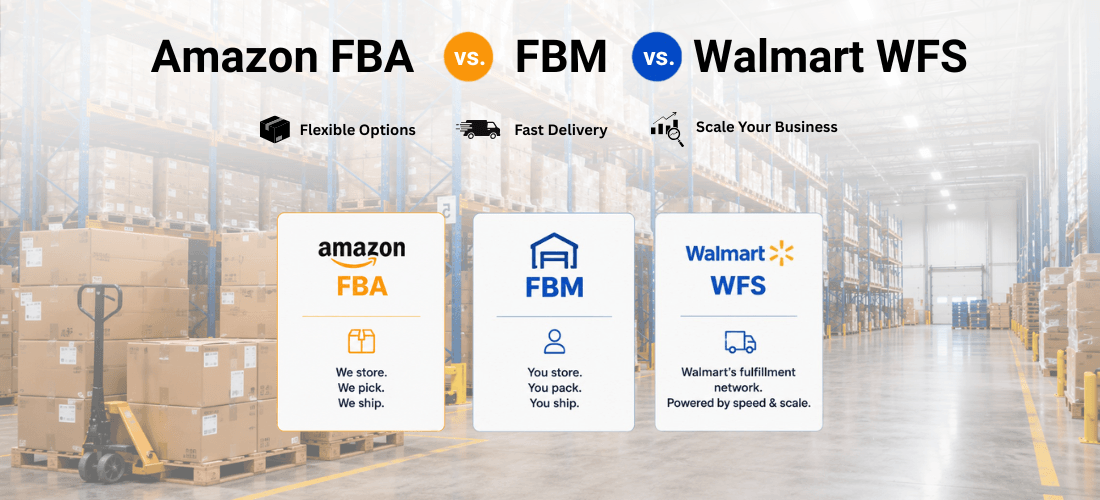
Fulfillment Showdown: Amazon FBA vs. FBM vs. Walmart WFS

Choosing between amazon fbm vs fba fulfillment is no longer just about convenience; it’s a strategic calculation of your brand’s survival. In 2026, Amazon’s 3.5% fuel surcharge and peak storage fees of $2.40 per cubic foot have transformed FBA into a high-stakes expense. High-margin brands are pivoting back to FBM to regain control over their bottom line and avoid the aggressive low-inventory-level fees that trigger when stock drops below 28 days. While Amazon remains the giant, Walmart WFS is emerging as a powerful contender by offering a simpler fee structure with no monthly subscription costs.

Fee Structures and Profit Margins

Amazon’s aged inventory penalties now kick in at 181 days, forcing sellers to move products faster or pay the price. This makes "dead inventory" a lethal profit killer for slower-moving SKUs. Recent omnichannel supply chain research highlights that inventory flow is the new currency of ecommerce. Walmart WFS offers a compelling alternative with storage rates holding steady at $0.75 during standard months, providing a more predictable cost model for brands looking to diversify. If you’re tired of complex surcharges, switching to a professional order fulfillment services provider can help you bypass these platform-specific traps.

Shipping Speed and Reliability

Organic rank lives or dies by the 2-day delivery promise. Amazon FBA is the gold standard for speed, but Walmart WFS is catching up with significantly less competition for that coveted delivery badge. To win on either platform, you must avoid the dreaded inbound defect fees, which can now reach $5.72 per unit on Amazon for mislabeled items. Utilizing an Amazon FBA prep center ensures your shipments meet strict 2026 compliance standards before they even hit the warehouse floor. This precision prevents rejected shipments and keeps your brand’s performance metrics in the green. Don’t let logistical errors stall your momentum; integrate a seamless fulfillment strategy that prioritizes accuracy and speed.

Winning the Retail War: Building a Scalable Multichannel Strategy

Success in 2026 requires more than just picking a side in the amazon fbm vs fba fulfillment debate. It’s about diversification. Relying solely on one platform leaves your brand vulnerable to sudden fee hikes or algorithm shifts. By expanding across Amazon, Walmart, and Shopify, you reduce platform risk and capture growth wherever your customers shop. Leading brands are using these to track their performance against the competition and stay ahead of the curve. Scaling without the stress means moving beyond the limitations of platform-specific silos.

Diversification as a Growth Lever

Stop splitting your stock into fragmented piles. You can use a single, unified pool of inventory to fulfill orders across every channel simultaneously. This is the core of modern multichannel fulfillment services. Whether it’s an Amazon FBM order, a Walmart sale, or a trending TikTok Shop purchase, your logistics must be seamless. This approach prevents overstocking and ensures your capital isn’t tied up in redundant inventory sitting in multiple warehouses. It’s the most efficient way to maintain agility during volatile peak seasons.

How Boost3PL Elevates Your Brand

Boost3PL acts as your high-performance strategic ally in the digital economy. Our technology offers seamless API integration that syncs your orders and inventory in real-time across all platforms. This level of automation is essential for maintaining the high performance standards required to win the Buy Box. Our pick and pack fulfillment processes are built for speed and precision, ensuring every package reflects your brand’s reputation for excellence. By optimizing your 3PL warehouse services, you gain a national reach that rivals the biggest players in the industry. We handle the logistical heavy lifting so you can focus on creative growth. Let’s boost your brand’s potential today.

Dominate the 2026 Retail Landscape

The battle between Amazon and Walmart isn’t about choosing a single winner. It’s about positioning your brand to thrive across every available channel. We’ve analyzed how shifting fees and the amazon fbm vs fba fulfillment debate impact your bottom line. Success now depends on your ability to remain agile, avoiding platform lock-in while maintaining elite delivery standards. You don’t have to navigate rising storage costs or complex inbound requirements alone. The right strategy turns logistical chaos into a competitive advantage.

Boost3PL acts as your high-performance strategic ally. We provide an expert Amazon FBA Prep Center and seamless API integrations for both Walmart and Amazon to keep your inventory in sync in real-time. Our nationwide US fulfillment coverage ensures your customers receive their orders with the speed they expect, regardless of the platform. Boost your brand’s growth with seamless multichannel fulfillment and reclaim your focus on strategic expansion. Your brand’s potential is limitless when your logistics are organized, fast, and reliable. Let’s scale your brand and win the retail war together.

Frequently Asked Questions

Is it better to sell on Amazon or Walmart in 2026?

Selling on both platforms is the only way to maximize your brand’s reach in 2026. Amazon offers the highest volume with its 37.6% market share, but Walmart’s 27.2% growth rate provides a faster path to visibility in a less saturated environment. Smart founders don’t choose; they integrate both to capture every segment of the 21.8% of retail purchases happening online this year. Diversification protects your brand from platform specific risks and fee hikes.

Can I use Amazon FBA to fulfill my Walmart orders?

You can use Amazon Multi-Channel Fulfillment (MCF), but Walmart strictly prohibits Amazon-branded packaging. Violating this policy can lead to immediate account suspension on Walmart Marketplace. A seamless 3PL partner uses neutral packaging to fulfill orders for both platforms simultaneously. This protects your brand’s standing on Walmart+ while you leverage Amazon’s massive reach. It’s the most reliable way to scale without platform friction.

How do Walmart Fulfillment Services (WFS) fees compare to Amazon FBA?

WFS fees are generally more predictable and often lower for standard items. Standard storage for WFS is $0.75 per cubic foot, while Amazon FBA charges $0.78 and adds a 3.5% fuel surcharge as of April 2026. During the peak season, Amazon’s storage fee jumps to $2.40 per cubic foot. Walmart’s lack of a monthly subscription fee makes it a highly cost effective alternative for brands focused on maintaining healthy margins.

What are the main requirements for selling on Walmart Marketplace?

Walmart is a curated marketplace that demands high performance and a proven track record. You must maintain a Negative Feedback Rate of 2% or less and provide a valid US Business Tax ID. They officially enforced new metrics in April 2026, including strict Return Rates and Item Not Received thresholds. They prioritize established brands that can demonstrate reliable fulfillment and high quality customer service standards.

How does an Amazon 3PL partner help with FBA prep and compliance?

A professional 3PL partner acts as your guardian against Amazon’s rising inbound defect fees. These penalties now range from $0.32 to $5.72 per unit for simple labeling or placement errors. We handle the precise kitting and labeling required to navigate the amazon fbm vs fba fulfillment landscape without losing your profits to avoidable fines. This ensures your inventory is organized, compliant, and ready for immediate sale upon arrival at the fulfillment center.

Which platform has a better return policy for sellers in 2026?

Walmart offers superior return flexibility through its massive physical store network. Their omnichannel approach allows customers to return online orders at local stores, which reduces the logistical burden on your brand. Conversely, Amazon has tightened its requirements for 2026. FBM sellers must now provide prepaid return labels for every item regardless of value. This makes Walmart a more seller friendly environment for managing the inherent costs of customer returns.

Amazon FBM Fulfillment: The 2026 Strategic Guide for Scaling Brands

The most profitable Amazon brands in 2026 aren’t waiting 14 days for FBA check-in times. They’re taking back their logistics. Relying solely on Amazon’s infrastructure has become a bottleneck for rapid growth. With FBA storage fees increasing by an average of 20% year-over-year since 2023, the shift toward amazon fbm fulfillment is no longer a backup plan; it’s a competitive necessity. You’ve likely felt the sting of generic brown boxes diluting your hard-earned brand identity. You’ve definitely seen those inventory "dark periods" where products sit in a warehouse but remain unpurchasable for weeks.

We agree that your brand deserves better than a one-size-fits-all shipping solution that eats your margins. You want to see your logo on every box and your products in customers’ hands without the FBA surcharge. This guide will show you how to master the mechanics of Merchant Fulfillment to regain total control over your customer experience. You’ll learn the exact strategies to boost your margins by up to 15% by cutting unnecessary storage surcharges. We’ll walk through the seamless integration of high-tech logistics that turns your shipping department into a high-performance growth engine, ensuring you never lose another day of sales.

Key Takeaways

  • Master the core mechanics of merchant-led logistics to regain total control over your inventory and shipping speed.
  • Analyze the 2026 fee landscape to see how flat-rate 3PL efficiencies can significantly outperform FBA’s per-unit costs.
  • Scale your operations seamlessly by integrating a strategic amazon fbm fulfillment model that eliminates generic packaging and elevates your brand.
  • Boost your delivery performance using tech-enabled warehousing and real-time inventory management to prevent overselling.
  • Discover how to leverage professional pick-and-pack automation to focus on high-level growth while your logistics partner handles the heavy lifting.

Understanding Amazon FBM Fulfillment: The Strategic Alternative to FBA

Amazon FBM fulfillment is your brand’s direct path to total logistical control. While FBA puts Amazon in the driver’s seat, FBM (Fulfilled by Merchant) keeps you in charge of storage, packing, and shipping. By 2026, the most successful brands have evolved into Hybrid Sellers. They don’t just pick one method. They leverage both to maximize market reach and protect against inventory caps. Industry data from 2024 shows that 33% of top sellers already use a combination of both methods to stay agile during peak seasons.

FBM offers immediate access to your physical inventory. You won’t wait weeks for a crowded fulfillment center to check in your shipment. You launch products faster. This agility is vital within the Amazon Marketplace, where speed often determines who wins the Buy Box. When you control the warehouse, you control the customer experience. You can include custom inserts or specialized packaging that FBA simply won’t handle. It’s about moving at the speed of your customers, not the speed of a massive bureaucracy.

How FBM Works for Modern Ecommerce Brands

The process is a high-speed relay that starts the moment a customer clicks buy. First, Amazon sends an order notification to your integrated system. Second, your inventory levels sync across every sales channel to prevent overselling. Third, the warehouse team initiates professional pick and pack fulfillment to get the order ready. Finally, automated tracking updates post to the Merchant Fulfilled Network (MFN) so the customer stays informed. This ensures you meet Amazon’s strict shipping requirements without lifting a finger.

This streamlined flow protects your seller account health. Professional fulfillment is the backbone of this strategy. It ensures your on-time delivery rate stays above the 97% threshold required for elite performance. Boost your brand’s reliability by moving away from rigid, slow-moving systems. Choose a seamless integration that scales with your ambition. Your growth is the primary metric of success, and FBM is the tool that makes that growth permanent. It’s time to take control of your logistics and elevate your brand’s reputation.

Amazon FBM vs. FBA: A Comparison Framework for 2026

Choosing between FBA and FBM is no longer a binary decision; it’s a margin-optimization strategy. While FBA offers convenience, the Forbes Advisor guide to selling on Amazon highlights how fulfillment costs fluctuate based on size and weight. In 2026, FBA fees have increased by an average of 5% across most standard categories. Amazon FBM fulfillment allows brands to bypass these per-unit penalties. When a customer orders three items, FBA charges three full fulfillment fees. A 3PL partner typically charges one base pick fee and a small incremental cost for additional items; this often saves brands 25% or more on multi-unit shipments.

The Brand Experience gap is the second critical factor. FBA locks your product in a generic brown box. FBM gives you total control. You can utilize custom packaging, branded inserts, and specialized kitting to elevate the unboxing experience. This builds long-term loyalty that a generic Amazon box cannot match. Additionally, FBM eliminates the "FBA black hole" during peak seasons. In Q4 2025, some sellers waited 21 days for FBA inventory check-ins. A strategic 3PL keeps your inventory live and shipping within 24 hours of arrival.

When to Choose FBM Over FBA

FBM is the superior choice for oversized or heavy goods that trigger FBA’s aggressive surcharges. It’s also vital for products requiring precision, such as expiration-date tracking or climate-controlled storage. You can manage these complexities through specialized 3PL warehouse services. Use FBM as a fail-safe to keep your listings active when FBA stock runs dry. You can optimize your inventory management to ensure you never miss a sale due to warehouse delays.

Winning the Buy Box with Seller Fulfilled Prime (SFP)

You don’t need FBA to keep the Prime badge. The 2026 SFP requirements demand a 99% on-time shipping rate and 1-day delivery for at least 20% of customer views. A high-performance 3PL partner enables these speeds without the restrictive storage limits of Amazon’s warehouses. This setup gives you the Prime badge while maintaining full control over your physical stock. Strategic amazon fbm fulfillment ensures your brand stays agile and profitable regardless of Amazon’s internal policy shifts.

Amazon FBM

Scale Your Growth with Seamless FBM Execution

You didn’t build your brand to spend your days tape-gunning boxes. You built it to scale. Boost your operational efficiency by offloading the logistical heavy lifting to a tech-enabled 3PL partner. High-performance logistics is no longer a back-office function; it is a strategic lever for growth. Professional FBM fulfillment transforms logistics from a cost center into a brand-building asset. This transition allows you to reclaim your time for product innovation while experts manage the 24-hour shipping windows required for success.

Real-time visibility is the heartbeat of a modern supply chain. Without precise warehousing and inventory management, you risk the dreaded overselling trap. Amazon’s algorithm penalizes stockouts and late shipments with brutal efficiency. Our systems sync inventory levels every 60 seconds across all platforms. This ensures your amazon fbm fulfillment strategy remains protected from account health triggers and negative customer feedback.

Integrating Amazon FBM with Shopify and TikTok Shop

Scalability thrives on simplicity. Stop fragmenting your stock across multiple warehouses and software platforms. One unified pool of inventory is the ultimate hack for rapid growth. It allows you to leverage your Amazon stock to fulfill orders from TikTok Shop and your own website instantly. This creates a consistent, premium unboxing experience that builds brand equity. Brands looking to sell everywhere without operational chaos should explore multichannel fulfillment services to unify their inventory across every sales channel. Explore these Shopify fulfillment services to sync your storefront and eliminate manual data entry errors forever.

The Boost3PL Advantage for Amazon Sellers

Amazon shipping SLAs are notoriously strict, but we thrive under pressure. Our high-performance team manages the complexity of amazon fbm fulfillment so you don’t have to. We provide:

  • Rapid Integration: Connect your Amazon Seller Central to our warehouse technology in seconds.

  • SLA Compliance: We maintain a 99.9 percent on-time shipping rate to keep your account in good standing.

  • Strategic Partnership: We act as a tech-savvy ally that handles the chaos of peak seasons with calm precision.

The result is a friction-free operation that grows as fast as your ambition. We provide the infrastructure; you provide the vision. Let’s scale together.

Take Control of Your Growth Strategy

Mastering amazon fbm fulfillment in 2026 is the ultimate move for brands ready to reclaim their margins and own their customer data. You’ve seen how the FBM vs. FBA framework favors those who prioritize flexibility and direct control over their logistics. Scaling your growth doesn’t have to be a nightmare when you have the right tech and expertise in your corner. It’s about turning your supply chain into a competitive advantage that fuels your expansion.

Boost3PL acts as your high-performance strategic ally. Our entrepreneur-led logistics experts maintain a 99.9% order accuracy rate to ensure your customers stay happy and your brand’s reputation remains spotless. With real-time multi-channel integration, your inventory stays perfectly synced across every sales channel you operate. We handle the heavy lifting so you can focus on building your empire. Stop letting fulfillment bottlenecks hold you back.

Boost your Amazon margins with seamless FBM fulfillment today!

Your brand deserves a partner that cares as much about your success as you do. Let’s build something incredible together.

Frequently Asked Questions

Is Amazon FBM cheaper than FBA in 2026?

Amazon FBM is often more cost-effective than FBA for brands shipping multi-unit orders, oversized goods, or items requiring custom branding. While FBA fulfillment fees increased by an average of 5.2% in 2025, FBM allows you to bypass peak season storage surcharges. You gain direct control over your margins by optimizing your own carrier contracts. This strategy works best for items exceeding 18-inch dimensions where Amazon’s cubic tier pricing becomes restrictive.

Can I still have the Prime badge with FBM?

You can earn the Prime badge through the Seller Fulfilled Prime (SFP) program by meeting Amazon’s strict 99% on-time shipping requirement. Success in SFP requires a 1-day or 2-day delivery promise that matches FBA speed. Partnering with a tech-forward 3PL ensures your amazon fbm fulfillment process hits these metrics consistently. We provide the real-time data visibility needed to maintain your Prime status while keeping your brand front and center.

How do returns work with Amazon FBM?

You manage the entire returns lifecycle directly, which allows your brand to recover up to 30% more product value compared to FBA’s automated disposal systems. Instead of letting Amazon mark items as unsellable, you inspect every return at your facility or partner warehouse. This hands-on approach reduces waste and protects your bottom line. You decide whether to refurbish, restock, or liquidate based on concrete inspection data and your specific brand standards.

Do I need a special warehouse for FBM?

You don’t need a dedicated facility to start, but scaling a brand requires a professional fba prep center or 3PL to meet Amazon’s performance standards. High-volume sellers often face a 4% late shipment rate threshold that’s nearly impossible to manage from a home office. Outsourcing to a seamless logistics partner provides the automated kitting and rapid sorting needed to boost your growth. Professional warehousing ensures your amazon fbm fulfillment strategy remains competitive.