

Schedule a Call

Tag: ecommerce operations

In-house fulfillment vs outsourcing: compare the real costs

Outsourcing isn’t automatically cheaper: businesses with fewer than 50-100 orders per month often find in-house fulfillment more economical. A useful in-house fulfillment vs outsourcing cost analysis compares the full cost of each model, not just warehouse wages against a 3PL’s fees. The right choice depends on order volume, existing infrastructure, shipping needs, and how much flexibility your operation requires.

It’s easy to see the appeal of handling orders yourself: you control inventory, packing, and the customer experience. But rent, utilities, equipment, software, staffing, training, shipping, and returns can add up beyond the obvious labor costs. This article breaks down those hidden expenses, compares them with common outsourced fulfillment charges, and explains how packaging, returns, and added services affect the equation. You’ll also get a practical decision guide for weighing in-house, 3PL, and hybrid fulfillment against your business’s needs.

Key Takeaways

  • Build a full in-house cost picture by counting space, equipment, software, staffing, training, and the time fulfillment takes from core business work.
  • Compare fixed operating expenses with the variable charges a 3PL may apply for storage, receiving, picking, packing, and returns.
  • Assess shipping, packaging, returns, and special handling together to see how each affects your true cost per order and customer experience.
  • Use order volume, existing warehouse resources, and seasonal demand to decide whether in-house, outsourced, or hybrid fulfillment best fits your operation.

Shipping, returns, packaging, and value-added services

A 3PL may access carrier discounts through its shipping volume; in-house rates depend on your own carrier arrangements and parcel mix. Product dimensions, weight, seasonal order volume, and return handling all affect fulfillment costs, while service requirements shape the customer experience.

In-House and 3PL Shipping Costs

In-house fulfillment relies on your own warehouse, shipping setup, and carrier accounts. That gives you direct control over dispatch and branded packaging, but your rates reflect your own parcel volume and reach. A 3PL can combine shipments across clients to negotiate carrier discounts and offer multiple shipping options. Its network may also position inventory closer to customers, supporting faster delivery across a wider geographic area.

Product and Returns Cost Factors

Large or heavy products take more space and can cost more to ship than compact items. Seasonal peaks can increase staffing needs and strain in-house capacity; a 3PL can adjust fulfillment capacity as demand changes. Returns add inspection, sorting, and restocking work. Compare those steps alongside outbound shipping, especially for products with frequent returns or packaging that needs special handling.

OptionCost structureShipping and customer experience
In-houseWarehouse and labor resourcesDirect control over speed and packaging
3PLVariable service chargesCarrier options and broader reach
HybridCosts split by product lineKeep custom orders in-house; outsource standard items

Choose by comparing your parcel mix, peak-season capacity, return workload, and packaging needs against the value of carrier access and flexible reach.

What hidden costs should businesses consider when managing in-house fulfillment?

A useful in-house fulfillment vs outsourcing cost analysis compares fixed expenses with variable provider charges. Include staffing, technology, facilities, and the value of operational control.

Fixed In-House and Variable 3PL Costs

In-house operations have fixed costs, such as salaries, utilities, and maintenance, even when order volume drops. A third-party logistics provider’s charges can vary with order volume, storage, and services used. Providers can spread infrastructure and operating costs across clients, while an in-house team offers more direct control over fulfillment. Compare both models in slow periods and at peak demand to understand how capacity affects total costs.

Warehouse, Labor, and Technology Costs

Add equipment, software, training, utilities, and facility maintenance to the estimate. Warehouse rent can rise by as much as 10%, while warehouse turnover ranges from 30 to 50% per year. Each departure can mean recruitment and training work, plus time spent replacing operational knowledge. These expenses continue even when delays or low order volume reduce output.

Cost Per Order and Total Ownership

Calculate cost per order by adding fulfillment expenses for a chosen period, then dividing by orders shipped. Include labor, rent, utilities, technology, packaging, and management time. For total ownership cost, add startup investments and recurring expenses, then compare them with variable 3PL charges. A careful in-house fulfillment vs outsourcing cost analysis also accounts for order volume and service needs. Counting labor alone can underestimate in-house fulfillment cost per order by up to 50%, obscuring the true cost of each model.

Outsourced fulfillment through third-party logistics providers

A third-party logistics provider can receive and store inventory, process ecommerce orders, and support fulfillment across sales channels. Instead of managing warehouse operations yourself, you pay for storage, order processing, and selected services. This can provide flexible capacity as demand rises or falls.

Break-even depends on your existing infrastructure and the provider’s pricing. Outsourcing typically reaches break-even at 200 to 500 orders monthly, depending on operating conditions and 3PL pricing. Below that range, per-order charges and storage can outweigh savings from avoiding fixed overhead. At higher volumes, shared facilities and carrier relationships can support growth without adding internal warehouse resources.

Software integration matters. Connect sales channels, inventory records, and order data before shifting fulfillment. Then map the flow: inventory arrives, orders sync, items are picked and packed, and returns are processed. Setup typically takes 2-6 weeks. Use that period to establish how stock discrepancies, order errors, and returns move between your team and the provider.

Outsourcing also changes control and risk. Your team can focus on product development and marketing, while the provider handles warehouse execution. But delays or system failures can affect order processing and customer satisfaction. Many 3PL contracts include termination clauses requiring 30-90 days’ notice, so include the exit timeline in your transition plan.

Compare proposals using the same order volume, storage requirements, service expectations, and returns assumptions. Include onboarding, integration, receiving, and any minimum charges in the total. A pilot can help assess order accuracy, software workflows, and peak-demand performance before transferring more inventory. Choose a provider whose operating model fits your supply chain, not simply the one with the lowest quoted fee.

Boost3PL: 3PL fulfillment services

Boost3PL provides 3PL fulfillment services and 3PL warehouse services for ecommerce businesses weighing operational costs against the demands of growth. If managing storage and order fulfillment internally is consuming resources your team needs elsewhere, outsourcing can shift fulfillment operations to a third-party logistics company.

Use your cost comparison to clarify where support would make a difference: warehouse capacity, fulfillment workload, or the ability to scale with demand. Boost3PL’s ecommerce fulfillment services give growing brands an option to explore when their current setup no longer fits their operational priorities.

Contact Boost3PL or visit Boost3PL online to discuss your fulfillment needs.

Make Your Next Fulfillment Move With Confidence

Your fulfillment model should support the business you’re building, not lock you into yesterday’s operating choices. Use your in-house fulfillment vs outsourcing cost analysis to identify which tasks your team should own, which could move to a partner, and what success should look like for your customers and operations.

For brands ready to explore outsourcing, Boost3PL offers 3PL fulfillment services and ecommerce fulfillment services as a third-party logistics company. Start with the operational challenge you want to solve, such as freeing up internal capacity or preparing for growth. A focused discussion can help clarify whether outside fulfillment fits your priorities.

Discuss fulfillment with Boost3PL and take the next step toward an operation built for your goals.

Frequently Asked Questions

Self-fulfillment and outsourced fulfillment: What is the difference?

With self-fulfillment, your team manages warehouse work and dispatch; with outsourced fulfillment, a logistics provider handles those tasks. The choice also shapes daily decisions: an in-house team manages exceptions directly, while an outsourced operation follows agreed processes. Before deciding, define who will handle inventory discrepancies and customer order changes.

At what order volume does outsourced fulfillment typically become economically viable in the United States?

In the United States, outsourced fulfillment typically reaches break-even at 200 to 500 orders per month, depending on operating conditions and 3PL pricing. Treat that as a comparison range, not a universal cutoff. Product mix, storage needs, seasonality, and existing warehouse resources affect the outcome. Compare both models using the same order pattern, including peak and slower periods.

How can a business decide if switching from in-house fulfillment to a 3PL provider is more cost-effective?

Compare both setups using the same forecast, sales channels, and service expectations. Account for transition work, including moving inventory, connecting order systems, and training staff on new processes. Then assess whether the change would free resources for higher-priority work. Ask whether the new setup can handle expected demand without adding internal capacity you would otherwise need.

What should companies consider when selecting a 3PL provider to support their growth and operations?

Choose a provider whose capabilities match your products, sales channels, and projected demand. Map how inventory updates, order edits, damaged goods, and returns will be handled. Assess reporting access, communication workflows, and contract terms, too. Multichannel sellers need coordinated inventory and order processes across platforms as the business expands.

When Should Your Business Consider Outsourcing Logistics?

Consider outsourcing when fulfillment regularly takes time away from product development, marketing, or customer support. It may also help when backlogs recur, warehouse space is limited, or demand swings are difficult to staff for internally. Identify the operational bottleneck first, then compare outsourcing with improving your current process. This keeps the decision focused on business priorities, not volume alone.
Calculating Ecommerce Fulfillment Costs: The 2026 Margin-First Guide

Your 2026 growth strategy is only as strong as your last fulfillment audit. With FedEx announcing a 5.9% average freight rate increase and Amazon implementing a 3.5% fuel and logistics surcharge, your margins are facing an unprecedented squeeze. You likely feel the weight of complex invoices and surprise peak-season fees that make forecasting feel like guesswork. It’s frustrating to build a brand only to see your profits eroded by hidden operational costs that you didn’t see coming.

We’re here to turn that around. This guide gives you the tools for calculating ecommerce fulfillment costs with total clarity, ensuring every shipment supports your expansion rather than draining your bank account. You’ll learn how to protect your margins while scaling across new platforms like TikTok Shop. We’ll provide a clear formula to audit your existing spend, a framework to evaluate 3PL quotes, and a roadmap to peak profitability through logistics efficiency. It’s time to stop reacting to invoices and start driving your brand’s financial future with precision and confidence.

Key Takeaways

  • Identify every line item beyond the standard invoice to capture your total fulfillment spend per order.
  • Master our 3-step framework for calculating ecommerce fulfillment costs by auditing a 90-day window of logistics data.
  • Uncover hidden drains on your profitability by factoring in invisible costs like insurance and warehouse equipment.
  • Evaluate the strategic shift from in-house operations to professional 3PL warehouse services to unlock zone skipping and lower shipping spend.
  • Transform your logistics from a mystery expense into a predictable engine for margin protection and brand scaling.

Beyond the Invoice: The Core Components of Ecommerce Fulfillment Costs

Stop looking at your shipping bills as the final word on your profitability. True fulfillment cost per order captures the entire lifecycle of a product. This lifecycle starts the moment a shipment hits the dock and ends only when it reaches the customer’s doorstep. It’s a comprehensive metric that includes every touchpoint in the Order fulfillment process. When you start calculating ecommerce fulfillment costs, you must look beyond the base shipping rate to see the full picture.

Modern 3PL environments split costs into fixed overhead and variable expenses. Fixed costs include monthly storage minimums or software access fees that remain steady. Variable expenses fluctuate with your sales velocity, covering labor for picking, packing, and shipping. This holistic view is the only way to master calculating ecommerce fulfillment costs without missing the small details that erode your margins. Dimensional weight (DIM) is a critical factor in 2026. Carriers calculate rates based on the space a package occupies, not just its weight. If your boxes are too big, you are paying for air. Silent killers like excessive packaging waste and inefficient kitting processes can drain your bank account before you even realize there’s a problem.

Operational Expenses: Labor, Storage, and Materials

Pick and pack fees are the heartbeat of your daily operations. However, your accuracy rate is the real cost driver. A 1% error rate leads to expensive returns and lost customer trust. For storage, hero-product brands thrive on pallet pricing, while high-SKU brands need the granularity of bin storage to keep overhead lean. In the US market, the shift toward sustainable packaging is no longer optional. While eco-friendly materials may have higher upfront costs, they reduce long-term brand risk and align with modern consumer expectations.

The Technology & Integration Layer

Technology isn’t a luxury; it’s a cost-saving necessity. Seamless API integrations for Shopify and TikTok Shop eliminate manual data entry errors and speed up processing times. Your account management fees should provide proactive strategy, not just status updates. Leveraging professional warehousing inventory management services reduces tech friction and ensures your data remains clean across every sales channel.

Calculating

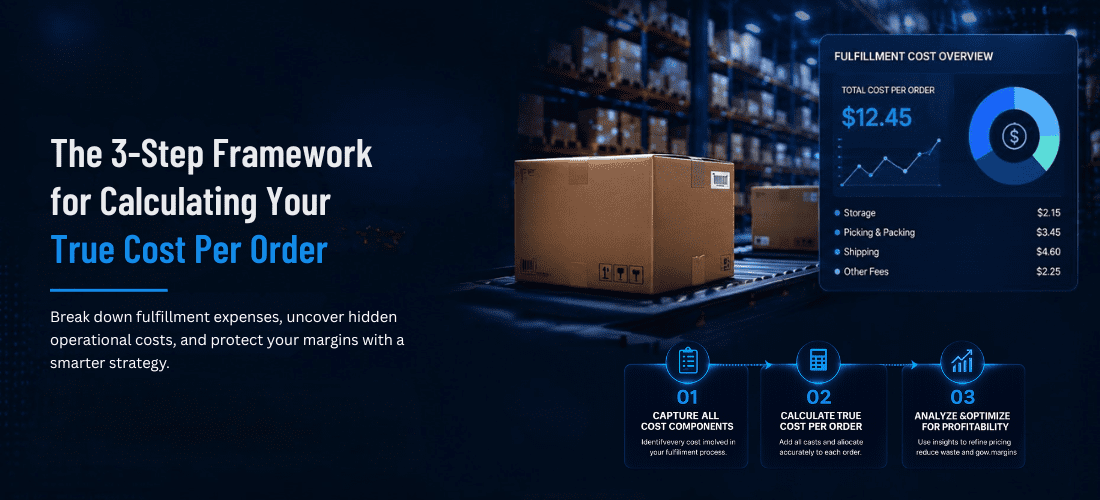
The 3-Step Framework for Calculating Your True Cost Per Order

Mastering your margins requires a move away from simple division. Most brands fail because they only look at a single month of data. This creates a skewed perspective that ignores the peaks and valleys of high-growth commerce. To get a real grip on calculating ecommerce fulfillment costs, you need a burdened view of every dollar spent to move a product from your manufacturer to your customer.

Step 1: Aggregate your logistics data. Gather every expense from the last 90 days. This includes freight-in, storage, pick and pack fees, and shipping labels. A 90-day window is the "gold standard" because it smooths out weekly anomalies while staying relevant to current carrier rates. However, for true annual forecasting, you should eventually compare this to a 12-month average to account for Q4 surcharges and seasonal dips.

Step 2: Identify the "invisible" layers. Your CPO isn’t just labor and postage. Factor in your WMS software subscriptions, warehouse insurance, and any specialized equipment like label printers or scanners. These are operational necessities that must be amortized across your total order volume to understand your true break-even point. For many growing brands, partnering with Financial Foothold for outsourced accounting ensures these complex overhead costs are tracked with precision.

Step 3: Apply the Cost Per Order (CPO) formula. Take your total logistics spend (Direct + Invisible) and divide it by your total shipped orders. Adjust this figure for seasonality by adding a buffer for peak-season surcharges, which can often spike your variable costs by 10% or more during November and December. Partnering with a professional ecommerce 3PL provider can simplify this calculation by consolidating these variables into a single, transparent dashboard.

The Multichannel Fulfillment Variance

Selling on TikTok Shop, Amazon, and Shopify simultaneously creates a "multichannel tax." Amazon has rigid prep requirements that differ from direct-to-consumer TikTok orders. You must weight your costs by platform. For example, your spend on Amazon FBA prep and multi-channel services may be higher per unit than Shopify orders, but the volume might justify the margin hit. Calculate a platform-specific CPO to see which channel is actually driving your profit.

Factoring in the "Return Tax"

Returns are a silent profit killer. With 2026 projections suggesting 15.8% of retail sales will be returned, reverse logistics must be part of your math. A 10% return rate can increase your overall CPO by up to 15% when you account for return shipping, labor for inspection, and potential disposal fees. Don’t let these costs hide in your P&L; treat every return as a variable fulfillment expense to keep your calculating ecommerce fulfillment costs accurate and actionable.

Strategic Optimization: Reducing Costs Without Sacrificing Speed

Crunching the numbers is only the first step. True mastery comes from using that data to re-engineer your operations for maximum profit. When calculating ecommerce fulfillment costs, many founders realize they’re trapped in the "founder’s trap." Every hour you spend managing tape, boxes, and warehouse staff is an hour lost on product development or high-level marketing. In-house fulfillment often looks cheaper on a basic spreadsheet, but it carries a massive opportunity cost that stunts your brand’s trajectory.

Switching to a professional ecommerce logistics provider unlocks advanced strategies like zone skipping. By placing your inventory closer to your customers in a strategic fulfillment center, you bypass expensive long-haul shipping zones. This move alone can slash your shipping spend and significantly increase delivery speed. Automation also plays a critical role. The tipping point for ROI happens when your manual labor costs exceed the cost of integrated tech solutions. Boost3PL eliminates this complexity tax, allowing you to scale without the operational friction that slows down your competitors.

Scaling with a High-Performance Strategic Ally

Professional pick and pack fulfillment services leverage massive scale to reduce your per-order labor costs. We provide a frictionless operation that protects your brand reputation and boosts customer LTV. "In 2026, the most expensive fulfillment strategy is the one that slows your ability to scale." Don’t let outdated processes become the bottleneck for your ambition. High-growth brands require a partner that moves as fast as the modern digital economy.

Next Steps: From Calculation to Execution

Take immediate action to protect your margins. Audit your current provider using the 90-day framework we established earlier. Identify the top three leaks in your pipeline, such as excessive packaging waste or slow intake times. Once you’ve identified these gaps, reach out for a strategy session. We’ll show you how Boost3PL optimizes these variables while calculating ecommerce fulfillment costs with total transparency. Turn your logistics from a cost center into a high-speed growth engine today.

Take Control of Your Brand’s Financial Future

Mastering the math of your supply chain is the ultimate competitive advantage. You’ve learned that calculating ecommerce fulfillment costs requires a deep dive into 90-day data sets and a keen eye for "invisible" overhead. By optimizing for dimensional weight and leveraging zone-skipping strategies, you transform logistics from a margin drain into a scalable engine. Every dollar you reclaim through efficiency is a dollar you can reinvest in your brand’s creative vision. It’s time to stop reacting to surprise surcharges and start driving your expansion with data-backed precision.

Stop letting operational chaos dictate your growth. We’re here to act as your high-performance strategic ally. Boost3PL provides specialized TikTok Shop and Shopify integrations alongside a professional Amazon FBA Prep Center to ensure your brand remains organized and fast. We thrive on handling the heavy lifting so you can focus on creative expansion. Our results-oriented partnership is built specifically for high-growth brands that value technological sophistication and operational excellence.

Ready to optimize your margins? Get a frictionless fulfillment quote from Boost3PL today.

Your success is the primary metric of our performance. Let’s build something remarkable together.

Frequently Asked Questions

How much should fulfillment cost as a percentage of revenue?

Fulfillment costs typically represent between 8% and 15% of a brand’s average order value. This range includes every expense from initial receiving and storage to final mile delivery. While luxury brands with high price points might see a lower percentage, brands selling heavy or low-cost items often find their logistics spend sits at the higher end of this bracket. Keeping your costs within this range is vital for maintaining healthy margins as you scale.

What is the average cost of pick and pack fulfillment in the USA?

Pick and pack fulfillment costs depend on your order volume, item count per box, and the complexity of your kitting requirements. Most providers structure their pricing with a base order fee followed by a smaller charge for each additional item picked. Brands with high-velocity "hero products" usually see lower per-unit costs than those managing thousands of individual SKUs. Focus on finding a partner that balances speed with high accuracy to avoid the hidden costs of shipping errors.

Is it cheaper to use Amazon FBA or a third-party logistics company?

The cost effectiveness of Amazon FBA versus a third party logistics company hinges on your sales channels and inventory turnover. Amazon FBA is built for speed within their ecosystem, but their peak-season storage hikes and surcharges can be aggressive. A dedicated ecommerce 3PL provider often offers more predictable pricing for multichannel brands. This is especially true if you’re growing on Shopify or TikTok Shop where brand control and custom packaging are priorities.

What are the most common hidden fees in 3PL contracts?

Common hidden fees include account management charges, API integration fees, and unexpected surcharges for receiving non-compliant shipments. Many founders miss these "silent killers" when calculating ecommerce fulfillment costs during the initial vetting process. You should also watch for dimensional weight adjustments and peak-season fuel surcharges that aren’t always highlighted in a basic quote. Demand a transparent, fully burdened cost model to ensure your brand’s profitability remains protected year-round.