

Schedule a Call

Tag: profit margins

Forecasting 3PL Costs: 2026 Guide for Ecommerce Brands

Your 2026 growth strategy is only as strong as your ability to master forecasting 3pl costs before the first order even ships. You’ve likely felt the sting of an invoice filled with “nickel-and-diming” fees or watched peak-season profits vanish into a black hole of hidden surcharges. It’s frustrating when shipping costs across different zones feel like a moving target and SKU-level storage calculations leave you guessing. You deserve a logistics partner that prioritizes your margin as much as your transit times.

We understand that uncertainty is the enemy of scale. This guide provides a data-driven framework to predict and optimize every dollar of your fulfillment spend. When you align with Boost3PL, you gain more than a warehouse; you gain a high-performance strategic ally dedicated to frictionless operations. We’ll show you how to build a clear line-item budget that protects your profit margins during the busiest months of the year. This walkthrough covers everything from complex storage math to shipping variables, giving you the confidence to dominate new channels like TikTok Shop or Amazon with total financial clarity.

Key Takeaways

  • Identify the “Big Three” drivers, storage volume, pick-and-pack complexity, and shipping zones, to eliminate budget surprises and protect your bottom line.
  • Master the process of forecasting 3pl costs by combining historical baseline data with precise growth multipliers for upcoming peak seasons.
  • Transition from reactive spending to proactive planning by leveraging predictive WMS analytics to optimize inventory placement and reduce transit costs.
  • Evaluate the financial impact of transaction-based pricing versus fixed monthly models to ensure your logistics budget scales efficiently with your volume.

Decoding the Variables: What Drives Your 3PL Cost Model?

Forecasting 3pl costs is the proactive calculation of fulfillment spend based on projected order volume and inventory velocity. To build an accurate budget, you must recognize that your total spend is a dynamic mix of fixed storage and variable transaction fees. Understanding What is Third-Party Logistics (3PL)? is the first step in identifying how these structures impact your cash flow. Your model relies on the “Big Three” drivers: storage volume, pick-and-pack complexity, and shipping zones. Master these variables, and you master your margins.

Don’t let SKU proliferation quietly erode your profits. High SKU counts often trigger storage minimums and management fees that eat into your profit margins, especially if inventory isn’t moving. By auditing your inventory velocity, you prevent slow-moving items from becoming a financial burden. Boost3PL acts as your high-performance strategic ally, helping you refine these variables to ensure every dollar spent drives immediate business growth.

Inbound and Storage Dynamics

When you are forecasting 3pl costs for the upcoming year, start at the loading dock. You need to factor in receiving fees, including drayage and unloading, as a front-end cost of inventory. Optimize your warehouse footprint by calculating costs based on pallet versus bin storage. Pallets offer bulk efficiency for deep inventory, while bins provide accessibility for high-velocity picks. Utilize professional warehousing and inventory management services to maintain expert oversight and eliminate wasted space in your storage model.

Multichannel Fulfillment and Shipping Volatility

Scaling into new channels adds layers of operational complexity. You must account for platform-specific requirements, such as TikTok Shop’s strict fulfillment SLAs, which can lead to penalties if your logistics aren’t synchronized. Your budget should also differentiate between D2C individual item picks and B2B pallet-level retail fulfillment. Leverage multichannel fulfillment services to see how syncing your sales channels stabilizes costs and provides a frictionless experience for your customers across every digital touchpoint.

The 3-Step Framework for Forecasting 3PL Costs in 2026

Stop leaving your margins to chance. Master the art of forecasting 3pl costs by implementing a rigorous, three-step framework that turns logistics from a black box into a predictable line item. This isn’t just about spreadsheets; it’s about building a financial moat around your brand.

First, aggregate your historical data to establish a solid baseline Cost Per Order (CPO). This number represents your true north. Second, apply growth multipliers to your projected order volume for upcoming sales events like BFCM or TikTok Shop promos. Don’t just plan for the average; plan for the surge. Finally, overlay carrier surcharges and DIM weight factors to prevent shipping budget blowouts. This proactive approach ensures your cash flow remains healthy even during the most aggressive scaling phases. If you want to see how these steps look in practice, partner with a strategic logistics ally today.

Volume Modeling and Growth Projections

Build a three-tier forecast, Conservative, Expected, and Aggressive, to stress-test your cash flow under different market conditions. If you plan on launching bundles or subscription boxes, you must include kitting and assembly time in your labor projections. Speed is a profit driver. Review our pick and pack fulfillment resources to understand how rapid processing affects your total labor spend. This level of detail separates the hobbyists from the high-growth founders who dominate their niche.

Accounting for Dimensional (DIM) Weight and Surcharges

Avoid the “DIM weight trap” where large, light packages cost as much as heavy ones. Carriers calculate fees based on the space your package occupies, not just its physical weight. Budget for seasonal peak surcharges that carriers implement in late Q4, as these can significantly impact your year-end profitability. Freight consolidation can lower per-unit shipping costs by 8-12% by maximizing trailer density and reducing individual carrier touches. Partnering with a tech-savvy ecommerce 3PL provider helps you navigate these variables with frictionless precision.

Scaling Smart: Optimizing Your Logistics Budget for Growth

Growth demands a shift from simply tracking expenses to actively optimizing your financial model. As your volume increases, you must evaluate whether transaction-based pricing or fixed monthly models serve your bottom line better. High-growth brands often find that fixed models provide more predictability, while transaction-based structures offer flexibility during experimental phases. Boost3PL acts as your strategic ally in this transition, turning complex logistics into a clear competitive advantage through frictionless integration across Shopify, Amazon, and TikTok Shop.

Successful forecasting 3pl costs involves more than looking at past invoices. It requires leveraging predictive analytics within your WMS to position inventory closer to your national customer base. By reducing the number of shipping zones your packages cross, you slash transit times and shipping spend simultaneously. This proactive approach ensures your logistics infrastructure supports your ambitions rather than limiting them.

Leveraging Tech for Predictive Savings

Utilize real-time data to identify high-velocity SKUs and move slow-moving inventory before it triggers expensive long-term storage fees. Our advanced WMS infrastructure allows you to implement rate shopping tools that automatically select the most cost-effective carrier for every unique zone. For a deeper breakdown of how different billing structures impact your margins, explore our guide on fulfillment center pricing. These tech-driven insights allow you to reclaim capital that would otherwise be lost to operational inefficiencies.

The Hybrid Advantage: Amazon FBA Prep and FBM

A sophisticated 2026 strategy often involves a hybrid approach to the Amazon ecosystem. You can forecast the cost-benefit of using a specialized Amazon FBA prep center to bypass Amazon’s increasingly high storage fees. By balancing FBA with Amazon FBM fulfillment, you maintain tighter control over your branding and shipping costs while keeping your Prime badge active. Check out our FBA prep center guide for strategic tips on outsourcing. This dual-threat model ensures your brand remains resilient and profitable across every sales channel.

Master Your Margins and Accelerate Growth

Predictability is the foundation of high-speed scaling. By mastering the variables that drive your logistics spend and implementing a data-driven framework, you transform fulfillment from a cost center into a strategic asset. You’ve learned how to establish a baseline Cost Per Order, navigate the “DIM weight trap,” and leverage hybrid models to maintain control over your branding. Mastering forecasting 3pl costs is the final step in protecting your profit margins while you dominate new digital channels.

Boost3PL is the high-performance strategic ally you need to eliminate operational chaos. We provide advanced WMS infrastructure for real-time cost tracking and dedicated Amazon FBA Prep and FBM support to ensure your brand stays agile. Our frictionless multichannel fulfillment integration allows you to sync Shopify, TikTok Shop, and Amazon effortlessly. Ready to scale without the surprise fees? Get a custom quote from Boost3PL today!

Stop guessing and start growing. Your brand’s reputation is in safe hands, and your financial future is clear. Let’s turn your 2026 expansion goals into a reality with logistics that work as hard as you do.

Frequently Asked Questions

How do I calculate the total cost of ownership for a 3PL?

Calculate your total cost of ownership by aggregating every line item on your invoice, including inbound receiving, monthly storage, pick-and-pack labor, and outbound shipping. You must also factor in administrative costs like account management or software integration fees. This holistic view ensures you aren’t just looking at the base rate, but the fully loaded cost of moving a product from the dock to the customer’s door. It’s about seeing the complete financial picture.

What are the most common hidden fees in 3PL pricing?

Hidden fees often appear as SKU maintenance charges, returns processing costs, or packaging material markups that aren’t explicitly highlighted in the initial quote. You might also encounter account minimums if your volume dips or unexpected surcharges for non-standard labeling. When you are forecasting 3pl costs, audit your contract for these line items to prevent budget overruns. Awareness of these variables protects your bottom line during aggressive scaling phases.

How does dimensional weight (DIM) affect my fulfillment budget?

Dimensional weight affects your budget by pricing shipments based on the space they occupy in a carrier’s vehicle. If you ship large, lightweight items, you’ll likely pay more than the actual weight suggests. Carriers use a DIM divisor to determine this billable weight, making it essential to optimize your packaging sizes. Using a tech-forward partner helps you select the smallest possible box to keep these costs under control while maintaining product safety.

Can I forecast 3PL costs if my ecommerce sales are seasonal?

You can accurately forecasting 3pl costs for seasonal sales by using historical peak data to establish a baseline for your high-volume months. Apply growth multipliers based on your current marketing spend and projected channel expansion, such as a new TikTok Shop launch. This tiered modeling allows you to predict labor needs and storage expansion before the holiday rush hits. Proactive planning ensures you have the capital to scale without friction.
Calculating Ecommerce Fulfillment Costs: The 2026 Margin-First Guide

Your 2026 growth strategy is only as strong as your last fulfillment audit. With FedEx announcing a 5.9% average freight rate increase and Amazon implementing a 3.5% fuel and logistics surcharge, your margins are facing an unprecedented squeeze. You likely feel the weight of complex invoices and surprise peak-season fees that make forecasting feel like guesswork. It’s frustrating to build a brand only to see your profits eroded by hidden operational costs that you didn’t see coming.

We’re here to turn that around. This guide gives you the tools for calculating ecommerce fulfillment costs with total clarity, ensuring every shipment supports your expansion rather than draining your bank account. You’ll learn how to protect your margins while scaling across new platforms like TikTok Shop. We’ll provide a clear formula to audit your existing spend, a framework to evaluate 3PL quotes, and a roadmap to peak profitability through logistics efficiency. It’s time to stop reacting to invoices and start driving your brand’s financial future with precision and confidence.

Key Takeaways

  • Identify every line item beyond the standard invoice to capture your total fulfillment spend per order.
  • Master our 3-step framework for calculating ecommerce fulfillment costs by auditing a 90-day window of logistics data.
  • Uncover hidden drains on your profitability by factoring in invisible costs like insurance and warehouse equipment.
  • Evaluate the strategic shift from in-house operations to professional 3PL warehouse services to unlock zone skipping and lower shipping spend.
  • Transform your logistics from a mystery expense into a predictable engine for margin protection and brand scaling.

Beyond the Invoice: The Core Components of Ecommerce Fulfillment Costs

Stop looking at your shipping bills as the final word on your profitability. True fulfillment cost per order captures the entire lifecycle of a product. This lifecycle starts the moment a shipment hits the dock and ends only when it reaches the customer’s doorstep. It’s a comprehensive metric that includes every touchpoint in the Order fulfillment process. When you start calculating ecommerce fulfillment costs, you must look beyond the base shipping rate to see the full picture.

Modern 3PL environments split costs into fixed overhead and variable expenses. Fixed costs include monthly storage minimums or software access fees that remain steady. Variable expenses fluctuate with your sales velocity, covering labor for picking, packing, and shipping. This holistic view is the only way to master calculating ecommerce fulfillment costs without missing the small details that erode your margins. Dimensional weight (DIM) is a critical factor in 2026. Carriers calculate rates based on the space a package occupies, not just its weight. If your boxes are too big, you are paying for air. Silent killers like excessive packaging waste and inefficient kitting processes can drain your bank account before you even realize there’s a problem.

Operational Expenses: Labor, Storage, and Materials

Pick and pack fees are the heartbeat of your daily operations. However, your accuracy rate is the real cost driver. A 1% error rate leads to expensive returns and lost customer trust. For storage, hero-product brands thrive on pallet pricing, while high-SKU brands need the granularity of bin storage to keep overhead lean. In the US market, the shift toward sustainable packaging is no longer optional. While eco-friendly materials may have higher upfront costs, they reduce long-term brand risk and align with modern consumer expectations.

The Technology & Integration Layer

Technology isn’t a luxury; it’s a cost-saving necessity. Seamless API integrations for Shopify and TikTok Shop eliminate manual data entry errors and speed up processing times. Your account management fees should provide proactive strategy, not just status updates. Leveraging professional warehousing inventory management services reduces tech friction and ensures your data remains clean across every sales channel.

Calculating

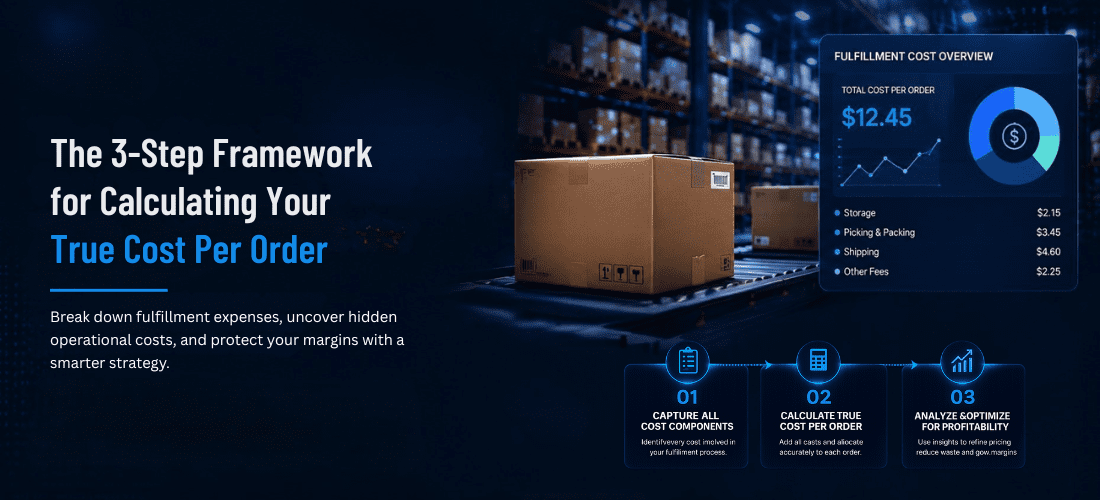
The 3-Step Framework for Calculating Your True Cost Per Order

Mastering your margins requires a move away from simple division. Most brands fail because they only look at a single month of data. This creates a skewed perspective that ignores the peaks and valleys of high-growth commerce. To get a real grip on calculating ecommerce fulfillment costs, you need a burdened view of every dollar spent to move a product from your manufacturer to your customer.

Step 1: Aggregate your logistics data. Gather every expense from the last 90 days. This includes freight-in, storage, pick and pack fees, and shipping labels. A 90-day window is the "gold standard" because it smooths out weekly anomalies while staying relevant to current carrier rates. However, for true annual forecasting, you should eventually compare this to a 12-month average to account for Q4 surcharges and seasonal dips.

Step 2: Identify the "invisible" layers. Your CPO isn’t just labor and postage. Factor in your WMS software subscriptions, warehouse insurance, and any specialized equipment like label printers or scanners. These are operational necessities that must be amortized across your total order volume to understand your true break-even point. For many growing brands, partnering with Financial Foothold for outsourced accounting ensures these complex overhead costs are tracked with precision.

Step 3: Apply the Cost Per Order (CPO) formula. Take your total logistics spend (Direct + Invisible) and divide it by your total shipped orders. Adjust this figure for seasonality by adding a buffer for peak-season surcharges, which can often spike your variable costs by 10% or more during November and December. Partnering with a professional ecommerce 3PL provider can simplify this calculation by consolidating these variables into a single, transparent dashboard.

The Multichannel Fulfillment Variance

Selling on TikTok Shop, Amazon, and Shopify simultaneously creates a "multichannel tax." Amazon has rigid prep requirements that differ from direct-to-consumer TikTok orders. You must weight your costs by platform. For example, your spend on Amazon FBA prep and multi-channel services may be higher per unit than Shopify orders, but the volume might justify the margin hit. Calculate a platform-specific CPO to see which channel is actually driving your profit.

Factoring in the "Return Tax"

Returns are a silent profit killer. With 2026 projections suggesting 15.8% of retail sales will be returned, reverse logistics must be part of your math. A 10% return rate can increase your overall CPO by up to 15% when you account for return shipping, labor for inspection, and potential disposal fees. Don’t let these costs hide in your P&L; treat every return as a variable fulfillment expense to keep your calculating ecommerce fulfillment costs accurate and actionable.

Strategic Optimization: Reducing Costs Without Sacrificing Speed

Crunching the numbers is only the first step. True mastery comes from using that data to re-engineer your operations for maximum profit. When calculating ecommerce fulfillment costs, many founders realize they’re trapped in the "founder’s trap." Every hour you spend managing tape, boxes, and warehouse staff is an hour lost on product development or high-level marketing. In-house fulfillment often looks cheaper on a basic spreadsheet, but it carries a massive opportunity cost that stunts your brand’s trajectory.

Switching to a professional ecommerce logistics provider unlocks advanced strategies like zone skipping. By placing your inventory closer to your customers in a strategic fulfillment center, you bypass expensive long-haul shipping zones. This move alone can slash your shipping spend and significantly increase delivery speed. Automation also plays a critical role. The tipping point for ROI happens when your manual labor costs exceed the cost of integrated tech solutions. Boost3PL eliminates this complexity tax, allowing you to scale without the operational friction that slows down your competitors.

Scaling with a High-Performance Strategic Ally

Professional pick and pack fulfillment services leverage massive scale to reduce your per-order labor costs. We provide a frictionless operation that protects your brand reputation and boosts customer LTV. "In 2026, the most expensive fulfillment strategy is the one that slows your ability to scale." Don’t let outdated processes become the bottleneck for your ambition. High-growth brands require a partner that moves as fast as the modern digital economy.

Next Steps: From Calculation to Execution

Take immediate action to protect your margins. Audit your current provider using the 90-day framework we established earlier. Identify the top three leaks in your pipeline, such as excessive packaging waste or slow intake times. Once you’ve identified these gaps, reach out for a strategy session. We’ll show you how Boost3PL optimizes these variables while calculating ecommerce fulfillment costs with total transparency. Turn your logistics from a cost center into a high-speed growth engine today.

Take Control of Your Brand’s Financial Future

Mastering the math of your supply chain is the ultimate competitive advantage. You’ve learned that calculating ecommerce fulfillment costs requires a deep dive into 90-day data sets and a keen eye for "invisible" overhead. By optimizing for dimensional weight and leveraging zone-skipping strategies, you transform logistics from a margin drain into a scalable engine. Every dollar you reclaim through efficiency is a dollar you can reinvest in your brand’s creative vision. It’s time to stop reacting to surprise surcharges and start driving your expansion with data-backed precision.

Stop letting operational chaos dictate your growth. We’re here to act as your high-performance strategic ally. Boost3PL provides specialized TikTok Shop and Shopify integrations alongside a professional Amazon FBA Prep Center to ensure your brand remains organized and fast. We thrive on handling the heavy lifting so you can focus on creative expansion. Our results-oriented partnership is built specifically for high-growth brands that value technological sophistication and operational excellence.

Ready to optimize your margins? Get a frictionless fulfillment quote from Boost3PL today.

Your success is the primary metric of our performance. Let’s build something remarkable together.

Frequently Asked Questions

How much should fulfillment cost as a percentage of revenue?

Fulfillment costs typically represent between 8% and 15% of a brand’s average order value. This range includes every expense from initial receiving and storage to final mile delivery. While luxury brands with high price points might see a lower percentage, brands selling heavy or low-cost items often find their logistics spend sits at the higher end of this bracket. Keeping your costs within this range is vital for maintaining healthy margins as you scale.

What is the average cost of pick and pack fulfillment in the USA?

Pick and pack fulfillment costs depend on your order volume, item count per box, and the complexity of your kitting requirements. Most providers structure their pricing with a base order fee followed by a smaller charge for each additional item picked. Brands with high-velocity "hero products" usually see lower per-unit costs than those managing thousands of individual SKUs. Focus on finding a partner that balances speed with high accuracy to avoid the hidden costs of shipping errors.

Is it cheaper to use Amazon FBA or a third-party logistics company?

The cost effectiveness of Amazon FBA versus a third party logistics company hinges on your sales channels and inventory turnover. Amazon FBA is built for speed within their ecosystem, but their peak-season storage hikes and surcharges can be aggressive. A dedicated ecommerce 3PL provider often offers more predictable pricing for multichannel brands. This is especially true if you’re growing on Shopify or TikTok Shop where brand control and custom packaging are priorities.

What are the most common hidden fees in 3PL contracts?

Common hidden fees include account management charges, API integration fees, and unexpected surcharges for receiving non-compliant shipments. Many founders miss these "silent killers" when calculating ecommerce fulfillment costs during the initial vetting process. You should also watch for dimensional weight adjustments and peak-season fuel surcharges that aren’t always highlighted in a basic quote. Demand a transparent, fully burdened cost model to ensure your brand’s profitability remains protected year-round.

Amazon FBM Fulfillment: The 2026 Strategic Guide for Scaling Brands

The most profitable Amazon brands in 2026 aren’t waiting 14 days for FBA check-in times. They’re taking back their logistics. Relying solely on Amazon’s infrastructure has become a bottleneck for rapid growth. With FBA storage fees increasing by an average of 20% year-over-year since 2023, the shift toward amazon fbm fulfillment is no longer a backup plan; it’s a competitive necessity. You’ve likely felt the sting of generic brown boxes diluting your hard-earned brand identity. You’ve definitely seen those inventory "dark periods" where products sit in a warehouse but remain unpurchasable for weeks.

We agree that your brand deserves better than a one-size-fits-all shipping solution that eats your margins. You want to see your logo on every box and your products in customers’ hands without the FBA surcharge. This guide will show you how to master the mechanics of Merchant Fulfillment to regain total control over your customer experience. You’ll learn the exact strategies to boost your margins by up to 15% by cutting unnecessary storage surcharges. We’ll walk through the seamless integration of high-tech logistics that turns your shipping department into a high-performance growth engine, ensuring you never lose another day of sales.

Key Takeaways

  • Master the core mechanics of merchant-led logistics to regain total control over your inventory and shipping speed.
  • Analyze the 2026 fee landscape to see how flat-rate 3PL efficiencies can significantly outperform FBA’s per-unit costs.
  • Scale your operations seamlessly by integrating a strategic amazon fbm fulfillment model that eliminates generic packaging and elevates your brand.
  • Boost your delivery performance using tech-enabled warehousing and real-time inventory management to prevent overselling.
  • Discover how to leverage professional pick-and-pack automation to focus on high-level growth while your logistics partner handles the heavy lifting.

Understanding Amazon FBM Fulfillment: The Strategic Alternative to FBA

Amazon FBM fulfillment is your brand’s direct path to total logistical control. While FBA puts Amazon in the driver’s seat, FBM (Fulfilled by Merchant) keeps you in charge of storage, packing, and shipping. By 2026, the most successful brands have evolved into Hybrid Sellers. They don’t just pick one method. They leverage both to maximize market reach and protect against inventory caps. Industry data from 2024 shows that 33% of top sellers already use a combination of both methods to stay agile during peak seasons.

FBM offers immediate access to your physical inventory. You won’t wait weeks for a crowded fulfillment center to check in your shipment. You launch products faster. This agility is vital within the Amazon Marketplace, where speed often determines who wins the Buy Box. When you control the warehouse, you control the customer experience. You can include custom inserts or specialized packaging that FBA simply won’t handle. It’s about moving at the speed of your customers, not the speed of a massive bureaucracy.

How FBM Works for Modern Ecommerce Brands

The process is a high-speed relay that starts the moment a customer clicks buy. First, Amazon sends an order notification to your integrated system. Second, your inventory levels sync across every sales channel to prevent overselling. Third, the warehouse team initiates professional pick and pack fulfillment to get the order ready. Finally, automated tracking updates post to the Merchant Fulfilled Network (MFN) so the customer stays informed. This ensures you meet Amazon’s strict shipping requirements without lifting a finger.

This streamlined flow protects your seller account health. Professional fulfillment is the backbone of this strategy. It ensures your on-time delivery rate stays above the 97% threshold required for elite performance. Boost your brand’s reliability by moving away from rigid, slow-moving systems. Choose a seamless integration that scales with your ambition. Your growth is the primary metric of success, and FBM is the tool that makes that growth permanent. It’s time to take control of your logistics and elevate your brand’s reputation.

Amazon FBM vs. FBA: A Comparison Framework for 2026

Choosing between FBA and FBM is no longer a binary decision; it’s a margin-optimization strategy. While FBA offers convenience, the Forbes Advisor guide to selling on Amazon highlights how fulfillment costs fluctuate based on size and weight. In 2026, FBA fees have increased by an average of 5% across most standard categories. Amazon FBM fulfillment allows brands to bypass these per-unit penalties. When a customer orders three items, FBA charges three full fulfillment fees. A 3PL partner typically charges one base pick fee and a small incremental cost for additional items; this often saves brands 25% or more on multi-unit shipments.

The Brand Experience gap is the second critical factor. FBA locks your product in a generic brown box. FBM gives you total control. You can utilize custom packaging, branded inserts, and specialized kitting to elevate the unboxing experience. This builds long-term loyalty that a generic Amazon box cannot match. Additionally, FBM eliminates the "FBA black hole" during peak seasons. In Q4 2025, some sellers waited 21 days for FBA inventory check-ins. A strategic 3PL keeps your inventory live and shipping within 24 hours of arrival.

When to Choose FBM Over FBA

FBM is the superior choice for oversized or heavy goods that trigger FBA’s aggressive surcharges. It’s also vital for products requiring precision, such as expiration-date tracking or climate-controlled storage. You can manage these complexities through specialized 3PL warehouse services. Use FBM as a fail-safe to keep your listings active when FBA stock runs dry. You can optimize your inventory management to ensure you never miss a sale due to warehouse delays.

Winning the Buy Box with Seller Fulfilled Prime (SFP)

You don’t need FBA to keep the Prime badge. The 2026 SFP requirements demand a 99% on-time shipping rate and 1-day delivery for at least 20% of customer views. A high-performance 3PL partner enables these speeds without the restrictive storage limits of Amazon’s warehouses. This setup gives you the Prime badge while maintaining full control over your physical stock. Strategic amazon fbm fulfillment ensures your brand stays agile and profitable regardless of Amazon’s internal policy shifts.

Amazon FBM

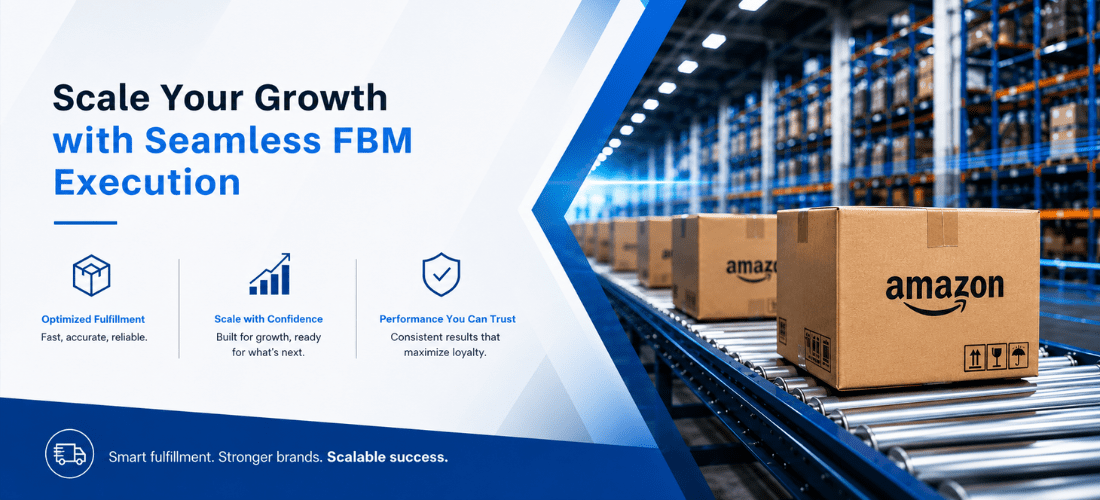
Scale Your Growth with Seamless FBM Execution

You didn’t build your brand to spend your days tape-gunning boxes. You built it to scale. Boost your operational efficiency by offloading the logistical heavy lifting to a tech-enabled 3PL partner. High-performance logistics is no longer a back-office function; it is a strategic lever for growth. Professional FBM fulfillment transforms logistics from a cost center into a brand-building asset. This transition allows you to reclaim your time for product innovation while experts manage the 24-hour shipping windows required for success.

Real-time visibility is the heartbeat of a modern supply chain. Without precise warehousing and inventory management, you risk the dreaded overselling trap. Amazon’s algorithm penalizes stockouts and late shipments with brutal efficiency. Our systems sync inventory levels every 60 seconds across all platforms. This ensures your amazon fbm fulfillment strategy remains protected from account health triggers and negative customer feedback.

Integrating Amazon FBM with Shopify and TikTok Shop

Scalability thrives on simplicity. Stop fragmenting your stock across multiple warehouses and software platforms. One unified pool of inventory is the ultimate hack for rapid growth. It allows you to leverage your Amazon stock to fulfill orders from TikTok Shop and your own website instantly. This creates a consistent, premium unboxing experience that builds brand equity. Brands looking to sell everywhere without operational chaos should explore multichannel fulfillment services to unify their inventory across every sales channel. Explore these Shopify fulfillment services to sync your storefront and eliminate manual data entry errors forever.

The Boost3PL Advantage for Amazon Sellers

Amazon shipping SLAs are notoriously strict, but we thrive under pressure. Our high-performance team manages the complexity of amazon fbm fulfillment so you don’t have to. We provide:

  • Rapid Integration: Connect your Amazon Seller Central to our warehouse technology in seconds.

  • SLA Compliance: We maintain a 99.9 percent on-time shipping rate to keep your account in good standing.

  • Strategic Partnership: We act as a tech-savvy ally that handles the chaos of peak seasons with calm precision.

The result is a friction-free operation that grows as fast as your ambition. We provide the infrastructure; you provide the vision. Let’s scale together.

Take Control of Your Growth Strategy

Mastering amazon fbm fulfillment in 2026 is the ultimate move for brands ready to reclaim their margins and own their customer data. You’ve seen how the FBM vs. FBA framework favors those who prioritize flexibility and direct control over their logistics. Scaling your growth doesn’t have to be a nightmare when you have the right tech and expertise in your corner. It’s about turning your supply chain into a competitive advantage that fuels your expansion.

Boost3PL acts as your high-performance strategic ally. Our entrepreneur-led logistics experts maintain a 99.9% order accuracy rate to ensure your customers stay happy and your brand’s reputation remains spotless. With real-time multi-channel integration, your inventory stays perfectly synced across every sales channel you operate. We handle the heavy lifting so you can focus on building your empire. Stop letting fulfillment bottlenecks hold you back.

Boost your Amazon margins with seamless FBM fulfillment today!

Your brand deserves a partner that cares as much about your success as you do. Let’s build something incredible together.

Frequently Asked Questions

Is Amazon FBM cheaper than FBA in 2026?

Amazon FBM is often more cost-effective than FBA for brands shipping multi-unit orders, oversized goods, or items requiring custom branding. While FBA fulfillment fees increased by an average of 5.2% in 2025, FBM allows you to bypass peak season storage surcharges. You gain direct control over your margins by optimizing your own carrier contracts. This strategy works best for items exceeding 18-inch dimensions where Amazon’s cubic tier pricing becomes restrictive.

Can I still have the Prime badge with FBM?

You can earn the Prime badge through the Seller Fulfilled Prime (SFP) program by meeting Amazon’s strict 99% on-time shipping requirement. Success in SFP requires a 1-day or 2-day delivery promise that matches FBA speed. Partnering with a tech-forward 3PL ensures your amazon fbm fulfillment process hits these metrics consistently. We provide the real-time data visibility needed to maintain your Prime status while keeping your brand front and center.

How do returns work with Amazon FBM?

You manage the entire returns lifecycle directly, which allows your brand to recover up to 30% more product value compared to FBA’s automated disposal systems. Instead of letting Amazon mark items as unsellable, you inspect every return at your facility or partner warehouse. This hands-on approach reduces waste and protects your bottom line. You decide whether to refurbish, restock, or liquidate based on concrete inspection data and your specific brand standards.

Do I need a special warehouse for FBM?

You don’t need a dedicated facility to start, but scaling a brand requires a professional fba prep center or 3PL to meet Amazon’s performance standards. High-volume sellers often face a 4% late shipment rate threshold that’s nearly impossible to manage from a home office. Outsourcing to a seamless logistics partner provides the automated kitting and rapid sorting needed to boost your growth. Professional warehousing ensures your amazon fbm fulfillment strategy remains competitive.

Amazon 3PL: How to Scale Your Brand and Protect Your Margins in 2026

What if the very platform built to scale your business is actually the one holding your margins hostage? By the end of 2024, Amazon’s updated fee structures and “aged inventory” surcharges forced many sellers to search for a more flexible amazon 3pl solution to protect their bottom line. You likely feel the daily pressure of maintaining a high IPI score while battling storage limits that seem to shrink the moment your sales take off. It’s frustrating to watch 15% of your potential profit disappear into storage fees and compliance penalties before a single customer even sees your product.

We agree that your brand deserves an elevated logistics strategy that moves as fast as your sales. This guide reveals how a strategic partnership empowers you to bypass restrictive FBA caps and ensure 100% prep compliance every single time. You will discover the exact roadmap to lower your overhead while expanding your reach across Shopify and TikTok. We are diving into the tech-driven tactics that keep your inventory fluid, your shipments accepted, and your brand ready to dominate the 2026 marketplace with seamless, multichannel precision.

Key Takeaways

  • Break free from the “Amazon Trap” by using a strategic partner to bypass restrictive storage limits and protect your IPI score.
  • Eliminate warehouse rejections and costly delays by mastering rigorous FBA prep requirements through expert kitting and labeling.
  • Optimize your operations with a hybrid fulfillment model that leverages an amazon 3pl to balance Prime speed with FBM flexibility.
  • Scale your brand seamlessly across TikTok Shop, Shopify, and Amazon with real-time technology integrations that keep your inventory in sync.
  • Transition to a brand-first logistics approach that protects your margins and fuels multichannel growth in the 2026 landscape.

The Amazon Trap: Why Brands Need an Amazon 3PL in 2026

Amazon is no longer just a marketplace; it is a high-stakes logistics game where the rules change without warning. An amazon 3pl acts as your strategic partner, managing inventory, prep, and fulfillment outside of Amazon’s increasingly restrictive ecosystem. By 2026, the “Amazon Trap” has become a clear threat to scaling brands. Sudden shifts in storage limits and volatile Inventory Performance Index (IPI) scores can freeze your growth overnight, leaving you with stock you cannot sell and fees you cannot afford.

Smart founders use a “Buffer Strategy” to reclaim their power. This involves holding bulk stock in a 3PL warehouse and drip-feeding inventory into FBA only as needed. This approach effectively side-steps Amazon’s aggressive peak season storage surcharges. In 2025, these fees often spiked by over 200 percent during the holiday corridor. By leveraging Third-party logistics (3PL) providers, you protect your margins and maintain the agility required to dominate the buy box.

Overcoming FBA Storage Limits and IPI Hurdles

Amazon rewards movement, not storage. We help you maintain a lean FBA presence to keep your IPI score high and your storage limits uncapped. Our Just-in-Time replenishment model ensures you never over-send inventory, which maximizes your cash flow for marketing and R&D. “In 2026, the most successful Amazon brands don’t store more; they store smarter by leveraging external warehouse agility.” This strategy turns logistics from a bottleneck into a competitive advantage.

Mitigating Risk: The Safety Net for Account Suspensions

Total reliance on FBA is a dangerous gamble. If Amazon flags your account for a policy update or a competitor complaint, your entire inventory is effectively held hostage. Your amazon 3pl serves as a vital safety net and a functional Plan B. Having stock ready in a private facility allows you to pivot to Shopify, Walmart, or eBay instantly. You keep your revenue flowing even if your Amazon storefront hits a temporary roadblock.

Maximizing Marketplace Efficiency: FBA Prep and FBM Mastery

Amazon’s receiving standards are more aggressive than ever. A single misplaced FN-SKU label or a poly-bag without a suffocation warning can trigger a warehouse rejection, stalling your inventory for weeks and hurting your IPI score. By partnering with a professional FBA prep center, you ensure 100% compliance with Seller Central standards before your products reach the dock. This level of precision is why 85% of top-tier sellers now utilize outsourced fulfillment services to handle logistical heavy lifting. Your amazon 3pl partner acts as the final gatekeeper, protecting your brand reputation and your bottom line.

The FBA Prep Checklist for 2026

Success in 2026 requires a zero-defect mindset to avoid Amazon’s updated non-compliance fees. Our prep process covers every essential detail for your Brand:

  • FN-SKU Labeling: Precise placement to ensure rapid scanning and zero lost units.
  • Expiration Tracking: Real-time monitoring for topical and consumable goods to prevent “expired” flags.
  • Fragile Bundling: Multi-layer protection for high-risk items using 2026-standard materials.

Automated kitting services can Boost your average order value (AOV) by 15% or more through strategic multi-packs. Read our FBA Prep Center guide to master these workflows and eliminate shipping friction. When evaluating your options, use our FBA prep center near me selection checklist for 2026 to ensure your next partner offers the technological integration and compliance standards your brand demands.

FBM as a Strategic Growth Lever

High-performance brands use a Hybrid Fulfillment model. You keep top sellers in FBA for the Prime badge, but use FBM for oversized or slower-moving SKUs to dodge Amazon’s aggressive long-term storage fees. High-speed pick and pack fulfillment allows you to meet Seller Fulfilled Prime standards effortlessly. This 3PL-backed FBM strategy serves as your ultimate insurance policy. When FBA stockouts occur, your merchant-fulfilled listings stay active. This allows you to win the Amazon Buy Box while your competitors go dark. Use this flexibility to elevate your inventory management and scale without limits.

Seamless Scaling: Integrating Your Amazon 3PL for Multichannel Success

Stop thinking like an Amazon seller and start acting like a brand leader. In 2026, your amazon 3pl isn’t just a warehouse; it’s the engine for your entire multichannel ecosystem. You must shift to a brand-first strategy where fulfillment supports every sale across all platforms simultaneously. This requires real-time technology integrations. Your partner must sync instantly with Shopify, TikTok Shop, and Amazon to ensure your operations move at the speed of social commerce. When your tech stack talks to each other, you eliminate manual errors and stop chasing data.

Unified Inventory: One Stock Pool for Every Channel

Adopt a single source of truth inventory model to dominate the market. This prevents the nightmare of overselling on TikTok while stock sits idle in an FBA warehouse. By mastering 3PL warehouse services, you gain the global visibility needed to scale. Brands using a unified stock pool see a 20% reduction in capital tied up in safety stock. A national 3PL network cuts shipping zones from 8 to 3, slashing delivery times by 48 hours for a superior customer experience.

Evaluating Your Partner: Beyond the Price Per Pick

Don’t settle for a vendor when you need a strategic ally. Use this 3-step framework to find your match:

  • Audit the Stack: Ensure they offer native, bi-directional API integrations for your specific tech stack.
  • Check the Stats: Demand their FBA rejection rate. A top-tier partner maintains a rate below 0.5% to protect your account health.
  • Test the Logic: Ask how they handle complex returns and kitting to ensure they can grow with your product line.

Look for the Boost factor. Choose a partner that treats your reputation as their own. Before making your final decision, review the strategic checklist for finding the right FBA prep center near me to verify they meet 2026 compliance and integration standards. Your amazon 3pl should offer the technological sophistication to handle the chaos of 10,000 orders a day without breaking a sweat. Scale your brand with confidence and keep your margins protected through every growth phase. It’s time to move fast and win.

Future-Proof Your Brand and Accelerate Growth

The 2026 e-commerce landscape demands more than just a warehouse; it requires a strategic engine. Amazon’s recent logistics shifts, such as the 2024 introduction of Inbound Placement Fees, mean your margins are under constant pressure. To win, you must master FBA prep compliance and unlock multichannel flexibility. A dedicated amazon 3pl isn’t just an option; it’s your brand’s competitive advantage in a crowded market. Before committing to any fulfillment strategy, founders must understand is Amazon FBA worth it in 2026 given the evolving fee structures and compliance requirements. If you’re still building your foundational knowledge, our definitive guide to what is FBA in 2026 breaks down the updated fee structures, the new fuel and logistics surcharge, and the critical compliance shifts every seller must know.

Boost3PL delivers the high-performance infrastructure you need to scale without the friction. Our specialized Amazon FBA Prep compliance experts ensure your shipments meet 100% of Amazon’s evolving requirements to avoid costly chargebacks. We provide real-time multichannel inventory syncing across every platform you sell on. You get entrepreneurial-minded support that treats your brand’s scale as our primary metric of success. We handle the heavy lifting so you can focus on the big picture.

Boost your Amazon growth with a seamless 3PL partner today

Stop fighting logistics bottlenecks and start accelerating your expansion. Your brand’s potential is limitless with the right partner behind you.

Frequently Asked Questions

Is an Amazon 3PL cheaper than using FBA storage?

Yes, utilizing an amazon 3pl often reduces your overhead, particularly during Amazon’s peak season from October to December. During these 3 months, FBA storage fees typically triple for most sellers. By shifting your bulk inventory to a private warehouse, you avoid these high monthly costs and the 181-day aged inventory surcharges. This strategy protects your margins and ensures your capital stays focused on growth rather than storage penalties.

What is the difference between an Amazon 3PL and an FBA Prep Center?

A prep center focuses strictly on labeling and kitting items to meet Amazon’s 45-page packaging manual. An amazon 3pl offers a more comprehensive partnership by managing long-term storage, merchant fulfillment, and multi-channel distribution. While a prep center is a pit stop, a 3PL acts as your brand’s strategic hub. We handle the logistical heavy lifting so you can scale your sales across 3 or more platforms simultaneously.

Can a 3PL help me win the Amazon Buy Box?

Yes, a 3PL boosts your Buy Box eligibility by ensuring your inventory never hits zero. Amazon’s 2024 algorithm updates prioritize sellers who maintain high in-stock rates and fast delivery speeds. By using a 3PL to bridge the gap during FBA check-in delays, you maintain a 100 percent offer presence. This reliable fulfillment signal tells Amazon’s system your brand is ready to deliver, helping you capture more of the 82 percent of sales that go through the Buy Box.

How does a 3PL integrate with my Amazon Seller Central account?

We connect to your account using the Amazon Selling Partner API for a seamless data flow. This link automates your order pulls and updates tracking numbers every 15 minutes. You gain real-time visibility into your stock levels without manual spreadsheets or data entry errors. It’s a plug-and-play solution that turns your Seller Central account into a high-performance engine, allowing you to monitor your brand’s growth from a single dashboard. Many founders question whether Amazon FBA is worth it in 2026 when considering the total cost of ownership and alternative fulfillment strategies.

Average Pick and Pack Fees 2026: The Ecommerce Founder’s Pricing Guide

Your fulfillment provider is either your greatest growth engine or your biggest margin killer in 2026. With warehouse labor costs climbing 12% over the last 18 months, every cent added to your per-order cost directly erodes your profitability. Mastering the average pick and pack fees 2026 is no longer optional for founders who want to scale without the friction of legacy pricing models. It’s time to stop guessing and start optimizing your spend with real data.

We agree that managing the complexity of multichannel fees across Shopify and TikTok Shop feels like a moving target. It’s frustrating to see your hard-earned revenue vanish into opaque line items and hidden surcharges from traditional providers. This guide promises to hand you the blueprint for your 2026 logistics budget, featuring a detailed breakdown of costs and the specific strategies you need to protect your margins. We’ll provide a clear benchmark to evaluate any 3PL quote and ensure your logistics remain seamless as you boost your brand to the next level.

Key Takeaways

  • Master the evolving fulfillment landscape by benchmarking your current costs against the projected average pick and pack fees 2026.
  • Decode complex pricing structures by distinguishing between “first item” and “add-on” fees to protect your per-order margins.
  • Compare independent 3PL rates against Amazon FBA to uncover hidden storage and prep fees that could be draining your profits.
  • Audit your total fulfillment spend by identifying “invisible” costs like packaging materials, dunnage, and SKU complexity surcharges.
  • Learn why transparent, flat-fee models are the 2026 standard for high-growth brands looking for a seamless strategic partnership.

Understanding the 2026 Pick and Pack Fee Landscape

Pick and pack services represent the core labor engine of your ecommerce operation. This process involves retrieving specific items from warehouse shelves and prepping them for shipment. In 2026, the average pick and pack fees 2026 reflect a market transformed by high-speed automation and shifting labor demographics. You aren’t just paying for a pair of hands; you’re investing in a seamless fulfillment ecosystem that protects your brand’s reputation.

Pricing in 2026 typically fluctuates between $2.50 and $8.00 per order. This wide gap exists because “average” is no longer a static number. It depends on your SKU complexity, order volume, and the level of technology your 3PL utilizes. Modern brands now track the Fulfillment Efficiency Ratio to measure success. This metric divides your total fulfillment spend by your total revenue. If your ratio exceeds 15%, your current fee structure is likely dragging down your ability to scale.

What is included in a standard 2026 pick and pack fee?

The “Pick” phase has evolved beyond paper lists. In 2026, 3PLs use advanced warehouse management systems (WMS) and AI-driven heat maps to locate SKUs in seconds. This precision reduces errors and keeps your inventory moving at light speed. The “Pack” phase involves selecting the most cost-effective, sustainable packaging and securing items with precision-cut dunnage. Every step is part of the broader order fulfillment process, which concludes with labeling and staging for carrier pickup. We ensure every package is optimized for transit to avoid dimensional weight surcharges that eat your margins.

Why 2026 pricing looks different than 2024

The logistics world shifted significantly over the last 24 months. Wage inflation in major logistics hubs hit a 6.2% year-over-year increase by January 2026, forcing manual warehouses to hike their rates. Conversely, tech-forward 3PLs stabilized their costs by integrating Autonomous Mobile Robots (AMRs) that handle the heavy lifting. These robots don’t take breaks or require overtime pay. This technological gap creates the price variance you see in the market today. While legacy providers struggle with labor shortages, automated partners offer more predictable, scalable pricing models. For a standard single-item order in 2026, the average pick and pack fee typically settles between $3.15 and $3.85 depending on your monthly volume. Boost your margins by choosing a partner that uses technology to offset rising labor costs.

Breaking Down the Pick and Pack Cost Components

Understanding the math behind your fulfillment invoice is the first step to scaling your brand. In 2026, the average pick and pack fees 2026 reflect a major shift toward high-tech automation and rapid turnaround times. Logistics costs remain a massive pillar of the global economy. A recent report on Logistics Costs and U.S. Gross Domestic Product highlights how these expenses drive modern business strategy. You aren’t just paying for a hand in a box; you’re investing in a seamless customer experience that protects your reputation.

The “First Item” vs. “Additional Item” model

Most 3PL providers utilize a tiered pricing structure to reward high-volume orders. The first item in an order is your base cost. In 2026, expect to pay between $2.50 and $5.00 for that initial pick. This fee covers the labor of traveling to the bin, verifying the SKU, and bringing it to the packing station. Because the picker is already at the location, additional items usually cost 40% to 60% less than the first. Smart brands use kitting and bundling to turn three separate picks into one single unit, slashing their average pick and pack fees 2026 instantly. This strategy maximizes your margins while keeping your fulfillment velocity high.

Multichannel surcharges: Shopify, TikTok Shop, and Amazon

Selling across multiple platforms adds layers of complexity to your logistics. TikTok Shop now mandates strict 24-hour shipping windows, which often requires priority routing and specialized handling surcharges. Integration fees have also become standard. These fees fund the technology stack that keeps your Shopify store synced with your 3PL in real-time. You can simplify this by using multichannel fulfillment services to consolidate your inventory into one pool. This eliminates the need for fragmented stock and reduces the risk of overselling across different marketplaces.

SKU complexity and fragile handling also dictate your base rate. A standard t-shirt is simple to process, but a glass vase requires bubble wrap, custom inserts, and specialized care. These fragile surcharges can add $1.00 to $3.00 per order depending on the materials used. Modern tech fees for API maintenance and real-time dashboard access are now standard in most contracts. To keep these costs from spiraling, focus on organization. Efficient warehousing and inventory management is your best defense against pick errors and wasted movement. When your inventory is organized and your data is clean, your fulfillment becomes a competitive advantage. Boost your operational efficiency by optimizing your pick and pack strategy today.

3PL Pick and Pack vs. Amazon FBA: Which Wins in 2026?

Choosing between Amazon FBA and a dedicated 3PL isn’t a simple coin flip. By 2026, the logistical landscape has shifted. You need to know exactly where your capital is working for you. The average pick and pack fees 2026 reflect a market where Amazon prioritizes high-velocity automation, while independent partners prioritize brand experience. Boost your bottom line by understanding which model protects your margins and which one drains your cash flow.

When Amazon FBA makes financial sense

Amazon remains the king of speed for small, lightweight items with massive turnover. If your product weighs under 12 ounces and moves 1,000 units weekly, FBA is a powerhouse. The Prime badge still triggers a conversion lift of up to 25% for most categories. However, Amazon’s 2026 fee updates are aggressive. They now include higher inbound placement fees and stricter low-inventory level surcharges. Small-margin brands must be precise. Using a third party logistics company to prep inventory ensures you meet Amazon’s rigid standards without the 40% surcharges for non-compliance.

When a 3PL partner provides better ROI

A 3PL partner wins when you want to own the customer experience. Amazon won’t use your custom-branded boxes or include personalized inserts. If you sell oversized goods, heavy items, or multi-SKU bundles, FBA fees often skyrocket. Personalized pick and pack fulfillment is essential for fragile or luxury goods that require a human touch. When calculating true warehousing costs, founders often find that 3PLs offer 15% to 20% lower total costs for non-standard inventory. You get total control over your packaging and a partner that treats your Brand like their own.

The most profitable path for founders in 2026 is the Hybrid Model. Don’t put all your eggs in one basket. Keep your top-selling SKUs in FBA to capture Prime traffic. Move your slower-moving inventory, oversized items, and multi-channel orders to a 3PL. This approach lowers the average pick and pack fees 2026 across your entire catalog. It creates a Seamless operation that scales across Shopify, TikTok Shop, and retail partners without the “hidden” FBA storage penalties that drain your bank account. Take action now to diversify your fulfillment and protect your growth.

How to Calculate and Reduce Your Total Fulfillment Spend

Stop guessing and start measuring. You can’t scale a high-growth brand on “vibes” alone. You need hard data to control your average pick and pack fees 2026. If you don’t understand where every cent goes, you’re leaving your margins to chance. Follow these four steps to take control of your bottom line.

  • Step 1: Audit your current average items per order (AIPO). If your AIPO is 1.2, you’re paying for a second pick on 20% of your orders. Increasing this number through bundles or upsells can slash your per-unit fulfillment costs by 15% to 22%.
  • Step 2: Factor in hidden costs. Tape, dunnage, and boxes aren’t free. In 2026, packaging materials are expected to account for 6% to 9% of your total fulfillment invoice. Track these as line items, not afterthoughts.
  • Step 3: Negotiate based on 2026 volume projections. Logistics partners value growth. Don’t negotiate using last year’s numbers. Present a clear roadmap showing your projected 35% growth to lock in tiered pricing that rewards your success.
  • Step 4: Optimize packaging to avoid dimensional weight (DIM) surcharges. Carriers penalize air. If your shipping box is 25% larger than the product inside, you’re paying for empty space. Use custom-fit mailers to keep your DIM factor low.

The Total Cost of Fulfillment (TCF) formula

Many founders make the mistake of focusing only on the pick fee. This is a trap. A low pick fee is meaningless if the provider pads their margins with high storage rates or marked-up shipping labels. You must look at the TCF to see the full picture. For a standard 1lb package, the TCF formula is the combined total of the monthly storage cost per unit, the individual pick and pack labor fee, and the final outbound shipping rate. This holistic view prevents hidden “service fees” from eroding your profits.

Practical tips to lower your 2026 fees

Efficiency is the enemy of high fees. Start by reducing your SKU count. Trimming the bottom 12% of slow-moving inventory simplifies the warehouse layout and speeds up the picking process. Next, standardize your box sizes. Using three core sizes instead of a dozen reduces material waste and helps you avoid the $2.50 custom handling surcharges that many carriers will implement by 2026. Finally, leverage Amazon FBA prep center services to ensure your inventory meets marketplace requirements before it hits the dock. This prevents costly non-compliance penalties and keeps your average pick and pack fees 2026 predictable.

Ready to stop overpaying and start growing? Get a transparent quote from Boost3PL and see how we optimize your spend.

Boost Your Margins: Why Transparent Fulfillment is the 2026 Standard

Legacy 3PL providers often hide costs in fuel surcharges, peak season premiums, or administrative fees. In 2026, high-growth brands demand total clarity. Recent industry data shows that 72% of fast-growing DTC brands migrated to flat-fee models by the end of 2025 to protect their bottom line. Understanding the average pick and pack fees 2026 requires looking past the base rate to find all-in transparency. Complex quotes stifle your momentum; simple, predictable pricing lets you forecast margins with 100% accuracy.

Your fulfillment partner should act as a strategic ally, not just a vendor. This means providing a cost structure that scales with you without “gotcha” moments. By choosing transparency, you reclaim time to focus on product development and customer acquisition. We believe your logistics should be an invisible engine that powers your growth without draining your resources. When you remove the friction of unpredictable billing, you empower your team to make bolder marketing decisions and inventory investments.

The Boost3PL Advantage: Seamless and Scalable

We built our infrastructure specifically for the 2026 ecommerce landscape. Our technology-first approach eliminates manual errors, ensuring your average pick and pack fees 2026 stay competitive even as your order volume doubles. We Boost your brand reputation by maintaining a 99.9% order accuracy rate, which is critical for long-term customer retention. Fast shipping isn’t enough; every unboxing experience must be perfect to drive repeat business in a crowded market.

Our pick and pack order fulfillment services integrate directly with Shopify, Amazon, and TikTok Shop. This seamless connectivity ensures real-time inventory sync across every channel you sell on. You focus on the creative strategy while we handle the logistical heavy lifting. Our systems are designed to scale instantly, whether you’re shipping 500 or 50,000 orders per month. We provide the automated workflows that modern digital-native brands require to stay agile.

Ready to Elevate Your Logistics?

Partnering with a dedicated ecommerce expert means your logistics become a competitive advantage rather than a bottleneck. Ambitious founders need a strategic ally that treats every package like a brand promise. Don’t let hidden fees or slow processing stall your momentum. We provide the speed, tech, and reliability you need to dominate your niche. Our team understands the unique pressures of scaling a business and offers a calm, controlled, and highly efficient solution to the chaos of shipping.

We offer the organized, fast, and deeply invested support your brand deserves. Get a clear view of your operational costs and start scaling today. Our team is ready to help you optimize every aspect of your supply chain, from the first click to the final delivery. Let’s build a fulfillment strategy that actually supports your vision for 2026.

Master Your Logistics and Own Your Growth

Navigating the shifting landscape of average pick and pack fees 2026 requires more than just a calculator; it demands a strategic ally. You’ve seen how transparent pricing and optimized workflows can reduce fulfillment overhead by 15% compared to outdated models. By leveraging a tech-forward 3PL instead of the rigid fee structures of Amazon FBA, you reclaim your margins and protect your customer experience. Success in 2026 belongs to the founders who prioritize data-driven logistics and seamless scalability.

Boost3PL is built for this exact moment. We don’t just move boxes; we accelerate your vision. Our 99.9% Order Accuracy Rate ensures your brand’s reputation stays flawless while our seamless integrations with Shopify, TikTok, and Amazon keep your operations running at light speed. With dedicated account management for scaling brands, you get the expert support needed to dominate the market. Don’t let shipping bottlenecks slow you down. It’s time to elevate your operations and win.

Boost your brand with seamless pick and pack fulfillment today!

Frequently Asked Questions

What is the average pick and pack fee for a standard ecommerce order in 2026?

Expect to pay between $2.50 and $5.50 for a standard single-item order in 2026. This range represents the average pick and pack fees 2026 based on current labor market trends and warehouse technology investments. Smaller, lightweight items sit at the lower end of this spectrum. Heavier or fragile goods often push costs toward the $5.50 mark. Boost your margins by auditing these rates against your specific product dimensions.

Do pick and pack fees include the cost of the shipping box?

No, most 3PL providers separate pick and pack labor from the physical packaging material costs. You’ll typically pay an additional $0.45 to $1.35 per box depending on the size and custom branding requirements. About 82% of 2026 logistics contracts list dunnage, tape, and boxes as distinct line items. Always confirm if your quote includes these essentials to avoid unexpected budget spikes.

How much extra does it cost to add a second item to an order?

Adding a second item typically costs between $0.55 and $1.15 per additional pick. This fee is lower than the base rate because the packer is already at the station with the order open. High-volume brands often negotiate this down to $0.40 for simple, small additions. Using smart kitting strategies can reduce these incremental costs by 18% when you bundle popular items before the peak season hits.

Are there extra pick and pack fees for TikTok Shop orders?

Yes, many 3PLs apply a $0.50 to $1.00 surcharge for TikTok Shop orders to handle specific labeling and strict 24-hour shipping requirements. TikTok’s rigorous fulfillment SLAs require specialized workflows to prevent account penalties. Boost3PL utilizes seamless API integrations to process these orders instantly. This speed helps you maintain a 99% on-time delivery rate even during viral sales events.

Is it cheaper to use a 3PL or Amazon FBA for pick and pack in 2026?

A 3PL is generally 20% to 30% more cost-effective than Amazon FBA for multi-channel fulfillment in 2026. While FBA is efficient for on-platform sales, their Multi-Channel Fulfillment fees have risen to over $7.50 for standard items. Utilizing a 3PL allows you to consolidate your inventory into one pool for your website and social shops. This approach eliminates the 4% “split-inventory” tax that drains your capital.

What are hidden fees I should look for in a 3PL pick and pack quote?

Watch for “account management” fees and “box brand” surcharges that can add $450 to your monthly invoice. Look closely at receiving fees, which often cost $18 per pallet or $2.50 per individual carton. Some providers also hide costs in “software access” fees ranging from $150 to $400. Demand a transparent, flat-rate structure to keep your scaling efforts predictable and profitable.

How does automation affect pick and pack pricing in 2026?

Automation has stabilized the average pick and pack fees 2026 by cutting manual labor requirements by 35%. Facilities that use autonomous mobile robots (AMRs) offer 12% lower per-pick rates than traditional manual warehouses. These tech-forward hubs also deliver a 99.9% order accuracy rate. You’ll experience faster turnaround times and fewer expensive return shipments when you partner with an automated fulfillment center.

Can I negotiate my pick and pack fees as my brand scales?

You can typically negotiate a 7% to 15% discount once your volume consistently exceeds 3,000 orders per month. 3PLs value density and predictable volume, so use your growth data during quarterly business reviews to secure better rates. Request “volume tiers” that trigger automatic discounts as your brand hits new milestones. Scaling shouldn’t mean overpaying; it’s your best opportunity to optimize your logistics contract.