Mastering Multi-Warehouse Fulfillment: The 2026 Strategy for Scaling Brands
08/20/2026
In 2026, relying on a single warehouse isn’t just a bottleneck. It’s a slow-motion exit from the market. You’ve likely felt the sting of watching margins evaporate into Zone 8 shipping surcharges while customers abandon carts because delivery takes five days. It’s frustrating to see growth capped by geography. This guide shows you how a strategic multi-warehouse fulfillment model turns your supply chain into a competitive weapon.
Discover how to slash shipping costs, achieve national 2-day delivery, and build a resilient infrastructure that handles the chaos of viral TikTok Shop trends. We’ll explore the tactical transition from one location to a distributed network. We’ll ensure your logistics remain frictionless as you scale. Boost3PL is your ally in mastering the complexity of modern logistics so you can focus on building your brand.
Key Takeaways
Stop losing margins to high-zone shipping costs and learn why distributed inventory is the baseline for winning the Buy Box in 2026.
Use your historical shipping data to pinpoint high-density customer clusters and optimize stock levels across the country.
Discover how to implement a multi-warehouse fulfillment strategy that syncs Shopify, TikTok Shop, and Amazon orders into one frictionless management system.
Identify the essential technological capabilities your 3PL partner needs to handle complex pick and pack fulfillment with total accuracy.
The Strategic Shift: Why Multi-Warehouse Fulfillment is Non-Negotiable in 2026
The era of shipping from a single garage or a solo coastal warehouse is over. In 2026, multi-warehouse fulfillment is the engine that drives high-growth brands. This distributed inventory strategy isn’t just about storage. It’s about placing your products closer to your customers to meet the “Amazon Effect” head-on. Modern shoppers view 2-day delivery as a baseline requirement, not a luxury. If your logistics can’t keep pace, your conversion rates will suffer.
Knowing when to scale is vital. Most founders hit a tipping point where the high costs of shipping to far-flung zones outweigh the overhead of adding a second inventory location. Managing this complexity requires a sophisticated Warehouse Management System (WMS) to maintain real-time visibility across your network. Beyond cost savings, a multi-warehouse fulfillment strategy provides critical risk mitigation. If a regional carrier faces a strike or a storm hits one hub, your business remains operational through your other nodes. It’s about building a brand that’s impossible to break.
Distributed Inventory: The Secret to Slashing Shipping Zones
Shipping from a single coast is a margin killer. Every package sent to Zone 7 or 8 represents wasted capital and unnecessary transit time. When you localize inventory, you transform expensive cross-country hauls into fast, affordable last-mile deliveries. This shift doesn’t just save money; it builds trust with every on-time arrival. Integrating this strategy with professional multichannel fulfillment services ensures your performance stays consistent across every platform you sell on, from Shopify to TikTok Shop.
Implementing a Multi-Warehouse Strategy: Best Practices for Seamless Scaling
Success in 2026 requires more than just extra space. It demands total synchronization. Sync your sales channels immediately so Shopify, TikTok Shop, and Amazon orders flow into one centralized system. This visibility prevents overselling and ensures every node in your multi-warehouse fulfillment network stays updated. Partnering with a strategic logistics ally ensures your data translates into real-world speed.
Audit your historical shipping data to find your high-density customer clusters across the USA. You can’t guess where your demand lives; you have to prove it through numbers. Once identified, establish rigorous warehousing and inventory management protocols to track stock levels in real time. Inventory rebalancing is the proactive movement of stock between nodes to match shifting demand and prevent regional stockouts. This keeps your growth frictionless even during peak seasons.
Smart Inventory Allocation: Putting Products Where the Demand Is
Don’t split your inventory blindly. Use a 60/40 or 50/50 split based on regional sales velocity to ensure your most popular SKUs are always near your buyers. Seasonal trends play a massive role here. Prepare for Q4 by pre-positioning stock in warehouses closest to your target demographics before the holiday rush begins. Integrating specialized Amazon FBA prep into your workflow allows you to move marketplace inventory fluidly between your own DTC nodes and Amazon centers. This agility is what separates market leaders from those who merely react to the market. Execute these steps to turn multi-warehouse fulfillment from a complex hurdle into your brand’s greatest asset.
Choosing the Right 3PL Partner for National Multi-Warehouse Success
Selecting a logistics provider is the most critical decision for your brand’s trajectory. You need more than a vendor; you need a strategic ally. Evaluate their technological sophistication first. A high-performance partner must provide frictionless integration with your Shopify, TikTok Shop, and Amazon stacks. If the data doesn’t flow instantly, your multi-warehouse fulfillment strategy will fail. Look for a team that executes pick and pack fulfillment with surgical accuracy across every node in their network. This precision protects your margins and your customer experience simultaneously.
Scalability is your next benchmark. Your infrastructure must absorb sudden viral surges from TikTok Shop or high-impact influencer launches without breaking. Boost3PL acts as the proactive guardian of your operations, managing the inherent chaos of rapid expansion so you can stay focused on creative growth and market domination. We provide the stability you need to scale without fear.
Beyond Storage: The Technology and Partnership Your Brand Needs
Real-time data reporting functions as the nervous system of any successful multi-warehouse fulfillment operation. Without it, you are flying blind. You deserve a partner who views themselves as a guardian of your reputation, not just a handler of boxes. This level of commitment ensures that every shipment reflects your brand’s quality and speed. Establishing a presence in a premier Fulfillment Center USA network provides the national reach required to win in the 2026 economy. We don’t just store products; we accelerate your business by providing the organized, fast, and efficient logistics foundation you need to thrive.
Dominate the National Market with Frictionless Logistics
Transitioning to a distributed network is the most impactful move your brand can make in 2026. By localizing inventory, you eliminate the shipping zone barriers that drain your margins and frustrate your customers. You’ve discovered how smart allocation and real-time data flow turn a complex supply chain into a streamlined growth engine. Don’t let logistical chaos hold back your creative vision. It’s time to build a resilient, high-performance infrastructure that thrives across every sales channel.
Success requires a partner who handles the technical heavy lifting. Accelerate your growth with Boost3PL’s national fulfillment solutions today. We provide expert Amazon FBA and FBM support, seamless TikTok Shop and Shopify integration, and a strategic USA-wide warehouse network. Master your multi-warehouse fulfillment strategy and reclaim your time to focus on what you do best. Your brand’s potential is limitless when you have the right strategic ally. Let’s scale together.
Frequently Asked Questions
Is multi-warehouse fulfillment more expensive than using a single warehouse?
Choosing multiple locations is a strategic trade-off. While storage costs rise, you offset them with massive savings in shipping spend. You eliminate the premium prices of Zone 7 and 8 deliveries by placing products closer to customers. This reduces the total cost per order and boosts conversion rates. Most high-growth brands find the reduction in transit costs pays for the extra space.
How many warehouses does my ecommerce brand actually need to achieve 2-day shipping?
You typically need two to three strategically placed warehouses to cover the majority of the continental USA with 2-day ground shipping. A common setup involves nodes on both sides of the country. Adding a third central node helps. This configuration allows you to reach high-density population centers quickly while keeping inventory management manageable. It’s the most efficient way to achieve national speed without overextending your capital.
What is the biggest challenge when managing inventory across multiple locations?
Real-time inventory visibility is the primary obstacle. Without a tech-forward system, you risk regional stockouts in one hub while sitting on excess inventory in another. Successful multi-warehouse fulfillment requires a centralized data sync. Don’t try to manage split shipments manually. It’s impossible at scale. A robust technological stack is your most important asset for maintaining frictionless operations.
Can I use multi-warehouse fulfillment for my Amazon FBM and TikTok Shop orders simultaneously?
You can and should use a distributed network for both channels. Modern multi-warehouse fulfillment providers offer multichannel sync. This technology routes orders from TikTok Shop and Amazon FBM to the closest available inventory node. It ensures you maintain the high performance standards required for the TikTok Shop Fast Shipping badge. You’ll scale across platforms without duplicating your logistics efforts.
The Strategic Business Case for Outsourcing Fulfillment in 2026
07/30/2026
Your half-empty warehouse isn’t an asset; it’s a drain on your ambition. With industrial vacancy rates tightening to 6.5% and shipping carriers hiking rates by an average of 5.9% this year, the business case for outsourcing fulfillment has never been more urgent. You started this brand to innovate and sell, not to troubleshoot shipping errors or manage a revolving door of warehouse staff earning $26.76 per hour. It’s time to stop playing defense with your operations and start scaling with precision.
Key Takeaways
Identify the “Founder’s Bottleneck” and learn how to redirect your energy from packing tape to high-level marketing strategy.
Build a powerful business case for outsourcing fulfillment by converting rigid warehouse overhead into a flexible, pay-as-you-go model that scales with your sales.
Unlock deep shipping discounts and carrier leverage that are typically reserved for high-volume enterprises, instantly improving your margins.
Synchronize Shopify, TikTok Shop, and Amazon through a frictionless tech stack that eliminates manual data entry and shipping errors.
Protect your brand reputation and avoid marketplace penalties by utilizing professional Amazon FBA prep services for precise inventory management.
The Hidden Costs of In-House Logistics and Internal Friction
Many founders fall into the trap of the “Founder’s Bottleneck.” It starts with a few orders a day and ends with you drowning in bubble wrap while your marketing strategy gathers dust. When your leadership team spends twenty hours a week on logistics, you aren’t just losing time; you’re losing the market share your competitors are actively claiming. Building a strong business case for outsourcing fulfillment starts with recognizing that your time is your most expensive asset.
Managing an internal warehouse in 2026 is becoming a heavy liability. With average warehouse wages reaching $26.76 per hour and a staggering 36% annual turnover rate, the fully loaded cost of labor is higher than ever. Every shipping error or delayed package erodes your customer lifetime value. In a world where 94% of Fortune 500 companies leverage Third-party logistics (3PL) providers, trying to build a DIY supply chain often results in stagnant technology and missed growth targets.
The Opportunity Cost of Manual Operations
Calculate the true cost of your manual labor. If your executive team is troubleshooting carrier delays instead of refining your product, you’ve hit a growth ceiling. Physical space constraints often force brands to stop selling simply because they’ve run out of room to pack. This friction limits your ability to scale during peak seasons, turning your most profitable months into operational nightmares.
Infrastructure Liabilities vs. Strategic Agility
Long-term warehouse leases are dangerous in a fluctuating market. With industrial vacancy rates tightening to 6.5%, locking yourself into a fixed space creates a massive liability if your sales volume shifts. Managing a warehouse team distracts you from your core mission. Instead of worrying about insurance and forklift maintenance, focus on your brand identity. Professional warehousing and inventory management services allow you to pivot instantly, scaling your footprint up or down based on real-time demand.
Building the Financial Case: Fixed Costs vs. Scalable ROI
The business case for outsourcing fulfillment is ultimately a battle of balance sheets. In-house logistics forces you to carry massive fixed liabilities regardless of your sales volume. You pay for every square foot of that $10.45 per square foot warehouse rent even when it’s half-empty. You pay for labor at $26.76 per hour even during slow weeks. By switching to a 3PL, you convert these rigid overheads into a variable “pay-as-you-go” model. You only pay for the space you use and the orders you ship.
This shift creates immediate financial breathing room. Instead of worrying about managing a facility, you pay per-order fees that align perfectly with your revenue. If sales dip, your costs drop instantly. If they surge, your margins remain protected. You can see how this works in detail by decoding fulfillment center pricing for your own transparent modeling. This level of clarity allows you to forecast profits with surgical precision.
The 3PL Volume Advantage
Carriers like UPS and FedEx announced a 5.9% general rate increase for 2026, but the real impact often hits 8-12% once surcharges are added. Most individual brands lack the leverage to negotiate. A 3PL partner aggregates the volume of hundreds of brands to secure deep shipping discounts you simply can’t access alone. Professional pick and pack fulfillment also slashes your internal error rate. Accurate orders mean fewer expensive returns and higher customer retention, directly boosting your bottom line.
Scalability Without Capital Expenditure
Growth shouldn’t require a massive capital injection. When Q4 peaks arrive, brands with in-house operations scramble to hire temporary staff and rent overflow space. This chaos eats your profits. With a 3PL, you scale effortlessly. You don’t need to buy more forklifts or sign another lease. This variable cost model acts as the ultimate insurance policy against market volatility. It ensures your brand stays lean and agile, ready to pivot at a moment’s notice. Start building your scalable logistics foundation today to lock in these efficiencies and protect your capital.
Executing the Shift: How 3PL Partnership Accelerates Growth
Execution is where your strategy meets the reality of the market. While the financial business case for outsourcing fulfillment is clear, the operational acceleration is what truly separates market leaders from also-rans. A high-performance strategic ally doesn’t just ship boxes; they integrate deeply with your tech stack to provide a frictionless experience across every sales channel. This allows you to focus entirely on your brand identity while your partner manages the complex logistics of the modern digital economy.
Success in 2026 requires more than just a website. You need to be everywhere your customers are. Utilizing professional Amazon FBA prep services ensures your inventory meets strict marketplace requirements, helping you avoid costly penalties and account suspensions. This proactive approach protects your revenue and your reputation simultaneously. It turns your supply chain from a point of vulnerability into a robust foundation for expansion.
Multichannel Mastery in the Modern Economy
Overselling is a brand killer. When a TikTok influencer goes viral, your inventory needs to sync across Shopify and Amazon in real-time. Modern multichannel fulfillment services are essential for 2026 brand survival, providing a single source of truth for your stock levels. This technological sophistication prevents the chaos of manual updates. It ensures you never have to send an “out of stock” apology email to a new customer during your biggest sales spikes.
Protecting Your Reputation Through Accuracy
Your brand is only as good as the last package your customer opened. Advanced 3PL technology ensures 99.9% order accuracy, a benchmark that is nearly impossible to maintain with in-house manual packing. Precision warehousing and inventory management acts as a guardian for your customer trust. By offloading the inherent chaos of supply chain management to a tech-savvy partner, you secure the organized, fast, and reliable delivery experience that modern consumers demand. This isn’t just an operational shift; it’s the final piece in your business case for outsourcing fulfillment that unlocks true, uninhibited growth.
Scale Your Vision Beyond the Warehouse Floor
You didn’t build your brand to manage a shipping dock; you built it to disrupt the market. Reclaiming your mental bandwidth starts by converting stagnant warehouse liabilities into a scalable growth engine. The business case for outsourcing fulfillment is clear. It replaces operational friction with technological precision. You gain access to deep shipping discounts and professional accuracy that protects your reputation at every customer touchpoint. It’s the difference between being a warehouse manager and being a visionary CEO.
It’s time to stop packing orders and start leading your industry. Boost3PL acts as your high-performance strategic ally, offering a national USA distribution network and specialized Amazon FBA prep center expertise. Whether you’re scaling on Shopify or dominating TikTok Shop, our seamless multichannel integration ensures your operations never miss a beat. Your growth potential shouldn’t be limited by the square footage of your office or the speed of your packing tape.
Take the leap and watch your brand reach its full potential. We’re ready to build this future with you.
Frequently Asked Questions
Is outsourcing fulfillment cheaper than doing it in-house?
Outsourcing is often significantly more cost-effective because it eliminates the financial burden of underutilized warehouse space and fixed labor costs. The business case for outsourcing fulfillment hinges on converting these rigid expenses into a variable model where you only pay for what you ship. You also benefit from bulk carrier rates that individual brands can’t negotiate alone, helping you absorb the 5.9% general rate increases seen across the industry in 2026.
How do I know if my business is large enough for a 3PL partner?
Will I lose control over my packaging and brand experience if I outsource?
You maintain full control over your brand experience while gaining the precision of a professional fulfillment team. A high-quality partner works with your custom packaging, branded inserts, and specific kitting requirements to ensure every unboxing is perfect. We view ourselves as the guardian of your reputation. This partnership ensures that every shipment reflects the high standards your customers expect from your brand, delivered with a level of consistency that’s difficult to achieve in-house.
How does a 3PL handle multichannel orders from TikTok Shop and Amazon?
A tech-forward 3PL uses seamless integrations to act as a single source of truth for all your sales channels. Orders from TikTok Shop, Shopify, and Amazon flow into one centralized system, allowing for real-time inventory syncing that prevents overselling. This frictionless approach ensures that no matter where your customer buys, the fulfillment process remains fast, organized, and reliable. Professional prep services also ensure you stay compliant with specific marketplace requirements, protecting your seller standing across every platform.
Mastering Ecommerce Fulfillment KPIs to Track: A 2026 Growth Strategy
06/28/2026
Surcharges now account for a staggering 33% of the average package cost, leaving many founders wondering where their profit margins went. If you feel buried under data while high return rates and carrier price hikes squeeze your bottom line, you’re at a critical crossroads. Identifying the exact ecommerce fulfillment kpis to track is no longer just a back-office chore; it’s the primary guardian of your brand’s reputation and capital efficiency in 2026.
We know the unique pressure of scaling a digital-native brand when delivery speeds can make or break your customer loyalty. This article reveals the critical fulfillment metrics that separate high-growth companies from those that hit a plateau. You’ll learn how to build a clear dashboard of essential KPIs that drives operational efficiency and creates a frictionless customer experience. We’ll show you exactly how to turn your logistics data into a powerful competitive advantage that fuels repeat purchases and long-term expansion.
Key Takeaways
Secure your brand identity by mastering the accuracy and speed metrics that define a premium customer experience.
Optimize your inventory turnover ratio to unlock trapped capital and maintain a frictionless flow across all digital sales channels.
Identify the essential ecommerce fulfillment kpis to track to slash your cost per order and protect margins against rising carrier surcharges.
Transform your return rate from a profit drain into a strategic diagnostic tool for product quality and partner performance.
Pivot from reactive logistics to proactive growth by building a data-driven dashboard designed for the high-speed 2026 economy.
The Foundation: Core Fulfillment Accuracy & Speed Metrics
Every Key Performance Indicator (KPI) acts as a vital sign for your brand’s operational health. If you aren’t monitoring the right data, you’re flying blind. In 2026, the primary ecommerce fulfillment kpis to track are those that directly impact your customer’s first impression and their decision to return. High-performance brands treat accuracy and speed as the bedrock of their reputation. Boost3PL turns these numbers into a functional promise of business acceleration. When these metrics are healthy, they drive up Customer Lifetime Value (CLV) by creating a reliable, frictionless experience. If your operations stall, your expansion stalls with it.
Order Accuracy Rate: The Reputation Protector
Calculate your accuracy by dividing total perfect orders by the total number of orders shipped. While 95% might have passed a decade ago, 99.9% is the 2026 standard for brands that want to scale. One wrong item can trigger a negative review that reaches thousands in seconds. Precision in pick and pack fulfillment services is your first line of defense against costly returns. When every shipment is right, you protect your capital and your brand identity simultaneously. Don’t settle for “good enough” when your competitors are aiming for perfection. Accuracy is the silent engine of brand loyalty.
Order Cycle Time: Winning the Speed Race
This metric measures the path from the moment a customer hits “Buy” to the second the package is “Out for Delivery.” It includes order entry, picking, packing, and carrier handoff. You can’t control the weather or carrier delays, but you can control your internal processing time. Reducing this cycle creates a massive competitive edge over slower competitors. It’s especially critical for success on high-velocity platforms like TikTok Shop or when managing Amazon FBM. Fast fulfillment signals to your customers that you’re organized, reliable, and ready for their next order. Speed builds the trust that turns a one-time buyer into a lifelong brand advocate. Our frictionless systems ensure that your speed remains a constant advantage.
Scaling the Strategy: Multichannel & Inventory Health KPIs
Scaling your brand requires more than just moving boxes. It demands a sophisticated grip on your stock levels across every digital storefront. In 2026, 86% of brands sell on two or more channels, making synchronization a survival skill. If your inventory data lags, your growth stalls. You need to master the essential supply chain KPIs that govern inventory health. These are the primary ecommerce fulfillment kpis to track if you want to maintain a high-velocity operation. These metrics ensure you aren’t just selling products, but optimizing your entire capital structure for expansion.
Inventory Turnover: Optimizing Capital for Growth
Inventory Turnover Ratio is your most powerful tool for maintaining a healthy bank account. Calculate it by dividing your cost of goods sold (COGS) by your average inventory value. This number reveals exactly which SKUs are high-velocity winners and which ones are dead weight. High stock levels protect you from stockouts, but excessive inventory traps your capital. You must find the balance. Our warehousing and inventory management services provide the real-time visibility you need to make these calls. These are the ecommerce fulfillment kpis to track if you want to stop bleeding cash on slow-moving products. Watch for inventory accuracy and shrinkage too. Even small discrepancies in a high-volume warehouse can lead to massive hidden costs. Aim for an accuracy rate above 99% to ensure your digital storefront reflects your physical reality.
Multichannel Sync: The 2026 Growth Accelerator
Ghost Inventory is the silent killer of modern ecommerce. This happens when your TikTok Shop thinks you have ten items left, but your Shopify store just sold the last five. If you oversell, you risk losing your Preferred Seller status or getting kicked out of the Amazon Buy Box. The KPI to track here is sync latency. This measures how many seconds it takes for a sale on one channel to update all others. In 2026, your tech stack should update stock levels across all platforms in under five seconds. This speed ensures a frictionless experience for your customers and keeps your brand’s reputation intact. Precise synchronization is the ultimate growth accelerator for digital-native brands. If you’re struggling to stay in sync, it might be time to upgrade your inventory strategy.
The Bottom Line: Cost Management & Partner Performance
Profitability isn’t just about your total sales volume. It’s about what you actually keep after the boxes leave the warehouse. As you scale, your margins face constant pressure from rising carrier fees and operational overhead. These are the final ecommerce fulfillment kpis to track to ensure your brand remains capital-efficient and ready for 2026 expansion. Transitioning from reactive tracking to proactive management turns your logistics from a cost center into a strategic asset.
If you are looking to partner with a 3PL that prioritizes these metrics, you might want to check out Pik Pak Logistics for their specialized eCommerce fulfillment solutions.
To successfully make this transition, your team needs the right analytical skills. Professional training from Momentum Plus can help you master the data tools required to manage these strategic assets effectively.
Fulfillment Cost per Order: Protecting Your Margins
Fulfillment Cost per Order (FCPO) is the ultimate metric for your bottom line. It aggregates every expense required to get a product to a customer. This includes storage, labor, packing materials, and shipping labels. Carrier surcharges now account for roughly 33% of the average package cost, making this KPI more volatile than ever. Efficient pick and pack fulfillment directly lowers your FCPO by slashing labor waste and eliminating redundant touches. Use this data to optimize your packaging dimensions and negotiate better rates with carriers. Every cent saved on FCPO is a cent added directly to your net profit.
Your Return Rate is another critical diagnostic tool. Retailers estimated a 15.8% return rate in 2025, which represents a massive drain on resources. Don’t just process these as losses. Analyze the data to identify SKU-level issues. High returns often signal a quality defect or a misleading product description. Solving these upstream issues protects your reputation and your capital simultaneously.
Leveraging a 3PL Ally for KPI Excellence
Tracking data is only the first step. You need a partner that takes ownership of the results. Boost3PL acts as your high-performance strategic ally, transforming complex operational tasks into a frictionless growth engine. Our Amazon FBA prep center ensures 100% compliance and zero-defect rates, protecting you from costly marketplace penalties. This level of precision allows you to focus on creative strategy while we handle the inherent chaos of the supply chain.
Founders should start by auditing their current FCPO and order cycle times today. Identify your single biggest bottleneck and address it immediately. Whether it’s high shipping costs or inventory inaccuracies, the right ecommerce fulfillment kpis to track will point the way. Don’t just monitor your data. Accelerate your brand with a partner that delivers measurable results and inspires immediate confidence.
Dominate Your Market with Data-Driven Fulfillment
Mastering the right ecommerce fulfillment kpis to track is your roadmap to a dominant brand presence in 2026. You now have the tools to move beyond reactive reporting and start building a high-performance logistics strategy. Success requires a relentless focus on order accuracy to protect your reputation; precise multichannel synchronization to fuel expansion; and aggressive cost management to secure your margins. These metrics aren’t just numbers on a screen. They are the primary indicators of your brand’s future potential.
Boost3PL stands ready as your strategic ally in this high-speed economy. We provide the high-performance warehouse infrastructure across the USA that scaling brands demand. Whether you need specialized Amazon FBA prep and FBM solutions or a strategic multichannel sync for TikTok Shop and Shopify, our systems ensure your operations remain effortless. We take ownership of the complex tasks so you can focus on your creative vision and strategic growth goals.
Take control of your data today and watch your operational efficiency soar. Your journey toward a frictionless customer experience starts with a single, decisive step toward better logistics. We’re here to ensure your expansion is as fast and reliable as your deliveries.
Frequently Asked Questions
What is the most important fulfillment KPI for a new ecommerce brand?
Order Accuracy Rate is the single most critical indicator for a new brand because it directly dictates your reputation and customer retention. Every mistake results in a costly return and a potentially viral negative review. Focus on this metric to ensure your brand identity remains protected while you build momentum. It is the first line of defense against the high costs of customer acquisition loss and ensures your initial growth is sustainable.
How do I calculate the Fulfillment Cost per Order (FCPO) accurately?
Calculate your Fulfillment Cost per Order (FCPO) by summing every fulfillment-related expense and dividing that total by the number of orders shipped in a specific period. You must include storage fees, labor costs for picking and packing, packaging materials, and actual shipping labels. This comprehensive view helps you identify the primary ecommerce fulfillment kpis to track for margin protection. It reveals exactly how much of your revenue is consumed by the logistics process and where you can optimize for better profitability.
What is a good Order Accuracy Rate for a scaling Shopify store?
A 99.9% Order Accuracy Rate is the necessary benchmark for any scaling Shopify store in 2026. While older standards might have allowed for a 2% error rate, today’s high-velocity digital commerce demands near-perfection to avoid the profit-draining cycle of returns and negative feedback. Achieving this level of precision signals that your operations are organized and ready for rapid expansion. It ensures a frictionless experience that keeps your customers returning for more.
How does multichannel fulfillment affect my inventory turnover ratio?
Multichannel fulfillment typically accelerates your inventory turnover ratio by exposing your products to a wider audience across platforms like TikTok Shop and Amazon. This increased sales velocity clears stock faster and keeps your capital fluid and ready for reinvestment. However, you must maintain precise synchronization to avoid “ghost inventory” and overselling. This high-performance approach turns your inventory from a stagnant asset into a fast-moving growth engine that powers your brand’s expansion.
Common Ecommerce Shipping Mistakes: The 2026 Guide to Frictionless Logistics
06/02/2026
Did you know that as of January 18, 2026, USPS Ground Advantage rates surged by an average of 7.8% while DIM weight divisors for major carriers shifted from 166 to 139? These hidden costs, combined with the total removal of the EU de minimis exemption, mean that common ecommerce shipping mistakes are more expensive now than ever before. Navigating these international trade shifts effectively requires professional Customs and Trade Logistics expertise. You’ve likely felt the frustration of rising rates eating your margins or the drain of constant "where is my order" tickets. It’s exhausting to manage Amazon FBA non-compliance fines when you should be focusing on your next big product launch.
We’re here to help you stop the bleeding and reclaim your time. This guide identifies the operational leaks in your strategy and provides a clear roadmap to scale your brand without the logistical headaches. You’ll learn how to transform your supply chain into a competitive advantage through expert 3PL fulfillment services. We’ll show you how to achieve predictable shipping costs, near-perfect order accuracy, and the frictionless multichannel growth your brand deserves. Let’s turn your logistics into a high-performance engine for success.
Key Takeaways
Stop draining your margins by identifying the hidden dimensional weight trap and automating manual data entry to prevent costly address corrections.
Discover how to avoid common ecommerce shipping mistakes by unifying your inventory across Shopify, Amazon, and TikTok Shop for a frictionless multichannel experience.
Safeguard your seller reputation by mastering Amazon FBA prep requirements to eliminate rejected shipments and costly non-compliance fines.
Eliminate human error by deploying a tech-driven WMS to automate your pick and pack fulfillment as you scale into new markets.
Slash transit times and delivery costs by positioning your inventory in a strategic fulfillment center USA to minimize shipping zones.
The Operational Blind Spots: Hidden Shipping Mistakes Draining Your Revenue
Operational leaks don’t always look like massive failures. Often, they’re quiet drains on your capital. These common ecommerce shipping mistakes usually hide in plain sight, masquerading as standard costs of doing business—much like how electronics resellers lose revenue on locked returns without an icloud activation lock bypass strategy. In 2026, where carrier rates for services like USPS Ground Advantage have climbed by 7.8%, every inch of wasted space or digit of incorrect data matters. You need a proactive strategy to plug these holes before they sink your profitability.
The Dimensional Weight (DIM) trap is the number one silent killer of ecommerce margins. Carriers calculate costs based on package volume rather than just physical weight. If you’re shipping small items in oversized boxes, you’re essentially paying to ship air. With DIM divisors tightening from 166 to 139 across major carriers, your shipping costs could skyrocket overnight without a strategy to optimize box sizes and packing methods. Real-time auditing is equally vital. Don’t assume your carrier invoices are accurate; verify them against actual shipping weights and zones to reclaim lost revenue.
Data Integrity: The Cost of Manual Entry Errors
Manual processes are an invitation for disaster. A single typo in a ZIP code or a missing apartment number triggers carrier surcharges and expensive address corrections. Address validation is the first line of defense against delivery failure. By automating this at checkout, you ensure your delivery and distribution process stays on track. Our pick and pack fulfillment systems use real-time data to catch these errors before they leave the warehouse.
Packaging Strategy: Beyond the Cardboard Box
Your unboxing experience shouldn’t come at the expense of your bottom line. Selecting the right materials is a strategic decision that impacts your entire supply chain. Use these tactics to protect your revenue:
Right-size your boxes: Minimize void fill to avoid DIM weight surcharges and reduce waste.
Optimize sealing: Improperly sealed packages lead to carrier rejection and sorting delays.
Audit your labels: Ensure high-contrast, durable labels to maintain high warehouse sorting speeds.
Strategic warehouse fulfillment services help you select the exact packaging needed to balance brand aesthetics with logistical durability.
The Scaling Wall: Why In-House Fulfillment Fails in a Multichannel World
Scaling a brand from a single Shopify store to a multichannel powerhouse is the ultimate goal for digital-native founders. However, this growth often exposes deep flaws in in-house operations. Managing inventory fragmentation across Shopify, Amazon, and TikTok without a single source of truth is one of the most common ecommerce shipping mistakes today. When your stock levels don’t sync in real time, you risk overselling. This triggers marketplace penalties and destroys customer trust. These ecommerce logistics challenges require a technologically advanced approach to keep your brand reputation intact.
Speed is the new currency of commerce. On high-velocity platforms like TikTok Shop, even a 24-hour delay in processing can tank your conversion rates. Relying on a single carrier is another trap that limits your flexibility. You need a multi-carrier network to pivot based on pricing and speed. This ensures your products reach customers without friction. If your current setup feels like it’s holding you back, it might be time to explore how our pick and pack fulfillment solutions can accelerate your growth.
Multichannel Chaos: Syncing Shopify, TikTok, and Amazon
Desynced inventory leads to chaos. Marketplace algorithms are unforgiving. They reward consistency and punish stockouts. Professional multichannel fulfillment services solve this by providing a unified view of your assets. This integration ensures 99.9% order accuracy across every sales channel you operate. Stop wasting time on manual spreadsheet updates and let technology handle the heavy lifting for your brand.
Amazon FBA Prep: Avoiding the Compliance Hammer
Amazon FBA is a massive growth lever, but it comes with strict compliance hurdles. FBA prep errors like incorrect barcodes, improper poly-bagging, or weight limit violations lead to rejected shipments and account health risks. These common ecommerce shipping mistakes are expensive and entirely preventable. For a deeper dive into maintaining compliance, check out our Amazon FBA Prep Center guide to see how we safeguard your seller status. Partnering with a proactive 3PL fulfillment provider ensures your shipments meet every requirement before they reach the warehouse floor.
Frictionless Fulfillment: Leveraging a Strategic 3PL to Eliminate Errors
Operational excellence isn’t just about moving boxes. It’s about protecting your brand’s future. Transitioning to a tech-enabled partner allows you to bypass the most common ecommerce shipping mistakes that stall growth. Instead of managing chaos, you leverage a system designed for precision. A modern Warehouse Management System (WMS) acts as the central nervous system of your logistics. It automates the pick and pack process, ensuring human error becomes a thing of the past. When your operations are automated, your brand becomes unstoppable.
Strategic positioning is your secret weapon for 2026. By utilizing a fulfillment center USA, you place your products closer to your customers. This reduces shipping zones and slashes transit times immediately. Faster shipping isn’t just a perk; it’s a requirement in the modern digital economy. Your 3PL acts as the guardian of your unboxing experience. They ensure every package reflects your brand’s quality. Plus, shifting from fixed warehouse overhead to a variable cost model means your expenses only grow as your sales do. This flexibility is vital for digital-native brands looking to scale fast.
The Power of Integrated Warehouse Management
Barcode scanning at every touchpoint ensures the right product reaches the right customer every time. From the moment we receive stock to the second it ships, our warehousing and inventory management protocols provide the total visibility you need for 2026 growth. You can track every movement in real time. This level of data integrity eliminates the "where is my order" tickets that drain your customer service resources. It turns your logistics into a transparent, high-performance engine.
From Logistics Bottleneck to Brand Acceleration
Don’t let packing boxes hold you back from your creative goals. Your time is better spent on marketing, community building, and product innovation. Shifting your operational burden to a professional 3PL transforms your logistics from a bottleneck into a growth engine. It’s time to build your empire without the logistical headaches that plague your competitors. You deserve a partner that is as invested in your success as you are. Partner with Boost3PL to secure your fulfillment strategy today and experience the power of frictionless operation.
Master Your Growth Strategy with Frictionless Logistics
In 2026, your logistics strategy is the difference between a stagnant brand and a market leader. We’ve explored how common ecommerce shipping mistakes like desynced inventory and the dimensional weight trap can silently erode your margins. You now have the roadmap to move beyond these bottlenecks. By shifting from reactive in-house packing to a proactive, tech-driven partnership, you reclaim the creative energy needed to build your empire.
Success requires precision at every touchpoint. Our specialized Amazon FBA Prep Center ensures your shipments meet every compliance standard. Our multichannel sync for Shopify and TikTok Shop keeps your stock levels accurate across every platform. Combined with our advanced pick and pack accuracy, you gain the operational stability to expand without hesitation. Don’t let logistics hold your vision hostage.
What is the most expensive shipping mistake for small ecommerce brands?
Inaccurate data entry and failing to account for Dimensional Weight (DIM) are the most expensive common ecommerce shipping mistakes. Address correction fees from major carriers often exceed $20 per package; while shipping small items in oversized boxes effectively doubles your postage costs due to volume-based pricing. Automating your data flow through professional order fulfillment services eliminates these manual leaks and protects your bottom line immediately.
How do I avoid Amazon FBA prep rejection and fines?
You avoid Amazon FBA rejection by partnering with a specialized Amazon FBA prep center that understands current compliance standards. Errors like non-scannable barcodes or missing suffocation warnings on poly bags trigger immediate fines and "unplanned service" fees that eat your margins. Professional prep ensures every unit is labeled, bagged, and boxed according to Amazon’s exact specifications before it ever leaves the warehouse floor.
Can a 3PL help me reduce shipping costs for my Shopify store?
A strategic 3PL reduces Shopify shipping costs by leveraging massive carrier volume discounts that individual brands cannot access on their own. By utilizing a fulfillment center USA, you also shift shipments from expensive long-haul zones to local zones. This transition slashes transit times and postage rates; allowing you to offer the competitive shipping speeds your customers expect without sacrificing your hard-earned profits.
What happens if I enter the wrong shipping weight or dimensions?
Entering incorrect weight or dimensions leads to automatic carrier audit surcharges and "additional handling" fees on your final invoice. Carriers use automated laser scales to verify every package; if your data doesn’t match, they charge the difference plus a penalty fee. Modern warehouse fulfillment services use integrated scales and cubing technology to ensure every shipment is 100% accurate before the label is even generated.
How does multichannel fulfillment work for TikTok Shop and Amazon?
Multichannel fulfillment works by syncing your Shopify, TikTok Shop, and Amazon inventory into a single source of truth. When an order is placed on any platform, the data flows directly to your ecommerce 3PL provider for immediate pick and pack fulfillment. This real-time integration prevents overselling and ensures that high-velocity sales from TikTok are processed with the same precision as your Amazon FBM fulfillment.
Is it cheaper to do fulfillment in-house or use a 3PL in 2026?
Using a 3PL is typically more cost-effective in 2026 because it replaces fixed warehouse overhead with a scalable, variable cost model. With major carriers implementing significant rate hikes this year, the deep discounts and technological efficiency of a third party logistics company outweigh the labor and lease costs of in-house operations. You pay only for the space and labor you actually use, which is vital for brands scaling in a fast-paced economy.
Calculating Ecommerce Fulfillment Costs: The 2026 Margin-First Guide
05/26/2026
Your 2026 growth strategy is only as strong as your last fulfillment audit. With FedEx announcing a 5.9% average freight rate increase and Amazon implementing a 3.5% fuel and logistics surcharge, your margins are facing an unprecedented squeeze. You likely feel the weight of complex invoices and surprise peak-season fees that make forecasting feel like guesswork. It’s frustrating to build a brand only to see your profits eroded by hidden operational costs that you didn’t see coming.
We’re here to turn that around. This guide gives you the tools for calculating ecommerce fulfillment costs with total clarity, ensuring every shipment supports your expansion rather than draining your bank account. You’ll learn how to protect your margins while scaling across new platforms like TikTok Shop. We’ll provide a clear formula to audit your existing spend, a framework to evaluate 3PL quotes, and a roadmap to peak profitability through logistics efficiency. It’s time to stop reacting to invoices and start driving your brand’s financial future with precision and confidence.
Key Takeaways
Identify every line item beyond the standard invoice to capture your total fulfillment spend per order.
Master our 3-step framework for calculating ecommerce fulfillment costs by auditing a 90-day window of logistics data.
Uncover hidden drains on your profitability by factoring in invisible costs like insurance and warehouse equipment.
Evaluate the strategic shift from in-house operations to professional 3PL warehouse services to unlock zone skipping and lower shipping spend.
Transform your logistics from a mystery expense into a predictable engine for margin protection and brand scaling.
Beyond the Invoice: The Core Components of Ecommerce Fulfillment Costs
Stop looking at your shipping bills as the final word on your profitability. True fulfillment cost per order captures the entire lifecycle of a product. This lifecycle starts the moment a shipment hits the dock and ends only when it reaches the customer’s doorstep. It’s a comprehensive metric that includes every touchpoint in the Order fulfillment process. When you start calculating ecommerce fulfillment costs, you must look beyond the base shipping rate to see the full picture.
Modern 3PL environments split costs into fixed overhead and variable expenses. Fixed costs include monthly storage minimums or software access fees that remain steady. Variable expenses fluctuate with your sales velocity, covering labor for picking, packing, and shipping. This holistic view is the only way to master calculating ecommerce fulfillment costs without missing the small details that erode your margins. Dimensional weight (DIM) is a critical factor in 2026. Carriers calculate rates based on the space a package occupies, not just its weight. If your boxes are too big, you are paying for air. Silent killers like excessive packaging waste and inefficient kitting processes can drain your bank account before you even realize there’s a problem.
Operational Expenses: Labor, Storage, and Materials
Pick and pack fees are the heartbeat of your daily operations. However, your accuracy rate is the real cost driver. A 1% error rate leads to expensive returns and lost customer trust. For storage, hero-product brands thrive on pallet pricing, while high-SKU brands need the granularity of bin storage to keep overhead lean. In the US market, the shift toward sustainable packaging is no longer optional. While eco-friendly materials may have higher upfront costs, they reduce long-term brand risk and align with modern consumer expectations.
The Technology & Integration Layer
Technology isn’t a luxury; it’s a cost-saving necessity. Seamless API integrations for Shopify and TikTok Shop eliminate manual data entry errors and speed up processing times. Your account management fees should provide proactive strategy, not just status updates. Leveraging professional warehousing inventory management services reduces tech friction and ensures your data remains clean across every sales channel.
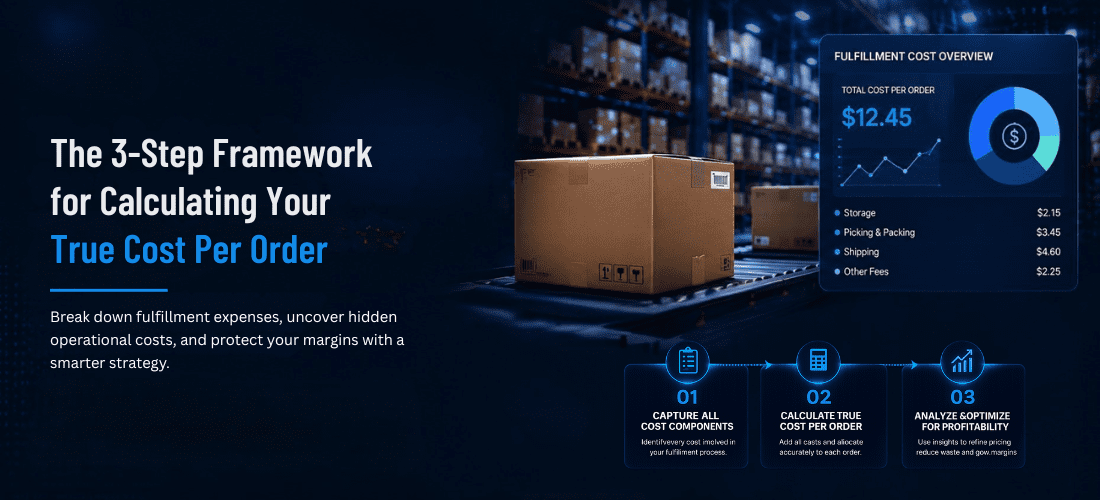
The 3-Step Framework for Calculating Your True Cost Per Order
Mastering your margins requires a move away from simple division. Most brands fail because they only look at a single month of data. This creates a skewed perspective that ignores the peaks and valleys of high-growth commerce. To get a real grip on calculating ecommerce fulfillment costs, you need a burdened view of every dollar spent to move a product from your manufacturer to your customer.
Step 1: Aggregate your logistics data. Gather every expense from the last 90 days. This includes freight-in, storage, pick and pack fees, and shipping labels. A 90-day window is the "gold standard" because it smooths out weekly anomalies while staying relevant to current carrier rates. However, for true annual forecasting, you should eventually compare this to a 12-month average to account for Q4 surcharges and seasonal dips.
Step 2: Identify the "invisible" layers. Your CPO isn’t just labor and postage. Factor in your WMS software subscriptions, warehouse insurance, and any specialized equipment like label printers or scanners. These are operational necessities that must be amortized across your total order volume to understand your true break-even point. For many growing brands, partnering with Financial Foothold for outsourced accounting ensures these complex overhead costs are tracked with precision.
Step 3: Apply the Cost Per Order (CPO) formula. Take your total logistics spend (Direct + Invisible) and divide it by your total shipped orders. Adjust this figure for seasonality by adding a buffer for peak-season surcharges, which can often spike your variable costs by 10% or more during November and December. Partnering with a professional ecommerce 3PL provider can simplify this calculation by consolidating these variables into a single, transparent dashboard.
The Multichannel Fulfillment Variance
Selling on TikTok Shop, Amazon, and Shopify simultaneously creates a "multichannel tax." Amazon has rigid prep requirements that differ from direct-to-consumer TikTok orders. You must weight your costs by platform. For example, your spend on Amazon FBA prep and multi-channel services may be higher per unit than Shopify orders, but the volume might justify the margin hit. Calculate a platform-specific CPO to see which channel is actually driving your profit.
Factoring in the "Return Tax"
Returns are a silent profit killer. With 2026 projections suggesting 15.8% of retail sales will be returned, reverse logistics must be part of your math. A 10% return rate can increase your overall CPO by up to 15% when you account for return shipping, labor for inspection, and potential disposal fees. Don’t let these costs hide in your P&L; treat every return as a variable fulfillment expense to keep your calculating ecommerce fulfillment costs accurate and actionable.
Strategic Optimization: Reducing Costs Without Sacrificing Speed
Crunching the numbers is only the first step. True mastery comes from using that data to re-engineer your operations for maximum profit. When calculating ecommerce fulfillment costs, many founders realize they’re trapped in the "founder’s trap." Every hour you spend managing tape, boxes, and warehouse staff is an hour lost on product development or high-level marketing. In-house fulfillment often looks cheaper on a basic spreadsheet, but it carries a massive opportunity cost that stunts your brand’s trajectory.
Switching to a professional ecommerce logistics provider unlocks advanced strategies like zone skipping. By placing your inventory closer to your customers in a strategic fulfillment center, you bypass expensive long-haul shipping zones. This move alone can slash your shipping spend and significantly increase delivery speed. Automation also plays a critical role. The tipping point for ROI happens when your manual labor costs exceed the cost of integrated tech solutions. Boost3PL eliminates this complexity tax, allowing you to scale without the operational friction that slows down your competitors.
Scaling with a High-Performance Strategic Ally
Professional pick and pack fulfillment services leverage massive scale to reduce your per-order labor costs. We provide a frictionless operation that protects your brand reputation and boosts customer LTV. "In 2026, the most expensive fulfillment strategy is the one that slows your ability to scale." Don’t let outdated processes become the bottleneck for your ambition. High-growth brands require a partner that moves as fast as the modern digital economy.
Next Steps: From Calculation to Execution
Take immediate action to protect your margins. Audit your current provider using the 90-day framework we established earlier. Identify the top three leaks in your pipeline, such as excessive packaging waste or slow intake times. Once you’ve identified these gaps, reach out for a strategy session. We’ll show you how Boost3PL optimizes these variables while calculating ecommerce fulfillment costs with total transparency. Turn your logistics from a cost center into a high-speed growth engine today.
Take Control of Your Brand’s Financial Future
Mastering the math of your supply chain is the ultimate competitive advantage. You’ve learned that calculating ecommerce fulfillment costs requires a deep dive into 90-day data sets and a keen eye for "invisible" overhead. By optimizing for dimensional weight and leveraging zone-skipping strategies, you transform logistics from a margin drain into a scalable engine. Every dollar you reclaim through efficiency is a dollar you can reinvest in your brand’s creative vision. It’s time to stop reacting to surprise surcharges and start driving your expansion with data-backed precision.
Stop letting operational chaos dictate your growth. We’re here to act as your high-performance strategic ally. Boost3PL provides specialized TikTok Shop and Shopify integrations alongside a professional Amazon FBA Prep Center to ensure your brand remains organized and fast. We thrive on handling the heavy lifting so you can focus on creative expansion. Our results-oriented partnership is built specifically for high-growth brands that value technological sophistication and operational excellence.
Your success is the primary metric of our performance. Let’s build something remarkable together.
Frequently Asked Questions
How much should fulfillment cost as a percentage of revenue?
Fulfillment costs typically represent between 8% and 15% of a brand’s average order value. This range includes every expense from initial receiving and storage to final mile delivery. While luxury brands with high price points might see a lower percentage, brands selling heavy or low-cost items often find their logistics spend sits at the higher end of this bracket. Keeping your costs within this range is vital for maintaining healthy margins as you scale.
What is the average cost of pick and pack fulfillment in the USA?
Pick and pack fulfillment costs depend on your order volume, item count per box, and the complexity of your kitting requirements. Most providers structure their pricing with a base order fee followed by a smaller charge for each additional item picked. Brands with high-velocity "hero products" usually see lower per-unit costs than those managing thousands of individual SKUs. Focus on finding a partner that balances speed with high accuracy to avoid the hidden costs of shipping errors.
Is it cheaper to use Amazon FBA or a third-party logistics company?
The cost effectiveness of Amazon FBA versus a third party logistics company hinges on your sales channels and inventory turnover. Amazon FBA is built for speed within their ecosystem, but their peak-season storage hikes and surcharges can be aggressive. A dedicated ecommerce 3PL provider often offers more predictable pricing for multichannel brands. This is especially true if you’re growing on Shopify or TikTok Shop where brand control and custom packaging are priorities.
What are the most common hidden fees in 3PL contracts?
Common hidden fees include account management charges, API integration fees, and unexpected surcharges for receiving non-compliant shipments. Many founders miss these "silent killers" when calculating ecommerce fulfillment costs during the initial vetting process. You should also watch for dimensional weight adjustments and peak-season fuel surcharges that aren’t always highlighted in a basic quote. Demand a transparent, fully burdened cost model to ensure your brand’s profitability remains protected year-round.
East Coast 3PL: The Strategic Advantage for High-Growth Brands in 2026
05/06/2026
Did you know that over 70% of the U.S. population is reachable within a 1 to 3 day ground shipping window from a single east coast 3pl? As the US 3PL market hits a projected $227.69 billion in 2026, high-growth brands are rapidly shifting their inventory away from West Coast bottlenecks. You likely feel the sting of the 5.9% FedEx rate increase and the constant pressure to maintain Amazon FBA compliance while scaling on TikTok Shop. It’s frustrating to watch your hard-earned margins vanish into cross-country shipping fees when your customers expect neighborhood speed.
We believe your logistics should be a competitive engine, not a source of anxiety. This article reveals how a strategic East Coast presence can slash your domestic shipping costs by up to 25% and provide the scalable infrastructure you need for aggressive expansion. You’ll learn exactly how to integrate your Shopify and social commerce channels into one seamless, automated operation. We’ll also preview the critical 2026 port trends and regulatory shifts that make the Eastern Seaboard the most reliable hub for your brand’s future. It’s time to boost your delivery speed and reclaim your focus on the creative goals that drive your business forward.
Key Takeaways
Leverage proximity to the most populated U.S. regions to dramatically reduce shipping zones and accelerate last-mile delivery times.
Identify the essential tech integrations needed to create a seamless, automated fulfillment engine across Shopify, TikTok Shop, and Amazon.
Optimize your multichannel strategy by combining expert FBA prep with high-speed FBM fulfillment to win the Buy Box and boost customer trust.
Discover why a high-performance east coast 3pl serves as the ultimate strategic hub for both national market dominance and international expansion.
##The Strategic Advantage of an East Coast 3PL in 2026
Speed wins in 2026. If you want to dominate the U.S. market, you have to go where the people are. An east coast 3pl puts your inventory within a 1 to 3 day ground shipping radius of 70% of the American population. This isn’t just about speed; it’s about survival. Shipping from California to New York in 2026 means facing a 5.9% FedEx rate hike and crossing eight shipping zones. By positioning your Brand on the Eastern Seaboard, you slash those zones down to one or two. This shift can reduce your domestic shipping costs by 25%, allowing you to reinvest that capital into your growth strategies.
Understanding What is a 3PL? is the first step toward building a resilient supply chain. A strategic partner does more than store boxes. They optimize your dock-to-stock timeline by leveraging proximity to major infrastructure. With the Port of New York and New Jersey handling record container volumes, your inventory moves from the ocean to the warehouse floor faster than ever. This rapid intake is vital for maintaining stock levels during viral TikTok trends or high-traffic Shopify sales events. Consider these strategic benefits of Eastern port access:
Accelerated Receiving: Shorter drayage distances from port to warehouse.
Inventory Resilience: Diversified import routes to avoid West Coast labor or congestion delays.
Cost Efficiency: Lower freight costs for goods arriving from European and Atlantic trade lanes.
Optimizing the Last-Mile for Eastern Seaboard Customers
Last-mile delivery is the final movement of goods from a fulfillment hub to the customer’s doorstep, which determines the speed and quality of the Brand’s first physical impression. In 2026, 1 to 2 day delivery is the baseline, not a luxury. When your Brand delivers this quickly, customer satisfaction scores climb and repeat purchase rates follow. We provide the high-performance infrastructure to turn your logistics into a loyalty engine that keeps customers coming back.
A Gateway for International Brand Expansion
Choosing an east coast 3pl also offers a unique Time Zone advantage for global scaling. It acts as the perfect hub for brands utilizing a uk fulfilment service. You can manage your U.S. and UK operations within the same business day, ensuring seamless communication across the Atlantic. This proximity to major transatlantic shipping lanes streamlines your cross-border logistics and accelerates your entry into European markets. Boost your global presence by starting where the world connects.
##How to Evaluate an East Coast Fulfillment Partner: The 2026 Framework
Your choice of an east coast 3pl defines your brand’s growth ceiling in 2026. With over 72,937 logistics businesses operating in the U.S., you can’t afford a partner who treats your inventory like a commodity. You need a strategic ally. Start by auditing their tech-stack compatibility. A modern provider must offer native, real-time integrations with Shopify, TikTok Shop, and Amazon. If they don’t, you’ll find yourself drowning in manual data entry and inventory discrepancies that kill your momentum.
Assess their ability to handle complexity at scale. Can they pivot from a high-volume TikTok Shop launch to acting as your Amazon FBA prep center within the same afternoon? This multichannel flexibility is what separates legacy warehouses from high-performance leaders. We recommend you evaluate your fulfillment strategy through the lens of partnership, looking for a team that prioritizes your success as their primary metric. Look for a partner that proactively communicates during seasonal spikes, ensuring your accuracy and speed never falter.
Technology and Real-Time Inventory Visibility
Reliable data is the backbone of any scaling brand. You need warehousing and inventory management services that provide 24/7 visibility into your stock levels. This transparency allows you to make informed decisions about restocks and marketing spend without the guesswork. Leverage automated kitting and bundling to boost your Average Order Value (AOV). By grouping products into kits, you create an elevated customer experience while maximizing your fulfillment efficiency across every sales channel.
Compliance and Marketplace Expertise
Marketplace rules are getting stricter. In 2026, TikTok Shop and Amazon have zero tolerance for shipping delays or packaging errors. This makes expert pick and pack fulfillment a non-negotiable requirement for brand protection. Your partner must understand the nuances of Amazon FBM fulfillment and FBA compliance to protect your account health. Accuracy isn’t just a metric; it’s the guardian of your reputation and your customer’s trust in a competitive economy.
##Maximizing Growth with Multichannel East Coast 3PL Services
Fragmentation is the enemy of scale. Managing separate inventory pools for Shopify, TikTok Shop, and Amazon creates chaos that stifles your growth. A high-performance east coast 3pl acts as your single source of truth, synchronizing every order into one seamless flow. This centralized hub allows you to deploy "Boost" strategies, such as inventory pooling, which ensures you never miss a sale on one platform while stock sits idle on another. By unifying your operations, you eliminate the logistical heavy lifting that keeps most founders trapped in the weeds of daily shipping.
Winning the Amazon Buy Box in 2026 requires more than just a good price; it demands flawless fulfillment speed. Our infrastructure positions your Brand to meet the most aggressive delivery promises, giving you a distinct edge over competitors shipping from distant regions. Integrating with a premier fulfillment center usa strategy transforms your logistics from a cost center into a growth engine. You gain the freedom to focus on creative strategy and market expansion while we handle the complex mechanics of national dominance.
The TikTok Shop Revolution and Fulfillment Speed
TikTok Shop changed the rules of engagement in 2026. The platform’s rigorous shipping requirements demand that orders are processed and tracking numbers uploaded within hours, not days. An east coast 3pl is essential for surviving viral product moments. When a creator’s video sends thousands of customers to your shop, our automated systems trigger immediate action. We ensure your account health remains pristine by meeting every deadline, allowing you to capitalize on social commerce trends without the fear of platform penalties.
Scaling Beyond the Warehouse
Stop thinking about packages and start thinking about your Brand. A dedicated logistics partner views themselves as the guardian of your reputation. Every order we ship is a physical touchpoint that builds long-term customer trust and brand equity. Seamless logistics ensure that the excitement a customer feels at checkout is matched by the speed and quality of the delivery. This reliability is what turns a one-time buyer into a lifelong advocate, providing the stable foundation you need to scale your business into a household name.
##Accelerate Your Brand’s National Expansion
The logistics landscape of 2026 demands more than just storage; it requires a high-performance engine for growth. By leveraging a strategic east coast 3pl, you position your Brand to reach 70% of the U.S. population within three days while slashing shipping costs by up to 25%. You’ve seen how regional proximity and advanced port access transform dock-to-stock times. The real power lies in the technology that unifies your sales channels. Whether you’re navigating the 5.9% FedEx rate hike or the strict compliance of TikTok Shop, your fulfillment partner must act as a guardian of your reputation.
It’s time to stop managing boxes and start scaling your vision. We provide the expert multichannel integration and dedicated Amazon FBA Prep Center services you need to thrive. Our strategic partnership model focuses on your success as the ultimate metric, removing the logistical heavy lifting from your plate. Before you commit to a provider, explore our comprehensive guide to the top 3PL USA companies for 2026 to ensure you’re selecting the right strategic ally for your brand’s growth. Boost your brand with seamless East Coast fulfillment today and secure your place at the forefront of the digital economy. Your customers are waiting; let’s deliver the speed and reliability they deserve.
##Frequently Asked Questions
What are the primary benefits of using an East Coast 3PL for ecommerce?
An east coast 3pl offers a strategic advantage by placing your inventory at the heart of the most densely populated region in the United States. This positioning allows you to reach the majority of your customers within 48 hours while significantly reducing the number of shipping zones your packages must cross. By minimizing these distances, you protect your margins against rising carrier rates and ensure a faster, more reliable customer experience that drives repeat business and brand loyalty.
How does an East Coast fulfillment center improve shipping times for UK-based brands?
For UK-based brands, an East Coast fulfillment center provides the fastest transit times for inventory arriving via Atlantic shipping routes. This proximity to major Eastern ports like New York and New Jersey accelerates the dock-to-stock process, getting your products ready for sale days faster than other regions. Additionally, the five-hour time difference makes it much easier to manage daily operations and communicate with your partner during standard business hours; this ensures your global supply chain remains synchronized.
Can an East Coast 3PL handle Amazon FBA prep and FBM orders simultaneously?
Yes, a professional east coast 3pl can manage both Amazon FBA prep and FBM orders from a single inventory pool. This multichannel approach allows you to maintain strict FBA compliance while simultaneously fulfilling orders directly to consumers from your own warehouse stock. By consolidating your inventory, you avoid the complications of splitting stock across multiple locations and ensure your Brand remains resilient across all marketplace platforms, including Shopify and TikTok Shop.
Is an East Coast 3PL more expensive than fulfillment in other US regions?
While warehouse lease costs in coastal markets are often 30% to 60% higher than in the Midwest, the total cost of fulfillment is frequently lower. The savings generated by reduced shipping zones and shorter last-mile delivery distances typically outweigh the higher rent. When you calculate the all-in cost per order, the East Coast remains a highly competitive location for brands that prioritize speed and want to reach the most active consumer markets in the country without excessive freight spend.
What is dropshipping & does it work in 2026?
03/25/2026
What if your fulfillment center pricing was a high-octane engine for growth rather than a black hole of ‘nickel-and-diming’ fees? You’ve likely watched with frustration as 18% of your gross margin vanishes into opaque invoices and unpredictable surcharges. It’s an exhausting reality for founders who manage complex multichannel sales across Shopify and TikTok while trying to keep logistics spend under control. You deserve a partner that treats your inventory like a high-growth Brand, not just a series of boxes to be moved through a warehouse.
We’re here to help you master the 2026 landscape of 3PL fee structures so you can transform every line item into a strategic advantage. You’ll discover how to secure lower shipping rates through volume aggregation and build a predictable pricing framework that protects your bottom line. This guide breaks down the exact steps to Boost your operational efficiency and ensure your fulfillment process is as seamless as your customer experience.
Key Takeaways
Master the Total Cost of Fulfillment (TCO) formula to uncover hidden administrative fees and protect your brand’s bottom line.
Decode the 2026 fulfillment center pricing landscape by identifying the true costs of API integration and SKU mapping during onboarding.
Compare “All-in-One” and “Pay-as-you-Go” models to determine which structure scales best with your seasonal peaks and viral growth.
Learn how to slash carrier fees through strategic packaging engineering and optimized inventory placement across key US regions.
Boost your operational efficiency by connecting your Shopify or TikTok Shop to a seamless, tech-first logistics partner built for scale.
Decoding the Total Cost of Fulfillment (TCO) in 2026
Stop chasing the lowest bid. In 2026, savvy founders know that a bottom-dollar quote usually masks a high-friction operation. You need to master the Total Cost of Fulfillment (TCO) to scale your brand with confidence. TCO is a simple but brutal calculation; take your total logistics expenses and divide them by your total volume of orders. This number tells the real story of your fulfillment center pricing strategy. With labor costs projected to rise by 4.2% this year alone, efficiency is your only shield against margin erosion.
The Hidden Costs of ‘Cheap’ Fulfillment
A $1.50 pick and pack fee looks great on a PDF. If that low rate comes with a 95% accuracy level, you’re actually bleeding cash. A single shipping error costs an average of $35 to rectify when you factor in return shipping, warehouse labor, and lost inventory value. If your Fulfillment house takes four days to ship an order, your customer service team will face a 22% spike in “Where is my order?” tickets. These hidden administrative burdens drain your focus and your bank account. Total Cost of Fulfillment (TCO) stands as the ultimate metric for e-commerce profitability in 2026.
Slow Shipping Speeds: Every extra day in transit increases the likelihood of a return by 8%.
Accuracy Penalties: Marketplace giants like Amazon and TikTok Shop slash your visibility by up to 30% if your late shipment rate exceeds 1%.
Administrative Bloat: Cheap providers often lack transparency, forcing you to spend 10 hours a week auditing invoices for hidden surcharges.
Why Founders Must Look Beyond the Quote
Don’t confuse the sticker price with your landed fulfillment cost. The sticker price is what the 3PL says they charge; the landed cost is what you actually pay after surcharges, fuel adjustments, and packaging markups. Labor costs have surged by 18% over the last three years, forcing many legacy providers to hide their margins in complex fee structures. Boost your brand by choosing a partner with a scalable pricing model that breathes with your business. If your orders jump from 500 to 5,000 during a Black Friday surge, your fulfillment center pricing should reward that growth, not punish it with emergency handling fees.
Automated technology integrations are no longer optional. Manual data entry creates a $2.15 drag on every order, while a seamless API connection cuts that overhead to zero. Modern 3PLs that use Autonomous Mobile Robots (AMRs) reduce error rates by 99.9%, ensuring your reputation remains spotless. High-performance brands prioritize reliability over the initial quote because they understand that a seamless operation is the cheapest operation in the long run. When your logistics are organized and fast, you stop managing fires and start managing growth. This is how you win in the 2026 digital economy.
The 3PL Fee Breakdown: Every Line Item Explained
Transparency is the bedrock of a successful partnership. To master your fulfillment center pricing, you must look past the aggregate monthly bill and scrutinize the individual line items. Most high-growth brands encounter a one-time onboarding fee ranging from $500 to $2,500. This isn’t just a “welcome” charge. It covers the technical heavy lifting of API integrations between your storefront and the warehouse management system (WMS). It also includes SKU mapping to ensure 100% data sync across your sales channels. Getting this right on day one prevents the technical friction that stalls scaling efforts later.
Receiving and intake fees typically follow a per-man-hour or per-pallet structure. Standard rates hover around $40 per hour for unloading and inspection. If your manufacturer sends non-compliant inventory without proper barcodes, expect “special project” surcharges that can increase intake costs by 50%. Precision at the dock is vital. Modern brands rely on 99.9% receiving accuracy to maintain trust. Research highlights that the rising costs of omnichannel order fulfillment now account for nearly 20% of total sales for many retailers. Controlling these inbound variables is your first line of defense.
Storage fees are where many brands lose their momentum. 3PLs generally offer two models: pallet-based or cubic-volume pricing. Pallet pricing is ideal for bulk inventory, while cubic pricing ensures you only pay for the exact space your individual units occupy. This is critical for small, high-value items. You should also watch for long-term storage fees. SKUs that sit for more than 180 days often trigger penalty rates, effectively turning your inventory into a liability rather than an asset.
Fulfillment fees, or “Pick and Pack” charges, represent the core of your operational spend. A standard structure includes a base fee for the first item (often $2.50 to $3.50) and a smaller incremental fee for each additional item in the same box. Shipping rates then complete the equation. By leveraging the massive carrier volume of a 3PL, you can access discounted Zone-based pricing that is impossible to secure as an independent shipper. Moving from Zone 1 to Zone 8 can double your costs, so strategic warehouse placement is a non-negotiable for national reach. Brands expanding into wholesale channels should also explore b2b order fulfillment services to understand how retailer compliance requirements and LTL freight costs add another layer to your total fulfillment spend.
Inbound Logistics and Inventory Management
Efficiency starts the moment the truck arrives. Standard receiving fees cover the basics; however, disorganized shipments lead to costly delays. You must prioritize storage optimization to protect your bottom line. Slow-moving SKUs are silent killers that drain capital every month they remain on the shelf. Use real-time inventory tracking to identify these bottlenecks before they impact your cash flow. This data-driven approach prevents stockouts and ensures your Brand remains reliable in the eyes of your customers. You can optimize your shipping spend by auditing these inbound processes quarterly.
Outbound Execution: Pick, Pack, and Ship
Order complexity dictates your daily expenses. A single-item order is straightforward, but multi-item orders require sophisticated logic to choose the right box size and packing material. Custom brand-centric kitting adds an elevated touch but usually carries a $1.00 to $3.00 surcharge per unit. Don’t overlook reverse logistics. Returns management involves a separate fee structure for inspection and restocking, often costing 1.5x the original pick fee. A seamless outbound strategy balances these costs with the premium experience your customers expect.
Comparing Fulfillment Pricing Models: Finding Your Fit
Choosing the right fulfillment center pricing model determines whether your margins thrive or dive. Most startups begin with the All-in-One model. It’s predictable. You pay a single bundled fee for receiving, picking, packing, and shipping. This simplicity helps brands shipping under 450 orders per month manage their cash flow without surprises. However, 28% of scale-ups find these bundles lack the transparency needed for deep optimization. You can’t see the specific costs of packaging versus labor, which hides potential savings as you grow.
The Pay-as-you-Go model offers the ultimate flexibility. It’s built for the 72% of TikTok brands that experience sudden viral spikes. You don’t pay for empty shelf space or idle labor. You only pay for the exact volume you move. If you ship 10,000 units in 48 hours, you pay for that surge. If you ship zero the next week, your costs drop to nearly nothing. It’s a lean approach that protects your capital.
High-volume brands typically graduate to Tiered Pricing. Once you exceed 5,000 monthly shipments, your per-unit costs should decrease. This structure leverages Economies of Density in E-Commerce to pass savings directly to the Brand. By consolidating high volumes within a specific region, a 3PL reduces the logistical friction per package. This data-driven analysis shows that as your density increases, your fulfillment center pricing should reflect that efficiency.
Flat-Rate Fulfillment serves specific niches perfectly. If your product category involves heavy items like 15lb fitness equipment, flat rates protect you from zone-based shipping spikes. Brands in the heavy-goods sector saved an average of 19% on shipping costs in 2023 by switching to flat-rate models. It removes the complexity of weight-based calculations and replaces it with a steady, manageable cost per box.
Transactional vs. Partnership Pricing
High-growth brands demand more than just a vendor; they need a strategic ally. Transparent, line-item billing is the foundation of this relationship. We call this the Boost factor. When your 3PL provides itemized invoices, you can identify exactly where to trim the fat. 94% of our partners prefer this over “black box” bundles because it aligns incentives. If we find a way to reduce your packaging costs by 12%, your Brand grows faster. When you grow, we grow. This transparency ensures your 3PL is motivated to optimize your operations, not just bill you for them.
Cross-Border Nuances: US vs. UK Pricing
Expanding your Brand internationally requires a shift in how you view fulfillment center pricing. In the UK, you must account for a 20% VAT and specific customs duties that don’t exist in the US domestic market. A dual-warehouse strategy is the most efficient way to scale. By utilizing facilities in North Bergen and Bedford, you place inventory within 2 days of 90% of your customers in both regions. This setup slashed transit times by 4 days for our international partners last year. By placing inventory in regional hubs closer to the customer, brands minimize DIM weight surcharges and avoid the high costs of long-zone shipping. It turns a complex global supply chain into a seamless, local experience for every customer.
Strategic Optimization: How to Lower Your Fulfillment Spend
Strategic fulfillment isn’t just about moving boxes. It’s about protecting your bottom line. You can’t control carrier rate hikes, but you can control how your brand interacts with those costs. Smart brands treat fulfillment center pricing as a variable they can manipulate through data and engineering. By optimizing the physical and digital aspects of your supply chain, you turn a cost center into a competitive advantage.
Start with inventory placement. Data from the 2020 US Census confirms that approximately 60% of the US population lives east of the Mississippi River. If your inventory sits exclusively in a West Coast warehouse, you’re paying Zone 8 prices to reach the majority of your customers. Shifting stock to East Coast hubs slashes transit times and drops shipping costs by an average of 22% per package. Speed wins customers; low zones win margins.
Kitting and bundling offer another high-impact lever. Every order carries a base pick-and-pack fee. When you bundle three items into a single SKU, you dilute that fixed cost across a higher Average Order Value (AOV). Instead of paying three separate fulfillment fees, you pay one slightly higher kitting fee. This strategy successfully increased margins for 34% of high-growth e-commerce brands last year by reducing the total percentage of revenue lost to logistics.
The Power of Packaging and DIM Weight
Carriers charge for the space you occupy, not just the weight you ship. This is Dimensional (DIM) weight. A single inch of unnecessary “air” in your packaging can trigger a 15% to 20% spike in shipping costs. We recommend a “Golden SKU” analysis to identify your top 10% most frequent orders. Engineering custom-fit, eco-friendly packaging for these specific items eliminates wasted space. You save money on corrugated materials and carrier fees simultaneously. It’s a double win for your brand’s sustainability and its bank account.
Leveraging Multichannel Efficiencies
Fragmented inventory is a silent profit killer. When you sync Shopify, TikTok Shop, and Amazon into a single inventory pool, you eliminate stockouts and overstocking. This visibility is vital for avoiding the “Amazon Penalty.” Amazon recently introduced low-inventory-level fees that can drain your profits if you don’t maintain specific weeks of supply. Using a dedicated FBA prep center allows you to feed Amazon exactly what it needs while keeping the rest of your stock available for other channels. Evaluating the best ecommerce fulfillment companies for your multichannel strategy ensures you select a partner with the technology and infrastructure to keep every sales channel synchronized and profitable.
Automate everything: Manual data entry errors cost brands between $35 and $50 per order in labor and returns.
FBM Flexibility: Use Fulfillment by Merchant (FBM) during FBA capacity limits to keep your listings active.
Real-time Sync: Reduce overselling by utilizing software that updates stock levels across all platforms every 60 seconds.
Efficiency doesn’t happen by accident. It happens through fulfillment center pricing models that reward smart volume and tight operations. When you optimize your packaging and sync your channels, you stop reacting to fees and start dictating your growth. You deserve a partner that treats your inventory like the revenue-generating asset it is.
Scaling with Boost3PL: Seamless Pricing for Modern Brands
Stop overcomplicating your overhead. Most logistics providers bury their costs in 20-page contracts filled with fuel surcharges and administrative fees. Boost3PL operates differently. We’ve built a model centered on transparent fulfillment center pricing that scales exactly when you do. You get results-oriented logistics without the guesswork. Our team eliminates the friction of hidden line items. We believe that if you can’t predict your margins, you can’t grow your business. That’s why our billing is clear, concise, and focused on your bottom line.
Our advanced tech integration removes the headache of manual data entry. We’ve engineered deep connections for Shopify and TikTok Shop that sync in real-time. This means your inventory levels update instantly across every sales channel. You won’t oversell; you won’t lose customers to stockouts. We treat your brand’s reputation as our own because we know a single late package can kill a customer’s lifetime value. Speed is our standard. Our systems are designed to process orders the moment they hit the dashboard, ensuring your customers receive their purchases faster than the competition.
The partnership promise at Boost3PL goes beyond simple pick and pack services. We act as a high-performance strategic ally for your business. We handle the logistical heavy lifting so you can focus on creative direction and market expansion. Whether you’re managing 50 SKUs or 5,000, our infrastructure supports your ambition. We provide the stability of a veteran firm with the agility of a startup partner. You aren’t just another account number in a database; you’re a brand we’re committed to elevating. Before committing to any provider, founders should understand exactly what to look for in an ecommerce fulfillment partner to ensure their logistics infrastructure can scale alongside their brand’s ambitions.
Why Boost3PL is the Strategic Ally for Founders
Global reach requires more than just a single warehouse in the middle of nowhere. We strategically positioned our facilities on the US East Coast and throughout the UK to slash transit times for international orders. Since our founding in 2018, we’ve mastered the nuances of being an Amazon FBA Prep Center and a high-volume FBM provider. This dual expertise allows you to pivot between sales channels without moving your inventory twice.
Our “Brand-First” approach ensures every unboxing feels like a premium event. We don’t believe that high-quality kitting should break the bank. We offer custom packaging solutions and inserts that maintain a 99.8% accuracy rate. By optimizing the physical touchpoint of your product, we help you drive repeat purchases and organic social media mentions. Your fulfillment center pricing stays predictable while your brand equity grows through superior customer experiences.
Ready to Boost Your Fulfillment?
Scale your operations without adding headcount or leasing expensive square footage. Since 2018, we’ve helped hundreds of e-commerce brands navigate the complexities of cross-border commerce and rapid scaling. We don’t just move boxes; we optimize your entire supply chain for maximum efficiency. Our team understands the unique pressures of the digital-native economy. We provide the calm, controlled, and highly efficient solution to the inherent chaos of shipping. It’s time to stop worrying about logistics and start focusing on your next product launch.
Take the next step toward a leaner, faster supply chain. Get your custom fulfillment pricing quote today! We will build a strategy tailored to your exact SKU count and monthly order volume. Let’s integrate your store and start scaling your brand with the precision it deserves.
Future-Proof Your Brand’s Growth Strategy
Logistics in 2026 requires a radical shift from passive shipping to active cost management. Success hinges on mastering your Total Cost of Fulfillment and eliminating the 12% margin leak often found in opaque fee structures. By optimizing your 3PL line items today, you capture more market share while competitors struggle with 20% higher overhead. Fulfillment center pricing is no longer just a line item; it’s the foundation of your global scalability.
Boost3PL provides the high-performance infrastructure founders need to dominate. We offer strategic warehouse locations across 5 key regions in the US and the UK to slash transit times by 48 hours. Our technology provides 100% seamless integrations for Shopify and TikTok Shop, ensuring inventory stays synced across every high-growth channel. If you’re expanding on marketplaces, our dedicated Amazon FBA Prep expertise removes the friction of strict compliance. We handle the logistical heavy lifting so you focus on 10x growth.
What is the average cost of fulfillment per order in 2026?
The average cost of fulfillment per order in 2026 is projected to range between $8.45 and $13.20. This estimate includes the combined costs of labor, packaging materials, and carrier postage. According to the 2024 Supply Chain Outlook, inflationary pressures on warehouse wages will drive these figures up by 5% annually. Plan your margins now to ensure your brand remains profitable as these operational costs evolve.
How do fulfillment centers charge for storage?
Fulfillment centers charge for storage based on the physical space your inventory occupies, usually measured in pallets or cubic feet. A standard 48 by 40 inch pallet typically costs $18 to $28 per month in a modern facility. Boost3PL uses real-time tracking to optimize your footprint. This ensures you only pay for the space you actually use, keeping your fulfillment center pricing lean and scalable.
Are there hidden fees I should look for in a 3PL contract?
Identify hidden fees like account management charges, packaging surcharges, and SKU maintenance fees before signing any agreement. Some contracts include a $300 monthly minimum or a 2% annual technology fee that isn’t always advertised. Always ask for a transparent breakdown of every possible line item. We prioritize a seamless partnership by eliminating these surprise costs, allowing you to focus on scaling your creative vision.
Is it cheaper to use Amazon FBA or a 3PL for multichannel fulfillment?
A 3PL is roughly 18% more cost-effective than Amazon FBA for multichannel fulfillment. While FBA is efficient for Prime, their Multi-Channel Fulfillment rates are significantly higher for Shopify or eBay orders. Switching to a dedicated partner allows you to maintain a consistent brand experience. You’ll avoid the $0.50 to $1.00 per-item out of network surcharges Amazon often applies to non-Amazon orders.
What is the difference between pick and pack fees and shipping fees?
Pick and pack fees cover the physical labor of selecting items and boxing them, while shipping fees are the postage costs paid to carriers. Pick and pack usually starts at $2.75 for the first item in an order. Shipping fees vary by weight and distance, often calculated using 2024 dimensional weight rules. Distinguishing these helps you accurately calculate your total fulfillment center pricing and maintain your bottom line.
How much does a 3PL charge for returns processing?
Processing a return typically costs between $3.50 and $6.00 per order. This fee covers the labor required to inspect the item, refurbish the packaging, and restock it into your active inventory. Since 25% of online purchases are returned, having an automated system is essential. Our seamless process gets your products back on the shelf in under 24 hours to maximize resale value and recover revenue quickly.
Does Boost3PL offer discounted shipping rates for small businesses?
Boost3PL offers small businesses the same deeply discounted shipping rates usually reserved for enterprise brands shipping 100,000 units per month. We leverage our aggregate volume to negotiate 35% to 45% off standard carrier rates. This allows your brand to compete with larger retailers immediately. You get instant access to these savings through our automated platform without needing to negotiate your own complex carrier contracts.
What are setup or integration fees, and are they negotiable?
Setup fees generally range from $750 to $3,000 and cover the technical integration of your e-commerce platforms. These fees are often negotiable if you sign a long-term agreement or meet specific volume thresholds. We view this as an investment in our partnership. For brands moving 1,500 orders monthly, we frequently waive these integration costs to get your fulfillment running at peak performance faster.

 08/20/2026