
Schedule a Call

Tag: supply chain management

Dunnage and Void Fill Best Practices: The 2026 Guide for Scaling Brands

What if your packaging was a strategic profit lever rather than a hidden tax on your growth? With the global dunnage market projected to reach $4.68 billion in 2026, high-growth brands are moving beyond simply stuffing boxes. They are mastering dunnage and void fill best practices to protect their margins and their reputations simultaneously. You likely feel the sting of inflated DIM weight charges or the dread of customer complaints about damaged goods and excessive, messy plastic. These operational hurdles don’t just cost money; they create friction in your customer’s experience and slow down your ability to scale.

We believe your fulfillment process should be a frictionless extension of your brand’s quality. This guide will show you how to achieve zero-damage shipments while navigating new 2026 regulations like California’s SB 343 labeling laws. We’ll break down how to choose high-performance materials that reduce costs and impress your customers. You will learn to optimize your box sizes, stay compliant with evolving environmental standards, and turn every unboxing into a premium brand moment. It’s time to build a supply chain that’s as fast and sophisticated as your business.

Key Takeaways

  • Distinguish between structural dunnage and space-filling void fill to build a high-performance, multi-layered protection strategy for your inventory.
  • Deploy a Fragility Matrix to precisely match materials like hex-wrap or air pillows to your product’s specific protection requirements and risk profile.
  • Master dunnage and void fill best practices by implementing the “Two-Inch Rule” to eliminate transit damage and safeguard your brand reputation.
  • Standardize packing protocols across your entire fulfillment team to ensure every customer receives a consistent, premium unboxing experience as you scale.
  • Optimize your material volume to reduce DIM weight charges and slash shipping costs without sacrificing the structural integrity of your packaging.

Dunnage vs. Void Fill: Defining the Foundation of Secure Shipping

Mastering dunnage and void fill best practices begins with understanding that these two terms are not interchangeable. They serve distinct, critical roles in your supply chain. Dunnage refers to the structural materials used to pad, brace, and protect your items from direct impact. It’s the cushioning that absorbs shock. Void fill, conversely, is the material used to occupy empty space inside a box. Its primary job is to prevent your product from shifting during transit. If your product moves, it breaks. If it lacks padding, it crushes.

In 2026, high-velocity automated sortation systems are the industry standard. Your packages will face rapid acceleration, sharp turns on conveyor belts, and heavy stacking in delivery vehicles. A “multi-layer” approach is now essential for high-value or fragile goods. This means using dunnage to wrap the product and void fill to lock it in place. This dual strategy maintains the structural integrity of the shipping box itself. When a box stays rigid, the product inside stays safe. This isn’t just about logistics; it’s about brand health. Every damaged item is a missed opportunity for customer retention and a direct hit to your bottom line.

The Hidden Cost of Air: Why DIM Weight Matters

Shipping carriers don’t just charge you for how much your package weighs. They charge you for the space it occupies. This is Dimensional (DIM) Weight. If you use a massive box for a small item, you’re paying to ship air. Excessive void fill is often a symptom of poor box selection. You can slash your shipping spend by auditing your packaging efficiency. Our warehousing and inventory management services help brands analyze their SKU dimensions to select the smallest possible footprint. Aim for a snug fit. This reduces the need for filler and keeps your shipping costs lean and competitive.

Dunnage as a Reputation Guardian

Think of dunnage as the insurance policy for every order you ship. It’s the final line of defense between a successful delivery and a costly return. When a customer opens a perfectly secured package, it triggers an immediate sense of trust. It proves you’re a professional, high-performance brand that cares about the details. A messy or damaged unboxing experience does the opposite. It creates friction and doubt. By prioritizing superior protection, you’re not just moving boxes. You’re delivering a promise of quality that keeps customers coming back.

Material Selection: Matching Your Dunnage to Your Product Profile

Selecting the right materials is a high-stakes decision for your margins. You can’t just throw bubble wrap at every SKU and expect to scale. Modern dunnage and void fill best practices require a data-driven approach that balances protection with sustainability. In 2026, consumers demand curbside-recyclable options. This shift has made kraft paper and hex-wrap the preferred choices for digital-native brands. These materials provide excellent shock absorption without the environmental guilt of plastic. For brands shipping internationally, adhering to International Safe Transit Association (ISTA) standards ensures your packaging survives the global supply chain’s rigors.

Your material choice should follow a Fragility Matrix. Non-fragile items like apparel only need lightweight void fill to prevent shifting. Semi-fragile goods require cushioning to absorb vibrations. High-fragility items, such as electronics or glassware, demand rigid blocking and bracing. If you’re selling on marketplaces, remember that our Amazon FBA prep services follow strict dunnage requirements. Using unapproved materials can lead to warehouse rejections and costly delays. Choosing the right partner for pick and pack fulfillment ensures these standards are met every time.

Lightweight Solutions for High-Volume Brands

Air pillows and paper dunnage are the heroes of high-volume shipping. They add negligible weight to your parcels, keeping your DIM weight charges under control. On-demand systems allow us to generate this filler only when needed. This maximizes space in a 3PL warehouse environment, leaving more room for your actual inventory. Implementing these dunnage and void fill best practices ensures you aren’t paying for excess weight or wasted warehouse square footage.

Heavy-Duty Protection for Fragile Shipments

Fragile inventory requires a more robust defense. Custom corrugated inserts offer a premium, organized look while locking items in place. For high-value luxury goods or specialized security tools like those from Lockpick Pros, we often recommend a “box-in-box” method. This creates an extra layer of impact protection and conceals the contents from prying eyes. Foam-in-place is another powerful tool for complex shapes, providing a custom-molded shield that prevents any internal movement during the roughest transit cycles.

Operational Best Practices for Scalable Packing

Scaling your brand requires more than just high-quality products. You need repeatable, efficient systems at the packing station. Implementing dunnage and void fill best practices ensures that your protection strategy scales as fast as your order volume. Start with the “Two-Inch Rule.” This standard requires at least two inches of cushioning between your product and the box walls on every side. It creates a critical buffer zone. By applying packaging science principles, you ensure that external shocks are absorbed before they reach your inventory.

Consistency is your greatest ally. Standardize your packing protocols across every shift. Every worker should know exactly how much paper or how many air pillows to use for each SKU. Use data from your pick and pack fulfillment reports to monitor damage rates. If a specific product consistently arrives broken, your protocol needs an update. Our multichannel fulfillment services help you maintain this brand-consistent packaging across all platforms. This ensures your identity remains intact regardless of where your customer shops.

The “Shake Test” and Beyond: Quality Control

Don’t guess; verify. Once a box is sealed, perform the “shake test.” If you hear movement inside, you need more void fill. It’s a simple, low-tech way to prevent transit damage. For new product launches, go a step further. Conduct periodic drop-tests from a height of three feet onto different box corners. This simulates real-world carrier handling and validates your dunnage and void fill best practices before you ship thousands of units. Performance testing is the only way to guarantee your strategy works under pressure.

Designing the Perfect Unboxing Experience

Protection doesn’t have to be ugly. Use branded tissue or custom-printed paper dunnage to turn a logistics necessity into a marketing win. It elevates the customer’s first physical interaction with your brand. However, avoid the trap of “over-packing.” Excessive layers of plastic or impossible-to-open tape create customer frustration and environmental waste. Aim for a frictionless, premium unboxing that feels intentional and efficient. Wellness brands like Bitter Boost understand that your packaging should reflect the sophistication of the product inside, not the chaos of the warehouse.

Secure Your Growth with Strategic Fulfillment

Your shipping strategy is a direct reflection of your brand’s commitment to excellence. By mastering the distinction between structural protection and space-filling, you’ve already taken the first step toward a more efficient supply chain. Implementing these dunnage and void fill best practices allows you to eliminate the friction of transit damage while optimizing your shipping spend. You don’t have to choose between a premium unboxing experience and your bottom line; with the right systems, you can achieve both.

Success in the modern digital economy requires a partner that moves as fast as you do. Boost3PL provides the technological sophistication and operational reliability you need to scale with confidence. With 99.9% shipping accuracy and strategic US-based warehouse locations, we ensure your products arrive exactly as intended. Whether you need expert Amazon FBA prep or seamless multichannel support, we’re here to handle the complexity so you can focus on your creative vision. We treat your reputation as our own, acting as a guardian of your customer experience at every step.

Partner with Boost3PL for frictionless, damage-free fulfillment and turn your logistics into a competitive advantage. Your next stage of growth starts here. Let’s build something remarkable together.

Frequently Asked Questions

What is the most cost-effective dunnage for ecommerce?

Recycled kraft paper is the most cost-effective solution for most scaling brands. It offers a low cost-per-unit and high versatility for wrapping, padding, or crumpling into void fill. Air pillows are a strong second for high-volume operations because they store flat and minimize inbound shipping costs for your warehouse. Choose the material that minimizes your total landed cost while meeting your fragility requirements.

How much void fill do I actually need per box?

You need exactly enough to prevent any internal shifting while maintaining a two-inch buffer for structural protection. Overfilling increases your DIM weight and creates a frustrating, messy unboxing experience for your customer. Use the “shake test” to verify that the product is locked in place without causing the box walls to bulge or lose their integrity.

Are biodegradable packing peanuts better than air pillows?

Air pillows are typically superior for operational efficiency and storage density in a modern fulfillment center. While biodegradable peanuts offer eco-friendly disposal, they are often messy and difficult for customers to handle. For brands prioritizing dunnage and void fill best practices in 2026, sustainable paper-based solutions like hex-wrap provide a cleaner, more premium unboxing experience than traditional peanuts.

How does dunnage affect my shipping rates in 2026?

Dunnage directly impacts your Dimensional (DIM) weight charges by dictating your minimum box size. If your protection strategy requires excessive volume, you’ll pay higher rates for the space your package occupies in the carrier’s vehicle. Optimizing dunnage and void fill best practices ensures you use the smallest possible footprint to protect your goods, keeping your shipping spend lean and your margins healthy.
How 3PL Improves Customer Experience: Turning Logistics into Brand Loyalty

What if your warehouse was actually your most powerful marketing tool? You’ve likely felt the sting of a viral TikTok moment turning into a logistical nightmare. When orders spike, shipping delays and high error rates don’t just hurt your bottom line; they destroy your reputation. It’s frustrating to watch a hard-won customer disappear because of a late package or a missing tracking link. You already know that in 2026, logistics is no longer a back-office function. It’s the physical manifestation of your brand’s promise. Understanding how 3pl improves customer experience is the difference between a one-time buyer and a lifelong fan.

A strategic 3PL partnership transforms your fulfillment from a draining cost center into a high-performance growth engine. You deserve professional-grade accuracy and lightning-fast delivery that wins back your time. This guide explores the shift toward tech-driven logistics, including why 74% of shippers now choose partners based on AI and automation capabilities. You’ll discover how to eliminate shipping friction, scale effortlessly during seasonal peaks, and pivot your focus back to product development. Let’s turn your supply chain into your greatest competitive advantage and build the brand loyalty your business earns every day.

Key Takeaways

  • Redefine your fulfillment strategy to deliver a premium brand experience that goes far beyond simple shipping.
  • Discover exactly how 3pl improves customer experience by eliminating unboxing friction and ensuring professional-grade order accuracy every time.
  • Maintain a seamless unboxing experience across Shopify, Amazon, and TikTok Shop to build trust through multichannel consistency.
  • Scale your operations with confidence using the agility of a strategic partner to handle viral spikes and seasonal peaks effortlessly.
  • Turn the headache of returns into a competitive advantage by implementing high-performance reverse logistics that drive second-purchase loyalty.

The Logistics-to-Loyalty Pipeline: Why 3PL is the New Customer Service

Logistics is no longer a hidden cost buried in your spreadsheet. It’s the front line of your customer service. When you partner with a Third-party logistics (3PL) provider, you’re doing more than just outsourcing labor. You’re hiring a guardian for your brand’s reputation. Traditional “pick and pack” is dead; today’s market demands brand experience delivery. Professional fulfillment eliminates unboxing friction, that frustrating moment when a customer receives a crushed box or the wrong size. Industry reports indicate that 83% of shippers see immediate satisfaction gains after outsourcing because they move from reactive chaos to proactive precision. This is exactly how 3pl improves customer experience by turning every shipment into a physical handshake between you and your buyer.

Positioning your 3PL as a high-performance strategic ally allows you to protect your brand identity at scale. You aren’t just moving inventory. You’re ensuring that the promise you made in your marketing is kept at the doorstep. To complement this physical reliability with a strong digital reputation, learn more about WhoRatesMe. When fulfillment is seamless, your logistics team becomes an invisible extension of your customer support, solving problems before the customer even knows they exist.

Speed and Accuracy as the Minimum Standard

Nothing kills brand trust faster than a “wrong item” review on social media. High-performance pick and pack fulfillment ensures your accuracy rates stay at professional grades, even during viral spikes. Anxiety starts the moment a customer clicks “buy.” The timing of that “Order Shipped” notification is a powerful psychological trigger. Fast, accurate processing tells your customer they’re in good hands, replacing buyer’s remorse with excitement and anticipation.

Radical Transparency and Real-Time Visibility

Modern shoppers demand to see every step of the journey. They don’t just want a tracking number; they want total visibility. Integrated 3PL warehouse services bridge this information gap by syncing directly with your storefront. This transparency builds a frictionless bridge between your warehouse and your customer’s doorstep. When your data is real-time, your customer feels in control, which is a core pillar of how 3pl improves customer experience in a competitive digital economy.

Scaling the Frictionless Experience Across Multiple Channels

Scaling your brand across multiple storefronts shouldn’t multiply your stress. Your customer’s unboxing experience must feel premium whether they buy from your Shopify store, Amazon, or a TikTok Shop. This unified reliability is a key way how 3pl improves customer experience by stripping away the complexity of modern commerce. Strategic multichannel fulfillment services centralize your stock and slash transit times. This ensures your brand is always ready to deliver, even when the next viral surge hits.

Platform-Specific Excellence: From Shopify to TikTok

Viral growth is a founder’s dream but an operational nightmare. A sudden spike leads to “oversold” notifications if your stock levels aren’t synced. High-performance multichannel fulfillment prevents this disappointment. It keeps your inventory data live across every storefront. This tech-driven approach protects your reputation and meets delivery guarantees. It’s a critical part of how 3pl improves customer experience during rapid expansion.

The Amazon Synergy: FBA and FBM for Customer Choice

Amazon customers expect perfection. A specialized Amazon FBA prep center ensures your products meet every rigid requirement. This prevents rejected shipments and costly delays. For direct control, FBM (Fulfillment by Merchant) lets you maintain the buyer relationship while keeping shipping fast. If you’re ready to streamline these complex operations, partnering with a strategic 3PL ally can turn your logistics into a growth engine.

Inventory management is the heartbeat of customer satisfaction. Nothing frustrates a loyal buyer more than a backorder notice after they’ve already paid. By leveraging advanced data, a 3PL helps you predict demand and keep your most popular items in stock. This proactive planning moves your brand from a reactive state to a position of total control. You focus on the creative strategy; we’ll handle the frictionless execution. This shift from back-office cost to customer engine is the ultimate competitive advantage in 2026.

Future-Proofing Satisfaction: Tech-Driven Fulfillment in 2026

In 2026, top-tier logistics operations don’t just react; they predict. By leveraging advanced warehousing and inventory management, you can forecast demand before the first order is even placed. This technological foresight is a cornerstone of how 3pl improves customer experience. It ensures your high-demand items are positioned correctly within a strategic fulfillment center USA, slashing delivery times and reducing your brand’s carbon footprint. You aren’t just shipping boxes. You’re executing a data-driven strategy that respects the customer’s time and values.

Every shipment generates valuable data. A high-performance 3PL partner helps you close the loop by analyzing shipping preferences and transit trends. If customers in a specific region consistently choose express options, you can adjust your regional stock levels accordingly. This constant refinement turns your supply chain into a living, breathing part of your product development cycle. It transforms logistics from a back-office necessity into a front-facing competitive advantage.

The Professional Return: Turning a Negative into a Positive

A frictionless return process is the number one driver of repeat business. If a customer needs to send an item back, the speed of that exchange determines their future loyalty. Professional 3PLs process returns immediately. This gets refunds or replacement items back to customers quickly, proving you value their satisfaction more than a single sale. High-performance reverse logistics turn a potential point of frustration into a powerful loyalty builder.

Tech-Forward Reliability as a Competitive Advantage

Use data-driven insights to optimize your shipping zones. This saves your customers money without sacrificing speed. When your logistics are this good, you become the “Silent Partner” in your customers’ lives. They never have to think about the warehouse because the service is effortless. This level of reliability is the ultimate way how 3pl improves customer experience and builds lasting brand power in a crowded digital economy.

Turn Your Logistics into Your Greatest Competitive Edge

Your supply chain is no longer just a series of shipments. It’s the physical bridge between your brand vision and your customer’s doorstep. From mastering the unboxing experience to scaling across TikTok and Amazon, every touchpoint matters. Understanding exactly how 3pl improves customer experience allows you to pivot from reactive survival to strategic growth. You’ve seen how precision in pick and pack, combined with radical transparency, turns a simple transaction into a lifelong partnership.

It’s time to stop letting operational bottlenecks hold your brand back. You need a strategic ally that treats your reputation as its own. With specialized multichannel support and tech-forward inventory management, you can focus on building your product while we handle the frictionless execution. Our team of Amazon FBA prep experts is ready to ensure your products meet every standard with professional-grade accuracy.

Ready to accelerate your brand’s growth? Partner with Boost3PL for frictionless fulfillment today.

Your next viral peak is coming. Make sure your logistics are ready to turn that surge into a community of loyal fans. Build something remarkable; let us handle the rest.

Frequently Asked Questions

How does a 3PL help with faster shipping times for my customers?

A 3PL accelerates shipping by using strategically located fulfillment centers across the USA to place your products closer to your final customers. This proximity reduces transit zones and slashes shipping costs. High-performance providers use automated systems to process orders the moment they hit your store. This ensures packages leave the warehouse faster than manual in-house operations ever could.

Will I lose the ‘personal touch’ of my brand if I use a 3PL?

You keep total control over your brand’s physical identity while a professional 3PL handles the heavy lifting. Many providers offer specialized kitting and custom packaging services that maintain your unique unboxing experience. By outsourcing the physical labor, you gain more time to design the creative elements that define your brand’s personality. You focus on the vision while we handle the execution.

Whether you need to distribute custom branded yeti tumblers bulk as part of a corporate gift campaign or include them in individual customer orders, a strategic 3PL partner makes the logistics of premium merchandise seamless.

How does 3PL inventory visibility prevent customer frustration?

Real-time visibility is exactly how 3pl improves customer experience by ensuring your storefront stock levels always match the physical reality in the warehouse. This synchronization prevents the “oversold” nightmare where a customer pays for an item that isn’t actually available. It builds immediate trust by providing accurate “In Stock” labels and reliable delivery estimates throughout the entire buying journey.

Can a 3PL handle the specific shipping requirements of TikTok Shop or Amazon?

Yes, a professional 3PL specializes in the rigid shipping and labeling requirements of platforms like TikTok Shop and Amazon. They act as an Amazon FBA prep center to ensure your inventory meets every compliance standard, preventing rejected shipments or costly penalties. Multichannel fulfillment services sync your data across every platform, keeping your operations frictionless no matter where your customers choose to shop.

What happens to the customer experience when I have a sudden surge in orders?

A 3PL provides the instant scalability you need to handle viral spikes without crashing your customer service team. When orders surge, the warehouse scales its labor and resources to maintain your standard shipping speed. This agility prevents the delays and high error rates that typically lead to negative reviews. You can scale with confidence knowing your fulfillment engine won’t stall during growth.

How does professional returns management improve customer retention?

Speed is the most important factor in reverse logistics. Professional returns management is a vital way how 3pl improves customer experience by processing exchanges and refunds the moment the item arrives back at the warehouse. This rapid response proves you value the customer’s satisfaction above a single sale. Effortless returns are the primary driver for turning a one-time buyer into a loyal fan.

Calculating the ROI of a 3PL: A Strategic Framework for Scaling Brands in 2026

Your 3PL isn’t a line-item expense; it’s the engine that determines how fast your brand can actually grow. If you’re still viewing logistics as a cost center, you’re missing the bigger picture when calculating the roi of a 3pl. You probably feel the weight of every mispick and the sting of shipping rates that keep your margins thin. It’s frustrating to spend your day managing boxes instead of marketing your products. We understand that scaling feels like a constant battle against operational friction. It’s time for a change.

You’re ready to move beyond the chaos and take control of your bottom line. We promise to help you master the exact formulas and hidden metrics required to prove the financial impact of outsourcing to a high-performance partner. This guide provides a clear ROI framework to help you reclaim your time, lower your per-order costs, and build a frictionless operation that fuels your brand’s expansion.

Key Takeaways

  • Audit your invisible overhead by identifying hidden expenses like warehouse insurance, utilities, and the true cost of seasonal labor turnover.
  • Master a strategic framework for calculating the roi of a 3pl by aggregating your total in-house spend and comparing it against professional quotes.
  • Unlock significant savings by leveraging negotiated carrier rates and reducing the financial impact of shipping errors.
  • Scale your brand across multiple channels like TikTok Shop and Shopify with Boost3PL’s frictionless tech integrations that prevent costly overselling.
  • Protect your marketplace status and avoid penalties through strategic Amazon FBA prep and smarter inventory management.

The Hidden Costs of Self-Fulfillment: Why Your Current Math is Wrong

Most founders start their logistics math with rent and postage. This is a mistake. When you’re calculating the roi of a 3pl, you must account for the "invisible" overhead that drains your bank account every single day. Audit your monthly spend on utilities, packing materials, and warehouse insurance premiums. These small line items often hide the true cost of staying in-house. Equipment maintenance and facility repairs also eat away at your margins, creating a financial leak that’s hard to plug without professional oversight.

Labor is your next big hurdle. It’s never just the hourly wage. You’re paying for recruitment, training, payroll taxes, and the high cost of seasonal turnover. If a warehouse worker leaves after two months, you’ve lost the thousands of dollars invested in their onboarding. Transitioning to Third-party logistics (3PL) providers eliminates these administrative headaches and stabilizes your operational costs. You stop paying for idle time and start paying for performance.

Don’t forget the "Dead Stock" penalty. Poor inventory management ties up your working capital in products that aren’t moving. Professional warehousing and inventory management services use data to keep your stock lean and your cash flow healthy. This ensures your money is working for you, not sitting in a dusty corner of a warehouse.

The Founder’s Opportunity Cost

Assign a real dollar value to every hour you spend on pick and pack fulfillment. If your time is worth $200 an hour and you spend 20 hours a week shipping boxes, you’re effectively paying $4,000 weekly for basic labor. Compare that to the cost of a strategic partner handling the same volume. Ask yourself: if I spent those 20 hours on high-level marketing instead of taping boxes, what would my brand’s growth look like by next quarter?

Technology Debt in In-House Logistics

Manual tracking systems might feel free, but they create technology debt. Technology debt is the cumulative cost of inefficient manual workarounds that slow down your entire operation. A modern Boost3PL WMS provides a frictionless experience that manual spreadsheets simply can’t match. Calculating the roi of a 3pl means recognizing that better tech leads to fewer errors, faster scaling, and a better reputation for your brand.

Calculating ROI

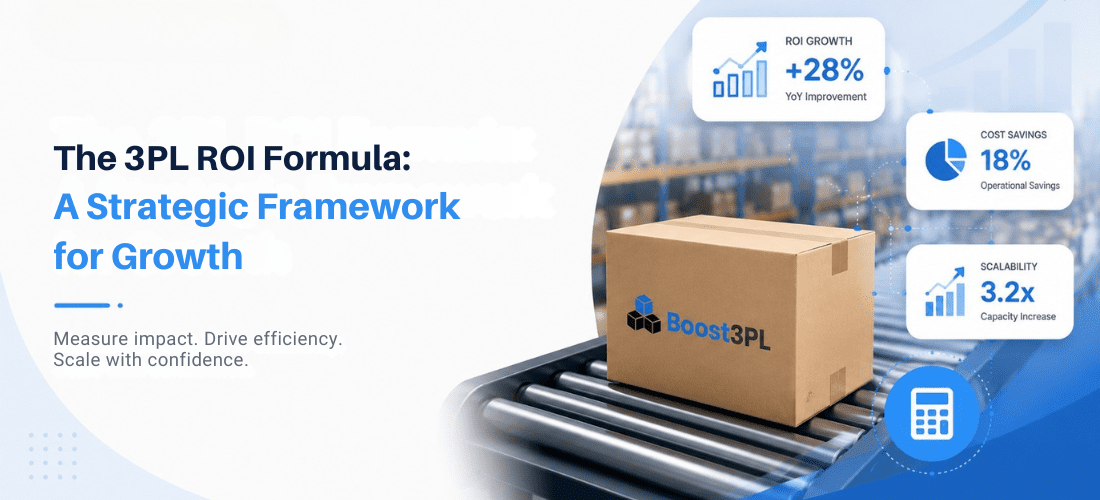
The 3PL ROI Formula: A Strategic Framework for Growth

Stop treating logistics like a guessing game. To see the real value of your operations, you need a structured approach to calculating the roi of a 3pl. Start by aggregating every dollar spent on your current in-house setup. This total must include rent, warehouse labor, technology subscriptions, and the cost of shipping errors. Next, compare these figures against 3PL quotes. High-performance partners often secure the best return on investment by slashing your base shipping costs through massive aggregate volume. Negotiated carrier rates can be 5% to 30% below retail prices, providing immediate margin relief.

The third step involves revenue recovery. You must calculate the money saved by eliminating mispicks and shipping delays. While competitors often focus only on the immediate cost of a mistake, you should consider the impact on your brand reputation and Customer Lifetime Value (CLV). Finally, add the scale multiplier. This represents your ability to handle a 500% spike in orders during peak season without the stress of hiring or training temporary staff. When calculating the roi of a 3pl, this flexibility is what transforms a warehouse into a strategic growth engine.

Hard Savings: Shipping Rates and Labor Efficiency

Soft Benefits: Conversion Lift and Customer Retention

Speed is a competitive advantage that directly impacts your bottom line. Quantify the impact of 2-day shipping on your cart abandonment rates. When customers trust your delivery speed, conversion rates climb. A perfect unboxing experience also drives repeat purchases and organic social shares. Maintaining this consistency across every platform is the core value of multichannel fulfillment services. If you’re ready to stop managing boxes and start scaling, it’s time to partner with a strategic ally that prioritizes your growth.

Maximizing Your Return with Boost3PL’s High-Performance Infrastructure

Your fulfillment partner should be a catalyst for expansion, not a bottleneck. When calculating the roi of a 3pl, the strength of their technology stack is often the deciding factor in long-term profitability. Boost3PL provides a frictionless integration that syncs your inventory across Shopify, TikTok Shop, and Amazon in real time. This technological sophistication prevents the nightmare of overselling, which is a critical risk for brands navigating the complex multichannel landscape of 2026. Professional frameworks for evaluating 3PL performance emphasize that a partner’s ability to integrate with your sales channels is a primary driver of efficiency gains.

Marketplace sellers face unique pressures that can quickly erode margins. Our strategic Amazon FBA prep services ensure your products meet strict compliance standards every time. This precision reduces the risk of costly marketplace penalties and stock-outs that damage your search rankings. By leveraging our national reach, you achieve lightning-fast delivery across the USA without the massive overhead of managing multiple regional warehouses yourself. You get the benefits of a nationwide network while maintaining a lean, agile business model.

Scaling Without the Friction

Boost3PL acts as a high-octane growth engine for your brand. We don’t just store boxes; we optimize your entire supply chain to handle sudden demand spikes with ease. Utilizing professional 3PL warehouse services allows you to maintain a 99.9% order accuracy rate even during your busiest seasons. This reliability protects your reputation and ensures that every customer receives a perfect unboxing experience.

The Bottom Line: Your Logistics Partner as a Profit Center

Shift your mindset away from simple cost-cutting. Stop asking "How much does it cost?" and start asking "How much growth does this partnership unlock?" Calculating the roi of a 3pl reveals that the right partner pays for itself by increasing conversion rates and improving customer retention. When you offload the chaos of daily operations, you gain the mental clarity needed to focus on creative strategy and brand building. In 2026, the most successful brands aren’t the ones with the biggest warehouses, but the ones with the most efficient partners.

Transform Your Logistics into a Strategic Growth Engine

Boost3PL is built for founders who demand excellence. We deliver 99.9% order accuracy and nationwide 2-day shipping coverage to keep you ahead of the competition. Our tech stack offers seamless integration with Shopify, TikTok Shop, and Amazon, ensuring your operations remain organized and fast. Stop drowning in pick-and-pack tasks and start focusing on your creative vision. Ready to accelerate your growth? Get a custom ROI analysis from Boost3PL today. We’re ready to help you build the future of your brand.

Frequently Asked Questions

How do I calculate the ROI of a 3PL for my ecommerce brand?

You calculate the ROI by subtracting your total outsourced fulfillment costs from the sum of your current in-house expenses and regained revenue. Your in-house math must include rent, labor, packing materials, and the cost of shipping errors. When calculating the roi of a 3pl, also factor in the value of your reclaimed time and the potential sales growth from faster shipping speeds.

Is a 3PL actually cheaper than fulfilling orders in-house?

A 3PL is generally more cost-effective because it converts high fixed costs into flexible variable costs. You stop paying for underutilized warehouse space and idle staff during slow seasons. By leveraging shared infrastructure and massive shipping volume, professional partners provide an efficiency level that solo brands can’t match. This model ensures you only pay for the fulfillment activity you actually use.

What are the most important KPIs to track when measuring 3PL performance?

Focus on order accuracy, shipping speed, and inventory precision. You should monitor the percentage of orders shipped within your promised window and the rate of mispicks. High-performance providers maintain a 99.9% order accuracy rate. Tracking these metrics helps you quantify the "soft" savings of a partnership, such as reduced customer service tickets and lower return processing costs.

How much can I save on shipping rates by using a 3PL?

Brands typically access negotiated carrier discounts that are 5% to 30% below retail shipping rates. These savings are a result of the 3PL’s ability to aggregate volume across their entire client base. When calculating the roi of a 3pl, these shipping discounts often offset a significant portion of the pick and pack fees. This immediate margin relief allows you to reinvest in customer acquisition.

What is the typical ‘break-even’ point for moving to a 3PL?

The break-even point often occurs when your order volume hits 500 to 1,000 shipments per month or when you need to lease dedicated warehouse space. It’s also the moment when the opportunity cost of your time becomes too high. If you’re spending more time taping boxes than growing your brand, the efficiency gains of outsourcing will immediately outweigh the service fees.

Does a 3PL help reduce customer acquisition costs (CAC)?

A 3PL indirectly lowers your CAC by increasing your Customer Lifetime Value and improving your conversion rates. Fast, reliable delivery leads to better reviews and higher repeat purchase rates, which makes your advertising spend more efficient. When your fulfillment is frictionless, you don’t have to spend as much to replace customers who were lost to poor shipping experiences.

How a 3PL Improves Supply Chain Resilience for Ecommerce Brands in 2026

In 2026, the Amazon Buy Box isn’t won by the brand with the best marketing. It’s won by the brand that never goes out of stock. With the total suspension of Section 321 duty-free entries and new EU sustainability mandates, the logistics game has changed forever. You’ve likely felt the sting of fragile shipping networks breaking during peak seasons or the panic of losing visibility into your inventory across multiple warehouses. It’s an exhausting cycle that threatens your brand reputation and your bottom line.

We understand that you need more than just a warehouse; you need a strategic ally. Discover how a 3pl improves supply chain resilience by transforming these operational headaches into a high-performance engine. This article explores how partnering with a tech-forward fulfillment company for ecommerce converts fixed costs into variable ones and creates a frictionless path to scale. We’ll show you how AI-powered forecasting and regionalized networks allow modern brands to pivot faster than the competition, ensuring your delivery speeds remain consistent even when global markets shift.

Key Takeaways

  • Shift from a fragile “just-in-time” model to a resilient “just-in-case” strategy that anticipates market shocks before they impact your customers.
  • Understand how a 3pl improves supply chain resilience by diversifying carrier networks to bypass regional bottlenecks and ensure consistent delivery speeds.
  • Leverage dynamic inventory placement to slash transit times and protect your brand reputation from weather-related delays and shipping disruptions.
  • Convert rigid, fixed logistics costs into a flexible variable model that scales automatically with your brand’s growth and seasonal demands.
  • Move beyond basic vendor transactions to build a high-performance strategic partnership that treats your fulfillment engine as a competitive advantage.

The New Standard of Supply Chain Resilience in Ecommerce

Resilience isn’t a defensive posture anymore. It’s an offensive strategy. In the 2026 ecommerce market, supply chain resilience means your brand has the muscle to anticipate shocks, react instantly, and thrive while others scramble. Old models focused on "just-in-time" inventory to save on storage costs, but that lean approach is now a liability. Today’s winners use a "just-in-case" strategic position. They keep stock closer to the customer and maintain buffer levels that protect against sudden spikes or shipping delays.

Digital-native brands face unique pressures that traditional retail never encountered. A single TikTok algorithm shift or a viral influencer moment can triple your demand overnight. Without an ecommerce logistics provider acting as your operational shock absorber, that success becomes a crisis. You need the infrastructure to handle 1,000% growth in a weekend without missing a single delivery deadline. This is exactly how a 3pl improves supply chain resilience; it provides the elastic capacity you can’t build on your own.

Identifying Vulnerabilities in Your Current Logistics Flow

Start by auditing your current setup for single points of failure. Relying on one warehouse or a single shipping carrier creates a fragile link in your chain. If that facility faces a labor shortage or that carrier hits a regional bottleneck, your business stops. Stockouts aren’t just missed sales; they are reputation killers that sink your marketplace rankings and destroy customer loyalty. Supply chain resilience is the ultimate competitive moat for 2026 ecommerce. By utilizing professional warehousing and inventory management services across multiple hubs, you ensure your brand stays visible and reliable regardless of external chaos.

Ecommerce Brands In 2026

4 Ways a 3PL Partner Strengthens Your Operations

Building a bulletproof operation requires more than just storing boxes. It’s about agility. Leading providers explain how 3PLs create more resilient supply chains by diversifying carrier networks to bypass regional shipping bottlenecks. If one carrier fails or a major hub freezes, your partner reroutes shipments instantly. Dynamic inventory placement follows this same logic. By spreading your stock across a 3PL warehouse services network, you reduce transit times and mitigate weather-related delays before they impact the customer.

This shift also transforms your financial structure. You convert heavy, fixed warehouse overhead into a flexible, pay-as-you-go model. You only pay for what you use. This is exactly how a 3pl improves supply chain resilience; it ensures your cash flow stays liquid even during market volatility. You gain the freedom to reinvest that capital back into product development—where you can discover VPrint3D Limited to support your prototyping needs—or high-growth marketing campaigns.

Multichannel Agility and Platform Protection

True resilience means your sales never stop. By leveraging multichannel fulfillment services, you keep your business active even if one platform experiences a technical outage or algorithm shift. Syncing your Shopify, Amazon, and TikTok Shop inventory prevents overselling and protects your account health. Utilizing a dedicated Amazon FBA prep center keeps your Prime eligibility intact during disruptions. Speed is your best defense. High-velocity pick and pack fulfillment ensures you maintain the seller ratings needed to win the Buy Box consistently.

Inventory Intelligence and Visibility

Data is the fuel for your supply chain engine. Frictionless software integration gives you real-time visibility into your stock levels across every warehouse. You can forecast demand spikes and stockout risks weeks in advance. This proactive approach allows you to focus on growth while your partner handles the operational complexity. If you’re ready to upgrade your backend, explore our warehousing and inventory management services to see the difference a tech-forward partner makes for your brand’s future.

Future-Proofing Your Brand with a Strategic 3PL Ally

Stop viewing logistics as a transactional cost center. In 2026, your fulfillment strategy is your brand’s backbone. Moving from a basic vendor relationship to a high-performance strategic partnership is the final step in securing your future. A partner with an entrepreneurial spirit doesn’t just ship boxes; they act as a guardian of your reputation. This deep alignment is exactly how a 3pl improves supply chain resilience. When your partner treats your success as their primary metric, you gain the confidence to pursue aggressive growth. Professional warehousing and inventory management provides the long-term stability you need to stay organized while the market remains chaotic.

Leveraging Integrated Technology for Real-Time Response

Dark data is the silent enemy of a scaling brand. If your inventory levels are hidden in spreadsheets or disconnected systems, you’re vulnerable to every market shift. A tech-forward 3PL illuminates your entire supply chain by integrating directly with your tech stack. You get a single source of truth for every SKU. Automated order routing then takes over, instantly sending orders to the most efficient fulfillment center USA location. This doesn’t just save time; it ensures your delivery promise stays intact even if one region faces a disruption.

Scaling Without the Risk of Fixed Assets

Owning a private warehouse is often a liability in a volatile economy. Long-term leases and fixed labor costs drain your capital and limit your ability to pivot. You don’t want to be stuck with empty square footage during a slow month or a cramped facility during a viral surge. A national 3PL network offers "instant" infrastructure that scales with you. You gain the reach of a global giant without the risk of heavy fixed assets. This model of outsourced infrastructure isn’t unique to ecommerce; in the energy and bulk transport sectors, DPP Logistics Company Ltd provides similar strategic resilience through their terminal and pipeline networks.

Boost3PL is the tech-savvy ally built for the modern digital economy. We thrive on handling complex operational tasks so you can focus on your creative and strategic goals. Don’t let logistics hold your brand back. Partner with Boost3PL today to build a frictionless, resilient supply chain that turns every disruption into a scalable competitive advantage.

Secure Your Competitive Edge in the 2026 Economy

The landscape of 2026 demands a shift from passive reaction to proactive agility. You’ve learned how moving to a "just-in-case" inventory strategy and diversifying your carrier networks protects your brand from the volatility of global trade. By leveraging integrated technology, you eliminate dark data and ensure your orders always find the fastest, most efficient path to the customer. This transition turns your logistics from a potential breaking point into a powerful engine for growth.

Understanding how a 3pl improves supply chain resilience is the first step toward true operational freedom. You can now stop worrying about rigid warehouse leases or sudden shipping bottlenecks and focus entirely on your creative vision. Boost3PL stands as your high-performance strategic ally. We offer advanced multichannel integration for Shopify, TikTok Shop, and Amazon alongside a strategic national fulfillment network designed to bypass regional disruptions.

It’s time to transform your supply chain into a scalable competitive advantage. Scale your brand with a resilient 3PL partner; Contact Boost3PL today. Your expansion is our primary metric for success. Let’s build a frictionless future together.

Frequently Asked Questions

What is supply chain resilience in 2026?

Supply chain resilience in 2026 is your brand’s ability to maintain seamless operations during global or regional shocks without losing customer trust. It goes beyond simple recovery; it’s about anticipating shifts like the suspension of Section 321 or new EU sustainability mandates. A resilient system uses real-time data to pivot inventory before a bottleneck occurs, turning market volatility into a competitive moat for your business.

How does a 3PL help with Amazon FBA prep during disruptions?

A 3PL acts as a critical buffer by providing professional Amazon FBA prep center services that ensure your inventory meets strict platform requirements even when primary warehouses are overwhelmed. If FBA intake slows down, your partner can quickly pivot to Amazon FBM fulfillment. This flexibility keeps your listings active and prevents the catastrophic loss of the Buy Box during peak season disruptions or carrier delays.

Can a 3PL reduce my shipping costs while improving resilience?

Yes, a 3PL reduces costs by converting high fixed overhead into a variable, pay-as-you-go model. Industry data shows that 66% of shippers agree using a 3PL contributes to lowering overall logistics costs. This is exactly how a 3pl improves supply chain resilience; it leverages a national warehouse network to place inventory closer to customers, which slashes last-mile delivery expenses while bypassing regional shipping delays.

What should I look for in a resilient ecommerce fulfillment partner?

Look for a tech-forward ecommerce logistics provider that offers seamless multichannel integration across Shopify, TikTok Shop, and Amazon. Your partner must possess a national network of 3PL warehouse services to ensure redundancy if one region fails. Prioritize providers that offer real-time visibility and proactive demand forecasting. You need a strategic ally that treats your brand’s reputation as their own primary metric for success.

How to Choose a 3PL Fulfillment Provider in 2026: The Strategic Founder’s Guide

In 2026, your warehouse isn’t just a storage space; it’s the high-tech engine room of your digital brand. If that engine stalls, your reputation goes with it. Learning how to choose a 3pl fulfillment provider is no longer about finding the cheapest labor. It’s about securing a strategic ally that moves at the speed of your Shopify and TikTok Shop feeds. You’ve likely felt the sting of inventory sync lag or the frustration of manual pick and pack errors that turn loyal customers into one-time buyers.

We agree that scaling your business shouldn’t feel like managing a constant crisis. You’ve outgrown the manual prep and the late-night inventory audits. This guide promises to teach you how to evaluate 3PL partners based on deep tech integration, multichannel expertise, and strategic scalability. We will preview how to navigate the 5.9% carrier rate increases and the new de minimis restrictions while building a fulfillment operation that feels effortless. It’s time to turn your supply chain into a high-performance growth tool and reclaim your focus for the big picture.

Key Takeaways

  • Discover why a tech-enabled 3PL acts as the central nervous system for your brand, ensuring your digital storefront and physical inventory move in perfect harmony.
  • Master sub-second inventory syncing to eliminate the risk of overselling during viral growth spurts on platforms like TikTok Shop and Shopify.
  • Learn exactly how to choose a 3pl fulfillment provider by prioritizing native integrations and high-accuracy pick and pack fulfillment that protects your margins.
  • Shift your mindset from hiring a vendor to securing a strategic ally that guards your brand reputation and handles operational chaos so you can scale.
  • Evaluate the non-negotiable plug-and-play connectors required to dominate multichannel fulfillment across Amazon, TikTok Shop, and beyond.

Identifying Your Growth Levers: Why You Need a Tech-Enabled 3PL in 2026

In the high-velocity commerce environment of 2026, a tech-enabled 3PL isn’t just a vendor. It is the central nervous system of your entire brand. When you are researching how to choose a 3pl fulfillment provider, you must prioritize speed and integration over simple square footage. Modern retail requires sub-second inventory syncing to prevent the disaster of overselling on viral platforms like TikTok Shop or Shopify. Minutes of delay mean thousands in lost revenue and platform strikes. You need a partner that breathes technology as much as you do.

Many founders fall into the ‘Tech Debt’ trap. They rely on basic shipping apps that worked during the startup phase but crumble under the weight of a scaling multichannel brand. Fulfillment software is the critical bridge that connects your digital sales platforms to the physical reality of the warehouse floor. Your decision on how to choose a 3pl fulfillment provider should hinge on whether their software can handle the inherent chaos of modern commerce. It ensures every click on a screen translates into a package on a truck without manual intervention.

The Cost of Operational Friction

Manual order processing is a silent killer of growth. Every hour you spend fixing address errors or manually updating stock levels is an hour stolen from your creative strategy. These invisible friction points lead to high error rates that tank your customer lifetime value. If a customer receives the wrong item or a late shipment, they won’t come back. You need a partner that eliminates this friction through automated workflows and proactive problem-solving.

Software as the Strategic Brain

The industry has shifted away from legacy WMS systems that operate in silos. A modern, API-first platform acts as your strategic brain. By utilizing Third-party logistics (3PL) providers with advanced tech stacks, you gain total control over your supply chain. Real-time data visibility empowers better warehousing and inventory management, allowing you to make proactive decisions based on live demand patterns. This is how you transform logistics from a cost center into a competitive edge that fuels your expansion.

Key Selection Criteria: Multichannel Syncing and Marketplace Mastery

Success in 2026 depends on your ability to sell everywhere at once. When evaluating how to choose a 3pl fulfillment provider, native integrations are your first filter. You need plug-and-play connectors for Shopify and TikTok Shop that eliminate manual data entry. If a provider relies on CSV uploads or outdated middleware, they are a bottleneck, not a partner. Your inventory must reflect reality across every channel in real time. This ensures you never sell a product you don’t have in stock.

This level of integration is particularly crucial for cross-border commerce; EZ3PL Ltd highlights how UK-based brands can leverage automated syncing to maintain high performance across multiple digital storefronts.

Accuracy is the only metric that matters for your bottom line. Demand a minimum of 99.9% accuracy in pick and pack fulfillment to protect your margins. Errors lead to returns, and returns kill growth. You also need a partner that scales effortlessly. Whether it’s a Q4 surge or a sudden viral social media moment, your 3PL must handle 10x order volume spikes without breaking a sweat. Transparency completes the picture. Insist on SKU-level profitability reporting and real-time tracking dashboards that show you the health of your business at a glance.

TikTok Shop and Shopify Integration Depth

Live-selling on TikTok creates unique demands that traditional warehouses can’t meet. Your multichannel fulfillment services must support high-velocity bursts of orders that happen in minutes. Unified inventory is non-negotiable. If you sell out on TikTok, your Shopify store needs to know instantly. This frictionless operation keeps your marketplace ratings high and your customers happy. If you want to see how this works in practice, consider partnering with a tech-first 3PL that prioritizes these digital-native channels.

Amazon FBA Prep and FBM Flexibility

Amazon remains a dominant force, but its rules are strict. Look for a professional Amazon FBA prep center that understands labeling, kitting, and packaging requirements. One mistake can lead to marketplace penalties or inventory blocks. Understanding how to choose a 3pl fulfillment provider that masters these marketplace nuances is the difference between profit and penalties. A strategic advantage comes from a partner that manages both FBA prep and FBM (Fulfilled by Merchant) under one roof. This hybrid approach allows you to pivot quickly if FBA storage limits tighten or shipping costs shift. It gives you the flexibility to keep selling no matter what the marketplace throws your way.

The Strategic Founders Guide

Beyond the Warehouse: Finding a Strategic Ally to Scale Your Brand

Many founders hesitate to outsource because they fear losing the personal touch that built their brand. It’s a valid concern. When you evaluate how to choose a 3pl fulfillment provider, you must look for an ally that acts as a guardian of your reputation. You aren’t just hiring a vendor to move boxes; you’re securing a high-performance partner. Boost3PL blends technological sophistication with a raw entrepreneurial spirit to protect your identity. We handle the inherent chaos of logistics so you can return to your creative roots. This frictionless experience ensures that as you scale, your customer experience remains elite.

Future-Proofing for 2026 Omnichannel Retail

Modern commerce moves too fast for reactive management. A top-tier fulfillment center USA now utilizes AI and predictive analytics to stay ahead of the curve. These tools identify potential supply chain bottlenecks before they ever impact your customers. A proactive partner anticipates issues like carrier delays or inventory shortages during peak seasons. This foresight is critical for maintaining your competitive edge in an omnichannel world. It transforms your supply chain from a back-office function into a proactive growth engine.

The Partnership Metric: Your Success

The old model of transactional billing is dead. Success in 2026 requires a shift toward a partnership model focused on total brand acceleration. When you decide how to choose a 3pl fulfillment provider, prioritize the one that measures their performance by your growth. You deserve a partner that is deeply invested in your unique identity and long-term vision. Stop wrestling with software integrations and manual spreadsheets. Start scaling with a strategic ally that treats your reputation as their own. Your brand’s next chapter begins when you trade operational chaos for streamlined, high-performance fulfillment.

Accelerate Your Expansion with Strategic Fulfillment

Logistics in 2026 demands more than just shipping boxes. It requires a seamless integration of your digital storefront and your physical inventory. You now understand that a tech-first approach is the only way to navigate carrier rate increases and complex marketplace requirements effectively. By prioritizing sub-second syncing and deep multichannel expertise, you protect your brand’s reputation and your customer’s long-term trust.

Mastering how to choose a 3pl fulfillment provider is the final step in turning operational friction into a scalable competitive advantage. It is about finding the brain that powers your physical operations so you can focus on the big picture. You’ve outgrown the manual audits and the inventory lag; it’s time for a solution that moves as fast as your sales feed.

Boost3PL stands ready as your high-performance strategic ally. We provide proprietary high-speed fulfillment technology alongside expert Amazon FBA prep to ensure your inventory moves without delay. Our multichannel support is specifically built for the high-velocity demands of TikTok Shop and Shopify founders. We are driven by your results and dedicated to the success of your brand identity.

Ready to accelerate your growth? Partner with Boost3PL today.

The future of your brand is built on the strength and reliability of your supply chain. It’s time to trade the chaos for a partner that scales at your speed and treats your success as the ultimate metric.

Frequently Asked Questions

What is the most important factor when choosing a 3PL for ecommerce?

The most critical factor is the provider’s ability to integrate seamlessly with your tech stack to provide real-time inventory visibility. In 2026, you cannot afford data lags that lead to overselling or stockouts on high-velocity channels. When you research how to choose a 3pl fulfillment provider, look for native API connections that automate the flow of information. This technological foundation ensures your physical operations keep pace with your digital growth and customer expectations.

Can one 3PL provider manage Shopify, TikTok Shop, and Amazon simultaneously?

Yes, a modern ecommerce logistics provider can manage all these channels through robust multichannel fulfillment services. The key is a unified inventory system that prevents channel conflict by syncing stock levels across every platform instantly. This allows you to scale on TikTok Shop while maintaining your Amazon FBA prep and Shopify storefront without manual intervention. It creates a frictionless experience where your brand remains consistent everywhere customers shop.

How do I know if my brand is ready to outsource to a 3PL?

You’re ready to outsource when operational tasks like packing boxes and managing returns start stealing time from your creative strategy. If you notice rising error rates or struggle to keep up with order spikes during viral moments, it’s time to transition. Moving to a professional fulfillment center USA allows you to offload the chaos of logistics. This shift empowers you to focus on high-level growth levers while experts handle the physical execution.

What is the difference between a traditional warehouse and a tech-enabled 3PL?

Traditional warehouses focus on manual labor and storage, often relying on paper trails or basic spreadsheets that slow down your growth. In contrast, a tech-enabled 3PL acts as a high-performance strategic ally using AI and real-time data to optimize every movement. These providers offer deep integrations and predictive analytics that anticipate bottlenecks before they happen. They prioritize speed of understanding and operational efficiency to turn your supply chain into a competitive advantage.

How does a 3PL handle Amazon FBA prep and compliance?

A specialized Amazon FBA prep center manages the entire compliance process, including labeling, kitting, and strict packaging requirements. They stay updated on Amazon’s evolving regulations to prevent marketplace penalties or inventory rejections. When you consider how to choose a 3pl fulfillment provider, ensure they have a dedicated team for these marketplace nuances. This precision protects your seller rating and ensures your products remain Prime-eligible without the headache of manual prep.

Will I lose control over my shipping and customer experience if I use a 3PL?

You actually gain more control by using a partner that offers SKU-level transparency and real-time tracking dashboards. A strategic 3PL acts as a guardian of your reputation, executing your brand’s specific standards at a scale you can’t achieve alone. You maintain oversight of the customer experience through clear data while offloading the manual burden of execution. It’s about trading the stress of micromanaging shipments for the confidence of a professional, frictionless operation.

Subscription Box Fulfillment Center: The 2026 Guide to Scaling Recurring Revenue

What if your fastest month of growth actually became your brand’s biggest liability? You’ve worked hard to build a loyal community, yet you know that a single month of sloppy kitting or delayed shipping can spike churn by 15% according to recent industry benchmarks. The monthly shipping surge is the ultimate stress test for your supply chain. If your current subscription box fulfillment center isn’t built for high-velocity assembly, your margins are likely leaking through inconsistent quality and inflated shipping rates.

We agree that your logistics should be an invisible engine for growth, not a source of customer complaints. This 2026 guide reveals how to master complex kitting with 99.9% accuracy and leverage national distribution to aggressively slash transit costs. You’ll discover how to Boost your unboxing experience and turn it into a powerful retention tool while maintaining a lean, profitable operation. We’re breaking down the tech-driven strategies that ensure seamless monthly cycles, allowing you to focus on your creative goals while we handle the logistical heavy lifting at scale.

Key Takeaways

  • Master the “surge” shipping model to execute high-volume launches within a 48-hour window without compromising operational stability.
  • Leverage real-time technology and seamless integrations with Shopify or Recharge to maintain total visibility over your recurring revenue logistics.
  • Evaluate your subscription box fulfillment center based on its ability to handle 10x growth spurts and complex, branded kitting requirements.
  • Implement lean logistics strategies to minimize packaging waste and slash shipping costs while elevating your brand’s unboxing experience.
  • Transform your fulfillment from a back-end cost into a strategic growth engine that actively protects and scales your brand reputation.

Why Subscription Box Fulfillment Requires a Specialized 3PL Strategy

Standard ecommerce logistics won’t cut it for recurring revenue models. While traditional shipping handles a steady trickle of orders, a specialized subscription box fulfillment center must master the "surge." This involves processing 10,000 orders in a 48-hour window without a single error. In the 2026 market, the subscription business model centers entirely on the unboxing experience. If a single insert is missing, your churn rate can spike by 15% in a single cycle. Precision is your primary retention tool. Boost your brand by treating the package as the physical manifestation of your brand’s promise.

The Complexity of Kitting and Assembly

Manual kitting requires elite labor management. You aren’t just picking items; you’re building a curated story. Every month brings new SKUs and rotating variations that demand strict attention to detail. High-performance 3rd party fulfillment services use digital checklists and weight-verification scales to ensure 99.9% accuracy. We verify every multi-item insert because one wrong variation ruins the customer’s "surprise and delight" moment. Speed and accuracy must coexist to protect your brand reputation and ensure long-term loyalty.

Managing the Monthly Shipping Surge

Traditional warehouses buckle under the weight of a monthly drop. You need a partner that scales labor instantly to meet tight assembly deadlines. Successful brands coordinate inventory from 8 different vendors to arrive simultaneously for assembly. A specialized subscription box fulfillment center prepares these pre-assembled kits days before the billing cycle hits. This proactive staging ensures that when the recurring payment triggers, your boxes hit the mail stream within 24 hours. We eliminate the lag that kills subscriber excitement and keeps your growth on an upward trajectory.

Key Criteria for Selecting Your Subscription Box Fulfillment Center

Your choice of a subscription box fulfillment center determines whether you scale or stall. You need a partner that treats your recurring revenue like their own. Growth isn’t a linear path; it’s a series of explosive moments that test your infrastructure. In 2026, baseline performance isn’t enough. You require a ecommerce 3pl provider that handles a 1,000% volume spike in a single month without breaking a sweat.

Technology must lead the way. Demand real-time inventory tracking that integrates directly with Shopify and Recharge. This ensures your subscribers never face an "out of stock" notification. A top-tier subscription box fulfillment center provides the visibility you need to manage churn and inventory levels simultaneously. Strategic 3PL warehouse services reduce transit times across the USA, cutting shipping costs and keeping customers happy. By placing inventory closer to your densest customer clusters, you can slash delivery windows by 48 hours or more.

Custom Branding and the Unboxing Experience

The unboxing experience is your most powerful marketing tool. It’s the physical manifestation of your digital brand. To launch a blockbuster business, your fulfillment partner must execute precise, Instagram-worthy packaging every time. This includes branded tissue, stickers, and personalized inserts. For wellness brands, kitting accuracy is non-negotiable. We specialize in health and beauty product fulfillment where precision maintains brand trust and ensures safety. Every box must arrive exactly as you envisioned it.

Multi-Channel Integration for Hybrid Brands

Modern brands don’t just sell subscriptions. You likely manage one-off store purchases alongside recurring boxes. This hybrid model adds complexity. You must sync inventory across Shopify, Amazon, and TikTok Shop to prevent overselling. A unified multichannel fulfillment approach protects your total brand inventory. It keeps your operations organized and your data clean. Boost your operational efficiency by centralizing your logistics under one roof and focusing on your next big product launch.

Scaling Your Brand with Boost3PL’s Fulfillment Excellence

Boost3PL acts as your strategic ally, treating your brand reputation with the same care you do. We don’t just ship boxes; we protect your customer experience. Our "Boost" approach to lean logistics focuses on aggressive waste reduction. By 2026, brands utilizing our automated inventory forecasting see an average 22% reduction in excess packaging costs and overstock. This precision ensures your capital stays in your growth budget, not sitting on a shelf.

The transition from a garage to a professional subscription box fulfillment center is a defining moment for founders. In a 2024 case study, one of our partners spent 30 hours every week managing assembly. After moving to Boost3PL, they redirected those 120 monthly hours into influencer marketing and product development. They doubled their subscriber count within six months. Put down the tape gun and focus on the vision that started it all. For a deeper look at how the right logistics partnership drives measurable growth, explore our strategic ecommerce 3PL provider case study for 2026.

Inventory Management and Real-Time Visibility

Eliminate the "black hole" of warehouse data. Our real-time dashboards provide 100% visibility into your stock levels at every stage. We manage lot tracking and expiration dates for consumable products with surgical precision to ensure freshness. Leverage this data to increase sales on Amazon while maintaining your core subscription site. Our warehousing and inventory management services keep your operations agile and data-driven. Subscription brands in the wellness space can also benefit from understanding the compliance demands covered in our guide to nutraceutical and health and beauty product fulfillment to stay ahead of regulatory requirements.

Seamless Logistics from Kitting to Last-Mile Delivery

We optimize the critical hand-off between assembly and our carrier network to guarantee on-time delivery. Our nationwide footprint ensures your subscribers receive their boxes simultaneously, regardless of their zip code. This synchronization builds community excitement and prevents social media spoilers. In 2026, the speed and reliability of last-mile delivery serve as the primary emotional touchpoint for subscriber retention, as a single late box often triggers an immediate cancellation.

Ready to elevate your operations? Scale your brand with a partner that values your growth as much as you do. Integrate with Boost3PL today and experience the power of seamless fulfillment.

Future-Proof Your Subscription Success

Your brand’s growth depends on a logistics partner that understands the unique pressure of recurring revenue. Mastering the complexities of a subscription box fulfillment center requires more than just shelf space. It demands a 99.9% Kitting Accuracy Guarantee to protect your customer experience and brand reputation. You need a specialized system built to handle high-volume surges during launch weeks without breaking a sweat. Boost3PL provides the infrastructure to turn these logistical challenges into your greatest competitive advantages.

Don’t let operational bottlenecks slow your momentum. With seamless Shopify and TikTok Shop integrations, your tech stack remains unified while your shipping stays fast and reliable. We act as your strategic ally, managing the heavy lifting so you can focus on creative strategy and customer acquisition. Our high-performance approach ensures that every box reflects the quality your subscribers expect. It’s time to stop worrying about inventory and start focusing on your next big move. We’re ready to help you elevate your operations and achieve the scale you’ve always envisioned for your business.

Ready to scale your subscription brand? Get a custom fulfillment quote from Boost3PL today.

Let’s build your legacy together.

Frequently Asked Questions

How much does subscription box fulfillment typically cost?

Your fulfillment costs depend on order volume and assembly complexity. The 2024 Fulfillment Cost Report indicates that brands typically allocate 15% of their gross revenue to logistics. This includes storage, kitting, and shipping. Partnering with a specialized subscription box fulfillment center allows you to convert these variable costs into a predictable monthly expense. You gain transparency and control over your margins as you scale. Optimizing your spend helps you reinvest in growth.

Can a 3PL handle custom branded packaging and inserts?

Every 3PL worth its salt handles custom branded packaging and marketing inserts to elevate your unboxing experience. Boost your brand identity by integrating custom tissue paper, stickers, or personalized thank-you notes into every shipment. We treat your brand as our own. Our team follows 100% of your specific assembly guides to ensure every box arrives looking exactly like your prototype. This precision builds customer loyalty and reduces churn.

What is the difference between kitting and pick-and-pack?

Kitting is the process of pre-assembling multiple items into a single unit before an order is placed. Pick-and-pack involves selecting individual items from warehouse shelves to fill a specific customer request. Subscription models rely heavily on kitting to handle high volumes during a single drop. This method increases efficiency by 30% compared to traditional picking. It ensures your subscription box fulfillment center remains fast and accurate during peak periods.

How does a fulfillment center handle the monthly surge of orders?

Fulfillment centers manage monthly surges by utilizing real-time inventory data and scalable labor forces. We synchronize with your e-commerce platform to forecast demand 30 days in advance. This preparation allows us to pre-kit 95% of your inventory before the shipping window opens. Our automated systems and streamlined workflows eliminate bottlenecks. You get a seamless transition from order placement to doorstep delivery without the typical monthly chaos.

FBA Prep Center Near Me: A Strategic Selection Checklist for 2026

Your search for an “fba prep center near me” might be leading your brand into a logistical dead end. While proximity seems like the obvious choice for speed, 2024 industry data reveals that 62% of high-growth sellers now prioritize technological integration over physical distance to avoid Amazon’s escalating non-compliance fees. A warehouse ten miles away is useless if it lacks the real-time visibility and automated kitting required to keep your inventory moving. You need a partner that combines strategic location with high-velocity execution.

It’s exhausting to battle hidden costs and shipping delays that stall your momentum. You want a logistics ally that understands your entrepreneurial drive and treats your brand with the same care you do. This guide promises to redefine your selection process and eliminate the chaos of inventory management. We’ll provide a comprehensive 2026 checklist to ensure your next partner offers 100% compliance, seamless Seller Central integration, and the scalability to boost your business to the next level. Discover how to transform your supply chain into a competitive advantage.

Key Takeaways

  • Redefine your search for an fba prep center near me by prioritizing strategic proximity to major ports and Amazon hubs over simple local convenience.
  • Master our 2026 selection checklist to identify a tech-forward partner that offers seamless, real-time software integration with your Seller Central account.
  • Boost your operational resilience by implementing a hybrid FBA and FBM model that eliminates stockouts and protects your brand’s growth.
  • Learn how to scale your brand across TikTok Shop and Shopify using a single, high-performance fulfillment hub designed for multichannel success.

Rethinking “Near Me”: Why Strategic Proximity Wins in 2026

Searching for an fba prep center near me usually stems from a desire for control. You want to drive over and see your stock. In 2026, that mindset kills growth. A modern Fulfillment house isn’t just a warehouse; it’s a strategic hub designed to accelerate your supply chain. Your physical distance to the inventory doesn’t matter. What matters is the distance between the prep center and Amazon’s regional sortation centers. Reducing this gap can slash transit times by 48 hours or more.

Strategic placement near major ports of entry like Long Beach or Newark eliminates thousands in drayage costs. If you buy wholesale, “near me” should mean a tax-free state. Using a partner in states like Delaware or Montana saves you 6% to 10% on every inbound invoice. That’s pure profit back in your pocket. Speed to the customer is determined by Amazon’s internal logistics, not how close you live to the prep table. Real growth happens when you stop looking at your zip code and start looking at the map from Amazon’s perspective.

The High Cost of Local Convenience

Small local shops often fail when Q4 volume spikes by 300%. They lack the automated systems to scale quickly. While a local center might seem convenient, you’ll pay more in the long run. National freight rates from a high-volume hub are often 20% lower than “buddy rates” at a local warehouse. You need a partner that handles surges without missing a beat. Boost your efficiency by choosing a facility built for high-velocity e-commerce, not just local storage.

Amazon FBA Compliance: The Non-Negotiable Standard

Amazon’s 2025 inbound placement fees and strict labeling requirements leave zero room for error. A generic fba prep center near me that does occasional shipping isn’t enough. One wrong barcode leads to rejected shipments or account health warnings. You need a Amazon FBA prep partner that acts as a seamless extension of your brand. We prioritize your reputation by ensuring every unit meets 100% of Amazon’s evolving standards. This precision protects your Buy Box status and keeps your inventory moving through the network without friction.

The Ultimate FBA Prep Center Selection Checklist

Proximity is just the starting point. When searching for an fba prep center near me, don’t let a short drive distract you from operational gaps. You need a partner that functions as a seamless extension of your brand. Demand 100% software integration. Your center must sync with Seller Central in real-time to prevent stockouts and data lag. Look for a transparent fee structure. High-growth brands avoid “monthly minimum” traps that punish lean inventory cycles. Ask for a clear breakdown of receiving, labeling, and kitting costs. Verify their scalability immediately. A true partner handles 100 units today and 10,000 units during a Q4 surge without breaking a sweat. This elasticity is what separates a standard warehouse from a strategic growth ally.

Operational Excellence Audit

Speed is your competitive advantage. Audit their turnaround time; it should never exceed 48 hours for standard shipments. Visual verification is equally vital. Ensure they provide photo documentation for damaged goods to protect your bottom line and facilitate insurance claims. If you run a hybrid model, verify they offer pick and pack order fulfillment to keep your FBM orders moving. This flexibility ensures your brand stays agile as market demands shift, allowing you to pivot between fulfillment methods without friction.

Communication and Technology Stack

Stop being a ticket number. Insist on dedicated account management where a real person knows your brand’s specific needs. Your tech stack must include warehousing and inventory management that updates instantly across all channels. This visibility is how you maintain the Buy Box and keep your momentum high. When you find an fba prep center near me that prioritizes tech, you’re ready to scale. Boost your operations by choosing a partner that treats your inventory like their own reputation and offers the transparency you deserve.

Scaling Your Brand: Moving from Prep to Multichannel Growth

Scaling isn’t just about sending more boxes to Amazon. It’s about diversifying your presence across TikTok Shop and Shopify without doubling your workload. A high-performance partner integrates your inventory across every channel seamlessly. You need a Hybrid Model to win. This strategy uses one partner for FBA prep and FBM (Fulfillment by Merchant) to protect your brand against sudden stockouts or Amazon warehouse delays. If Amazon pauses your inbound shipments, your FBM stock keeps the revenue flowing and your rankings stable.

Stop looking for a simple warehouse. You need a guardian of your customer experience. Transitioning from a manual, local process to an automated national 3PL partner changes your growth trajectory. While you might start your search for an fba prep center near me, your brand deserves a partner with the tech stack to scale nationally. This transition moves you from working in your business to working on your business.

  • Automate inventory sync across all sales channels.
  • Reduce shipping times by positioning stock closer to the customer.
  • Eliminate the risk of “Out of Stock” badges with a dual FBA/FBM strategy.

Winning the Buy Box Through Logistics

Amazon’s algorithms prioritize speed and consistency. Fast prep and reliable replenishment directly impact your Inventory Performance Index (IPI). High inventory health scores are the secret to winning the Amazon Buy Box in 2026. When your logistics partner cuts lead times by 48 hours, your conversion rates climb. Reliability isn’t a luxury; it’s your primary competitive advantage. Finding the right fba prep center near me ensures your products are ready for prime time before your competitors even print their labels.

The Boost3PL Advantage: Seamless Acceleration

Boost3PL provides the essential acceleration your brand needs to dominate. We eliminate the massive overhead of physical warehouses so you can focus on product development and marketing. View your Amazon 3PL strategy as a profit-driver instead of a cost center. We offer the technology and speed that turns logistics into your brand’s greatest strength. It’s time to scale without limits.

Future-Proof Your Fulfillment Strategy

Searching for an fba prep center near me in 2026 means looking beyond your local city limits to find strategic warehouse placement that drives profit. Modern e-commerce demands a selection checklist that balances rapid Amazon intake with the flexibility to scale across Shopify and TikTok Shop seamlessly. Success today isn’t about being close to your house; it’s about being close to your customers through a robust US-based infrastructure.

Boost3PL has been at the forefront of this shift since our founding in 2018. We’ve developed a tech-forward warehouse network that prioritizes speed and technological sophistication. Our team acts as a high-performance ally, managing the logistical heavy lifting so you can focus on creative brand goals. By integrating directly with your primary sales channels, we ensure your inventory remains organized and efficient even during high-volume surges. You’ll gain the freedom to innovate while we handle the kitting and shipping with precision. Before choosing your fulfillment strategy, make sure you fully understand what is FBA and how the updated 2026 fee structures impact your margins.

Ready to accelerate your results? Boost your Amazon margins with professional FBA prep; get a quote from Boost3PL today. Your brand deserves a logistics partner that moves as fast as the global supply chain does. Let’s build your legacy together.

Frequently Asked Questions

How much does an FBA prep center typically cost in 2026?

In 2026, standard FBA prep services typically range from $1.50 to $2.25 per unit for basic labeling and bagging based on projected 4.2% annual labor inflation from 2024 industry benchmarks. You’ll also encounter monthly storage fees that average $0.85 per cubic foot during off-peak months. Boost your margins by choosing a partner with transparent, flat-fee structures that eliminate hidden surcharges. This clarity helps you forecast your landed costs with 100% accuracy.

Can I use an FBA prep center for my TikTok Shop orders too?

You can absolutely use a versatile fba prep center near me to fulfill TikTok Shop orders through integrated multi-channel distribution. Modern centers sync directly with TikTok Shop via API to automate order flow and real-time tracking updates. This seamless integration allows you to maintain a unified inventory pool for both Amazon and social commerce. It’s the fastest way to scale your brand across multiple digital platforms while keeping operations lean and efficient.

Do FBA prep centers handle returns and removals from Amazon?

Most professional prep centers manage the entire Amazon removal and return process, including detailed inspection, grading, and restocking. They process these items within 48 to 72 hours of arrival to ensure your capital isn’t tied up in unsellable stock. Logistics teams classify returns into specific categories like “New,” “Open Box,” or “Damaged” so you can make data-driven decisions on liquidation. This system protects your brand reputation by keeping faulty products out of customers’ hands.

Is it better to have a prep center near the port or near an Amazon warehouse?

Choosing a prep center near a major port is generally more cost-effective for brands importing 100% of their goods from overseas. This strategy reduces drayage costs, which can save you $300 to $500 per container in inland trucking fees. Searching for an fba prep center near me in port cities like Long Beach or Savannah ensures your inventory hits the shelves faster. It minimizes the distance between the ship and the shelf, accelerating your cash flow cycle. To fully evaluate whether this model works for your business, review what is FBA and how Amazon’s 2026 fulfillment mechanics affect your inbound shipping decisions.

Mastering Order Fulfillment Services: The 2026 Founder’s Evaluation Checklist

Your 3PL isn’t just a warehouse; it’s the high-performance engine of your brand’s reputation. Research from late 2024 indicates that a single shipping error can slash a customer’s lifetime value by 40% instantly. If you’re currently battling inventory gaps between Shopify and Amazon or watching hidden fees eat 12% of your net margins, your current order fulfillment services are a bottleneck, not a benefit. It’s time to stop settling for legacy logistics and start demanding a partner that actually boosts your growth.

We agree that you should be focused on creative strategy, not chasing down lost packages or updating manual spreadsheets. You deserve a logistics setup that works as hard as you do. This guide provides our 2026 Founder’s Evaluation Checklist, a 7-point framework to help you identify a ecommerce fulfillment partner that delivers a seamless experience across TikTok, Amazon, and Shopify. We’ll show you how to automate inventory tracking and secure the 2-day delivery speeds that turn one-time buyers into lifelong brand advocates.

Key Takeaways

  • Transform your logistics from a warehouse bottleneck into a strategic growth engine by partnering with a dedicated Brand Guardian.
  • Apply our high-energy “Boost” framework to identify the technological sophistication necessary for scaling your brand through 2026.
  • Discover the seven critical factors for selecting order fulfillment services that integrate seamlessly with Shopify, Amazon, and TikTok.
  • Unlock the secrets to winning the Amazon Buy Box and dominating TikTok Shop algorithms through precision-engineered fulfillment strategies.
  • Leverage strategic US-based fulfillment centers to accelerate national delivery speeds and provide the seamless experience your customers demand.

Evaluating Order Fulfillment Services: Why Outsourcing is Your Growth Catalyst

In the 2026 ecommerce market, order fulfillment services function as the strategic backbone of your entire operation. Your logistics partner isn’t just a warehouse; they’re your Brand Guardian. They protect your reputation with every parcel sent. The transition from manual, garage-based shipping to professional 3PL warehouse services isn’t just a move; it’s a massive upgrade in capability. For brands scaling in 2026, seamless logistics are no longer optional. They’re a survival requirement. High-performance order fulfillment ensures your customers receive exactly what they bought, exactly when they expect it.

The Core Components of Professional 3PL Fulfillment

Precision drives growth. A professional pick and pack fulfillment process reduces error rates to below 0.1%, ensuring every customer gets the right product. Beyond simple shipping, sophisticated warehousing and inventory management services maintain stock health through real-time data tracking. This prevents costly stockouts and overstock scenarios. You can also elevate the unboxing experience through custom kitting and assembly. This turns a simple delivery into a powerful brand touchpoint that boosts customer lifetime value by as much as 30%.

Signs Your Brand is Ready to Outsource Logistics

Many founders hit an inflection point when they reach 50 orders per day or sustain a 15% month-over-month growth rate. At this stage, manual order fulfillment services stall your progress. In-house management carries hidden costs that drain your capital. You’re paying for warehouse space, $22 per hour labor costs, and the massive opportunity cost of your own time. Outsourcing logistics is the moment a founder stops packing boxes and starts building a brand. It frees up roughly 20 hours of executive time every week to focus on marketing and product development. Boost your operational efficiency now to secure your market share for the future.

The Ultimate 3PL Selection Checklist: 7 Critical Factors for 2026

Welcome to the “Boost” evaluation framework. In 2026, logistics isn’t a back-office cost; it’s your most powerful growth engine. Choosing a partner is about more than finding a warehouse. It’s about securing a strategic ally that treats your reputation as their own. You need a high-performance setup that turns shipping speed into a competitive advantage. This checklist ensures your brand stays ahead of the curve.

Many founders struggle with complex challenges in order fulfillment when they settle for legacy providers. Don’t let outdated processes stall your momentum. Instead, look for a partner that offers an elevated approach to multi-channel prep to ensure your inventory is always ready for the next surge.

Technology & Multichannel Integration Capabilities

Your tech stack must be seamless. Modern brands can’t waste time on manual data entry or CSV uploads. Demand native integrations with Shopify, TikTok Shop, and Walmart Marketplace. You need real-time inventory visibility across every sales channel to prevent overselling and stockouts. Verify that your provider offers pick, pack, and order fulfillment services that sync perfectly with Amazon FBM. This level of technological sophistication allows you to manage a global brand from a single dashboard. If they don’t offer automated, bi-directional syncing, they aren’t ready for 2026.

Service Level Agreements (SLAs) and Accuracy Benchmarks

Precision is the only metric that matters when your brand is on the line. The gold standard for order accuracy is now 99.9% or higher. Anything less leads to negative reviews and wasted customer service hours. Ask about “dock-to-stock” times. Leading partners move your products from the receiving dock to the “available” shelf in 48 hours or less. Ensure they guarantee same-day shipping for orders placed before a late afternoon cutoff. You also need a clear, automated process for handling returns. A fast exchange process turns a potential return into a loyal customer. High-performance order fulfillment services prioritize these benchmarks to keep your business moving at the speed of social commerce. Before committing to a provider, it’s worth researching the best ecommerce fulfillment companies of 2026 to benchmark these SLAs against top-rated industry standards.

Ready to see how these standards can transform your growth? It’s time to optimize your inventory management and reclaim your time for creative strategy.

Maximizing Brand Reach with Strategic Order Fulfillment

Speed is the ultimate currency for digital brands in 2026. If your delivery takes five days, you’ve already lost the TikTok Shop algorithm and the Amazon Buy Box. High-performance order fulfillment services transform your logistics from a back-office cost into a front-line growth engine. A strategically located US-based fulfillment center ensures your brand hits a two-day delivery standard across 98% of the continental United States. This logistical speed keeps your products at the top of search results and in front of ready-to-buy customers.

Seamless logistics allow for rapid seasonal scaling without the friction that kills momentum. When a viral moment hits, your infrastructure must respond instantly. Founders who prioritize fulfillment agility see 35% higher customer retention rates because the post-purchase experience matches the marketing hype. It’s about building a brand that’s as reliable as it is innovative. By integrating warehousing and inventory management into a unified strategy, you eliminate the bottlenecks that stop most startups from becoming household names.

Navigating the Amazon Ecosystem: FBA Prep vs. FBM

Marketplace success requires total precision. Amazon FBA offers Prime visibility, but strict inbound requirements often lead to 40% higher storage fees during peak seasons if inventory isn’t managed correctly. Utilizing a professional Amazon FBA prep center prevents marketplace penalties and ensures every SKU meets compliance standards. While FBA wins on visibility, FBM offers 18% better margins on oversized items and gives you total control over the unboxing experience. Smart founders leverage both to maximize profit and mitigate platform risk.

The Boost3PL Advantage: Scaling Without the Stress

Your brand needs a partner that moves at the speed of social commerce. Boost3PL provides the Boost necessary for multichannel success. We replace operational friction with seamless, tech-forward automation. Our results-oriented approach delivers 99.9% order accuracy and real-time inventory visibility across every channel you sell on. We handle the heavy lifting so you can focus on creative strategy and customer acquisition. Scale your volume by 400% this Q4 without breaking a sweat. It’s time to elevate your logistics strategy and partner with a team invested in your growth.

Scale Your Brand with 2026-Ready Logistics

Your brand deserves a logistics partner that moves as fast as your sales cycle. By 2026, the gap between market leaders and struggling startups will be defined by operational efficiency. You’ve learned that outsourcing isn’t just a cost center; it’s a strategic engine that unlocks global reach. Selecting the right order fulfillment services requires a checklist that prioritizes real-time visibility and rapid scalability. Don’t let logistics become the bottleneck that stifles your creativity or limits your expansion.

Stop managing boxes and start building your empire. Boost3PL provides the technological backbone you need to dominate every channel. We deliver 99.9% order accuracy and provide same-day shipping capabilities that keep your customers coming back. Our platform features direct integrations with Shopify, TikTok, and Amazon, ensuring your inventory stays synced across the entire digital landscape. We don’t just ship packages; we protect your reputation with every delivery. It’s time to elevate your operations with a choosing the right ecommerce fulfillment partner who understands the high-stakes world of digital commerce.

Ready to accelerate your growth? Boost Your Brand with Seamless Order Fulfillment. The future of your e-commerce journey starts with a partner who’s as invested in your success as you are.

Frequently Asked Questions

What are the typical fees for order fulfillment services?

Most order fulfillment services charge based on a four-pillar fee structure: receiving, storage, pick and pack, and shipping. Expect to pay $5 to $15 per pallet for inbound receiving and $0.40 to $0.60 per cubic foot for monthly storage. Pick and pack fees typically start at $2.50 for the first item. We ensure your brand’s margins stay protected by eliminating hidden surcharges that can eat 15% of your profit.

How do order fulfillment services handle returns?

Our reverse logistics process transforms returns into a seamless brand experience by processing items within 24 hours of arrival. We inspect every unit against a 5-point quality checklist to determine if it’s fit for restocking, refurbishing, or disposal. Efficient return management can recover up to 70% of lost inventory value. Boost your customer loyalty by providing a fast, transparent exchange process that keeps your stock levels accurate in real-time.

Can a 3PL integrate with my Shopify and TikTok Shop simultaneously?

Yes, a modern 3PL uses robust API integrations to sync your Shopify and TikTok Shop storefronts into a single dashboard. This unified view ensures 100% inventory accuracy across all sales channels, preventing overselling during viral growth spurts. You can scale your multi-channel presence without manual data entry. By centralizing your order fulfillment services, you maintain a consistent delivery standard for every customer, regardless of where they click buy.

What is the difference between a fulfillment center and a standard warehouse?

A fulfillment center is designed for high-velocity movement, while a standard warehouse focuses on long-term static storage. Standard warehouses often hold bulk inventory for 6 to 12 months with minimal activity. In contrast, our fulfillment centers prioritize a 24-hour turnover rate to get orders out the door fast. We optimize every square foot for picking speed and packing efficiency. This ensures your brand delivers an elevated unboxing experience rather than just sitting on a dusty shelf. If your growth strategy includes landing big-box retail contracts or expanding into wholesale channels, understanding b2b order fulfillment services will be essential to maintaining compliance and protecting your margins at scale.

Average 3PL Costs in 2026: The Founder’s Guide to Fulfillment Pricing

What if your 2026 profit margins are already leaking through accessorial charges you haven’t even seen yet? For most e-commerce founders, searching for average 3pl costs 2026 starts with a simple per-pick price but ends in a maze of Q4 surcharges. These hidden fees can unexpectedly consume 12% of your bottom line. You likely feel that opaque pricing structures make accurate budgeting impossible as you scale. It’s exhausting to watch your growth get swallowed by line items that confuse rather than clarify.

We are here to flip the script and give your brand total clarity. This guide delivers a transparent breakdown of the 2026 logistics landscape; it arms you with the frameworks needed to compare 3PL quotes apples-to-apples. You will master the ROI of modern fulfillment and identify the specific costs that traditional firms bury in the fine print. We’ll show you how to lock in predictable per-order costs so you can focus on your creative goals while we handle the seamless execution. We will break down every fee from storage to shipping so you can scale with absolute confidence.

Key Takeaways

  • Master the four pillars of fulfillment billing to eliminate invoice surprises and secure the transparency your brand deserves.
  • Navigate the 2026 logistics landscape with a clear breakdown of the average 3pl costs 2026 brands need to budget for.
  • Compare the true ROI of 3PL against Amazon FBA and self-fulfillment to reclaim your time and scale your business faster.
  • Identify the most common hidden fees and learn how to negotiate monthly minimums that support your growth trajectory.
  • Transform your fulfillment from a cost center into a seamless growth engine through advanced inventory forecasting and cost-per-order optimization.

Understanding the 3PL Pricing Landscape in 2026

Your 3PL provider is more than a line item on a spreadsheet. In 2026, logistics costs represent a variable investment in your Brand’s physical infrastructure. Stop viewing fulfillment as a drain on your margins. Instead, see it as the engine that powers your scale. The average 3pl costs 2026 reflect a market where fuel has stabilized at roughly $4.10 per gallon, but labor remains a premium expense. You aren’t just paying for shelf space; you’re buying a competitive advantage.

Pricing is no longer one-size-fits-all. A Brand moving 5,000 monthly orders with a single SKU faces a vastly different cost structure than a boutique with 500 orders and 200 high-fragility SKUs. Complexity drives cost. We embrace the “Boost” philosophy. This means viewing your logistics partner as a strategic ally. When your 3PL operates with high-octane efficiency, your Brand wins. We handle the logistical heavy lifting so you can focus on creative growth and market domination.

  • Volume: Higher order counts often unlock lower pick fees.
  • SKU Density: More SKUs require more storage footprints and complex inventory management.
  • Product Profile: Fragile or oversized items demand specialized handling and higher insurance premiums.

The Shift Toward Tech-First Fulfillment

AI and automation have redefined the warehouse floor. By 2026, 70% of leading fulfillment centers have integrated autonomous mobile robots to stabilize labor costs. This tech-driven approach reduces human error and keeps your pricing predictable. Real-time WMS integration is mandatory. Manual data entry is a hidden cost that kills your momentum. A 2% error rate in data entry can lead to a 10% loss in annual profits due to returns and customer churn. Utilize warehousing and inventory management that connects directly to your storefront for a seamless data flow.

National vs. International Cost Dynamics

Location dictates your total landed cost. In the United States, the price floor for pallet storage in Tier 1 logistics hubs like Atlanta or Chicago has reached $20 to $25 per month. If you are eyeing the UK market, expect a 12% variance in fulfillment fees due to different labor regulations and VAT complexities. Shipping zones are the silent margin killers. Moving a package across eight zones can increase your shipping spend by 55% compared to local delivery. A smart pick and pack fulfillment strategy places your inventory closer to the end consumer. This reduces transit time and slashes your average 3pl costs 2026 by optimizing the final mile.

Success in 2026 requires speed. It requires precision. Most importantly, it requires a partner that treats your Brand with the respect it deserves. Boost your operations by choosing a pricing model that scales with your ambition.

The Anatomy of a 3PL Invoice: Breaking Down Core Fees

Stop looking at shipping as a single, isolated expense. To scale your brand with confidence, you must master the four pillars of 3PL billing: Inbound, Storage, Outbound, and Admin. Transparency in these line items is the primary hallmark of a reliable partner. Hidden fees are growth killers. By utilizing professional pick and pack fulfillment services, you can standardize your per-order costs and eliminate the financial guesswork that plagues many startups.

We encourage founders to adopt the Total Cost of Fulfillment (TCF) framework. This holistic view moves beyond chasing the lowest individual rate and focuses on the aggregate cost of moving a product from the factory to the customer’s doorstep. Understanding the average 3pl costs 2026 requires a deep dive into how these specific fees interact to impact your bottom line. When your logistics are seamless, your brand has the freedom to innovate without operational friction.

Inbound and Receiving Fees

Your inventory’s journey begins the moment it hits the dock. In 2026, expect to pay between $25 and $45 per pallet for standard receiving services. Some providers utilize a per-hour model, typically ranging from $40 to $65 per man-hour, while others charge per unit. Per-unit models generally favor brands with high-value, low-volume goods. Per-hour models often benefit bulk shipments with high SKU counts. Accuracy is vital here. Poor labeling or non-compliant shipments often trigger surcharges that can eat 12% to 18% of your product margin before the first sale occurs.

Storage and Inventory Management

Warehouse space is a strategic asset, not just a place to store boxes. Monthly storage rates for standard pallets currently sit between $20 and $45. If you sell high-velocity small items, you’ll likely utilize bin or shelf storage to maximize density and picking speed. You should integrate advanced warehousing and inventory management practices to reduce dead stock costs. Keeping your inventory lean ensures your capital remains fluid and your Brand stays agile in a fast-moving market.

Pick, Pack, and Packaging Materials

This is the engine of your customer experience. Standard single-item order fees for the average 3pl costs 2026 hover between $2.50 and $5.00. Don’t ignore incremental item charges, as these additions are critical for high-AOV bundles and kitting projects. You also face a choice between custom branded packaging and standard 3PL materials. While custom boxes boost the unboxing experience, they can add $0.60 to $1.75 per shipment. Balancing these costs ensures your fulfillment remains a competitive advantage rather than a drain on resources. Ready to elevate your operations? Boost your growth by partnering with a team that treats your inventory like their own.

3PL vs. Amazon FBA vs. Self-Fulfillment: A 2026 Cost Comparison

Choosing a fulfillment strategy isn’t just about shipping rates. It’s about protecting your time and your margins. Many founders start by packing boxes themselves, but this creates a massive hidden deficit. If your time is worth $200 per hour and you spend 10 hours a week on fulfillment, you’re losing $8,000 in monthly growth potential. That’s the real cost of self-fulfillment. In 2026, the average 3pl costs 2026 models prioritize this opportunity cost by automating the entire backend of your business.

Amazon FBA offers “free” shipping to Prime members, but this convenience carries a heavy price tag. You’ll pay 15% in referral fees plus fulfillment fees that often consume 30% to 40% of your gross revenue. A 3PL provides a transparent alternative. You own the customer data, control the unboxing experience, and keep your margins. Successful brands now use a hybrid model. They send 20% of high-velocity inventory to FBA for the Prime badge and keep the remaining 80% in a 3PL to maintain flexibility.

The FBA “Tax”: Storage and Fulfillment Surcharges

Amazon’s storage fees are volatile. During Q4, standard-size storage rates typically jump from $0.87 per cubic foot to over $2.40. This 175% increase can wipe out your holiday profits overnight. Using an Amazon FBA prep center allows you to drip-feed inventory into their system. This strategy helps you avoid the 180-day long-term storage penalties that hit many sellers in 2025. For oversized items, Fulfillment by Merchant (FBM) via a 3PL is almost always cheaper. You avoid the heavy-item surcharges that Amazon uses to discourage bulky inventory in their sortation centers.

Multichannel Fulfillment: Shopify and TikTok Shop

The average 3pl costs 2026 include the technological “glue” that connects your stores. Modern 3PLs charge a flat monthly fee, usually between $200 and $500, to sync Shopify, TikTok Shop, and Walmart Marketplace into one dashboard. This integration is vital for TikTok Shop. TikTok requires a 48-hour ship-out time; failing this metric leads to account strikes and financial penalties. A tech-forward 3PL ensures your Brand meets these speed requirements automatically. You get standardized costs across every channel, which simplifies your accounting and lets you scale without fear of hidden platform-specific fees.

  • Speed: 3PLs offer 99.9% same-day shipping accuracy.
  • Savings: Hybrid models reduce overall storage overhead by 25%.
  • Scale: Automated syncing handles 1,000+ orders daily without extra founder effort.

Stop managing packages and start managing your Brand. Seamless logistics are the foundation of your 2026 growth strategy. Boost your efficiency by offloading the manual labor to a partner that treats your inventory like their own.

Transparency is the foundation of a scalable partnership. When calculating average 3pl costs 2026, founders often overlook the line items that don’t appear in the initial quote. You need to account for five primary hidden fees: SKU maintenance, packaging disposal, dynamic fuel surcharges, tech integration maintenance, and dedicated account management. These can add 12% to your monthly bill if left unchecked. Most 3PLs require monthly minimums between $500 and $2,500 to maintain your space and tech access. Don’t let these numbers stall your growth. Negotiate a ramp-up period where minimums are waived for the first 90 days as you scale your order volume.

Peak season brings a surge in demand and a spike in costs. Expect surcharges of 15% to 30% between October and December. Budget for these by allocating a logistics reserve early in the year. High-performance brands use this time to optimize their packaging to offset carrier increases. Technology fees often range from $100 to $500 per month. View these as an investment in real-time visibility rather than a sunk cost. A seamless data flow prevents stockouts and keeps your brand reputation intact. It’s the difference between guessing and growing.

Accessorial Charges: The “Death by a Thousand Cuts”

Returns processing is no longer a simple task; it’s a complex reverse supply chain. In 2026, return fees typically include inspection, refurbishing, and restocking. Kitting and bundling remain labor-intensive projects. 3PLs bill these as manual labor, often charging $45 to $75 per man-hour. Address correction fees are another silent profit killer. Carriers charge up to $20 per mistake. Use automated validation tools to Boost your accuracy before the label is even printed.

Shipping Margins and Carrier Rates

Your 3PL either passes through carrier rates or adds a markup. Pass-through models offer transparency, while markups might include the cost of managing the relationship. Leverage your partner’s volume to secure deep discounts, especially regarding DIM weight optimization. A 3PL that understands dimensional weight can save you 22% on shipping for lightweight, bulky items. Avoid flat rate traps for heavy goods. While they seem simple, they often hide margins that eat into your bottom line as your product weight increases.

Scale your brand with confidence. Get a transparent quote for your fulfillment needs today.

Scaling Your Brand: How to Optimize Your Fulfillment Spend

Stop viewing fulfillment as a drain on your capital. It’s time to transform your logistics from a cost center into a high-octane growth engine. When you plan for the average 3pl costs 2026, focus on how every dollar spent accelerates your Brand’s reach. Smart inventory forecasting can slash your cost-per-order by 18% by eliminating emergency restocks and overstock fees. This proactive approach ensures your capital isn’t rotting on a shelf.

Seamless integration isn’t a luxury; it’s the ultimate Boost for your customer Lifetime Value (LTV). When your tech stack talks to your warehouse in real time, you eliminate the shipping delays that cause 63% of customers to abandon a brand after one bad experience. Fast, accurate shipping turns a one-time buyer into a brand evangelist who trusts your delivery promise every single time.

Inventory Accuracy and Loss Prevention

Precision is the only metric that matters in a high-speed warehouse environment. You should demand 99.9% accuracy because even a 1% error rate can cost a mid-sized brand $45,000 annually in lost goods and customer service labor. Real-time visibility prevents capital lock-up by identifying slow-moving SKUs before they become a liability. This level of transparency allows you to scale with confidence, knowing your physical inventory matches your digital store exactly.

3PL shrinkage is the loss of inventory due to damage, theft, or administrative errors, typically capped at an industry standard allowance of 0.5% or less.

Partnering for the Long Haul

Don’t get trapped by the lowest bidder. A cheap quote usually hides a high “error cost” that erodes your margins through mispicks and late deliveries. Understanding the average 3pl costs 2026 allows you to spot outliers that are either too expensive or suspiciously cheap. Your partner must master the specific requirements of the Amazon, Shopify, and TikTok Shop ecosystems to keep your Brand compliant and visible. By 2026, 74% of successful founders will prioritize 3PLs that offer native integrations over those that require clunky third-party middleware.

Final Checklist: 3 Questions to Ask Before Signing in 2026

  • How does your warehouse management system handle peak season surges without increasing my error rate?
  • Can you provide a guaranteed 24-hour turnaround for TikTok Shop orders to maintain my seller rating?
  • What is your specific protocol for handling and reporting inventory shrinkage in real time?

Ready to Boost your fulfillment?

Future-Proof Your Fulfillment Strategy

Navigating the complexity of modern logistics requires more than just a basic spreadsheet. By 2026, logistics experts project that fulfillment expenses will account for 10% to 20% of an e-commerce brand’s total revenue. You’ve now seen how the average 3pl costs 2026 landscape demands a shift from simple warehousing to high-performance tech integration. Mastering your multichannel footprint across Shopify, Amazon, and TikTok is the only way to avoid the 15% margin erosion often caused by unmanaged peak season surcharges.

You don’t have to tackle these logistical hurdles alone. Boost3PL acts as your strategic ally; we provide a high-performance US national warehouse network and professional Amazon FBA Prep Center services that keep your inventory moving at scale. We prioritize your brand’s reputation with seamless integrations that turn fulfillment into a genuine competitive advantage. It’s time to stop managing boxes and start scaling your vision with a partner invested in your growth. Boost your brand’s fulfillment with a seamless 3PL partner today. Your next level of scale is within reach.

Frequently Asked Questions

What is the average 3PL fulfillment cost per order in 2026?

Expect the average 3PL fulfillment cost per order in 2026 to range between $5.50 and $12.50 depending on your SKU complexity and order volume. This total includes pick and pack fees plus packaging materials. High-growth brands see lower per-unit costs by leveraging automated sorting systems that reduce labor hours. Boost your margins by optimizing your packaging size to fit within these standard pricing tiers and streamline your operations.

How much does 3PL storage cost per pallet in 2026?

Standard storage rates for a 48×40 pallet typically fall between $20 and $35 per month in 2026. Urban warehouses in logistics hubs like Los Angeles or New Jersey often charge a 15 percent premium over rural facilities. Use real-time inventory tracking to maintain a 4:1 turnover ratio. This ensures you aren’t wasting capital on stagnant stock that eats into your monthly profit and slows your brand’s momentum.

Are there hidden fees I should look for in a 3PL contract?

Look for account management fees and EDI integration costs that can add $500 to your monthly bill without warning. Many founders overlook return processing charges which often start at $2.50 per item plus shipping. Review your contract for special project rates that bill at $45 per man-hour for kitting or labeling. Demand a transparent fee schedule to keep your fulfillment costs predictable as you scale your brand seamlessly.

Is it cheaper to use Amazon FBA or a 3PL in 2026?

A 3PL is generally 15 percent to 20 percent cheaper than Amazon FBA for brands selling across multiple platforms like Shopify and TikTok Shop. While FBA offers Prime badges, their storage fees often spike by 300 percent during the Q4 holiday season. Using a 3PL allows you to avoid Amazon’s strict inventory placement fees which can cost $0.20 per unit. It’s the best way to maintain total control over your brand’s unboxing experience.

What are 3PL monthly minimums and do I have to pay them?

Most 3PLs require a monthly minimum spend between $1,500 and $3,000 to cover their overhead and dedicated account support. If your order volume doesn’t reach this threshold, you’ll pay the difference as a flat fee. Boost your volume quickly to bypass these minimums and unlock better tier pricing. We recommend starting with at least 250 orders per month to ensure your unit economics stay healthy and your growth remains profitable.

How do peak season surcharges work for ecommerce fulfillment?

Peak season surcharges usually apply from October 15 through January 15 and add $0.40 to $1.00 per package to your standard rates. Carriers like UPS and FedEx implement these to handle the 25 percent surge in holiday volume across the globe. Your 3PL passes these costs directly to you to cover seasonal labor and expanded warehouse hours. Plan your promotions early to account for these temporary price hikes in your 2026 budget.

What is a technology fee in 3PL pricing?

A technology fee covers the cost of seamless software integrations and real-time data reporting, usually ranging from $100 to $500 monthly. This investment gives you a centralized dashboard to track every order and inventory level across your entire network. High-performance 3PLs use this fee to maintain secure API connections with your storefront. It’s a small price for the automation that prevents costly manual shipping errors and elevates your customer experience.

How can I reduce my 3PL shipping costs?

Reduce your shipping costs by 15 percent through zone skipping and strategic inventory placement across multiple regional warehouses. Lowering your package weight by just 2 ounces can save you $0.50 per shipment on average 3pl costs 2026. Negotiate bulk rates with your 3PL to leverage their total shipping volume. This collaborative approach turns your logistics from a cost center into a competitive advantage that helps you scale faster than the competition.

3PL Reporting and KPIs: The Founder’s Guide to Logistics Data in 2026

What if the biggest threat to your brand’s 2026 expansion isn’t your marketing spend, but the data you aren’t seeing? Recent industry audits show that 72% of high-growth brands lose up to 15% of their net profit to hidden logistics inefficiencies they fail to track. Mastering 3pl reporting and kpis is no longer a back-office task; it’s the strategic engine you need to scale. You’ve likely felt the sting of stockouts during a peak sale or watched unexpected shipping surcharges slash your margins by 12% in a single month. It’s a common bottleneck that keeps even the most seasoned founders awake at night.

We’re here to turn that complex data into your greatest competitive advantage. This guide promises to hand you the exact framework required to audit your 3PL performance and optimize a seamless multichannel fulfillment strategy. We’ll show you how to use real-time insights to achieve 99.9% order accuracy and gain the data-backed confidence to launch on platforms like TikTok Shop without breaking your operations. Let’s boost your brand’s transparency and move from reactive shipping to proactive, high-speed growth.

Key Takeaways

  • Stop guessing and start growing by transforming your supply chain from a black box into a transparent window of real-time data.
  • Identify the essential performance metrics that protect your brand reputation and ensure every customer delivery is seamless and fast.
  • Master 3pl reporting and kpis to eliminate “dead capital” and ensure your inventory management directly fuels your bottom-line profitability.
  • Learn how to leverage tech-forward dashboards and direct software integrations to turn complex logistics data into immediate strategic action.
  • Discover how a high-performance partner like Boost3PL elevates your multichannel strategy with automated, scalable reporting built for modern founders.

Moving Beyond the Logistics Black Box: Why 3PL Reporting Matters

Stop treating your fulfillment process like a black box. Your brand’s survival depends on clarity, not guesswork. Real-time Third-party logistics (3PL) reporting acts as the transparent window into your supply chain health. It allows you to see exactly how your inventory moves from the receiving dock to the customer’s doorstep. By 2026, the era of waiting for a static monthly spreadsheet will be completely obsolete. High-growth ecommerce founders now demand real-time data visibility to make split-second decisions. Taking your partner’s word for it is a massive risk to your hard-earned reputation. If you don’t own your data, you don’t own your customer experience. Robust 3pl reporting and kpis transform logistics from a backend chore into a scalable competitive advantage.

The Cost of Poor Visibility

Hidden errors are the silent killers of your profit margins. A 2% error rate in order accuracy might seem small, but it often triggers a 15% drop in customer lifetime value due to negative reviews and churn. Data gaps prevent you from seeing the full picture. You might be losing 1.5% of your stock to unknown shrinkage without even realizing it. These “silent killers” include:

  • Shipping Delays: Untracked transit times that lead to “Where is my order?” (WISMO) tickets.
  • Inventory Gaps: Inaccurate counts that cause 25% overstocking or sudden stockouts.
  • Margin Erosion: Hidden fees and surcharges that aren’t captured in basic reports.

Without clear 3pl reporting and kpis, you can’t forecast accurately. You’re simply reacting to chaos rather than managing a business.

Data as a Strategic Asset for Brand Growth

Shift your mindset. View your logistics data as a strategic asset that allows you to Boost your operations. When you identify a bottleneck in the picking process, you can optimize your fulfillment strategy immediately. This proactive approach is vital for peak seasons. Brands that analyzed their 2024 performance history saw a 22% increase in efficiency during Black Friday rushes because they knew exactly where their labor and inventory needed to be.

Your data also serves as your strongest negotiation tool. Use your performance history to secure better shipping rates and favorable contract terms. When you can prove your volume and efficiency with hard numbers, you move from a client to a high-performance partner. This level of sophistication is what separates digital-native brands that scale from those that plateau. Every data point is an opportunity to refine your Brand and elevate the customer experience.

Essential 3PL Performance Metrics: Measuring Speed and Accuracy

Your brand’s reputation lives or dies at the customer’s front door. While marketing gets the initial click, logistics keeps the customer coming back for more. Mastering 3pl reporting and kpis isn’t just about collecting data; it’s about building a seamless bridge between your warehouse and your customer’s expectations. You must distinguish between warehouse speed and carrier transit times to identify where bottlenecks actually exist. Your 3PL controls the clock from the moment an order hits the system until it’s handed to the driver. If your warehouse takes 48 hours to process an order, even overnight shipping won’t save the customer experience.

High-growth ecommerce founders need a clear view of the internal engine. You can’t optimize what you don’t measure. By focusing on metrics that impact the doorstep experience, you turn your supply chain into a competitive advantage. This data-driven approach allows you to scale without the typical growing pains of lost packages or delayed arrivals.

Order and Shipping Accuracy (The 99.9% Standard)

Precision is the foundation of scale. Order accuracy means picking the right SKU for the right buyer every single time. Shipping accuracy ensures that the correct label hits the correct box and reaches the intended destination. A 1% error rate sounds small, but for a brand doing 10,000 orders a month, that’s 100 disappointed customers and 100 costly returns. Anything below a 99% threshold is a red flag for your brand’s health. Reliable partners utilize a rigorous framework for performance indicators to ensure these numbers stay near perfect.

Errors eat your margins and kill customer lifetime value. When a customer receives the wrong size or color, the trust is broken immediately. You aren’t just paying for the return shipping; you’re paying for the lost future revenue from that buyer. Demand 99.9% accuracy to protect your Brand’s integrity and keep your operations lean.

Time-to-Fill and Dock-to-Stock Benchmarks

Speed isn’t just about shipping; it’s about availability. Time-to-Fill measures the hours between order placement and carrier pickup. For 2026, the gold standard is same-day fulfillment for orders placed before 2:00 PM. Every hour an order sits on a warehouse floor is an hour your customer is checking their tracking link with growing frustration. Integrating these targets into your pick and pack fulfillment strategy ensures your brand stays agile and responsive to demand spikes.

Dock-to-Stock tracks how fast your 3PL moves new inventory from the receiving bay to the shelf. You can’t sell what isn’t “live” in the system. Aim for a 24-hour dock-to-stock window to keep your cash flow moving and avoid “out of stock” messages on your storefront while product sits in a trailer. If you’re ready to Boost your operational velocity, it’s time to optimize your inventory management with a partner that values speed as much as you do.

Inventory and Financial KPIs: Protecting Your Brand’s Bottom Line

Your front-end sales might be soaring, but your bank account tells the real story. To scale effectively, you must shift your focus to the back-end metrics that dictate your actual profitability. Mismanaging stock creates “dead capital.” This is cash trapped in slow-moving SKUs or forgotten boxes that should be fueling your next product launch. Precise 3pl reporting and kpis reveal exactly where your money is tied up. Professional warehousing and inventory management transforms your warehouse from a cost center into a profit engine. You deserve absolute financial transparency. Every invoice should be clear, concise, and free of “miscellaneous” fees that erode your margins. Boost your brand by demanding reports that highlight every cent spent on fulfillment.

Inventory Accuracy and Shrinkage Rates

Calculate your inventory accuracy by dividing your physical count by your system records. High-performance brands aim for 99.9% accuracy. Anything less is a leak in your revenue bucket. Your shrinkage rate should stay near zero. If your 3PL loses more than 0.2% of your stock annually, you’re losing more than just hardware; you’re losing trust. “Ghost inventory” is a silent killer for digital-native brands. You waste 100% of your marketing spend when a customer clicks an “In Stock” button for a product that doesn’t exist. This leads to immediate refunds and a 25% drop in customer lifetime value due to poor first impressions.

Shipping Cost Per Unit and Return Processing

Stop looking at postage alone. Your true shipping cost per unit includes the pick fee, packaging materials, and labor. Use 3pl reporting and kpis to identify SKU-level profitability. If a specific item costs 15% more to ship because of its dimensions, you need to know. Returns are another critical profit drain. Your 3PL must process returns with lightning speed. Aim to have returned items inspected and back on the “buyable” shelf within 48 hours. If a return sits in a corner for two weeks, its resale value can drop by 10% or more. Seamless return processing ensures you recover capital quickly and keep your inventory moving. Focus on these numbers to keep your brand lean, mean, and ready to dominate the market.

How to Manage 3PL Performance Using Real-Time Dashboards

A 3PL dashboard is a real-time command center for your brand. Stop waiting for static PDF reports that arrive 10 days after the month ends. You need live data to make moves that scale your growth. Modern ecommerce demands a tech-forward partner that offers direct software integrations with your Shopify, Amazon, or BigCommerce storefront. This seamless connectivity transforms raw 3pl reporting and kpis into actionable intelligence you can use to pivot instantly.

Effective management requires distinguishing between two types of data. Lagging indicators, such as your total shipping spend from last month, tell you where you have been. These are useful for accounting but do nothing for strategy. Leading indicators, such as your current dock-to-stock time or real-time inventory velocity, tell you where you are going. Use these metrics to prevent stockouts before they happen and ensure your brand maintains its momentum. When you see your inventory levels dip below a 14-day supply, your dashboard should trigger an immediate reorder alert.

Setting and Auditing Service Level Agreements (SLAs)

Turn your performance expectations into ironclad contractual obligations. A professional 3PL must commit to specific benchmarks, such as a 99.8% order accuracy rate or same-day shipping for every order placed before 1:00 PM. Schedule monthly business reviews to audit these findings against your dashboard data. If a partner misses these targets for two consecutive months, use your data to trigger a formal performance review. Data removes the emotion from these conversations and keeps the focus on your Brand success.

Identifying Red Flags in Your Monthly Reports

Watch your invoices for “miscellaneous” fees that exceed 4% of your total monthly spend. These vague line items often hide operational inefficiencies or a lack of transparent pricing. Another major red flag is an accuracy rate that swings wildly, like hitting 99% one week and dropping to 88% the next. This volatility suggests the 3PL is outgrowing its own capacity or failing to manage its labor force effectively. If your dock-to-stock time consistently stretches beyond 48 hours, your provider is likely overwhelmed and prioritizing other clients over your growth.

Boost your operational efficiency by switching to a partner that prioritizes transparency and speed. Optimize your fulfillment strategy with Boost3PL today.

Elevating Your Strategy with Boost3PL’s Multichannel Reporting

Data isn’t just numbers on a screen; it’s the fuel for your brand’s acceleration. At Boost3PL, we don’t just ship boxes. We provide the high-performance intelligence you need to dominate your niche. Our platform transforms raw logistics into actionable insights, ensuring your 3pl reporting and kpis move the needle on your bottom line. We bridge the gap between your sales channels, giving you a crystal-clear view of your entire operation. You need speed, tech, and a partner that treats your brand like their own. We deliver that visibility so you can focus on the big picture.

Seamless Integration Across Shopify, TikTok, and Amazon

Managing fragmented data across Shopify, TikTok, and Amazon can sink your margins. Boost3PL creates a single source of truth for your business. Our tech stack integrates directly with your storefronts to provide 100% visibility into every order. For brands looking to scale on the world’s largest marketplace, our Amazon FBA prep and multichannel services ensure your inventory meets every strict requirement. We track FBA prep metrics with 99.9% accuracy, which effectively eliminates the risk of Amazon penalties or costly chargebacks. Your customers stay happy because real-time tracking updates their phones the moment a package leaves our floor. This level of transparency builds the trust necessary for repeat purchases and long-term loyalty.

Scaling Your Brand with Data-Driven Fulfillment

Founders focused on 10x growth don’t guess; they measure. They choose a partner that speaks the language of KPIs. Our reporting doesn’t just look backward at what happened yesterday. It looks forward. We help you forecast exactly how much inventory you need for your next big “Boost” or seasonal surge. By analyzing historical velocity and lead times, we help partners reduce stockouts by an average of 22%. This data-driven approach allows you to reinvest capital where it matters most, like your marketing and product development. We provide the metrics that matter to keep you lean and mean, including:

  • Order Accuracy Rate: We maintain a 99.8% accuracy level to protect your brand reputation.
  • Inventory Turnover: Identify slow-moving SKUs before they become a storage cost burden.
  • Shipping Zone Optimization: See exactly where your customers are to reduce transit times and costs.

Stop settling for spreadsheets that don’t tell the whole story. When you master your 3pl reporting and kpis, you take control of your growth. Scale your brand with a partner who values your data and provides the roadmap for your next level of success. It’s time to give your logistics the Boost it deserves.

Own Your Growth with Data-Driven Fulfillment

Stop guessing and start growing. Modern e-commerce demands more than just moving boxes; you need a partner that turns raw data into a competitive advantage for your brand. By mastering 3pl reporting and kpis, you regain total control over your reputation and financial health. Boost3PL delivers this clarity through a real-time multichannel dashboard that unifies your entire operation into one single source of truth. We eliminate errors with a 99.9% order accuracy guarantee and streamline complex requirements with our specialized Amazon FBA prep expertise. Scaling in 2026 requires a tech-forward strategy that prioritizes speed without sacrificing precision. Don’t let operational friction slow your momentum. It’s time to elevate your fulfillment strategy and focus on what you do best: building your brand. You’ve built something incredible, and we’re here to help you scale it to the next level. Boost your brand with data-driven fulfillment. Get a Quote Today

Frequently Asked Questions

What are the most important KPIs for a 3PL to track?

Focus on order accuracy, on-time shipping, and inventory shrinkage to gauge performance. These metrics define your brand’s reliability and directly impact your bottom line. Aim for a 99.8% order accuracy rate to ensure customer satisfaction and minimize costly returns. Tracking 3pl reporting and kpis like these allows you to identify bottlenecks before they stall your growth. We use automated dashboards to monitor these figures every hour, ensuring your scaling efforts stay on track.

How often should I receive performance reports from my 3PL?

Demand real-time access through a digital dashboard rather than waiting for static files. Traditional monthly reports are outdated in the fast-paced ecommerce world where every hour counts. You should view your data 24/7 to make instant, informed decisions about your inventory. While daily checks keep you informed, a deep-dive monthly review helps analyze long-term trends and seasonal shifts. Boost your efficiency by setting up automated weekly summaries that highlight wins and areas for optimization.

What is a typical order accuracy rate for ecommerce fulfillment?

A gold-standard order accuracy rate sits at 99.5% or higher for top-tier fulfillment centers. If your rate drops below 98%, you’re likely losing 15% of your profit to shipping corrections and customer service labor. High-performing partners utilize barcode scanning and multi-point verification to hit these numbers consistently. This precision protects your brand reputation and keeps your customers coming back. It’s the difference between a seamless delivery and a frustrated social media review.

How do I calculate the cost per unit shipped?

Calculate this figure by adding your total monthly fulfillment costs and dividing by the number of units shipped. You must include storage fees, picking costs, and packaging materials in your total calculation. For example; if you spend $5,000 to ship 1,000 units, your cost per unit is $5.00. Monitoring this monthly helps you identify shipping zone inefficiencies and optimize your packaging strategy for better margins. It’s a vital metric for maintaining a healthy, scalable business model.

What is the difference between warehouse KPIs and shipping KPIs?

Warehouse KPIs measure internal efficiency like dock-to-stock time and picking accuracy. Shipping KPIs focus on the external journey, tracking transit times and carrier performance once the package leaves the facility. Warehouse metrics tell you how fast your team works; shipping metrics tell you how fast the package reaches the customer. Both are vital components of 3pl reporting and kpis that ensure your logistics engine runs smoothly. You need visibility into both to maintain a truly elevated customer experience.

What should I do if my 3PL is not meeting their SLA targets?

Schedule an immediate performance review to identify the root cause of the failure. Review your Service Level Agreement to confirm the agreed-upon benchmarks, such as a 24-hour ship-out guarantee. If performance doesn’t improve within 30 days, it’s time to pivot to a more reliable partner. Don’t let poor logistics throttle your growth or damage your reputation. Protect your brand by demanding accountability and transparency from your fulfillment provider at every stage of the process.

How does real-time reporting help with inventory management?

Real-time reporting eliminates the 10% inventory discrepancy common in manual systems. It provides an instant view of stock levels, allowing you to trigger reorder points automatically before you run out. This prevents stockouts during high-traffic sales events and reduces excess inventory costs by 20%. Seamless integration ensures you never sell a product that isn’t physically on the shelf. This level of control allows you to focus on creative strategy while the technology handles the heavy lifting.

Can I integrate my Shopify store directly with my 3PL’s reporting dashboard?

You can sync your Shopify store via a direct API integration in under 10 minutes. This connection allows for automated order flow and instant data syncing between your storefront and the warehouse. You’ll see every status update from unfulfilled to delivered without any manual data entry. It’s the fastest way to boost your operational visibility and manage your scaling brand with total confidence. Integration ensures your data is always accurate, giving you the freedom to scale without friction.