
 03/25/2026
What if your fulfillment center pricing was a high-octane engine for growth rather than a black hole of ‘nickel-and-diming’ fees? You’ve likely watched with frustration as 18% of your gross margin vanishes into opaque invoices and unpredictable surcharges. It’s an exhausting reality for founders who manage complex multichannel sales across Shopify and TikTok while trying to keep logistics spend under control. You deserve a partner that treats your inventory like a high-growth Brand, not just a series of boxes to be moved through a warehouse.
We’re here to help you master the 2026 landscape of 3PL fee structures so you can transform every line item into a strategic advantage. You’ll discover how to secure lower shipping rates through volume aggregation and build a predictable pricing framework that protects your bottom line. This guide breaks down the exact steps to Boost your operational efficiency and ensure your fulfillment process is as seamless as your customer experience.
Key Takeaways
- Master the Total Cost of Fulfillment (TCO) formula to uncover hidden administrative fees and protect your brand’s bottom line.
- Decode the 2026 fulfillment center pricing landscape by identifying the true costs of API integration and SKU mapping during onboarding.
- Compare “All-in-One” and “Pay-as-you-Go” models to determine which structure scales best with your seasonal peaks and viral growth.
- Learn how to slash carrier fees through strategic packaging engineering and optimized inventory placement across key US regions.
- Boost your operational efficiency by connecting your Shopify or TikTok Shop to a seamless, tech-first logistics partner built for scale.
Decoding the Total Cost of Fulfillment (TCO) in 2026
Stop chasing the lowest bid. In 2026, savvy founders know that a bottom-dollar quote usually masks a high-friction operation. You need to master the Total Cost of Fulfillment (TCO) to scale your brand with confidence. TCO is a simple but brutal calculation; take your total logistics expenses and divide them by your total volume of orders. This number tells the real story of your fulfillment center pricing strategy. With labor costs projected to rise by 4.2% this year alone, efficiency is your only shield against margin erosion.
The Hidden Costs of ‘Cheap’ Fulfillment
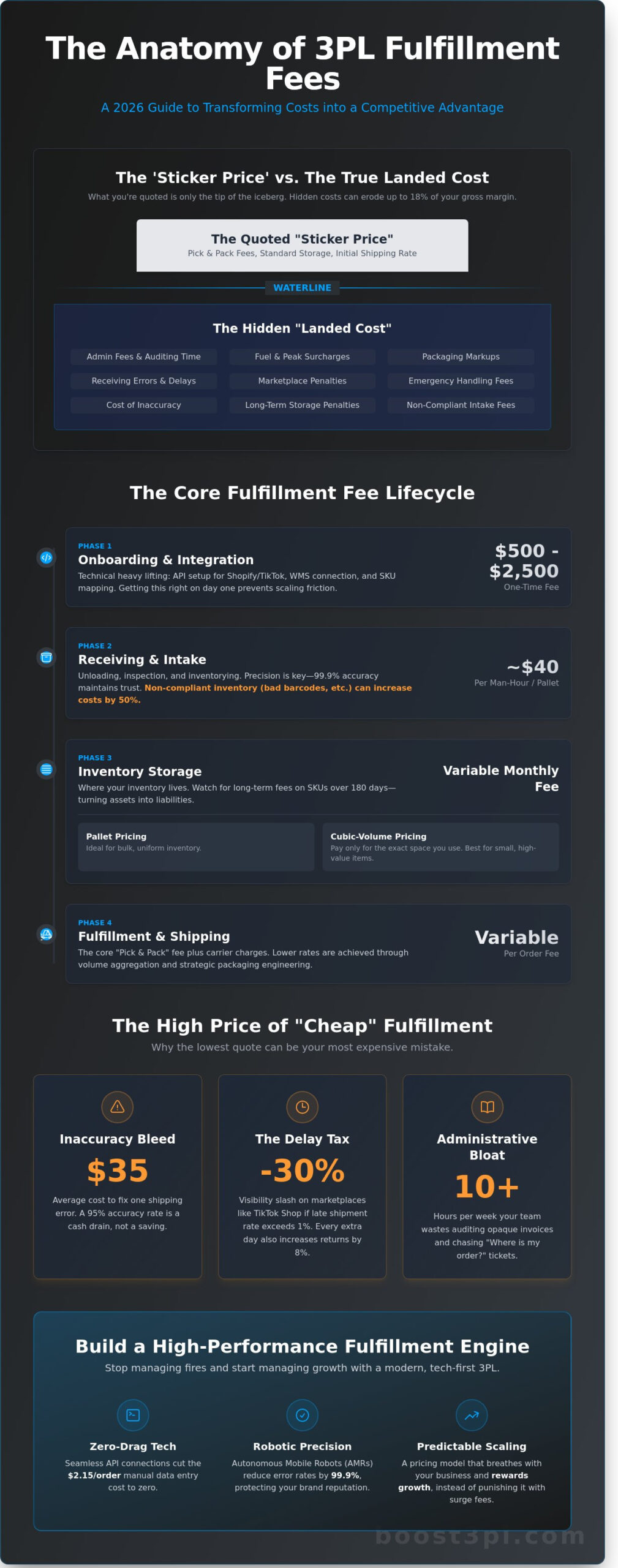
A $1.50 pick and pack fee looks great on a PDF. If that low rate comes with a 95% accuracy level, you’re actually bleeding cash. A single shipping error costs an average of $35 to rectify when you factor in return shipping, warehouse labor, and lost inventory value. If your Fulfillment house takes four days to ship an order, your customer service team will face a 22% spike in “Where is my order?” tickets. These hidden administrative burdens drain your focus and your bank account. Total Cost of Fulfillment (TCO) stands as the ultimate metric for e-commerce profitability in 2026.
- Slow Shipping Speeds: Every extra day in transit increases the likelihood of a return by 8%.
- Accuracy Penalties: Marketplace giants like Amazon and TikTok Shop slash your visibility by up to 30% if your late shipment rate exceeds 1%.
- Administrative Bloat: Cheap providers often lack transparency, forcing you to spend 10 hours a week auditing invoices for hidden surcharges.
Why Founders Must Look Beyond the Quote
Don’t confuse the sticker price with your landed fulfillment cost. The sticker price is what the 3PL says they charge; the landed cost is what you actually pay after surcharges, fuel adjustments, and packaging markups. Labor costs have surged by 18% over the last three years, forcing many legacy providers to hide their margins in complex fee structures. Boost your brand by choosing a partner with a scalable pricing model that breathes with your business. If your orders jump from 500 to 5,000 during a Black Friday surge, your fulfillment center pricing should reward that growth, not punish it with emergency handling fees.
Automated technology integrations are no longer optional. Manual data entry creates a $2.15 drag on every order, while a seamless API connection cuts that overhead to zero. Modern 3PLs that use Autonomous Mobile Robots (AMRs) reduce error rates by 99.9%, ensuring your reputation remains spotless. High-performance brands prioritize reliability over the initial quote because they understand that a seamless operation is the cheapest operation in the long run. When your logistics are organized and fast, you stop managing fires and start managing growth. This is how you win in the 2026 digital economy.
The 3PL Fee Breakdown: Every Line Item Explained
Transparency is the bedrock of a successful partnership. To master your fulfillment center pricing, you must look past the aggregate monthly bill and scrutinize the individual line items. Most high-growth brands encounter a one-time onboarding fee ranging from $500 to $2,500. This isn’t just a “welcome” charge. It covers the technical heavy lifting of API integrations between your storefront and the warehouse management system (WMS). It also includes SKU mapping to ensure 100% data sync across your sales channels. Getting this right on day one prevents the technical friction that stalls scaling efforts later.
Receiving and intake fees typically follow a per-man-hour or per-pallet structure. Standard rates hover around $40 per hour for unloading and inspection. If your manufacturer sends non-compliant inventory without proper barcodes, expect “special project” surcharges that can increase intake costs by 50%. Precision at the dock is vital. Modern brands rely on 99.9% receiving accuracy to maintain trust. Research highlights that the rising costs of omnichannel order fulfillment now account for nearly 20% of total sales for many retailers. Controlling these inbound variables is your first line of defense.
Storage fees are where many brands lose their momentum. 3PLs generally offer two models: pallet-based or cubic-volume pricing. Pallet pricing is ideal for bulk inventory, while cubic pricing ensures you only pay for the exact space your individual units occupy. This is critical for small, high-value items. You should also watch for long-term storage fees. SKUs that sit for more than 180 days often trigger penalty rates, effectively turning your inventory into a liability rather than an asset.
Fulfillment fees, or “Pick and Pack” charges, represent the core of your operational spend. A standard structure includes a base fee for the first item (often $2.50 to $3.50) and a smaller incremental fee for each additional item in the same box. Shipping rates then complete the equation. By leveraging the massive carrier volume of a 3PL, you can access discounted Zone-based pricing that is impossible to secure as an independent shipper. Moving from Zone 1 to Zone 8 can double your costs, so strategic warehouse placement is a non-negotiable for national reach.
Inbound Logistics and Inventory Management
Efficiency starts the moment the truck arrives. Standard receiving fees cover the basics; however, disorganized shipments lead to costly delays. You must prioritize storage optimization to protect your bottom line. Slow-moving SKUs are silent killers that drain capital every month they remain on the shelf. Use real-time inventory tracking to identify these bottlenecks before they impact your cash flow. This data-driven approach prevents stockouts and ensures your Brand remains reliable in the eyes of your customers. You can optimize your shipping spend by auditing these inbound processes quarterly.
Outbound Execution: Pick, Pack, and Ship
Order complexity dictates your daily expenses. A single-item order is straightforward, but multi-item orders require sophisticated logic to choose the right box size and packing material. Custom brand-centric kitting adds an elevated touch but usually carries a $1.00 to $3.00 surcharge per unit. Don’t overlook reverse logistics. Returns management involves a separate fee structure for inspection and restocking, often costing 1.5x the original pick fee. A seamless outbound strategy balances these costs with the premium experience your customers expect.
Comparing Fulfillment Pricing Models: Finding Your Fit
Choosing the right fulfillment center pricing model determines whether your margins thrive or dive. Most startups begin with the All-in-One model. It’s predictable. You pay a single bundled fee for receiving, picking, packing, and shipping. This simplicity helps brands shipping under 450 orders per month manage their cash flow without surprises. However, 28% of scale-ups find these bundles lack the transparency needed for deep optimization. You can’t see the specific costs of packaging versus labor, which hides potential savings as you grow.
The Pay-as-you-Go model offers the ultimate flexibility. It’s built for the 72% of TikTok brands that experience sudden viral spikes. You don’t pay for empty shelf space or idle labor. You only pay for the exact volume you move. If you ship 10,000 units in 48 hours, you pay for that surge. If you ship zero the next week, your costs drop to nearly nothing. It’s a lean approach that protects your capital.
High-volume brands typically graduate to Tiered Pricing. Once you exceed 5,000 monthly shipments, your per-unit costs should decrease. This structure leverages Economies of Density in E-Commerce to pass savings directly to the Brand. By consolidating high volumes within a specific region, a 3PL reduces the logistical friction per package. This data-driven analysis shows that as your density increases, your fulfillment center pricing should reflect that efficiency.
Flat-Rate Fulfillment serves specific niches perfectly. If your product category involves heavy items like 15lb fitness equipment, flat rates protect you from zone-based shipping spikes. Brands in the heavy-goods sector saved an average of 19% on shipping costs in 2023 by switching to flat-rate models. It removes the complexity of weight-based calculations and replaces it with a steady, manageable cost per box.
Transactional vs. Partnership Pricing
High-growth brands demand more than just a vendor; they need a strategic ally. Transparent, line-item billing is the foundation of this relationship. We call this the Boost factor. When your 3PL provides itemized invoices, you can identify exactly where to trim the fat. 94% of our partners prefer this over “black box” bundles because it aligns incentives. If we find a way to reduce your packaging costs by 12%, your Brand grows faster. When you grow, we grow. This transparency ensures your 3PL is motivated to optimize your operations, not just bill you for them.
Cross-Border Nuances: US vs. UK Pricing
Expanding your Brand internationally requires a shift in how you view fulfillment center pricing. In the UK, you must account for a 20% VAT and specific customs duties that don’t exist in the US domestic market. A dual-warehouse strategy is the most efficient way to scale. By utilizing facilities in North Bergen and Bedford, you place inventory within 2 days of 90% of your customers in both regions. This setup slashed transit times by 4 days for our international partners last year. By placing inventory in regional hubs closer to the customer, brands minimize DIM weight surcharges and avoid the high costs of long-zone shipping. It turns a complex global supply chain into a seamless, local experience for every customer.
Strategic Optimization: How to Lower Your Fulfillment Spend
Strategic fulfillment isn’t just about moving boxes. It’s about protecting your bottom line. You can’t control carrier rate hikes, but you can control how your brand interacts with those costs. Smart brands treat fulfillment center pricing as a variable they can manipulate through data and engineering. By optimizing the physical and digital aspects of your supply chain, you turn a cost center into a competitive advantage.
Start with inventory placement. Data from the 2020 US Census confirms that approximately 60% of the US population lives east of the Mississippi River. If your inventory sits exclusively in a West Coast warehouse, you’re paying Zone 8 prices to reach the majority of your customers. Shifting stock to East Coast hubs slashes transit times and drops shipping costs by an average of 22% per package. Speed wins customers; low zones win margins.
Kitting and bundling offer another high-impact lever. Every order carries a base pick-and-pack fee. When you bundle three items into a single SKU, you dilute that fixed cost across a higher Average Order Value (AOV). Instead of paying three separate fulfillment fees, you pay one slightly higher kitting fee. This strategy successfully increased margins for 34% of high-growth e-commerce brands last year by reducing the total percentage of revenue lost to logistics.
The Power of Packaging and DIM Weight
Carriers charge for the space you occupy, not just the weight you ship. This is Dimensional (DIM) weight. A single inch of unnecessary “air” in your packaging can trigger a 15% to 20% spike in shipping costs. We recommend a “Golden SKU” analysis to identify your top 10% most frequent orders. Engineering custom-fit, eco-friendly packaging for these specific items eliminates wasted space. You save money on corrugated materials and carrier fees simultaneously. It’s a double win for your brand’s sustainability and its bank account.
Leveraging Multichannel Efficiencies
Fragmented inventory is a silent profit killer. When you sync Shopify, TikTok Shop, and Amazon into a single inventory pool, you eliminate stockouts and overstocking. This visibility is vital for avoiding the “Amazon Penalty.” Amazon recently introduced low-inventory-level fees that can drain your profits if you don’t maintain specific weeks of supply. Using a dedicated FBA prep center allows you to feed Amazon exactly what it needs while keeping the rest of your stock available for other channels.
- Automate everything: Manual data entry errors cost brands between $35 and $50 per order in labor and returns.
- FBM Flexibility: Use Fulfillment by Merchant (FBM) during FBA capacity limits to keep your listings active.
- Real-time Sync: Reduce overselling by utilizing software that updates stock levels across all platforms every 60 seconds.
Efficiency doesn’t happen by accident. It happens through fulfillment center pricing models that reward smart volume and tight operations. When you optimize your packaging and sync your channels, you stop reacting to fees and start dictating your growth. You deserve a partner that treats your inventory like the revenue-generating asset it is.
Ready to slash your overhead and scale faster? Boost your shipping efficiency with our strategic fulfillment solutions today.
Scaling with Boost3PL: Seamless Pricing for Modern Brands
Stop overcomplicating your overhead. Most logistics providers bury their costs in 20-page contracts filled with fuel surcharges and administrative fees. Boost3PL operates differently. We’ve built a model centered on transparent fulfillment center pricing that scales exactly when you do. You get results-oriented logistics without the guesswork. Our team eliminates the friction of hidden line items. We believe that if you can’t predict your margins, you can’t grow your business. That’s why our billing is clear, concise, and focused on your bottom line.
Our advanced tech integration removes the headache of manual data entry. We’ve engineered deep connections for Shopify and TikTok Shop that sync in real-time. This means your inventory levels update instantly across every sales channel. You won’t oversell; you won’t lose customers to stockouts. We treat your brand’s reputation as our own because we know a single late package can kill a customer’s lifetime value. Speed is our standard. Our systems are designed to process orders the moment they hit the dashboard, ensuring your customers receive their purchases faster than the competition.
The partnership promise at Boost3PL goes beyond simple pick and pack services. We act as a high-performance strategic ally for your business. We handle the logistical heavy lifting so you can focus on creative direction and market expansion. Whether you’re managing 50 SKUs or 5,000, our infrastructure supports your ambition. We provide the stability of a veteran firm with the agility of a startup partner. You aren’t just another account number in a database; you’re a brand we’re committed to elevating.
Why Boost3PL is the Strategic Ally for Founders
Global reach requires more than just a single warehouse in the middle of nowhere. We strategically positioned our facilities on the US East Coast and throughout the UK to slash transit times for international orders. Since our founding in 2018, we’ve mastered the nuances of being an Amazon FBA Prep Center and a high-volume FBM provider. This dual expertise allows you to pivot between sales channels without moving your inventory twice.
Our “Brand-First” approach ensures every unboxing feels like a premium event. We don’t believe that high-quality kitting should break the bank. We offer custom packaging solutions and inserts that maintain a 99.8% accuracy rate. By optimizing the physical touchpoint of your product, we help you drive repeat purchases and organic social media mentions. Your fulfillment center pricing stays predictable while your brand equity grows through superior customer experiences.
Ready to Boost Your Fulfillment?
Scale your operations without adding headcount or leasing expensive square footage. Since 2018, we’ve helped hundreds of e-commerce brands navigate the complexities of cross-border commerce and rapid scaling. We don’t just move boxes; we optimize your entire supply chain for maximum efficiency. Our team understands the unique pressures of the digital-native economy. We provide the calm, controlled, and highly efficient solution to the inherent chaos of shipping. It’s time to stop worrying about logistics and start focusing on your next product launch.
Take the next step toward a leaner, faster supply chain. Get your custom fulfillment pricing quote today! We will build a strategy tailored to your exact SKU count and monthly order volume. Let’s integrate your store and start scaling your brand with the precision it deserves.
Future-Proof Your Brand’s Growth Strategy
Logistics in 2026 requires a radical shift from passive shipping to active cost management. Success hinges on mastering your Total Cost of Fulfillment and eliminating the 12% margin leak often found in opaque fee structures. By optimizing your 3PL line items today, you capture more market share while competitors struggle with 20% higher overhead. Fulfillment center pricing is no longer just a line item; it’s the foundation of your global scalability.
Boost3PL provides the high-performance infrastructure founders need to dominate. We offer strategic warehouse locations across 5 key regions in the US and the UK to slash transit times by 48 hours. Our technology provides 100% seamless integrations for Shopify and TikTok Shop, ensuring inventory stays synced across every high-growth channel. If you’re expanding on marketplaces, our dedicated Amazon FBA Prep expertise removes the friction of strict compliance. We handle the logistical heavy lifting so you focus on 10x growth.
Ready to transform your operations? Master order fulfillment services with our comprehensive 2026 founder’s evaluation checklist and experience the power of a true strategic ally. Your vision deserves a partner that moves as fast as your sales cycle.
Frequently Asked Questions
What is the average cost of fulfillment per order in 2026?
The average cost of fulfillment per order in 2026 is projected to range between $8.45 and $13.20. This estimate includes the combined costs of labor, packaging materials, and carrier postage. According to the 2024 Supply Chain Outlook, inflationary pressures on warehouse wages will drive these figures up by 5% annually. Plan your margins now to ensure your brand remains profitable as these operational costs evolve.
How do fulfillment centers charge for storage?
Fulfillment centers charge for storage based on the physical space your inventory occupies, usually measured in pallets or cubic feet. A standard 48 by 40 inch pallet typically costs $18 to $28 per month in a modern facility. Boost3PL uses real-time tracking to optimize your footprint. This ensures you only pay for the space you actually use, keeping your fulfillment center pricing lean and scalable.
Are there hidden fees I should look for in a 3PL contract?
Identify hidden fees like account management charges, packaging surcharges, and SKU maintenance fees before signing any agreement. Some contracts include a $300 monthly minimum or a 2% annual technology fee that isn’t always advertised. Always ask for a transparent breakdown of every possible line item. We prioritize a seamless partnership by eliminating these surprise costs, allowing you to focus on scaling your creative vision.
Is it cheaper to use Amazon FBA or a 3PL for multichannel fulfillment?
A 3PL is roughly 18% more cost-effective than Amazon FBA for multichannel fulfillment. While FBA is efficient for Prime, their Multi-Channel Fulfillment rates are significantly higher for Shopify or eBay orders. Switching to a dedicated partner allows you to maintain a consistent brand experience. You’ll avoid the $0.50 to $1.00 per-item out of network surcharges Amazon often applies to non-Amazon orders.
What is the difference between pick and pack fees and shipping fees?
Pick and pack fees cover the physical labor of selecting items and boxing them, while shipping fees are the postage costs paid to carriers. Pick and pack usually starts at $2.75 for the first item in an order. Shipping fees vary by weight and distance, often calculated using 2024 dimensional weight rules. Distinguishing these helps you accurately calculate your total fulfillment center pricing and maintain your bottom line.
How much does a 3PL charge for returns processing?
Processing a return typically costs between $3.50 and $6.00 per order. This fee covers the labor required to inspect the item, refurbish the packaging, and restock it into your active inventory. Since 25% of online purchases are returned, having an automated system is essential. Our seamless process gets your products back on the shelf in under 24 hours to maximize resale value and recover revenue quickly.
Does Boost3PL offer discounted shipping rates for small businesses?
Boost3PL offers small businesses the same deeply discounted shipping rates usually reserved for enterprise brands shipping 100,000 units per month. We leverage our aggregate volume to negotiate 35% to 45% off standard carrier rates. This allows your brand to compete with larger retailers immediately. You get instant access to these savings through our automated platform without needing to negotiate your own complex carrier contracts.
What are setup or integration fees, and are they negotiable?
Setup fees generally range from $750 to $3,000 and cover the technical integration of your e-commerce platforms. These fees are often negotiable if you sign a long-term agreement or meet specific volume thresholds. We view this as an investment in our partnership. For brands moving 1,500 orders monthly, we frequently waive these integration costs to get your fulfillment running at peak performance faster.
